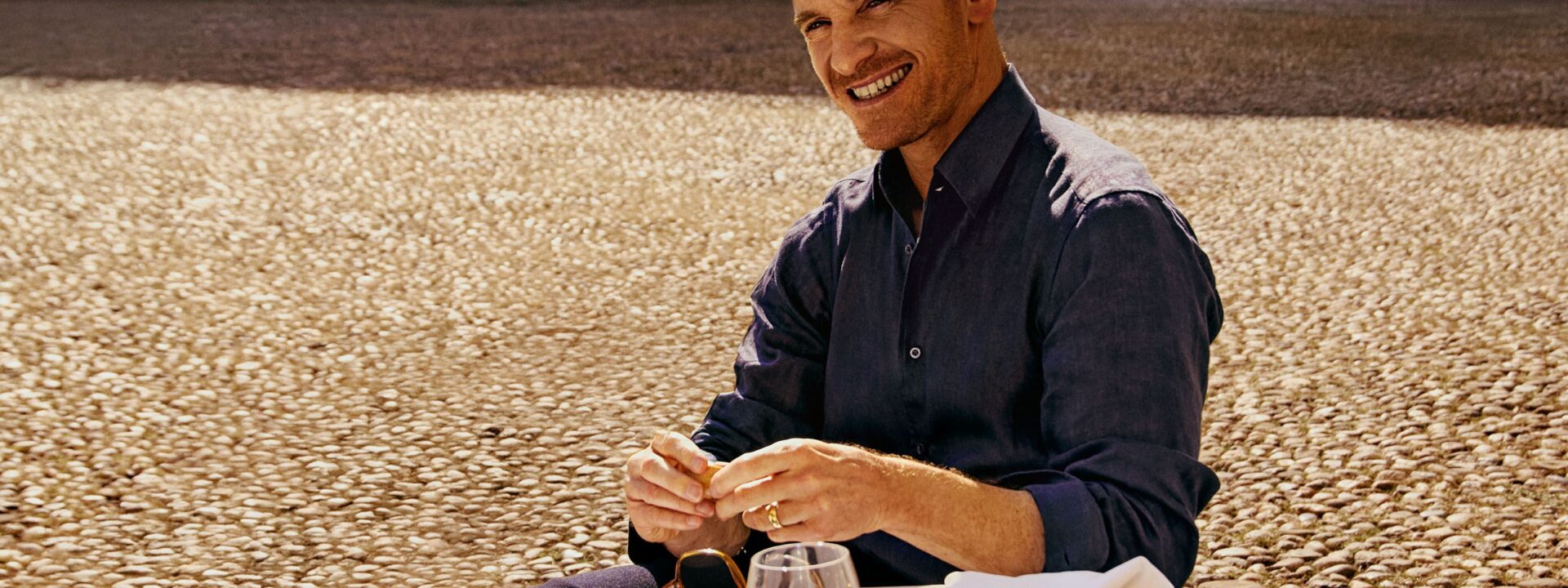
For 110 years, the Italian fragrance house Acqua di Parma has never used a celebrity ambassador to sell its products. That changes now.
The LVMH-owned brand has chosen Michael Fassbender as its first face, though CEO Giulio Bergamaschi is quick to clarify that he is not simply a “celebrity ambassador.” “For me, Michael is more than a remarkable acting talent,” Bergamaschi says. “He is a choice of substance that will nurture our equity and foundation, not just a viral choice. Of course, we expect he will bring new attention to the brand and a cultural credibility that makes our message more precise, universal, and authentic.”
To mark the occasion, the brand has launched a limited-edition fragrance, Colonia Profumo Millesimato. It is the centerpiece of the fragrance house’s “The Art of Living Italian” campaign, which also features the 48-year-old German-Irish actor and Sabrina Impacciatore, the Italian actress who rose to fame in The White Lotus and recently appeared in The Paper. The campaign was shot in Parma, the historic Italian town where the brand was founded.
Bergamaschi insists the brand is not straying from its strategy of sprezzatura—the art of discreet elegance—but is instead celebrating a moment of expression. “We simply expect to strengthen our values in an original way. Acqua di Parma has never chased hype, and we don’t behave in certain ways to please trends. We’re a maison built on timelessness and discernment,” he says.
The brand’s priorities remain aligned with four key pillars: quality, craftsmanship, human dimension, and Italianity. Acqua di Parma also boasts a rich history that has propelled it to the top of the fragrance market, thanks to elements like its signature sunshine-yellow color palette, the coat of arms from Marie Louise (Duchess of Parma and Napoleon’s second wife), its Art Deco-shaped bottles, and its hatbox packaging.
The luxury fragrance market has been a bright spot during a global luxury slowdown. In LVMH’s third-quarter earnings, sales for perfumes and cosmetics rose by 2%. “The brand is in good health,” says Bergamaschi. However, he notes that luxury consumers are shifting their buying habits after a surge in sales driven by the TikTok trend for woody scents, such as Maison Francis Kurkdjian’s Baccarat Rouge 540 or Vilhelm Parfumerie’s Faces of Frances. Consumers are now thinking twice before making a purchase.
“Luxury clients these days are a bit more reluctant to follow hype and are more demanding about quality. In the world of niche fragrance, clients are understanding that loud performance doesn’t always mean superior quality. A new generation is realizing that quality lies in the ingredients and their extraction,” Bergamaschi explains. He emphasizes the brand’s focus on olfactory techniques through in-store experiences and customer service, as well as collaborations with partners like Italian luxury car manufacturer Maserati, the French restaurant Le Petit Maison, and British designer Samuel Ross.
In 1916, Acqua di Parma’s founder, Baron Carlo Magnani, created Colonia—a light fragrance with notes of lemon, lavender, rose, rosemary, and patchouli—as a contrast to the powdery, floral French perfumes popular at the time. That same scent remains a bestseller today and has expanded into a standalone collection with variations ranging from musky and woody to fresh citrus.
Another top performer is the Blu Mediterraneo collection, inspired by the charm of the Italian Mediterranean and named after destinations like Amalfi, Capri, Sicily, and Panarea. “What we’re seeing from our clients, especially younger demographics, is that they are playing around with the idea of layering their fragrances,” says Bergamaschi.
The new limited-edition Colonia Profumo Millesimato fragrance from Acqua di Parma continues this legacy.Acqua di Parma. Photo: Courtesy of Acqua di Parma
Over the past six years, the brand has gained new followers across Asia, the Middle East, and North America, as consumers explored different brands and fragrances during the pandemic. Sales are now consistently driven by a younger clientele, and there is an even split between men and women engaging with the scents—two goals Acqua di Parma has steadily worked toward by establishing itself as a gender-neutral fragrance house in newer markets. While in Europe the brand is still widely linked with masculinity, Bergamaschi notes that its overall customer base is evenly divided between genders.
The key challenge is to convey Italian essence to other regions without resorting to clichés. Bergamaschi has turned to hospitality, a universal Italian language that translates easily anywhere. In 2022, Acqua di Parma launched a café pop-up in Milan, followed by its Yellow Café in Seoul in June 2025, and another temporary installation from September to November 2025 inside Bloomingdale’s at Dubai Mall. Each offered an Italian coffee experience served in yellow and white ceramic cups, with tables adorned by the brand’s candles and diffusers.
Brands have been leaning into café culture to attract Middle Eastern consumers, who largely do not drink alcohol, as well as millennials and Gen Zs who have traded martinis for matcha. Over time, these pop-ups have become Instagram-friendly destinations where customers spend time and money, connecting with brands in an organic way.
Michael Fassbender in Acqua di Parma’s The Art of Living Italian campaign. Photo: Courtesy of Acqua di Parma
The Acqua di Parma Caffettino will tour throughout the year to celebrate the brand’s 110th anniversary. “These pop-ups generate a natural buzz—we’re not a brand that relies heavily on social media,” says Bergamaschi. While Acqua di Parma doesn’t host elaborate influencer events, it still partners with selected creators on platforms like TikTok to promote its fragrances.
Bergamaschi joined Acqua di Parma in March 2023 from Loro Piana, where he spent a year as strategic missions director. Before that, he was with L’Oréal Group for 18 years, working in Italy, France, and China. “At L’Oréal, I learned everything about the beauty market and discovered Asia. My time at Loro Piana, though brief, taught me so much about obsessing over quality and the endless pursuit of excellence,” he says.
Even in a year of celebration, Bergamaschi is committed to keeping Acqua di Parma discreet, authentic, and uncompromisingly true to its Italian heritage.
Frequently Asked Questions
Of course Here is a list of FAQs about how Acqua di Parmas CEO is shaping the future of fragrance designed to be clear concise and conversational
Beginner General Questions
1 Who is the CEO of Acqua di Parma
The CEO is Laura Burdese She took on the role in 2019 bringing extensive experience from the luxury goods sector
2 Whats so special about Acqua di Parma anyway
Its an iconic Italian luxury brand founded in 1916 famous for its timeless sunny Mediterranean scents elegant packaging and commitment to Made in Italy craftsmanship Its known for being sophisticated but never loud
3 What does a CEO of a perfume company actually do to shape the future
They set the overall vision and strategy This means deciding what new fragrances to create how to tell the brands story where to sell products and how to make the brand relevant for new generations while staying true to its heritage
Strategic Vision Brand Direction
4 What is Laura Burdeses main goal for the brands future
Her goal is to evolve Acqua di Parma from being seen primarily as a classic cologne brand into a comprehensive lifestyle and olfactive maisona destination for a full range of luxury scents and experiences
5 How is she making the brand more modern without losing its classic feel
By carefully expanding the fragrance portfolio Shes launching new contemporary scent collections that appeal to current tastes while meticulously preserving and reissuing beloved classics Its about adding new chapters to the story not rewriting the book
6 Is she focusing on any new types of fragrances
Yes A key focus is expanding beyond the classic citrus colognes into richer more complex fragrances like woody amber and oriental scents This attracts fragrance enthusiasts looking for depth and longevity moving the brand into new olfactive territories
7 How is she using sustainability to shape the brands future
Sustainability is a core pillar This includes initiatives like refillable bottles responsibly sourced ingredients and reducing environmental impact across production For modern consumers luxury and responsibility must go handinhand
Market Consumer Focus