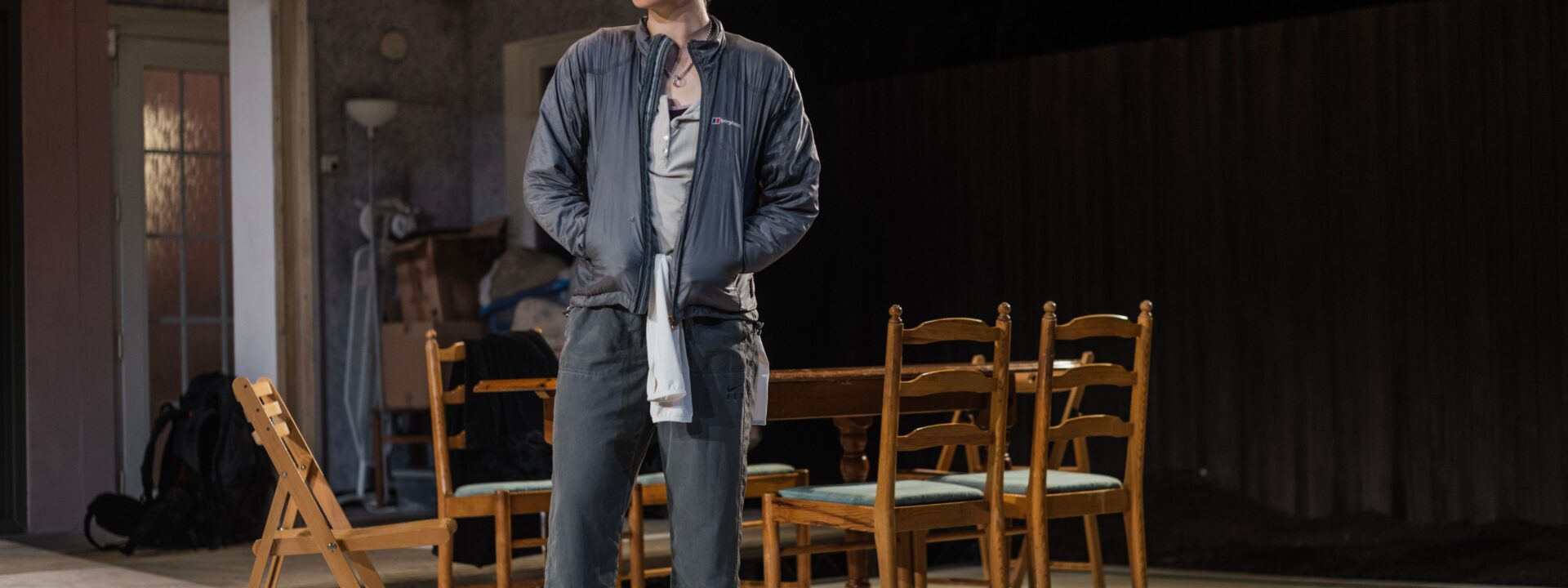
“Reading Greek plays feels a bit like a migraine. There’s a puzzle or knot inside them that I don’t immediately understand—and the work is trying to untangle that knot,” says Emma D’Arcy thoughtfully.
D’Arcy, known to fans of House of the Dragon as Rhaenyra Targaryen, heir to the Iron Throne, is discussing The Other Place, a play loosely based on Sophocles’ Antigone, which is about to open at The Shed in New York. This powerful adaptation isn’t set in ancient Greece, and its heroine Annie—played by D’Arcy—isn’t a king’s daughter. Instead, she’s an alienated young woman returning to a blended family, where her uncle Chris (Tobias Menzies) is trying to build a new life with his wife and wants to bury his brother’s ashes, which remain in the family home. Annie is fiercely opposed to this.
As D’Arcy explains: “At its simplest, you have one character driven to reveal the past—the truth, history—and another desperate to hide, disguise, and bury it. That becomes the core engine of the tragedy.”
The result is a searing drama that left audiences at London’s National Theatre, where the production opened in late 2024, gasping in surprise, shock, and sympathy. “I’ve rarely been in a show that just lit up the room,” says Menzies quietly. “There were many times when we were genuinely ahead of the audience, which is increasingly hard to do because audiences are so story-literate. To have people not quite see what’s welling up beneath their feet is electric.”
We’re speaking over Zoom with Alexander Zeldin, who wrote and directed The Other Place. He’s best known for The Inequalities Trilogy, a series of plays examining the lives of people in poverty. (One of them, Love, was staged at the Park Avenue Armory in 2023.) The Other Place was his first commission to work with an existing text.
“It was a very uncomfortable starting point for me,” Zeldin says. “I realized early on that I couldn’t do a straightforward modern adaptation. So I stepped back, thought a lot, and found a way in.”
He’s speaking from the Greek island of Hydra, where, coincidentally, he wrote the first draft. “I think a piece of theater is an event—something you do in 3D. It’s not purely literary, though it starts there. Being in Greece for a while made it clear this needed to be a deeper investigation of the play’s resonance.”
The process involved three workshops followed by a six-week rehearsal period. D’Arcy and Menzies were attached from the beginning “because I love to write with actors in mind,” Zeldin explains. “It was a rich, particular, and unique process,” Menzies notes. “Right from the start, it felt like a really good combination of minds. It was very heady and emotional at times.”
A profound study of grief and relationship dynamics, underscored by haunting music from Foals’ Yannis Philippakis, The Other Place explores classical Greek themes of honor, incest, and inheritance within the naturalistic frame of a modern family. As in Oedipus—another adaptation playing in New York this season—the terrible need for truth to emerge shatters all attempts to conceal it. (In a way, The Other Place continues the story of Oedipus, since Antigone and her sister Ismene—reimagined here as Annie and Issy—are his daughters.)
For D’Arcy, the appeal of ancient Greek drama to contemporary audiences lies partly in its “scale”: “I think it’s about their ability to hold emotional and psychic scale within a domestic space,” they say. “We are in a moment that has perhaps outsi—”We had grown weary of much of the theatrical work we were seeing. There is a search for a different kind of scale.
They are grateful if something like House of the Dragon is what drives people to engage with the material. “I like the workflow of this slightly mysterious, often quite confusing thing called profile, which causes young people to go into theater spaces where they can have experiences unlike many others,” D’Arcy says. “That feels really hopeful. What people forget is that something can actually happen in a theater. I think that’s why its younger audiences really responded to it.”
Zeldin enthusiastically chimes in: “Yes, it’s one of the few spaces we have where something truly unmediated can actually happen.”
Then Menzies takes up the theme. “That’s why I think it’s increasingly important to push back against the influence of Netflix on theater. You sometimes go to see theater and it is trying to mimic that stuff. That, for me, feels like an abdication of our responsibility in theater. We’ve got to hold our ground and make it a space where people can commune together with ancient stories and big ideas, and not have it turned into a widget.”
Like D’Arcy, Menzies loves acting onstage—but he values his screen career, too. He became widely known for his sensitive portrayal of Prince Philip, Duke of Edinburgh, opposite Claire Foy’s Queen Elizabeth in The Crown, and comes to The Other Place on the heels of his starring role as Edwin Stanton in the historical epic Manhunt. His most recent film role was as a manipulative investor in Brad Pitt’s Grand Prix extravaganza F1.
“One of the things I love about my job is the need to shapeshift for different rooms,” he says with a grin. “It’s the same stuff really, but you’re just turning the dial to different levels, and obviously it can come out looking pretty different.”
D’Arcy’s next big screen appearance, apart from the fourth season of House of the Dragon—to be released in the summer—will be in Digger, the new film from Alejandro G. Iñárritu, starring Tom Cruise. “That was unlike anything else I’ve done,” they say. “With Alejandro, the benchmark is way up on the ceiling. On most film sets, there’s traditionally what one desires in a piece of work and the practical reality, and then the work becomes a compromise between those two poles. With Alejandro, it’s sort of his way or no way. The man has such vision. Also, Tom Cruise is brilliant. He is amazing and he’ll be amazing in this film.”
But for now, everyone’s attention is on the transfer of The Other Place. “What I am most looking forward to is getting into the rehearsal room and deepening what we have,” says Zeldin. “I love coming back to work; I always think it gets better the second time around. I don’t want to get too political, but this is a magical opportunity to do things that are at the frontier, art that is a bit out there. This is not the moment to settle for the middle ground.”
The Other Place is at The Shed from January 30 through March 1.
Frequently Asked Questions
Of course Here is a list of FAQs about Emma DArcy Tobias Menzies and Alexander Zeldin discussing bringing The Other Place to The Shed
General Beginner Questions
Q Who are Emma DArcy and Tobias Menzies
A They are acclaimed British actors Emma DArcy is best known for their role as Rhaenyra Targaryen in House of the Dragon Tobias Menzies is known for playing Prince Philip in The Crown and Edmure Tully in Game of Thrones
Q What is The Other Place
A The Other Place is a powerful intimate stage play written and directed by Alexander Zeldin Its a drama about a family in temporary housing focusing on the struggles and humanity of people in the UKs social care system
Q Who is Alexander Zeldin
A Alexander Zeldin is a BritishFrench writer and theatre director He is known for creating a series of critically acclaimed socially conscious plays including The Other Place that often feel more like reallife experiences than traditional theatre
Q What is The Shed
A The Shed is a major cultural center in New York City located in Hudson Yards Its known for presenting innovative and groundbreaking work across theatre music and visual art
Q Why is this production a big deal
A It brings a celebrated and emotionally raw British play to a major New York stage featuring two very famous TV stars in a completely different intense theatrical setting
About the Production Creative Process
Q Is this a traditional play with a clear plot
A Not exactly Zeldins work is often described as hyperrealistic or verbatiminspired It focuses on creating authentic moments and emotional truth often without a conventional plot to immerse the audience in the characters reality
Q What is the tone or style of the play
A The tone is intense empathetic and often uncomfortable Its designed to make the audience feel the tension frustration and fragile hope of the characters The style is minimalist and naturalistic