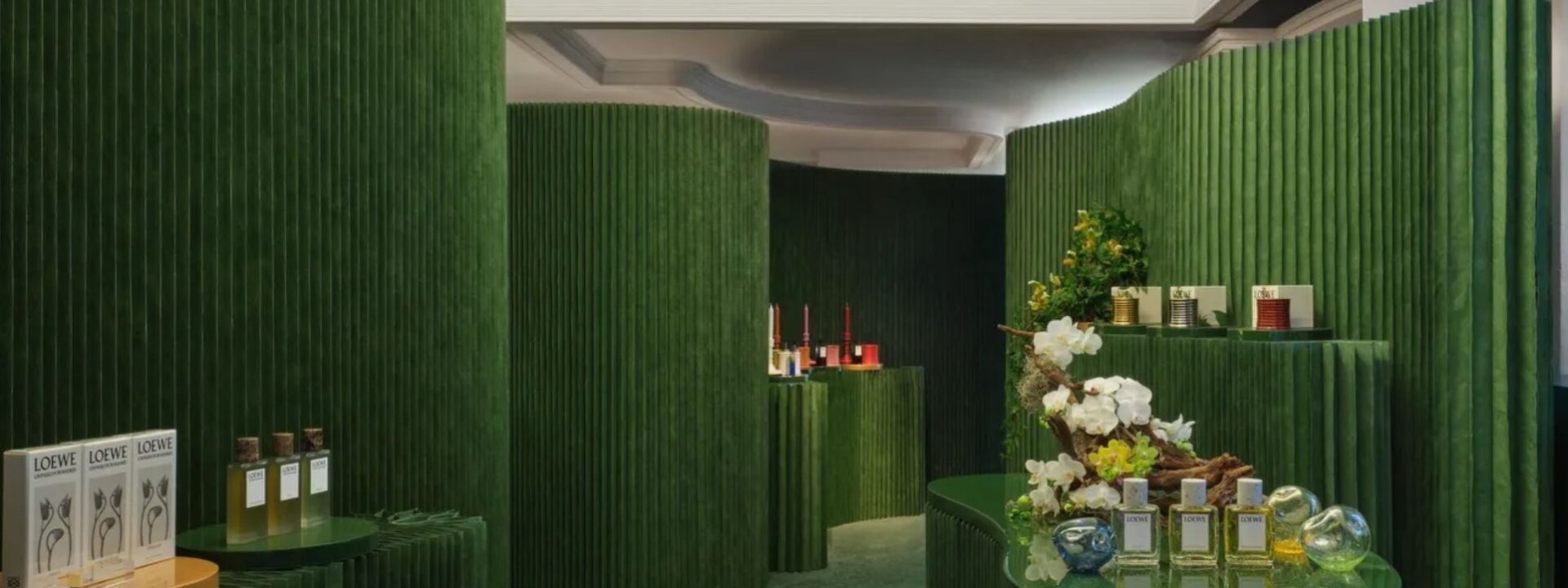
Two weeks ago, Loewe Perfumes opened a large holiday pop-up at New York’s Rockefeller Center. Running until January 31, the green garden-themed temporary space is the brand’s first U.S. storefront, located just steps from the popular Rockefeller Christmas tree. This follows a series of major beauty events and activations in the U.S. in recent months, from Valentino Beauty’s star-studded Studio 54 party during New York Fashion Week to fragrance launches from brands like Prada, Miu Miu, and Christian Louboutin.
With Chinese consumer spending and travel retail revenue remaining subdued in 2025, major beauty brands have shifted their focus to the U.S. market this year. In L’Oréal’s half-year earnings report this summer, CEO Nicolas Hieronimus expressed optimism about the U.S., stating plans to sharpen the company’s focus there as Chinese demand stays weak. Estée Lauder has also identified the U.S. as a priority in response to the slowdown in China. In its fiscal 2025 results, Asia-Pacific sales fell 7%, reflecting ongoing challenges in Chinese consumer sentiment.
Meanwhile, LVMH’s perfumes and cosmetics division reported 2% organic sales growth, reaching €1.9 billion in the third quarter. The company noted that the U.S. market remained stable over the first nine months of 2025.
While the U.S. has grown more strategically important for beauty brands, prioritizing this region is not a guaranteed solution to offsetting soft sales in China and travel retail. As more brands invest in the market, competition for American consumers is intensifying. To stand out, brands will need to leverage their heritage and demonstrate genuine commitment to U.S. shoppers by offering convenient services that combine storytelling with strong product placement.
Dominique Temple, founder and CEO of communications agency DT Consulting, which works with brands like Dr. Barbara Sturm and Rhode, emphasizes that a successful U.S. launch should blend storytelling, strategic retail positioning, influencer partnerships, and cultural immersion. “It’s important to clarify your brand positioning while establishing credibility, whether through hero products, expert authority, or a well-aligned retail partner,” she explains.
Meeting Consumers Where They Are
A significant portion of American consumers are willing to buy luxury and premium beauty products “without the bells and whistles required in other markets,” says Marc Elrick, CEO and founder of the UK-based skincare brand Byoma, which is sold at Ulta Beauty, Target, and Amazon. These mass-market retailers, which prioritize convenience over the “frills” of luxury shopping, are key channels for brand discovery and expansion in the U.S., especially among younger consumers.
Beauty is one of the fastest-growing categories for Amazon in the U.S., reaching over 100 million unique beauty customers monthly. Amazon currently stocks numerous premium labels, including Elemis, Olaplex, Lancôme, and Tatcha, and aims to expand its premium beauty business, according to former Amazon Beauty US Stores general manager Melis Del Rey. (Del Rey was recently appointed CEO of Supergoop.) International brands are taking note: Charlotte Tilbury launched on Amazon Beauty in September, joining existing retailers like Ulta Beauty, Nordstrom, and Bluemercury.
Ulta Beauty is another crucial platform for international brands looking to grow across the U.S. The retailer recently raised its full-year sales guidance after outperforming forecasts in the third quarter of fiscal 2025, driven by strong demand for fragrances and skincare. International brands are leading this growth: fragrances saw double-digit growth, led by Valentino and Dolce & Gabbana, while skincare spikes were driven by K-Beauty brands, which Ulta Beauty CEO Kecia Steelman said “continue to resonate with our guests.”The appeal of mass market retailers and e-tailers in the US comes down to scale, convenience, and discovery. They offer an easy one-stop shop where beauty products sit alongside groceries, clothing, and household essentials. They also typically have strong loyalty programs that encourage repeat purchases, says Temple.
Marissa Lepor, managing director at The Sage Group, agrees. “Today’s customer is open to building a beauty routine across different price points rather than buying everything from a single brand or retailer. They mix and match, which is why many brands are now diversifying their distribution across their own direct-to-consumer channels, retailers, and online marketplaces.”
While brands are seeing growth, economic pressure remains on the American consumer. They want to feel that products are worth the price. “The US consumer is now more informed than ever, but they’re also overwhelmed and demanding transparency,” says Byoma’s Elrick. “The consumer has become more globalized because they have access to information through channels like TikTok, AI, and Instagram,” he adds.
Temple argues that “US consumers are uniquely diverse, convenience-driven, and value-conscious, but also deeply brand loyal once trust is earned. Unlike many markets where preferences are more uniform, the US spans dozens of cultural identities, income levels, regional lifestyles, and beauty ideals. This makes the market incredibly dynamic but also highly competitive. US consumers expect brands to meet them where they are, so having a specific strategy for that market is key.”
In a post-Covid world, she adds that “we’ve all become self-made experts, and customer education has really reached another level. Even younger generations are ingredient-savvy and aren’t swayed by marketing alone.”
Hospitality as a Vehicle for Growth
As the beauty market becomes increasingly saturated, brands are looking for innovative strategies to build long-term customer relationships.
“Immersive brand experiences like spas, retail stores, and other physical spaces are an excellent way to build brand loyalty and introduce customers to the world of the brand, not just a specific product,” says Lepor.
In October, the ultra-luxury skincare brand 111Skin opened a standalone spa at New York’s Plaza Hotel, offering advanced facials and massages. In the US and beyond, consumers are investing more in experiences and lifestyle rather than conspicuous luxury. Hospitality and wellness treatments are a great way to enter the market or scale a US business.
111Skin CEO Eva Alexandridis—who co-founded the brand with her husband Dr. Yannis Alexandridis in 2012—says the brand has seen year-on-year double-digit growth in the US since 2024. The US market now accounts for 40% of the business. Earlier this year, 111Skin received a minority investment from Kim Kardashian and Jay Sammons’s private equity firm Skky Partners, partly to fund its US expansion.
111Skin’s move into a permanent clinic at the Plaza Hotel felt like the perfect way to target the discerning US luxury shopper. Having a physical space, where consumers spend extended time with the brand, allows 111Skin experts to educate customers about ingredients and heritage—the brand originated on London’s Harley Street, known for its luxury medical practitioners. “US consumers are inquisitive and want to know who is behind the brand, the ingredients, clinical studies, and trials,” says Alexandridis. “They want to know everything. You can’t just sell them a product; it has to have real provenance.”In New York, luxury beauty brands are increasingly turning to high-end hotels and spas to reach affluent consumers. “The US hospitality sector is uniquely influential because experiences drive aspiration. For luxury beauty, having a spa presence allows brands to engage a captive audience willing to spend, while leveraging the established brand ecosystem a hotel provides,” says Temple. “In a saturated market, hospitality offers luxury players a boutique setting to distinguish themselves from mass channels.”
Other brands are following this strategy. Dior opened its first permanent spa residence in August at East 57th Street and Madison Avenue, featuring gilded interiors and a Haute Couture facial treatment using customized technology developed with American aesthetician Sarah Akram. Meanwhile, fellow LVMH brand Guerlain launched a permanent 22,000-square-foot spa in New York’s Waldorf Astoria hotel—its largest worldwide. Operating as a full wellness clinic, it offers treatments centered on four pillars: nutrition, sleep, movement, and mindfulness.
“More than a hotel spa, this is a true sanctuary nestled in the heart of Manhattan—a place where beauty, wellness, and longevity converge,” Guerlain CEO Gabrielle Saint-Genis said in a statement. “This exceptional destination embodies Guerlain’s Art of Wellness, a legacy deeply rooted in our DNA since 1850. With this opening, we proudly continue our legacy of combining French art de vivre and exceptional savoir faire to redefine the future of well-being.”
While beauty brands are focusing on the US through 2026, Morgan Stanley reports that spending in China is not expected to recover until 2027. Still, experts agree the long-term outlook is promising for brands with a presence in both regions.
“The beauty market in the US continues to grow rapidly, so when China picks up, brands that have invested in scaling in both the US and China are poised to benefit from these strategic initiatives,” says Lepor. This is especially true for brands that are part of a larger luxury house. “The beauty divisions of luxury brands become even more important, both for driving consistent revenue from existing customers and for capturing spending from customers who may be priced out of other categories.”
Frequently Asked Questions
FAQs The American Dollar in Beauty Aesthetics
Beginner Questions
What does The American Dollar is Beautys New Favorite Currency mean
Its a phrase highlighting how the US dollar has become a dominant and preferred method of payment in the global beauty and aesthetics industry especially for highend treatments luxury products and medical tourism
Why is the US dollar so important in beauty now
Due to global economic factors the dollar is strong and stable Many international clinics luxury brands and online beauty platforms price their services in dollars to attract a worldwide clientele and simplify transactions
Is this only for surgeries and major procedures
No it spans the entire industry luxury skincare premium makeup brands nonsurgical treatments wellness retreats and even beauty tech subscriptions often use dollar pricing
As a consumer do I always have to pay in dollars
Not necessarily Many businesses display prices in dollars for consistency but local payment options are usually available However you might find better deals or exclusive offers when paying in USD directly
Benefits Practicalities
What are the benefits for consumers paying in dollars
Price Transparency Easier to compare costs internationally
Access Allows booking with top clinics or brands abroad that primarily operate in USD
Potential Savings In some countries paying in dollars can be cheaper than local currency due to exchange rates or included benefits
What are the benefits for beauty businesses
Global Reach Attracts international clients without currency confusion
Financial Stability Protects against local currency inflation or devaluation
Premium Positioning Using USD can align a brand with a luxury international standard
How do exchange rates affect me
If your local currency is weak against the dollar treatments priced in USD will feel more expensive Its crucial to check the current rate and any bank fees for conversion before paying
Are there any risks to paying in USD
Yes If youre not careful dynamic currency conversion at payment terminals can add poor exchange rates and high fees Always choose to be charged in the local currency of your card if given the option abroad
Common Problems Tips
I see a great price in dollars but my bank charges high foreign transaction fees What can I do
Use