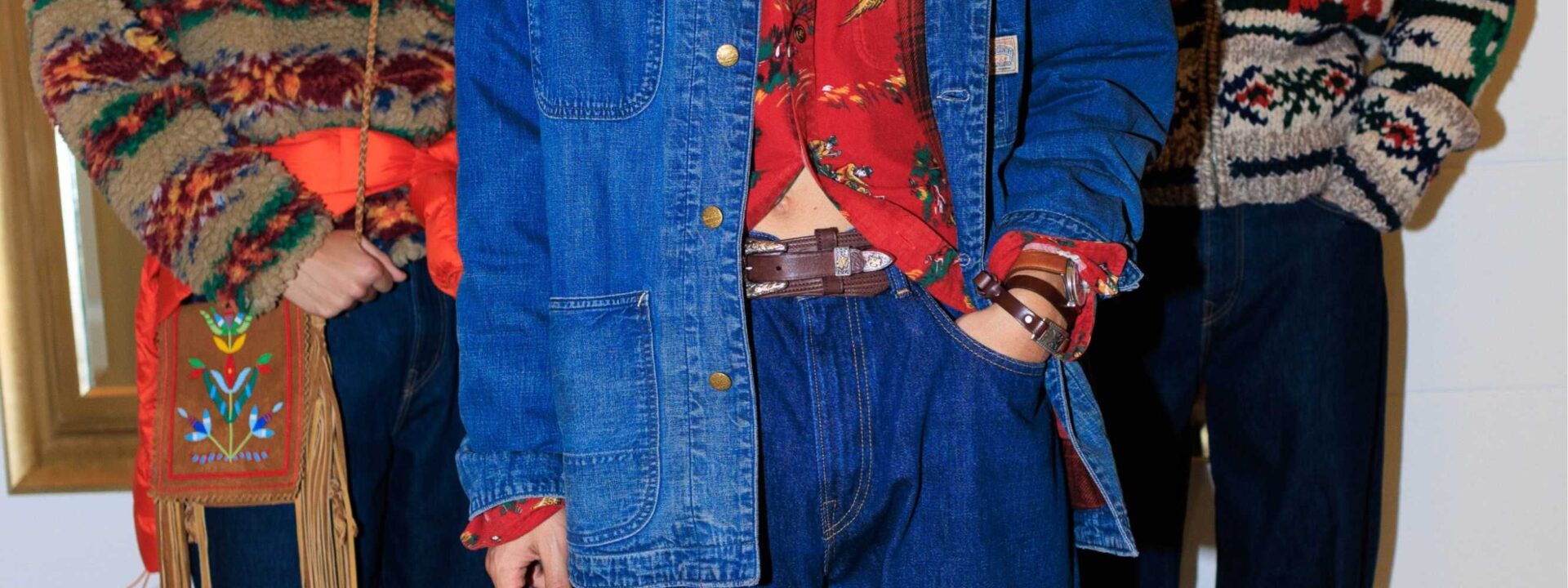
On Friday night, Ralph Lauren held its first dedicated men’s show—and its first show in Milan—in over twenty years. The event took place at the Palazzo Ralph Lauren, the brand’s Milan home since 1999, and also marked the debut presentation combining its Polo and Purple Label lines. The collection blended Ralph’s many influences, from Purple Label’s sharp tailoring, overcoats, and tuxedos to a technicolor Polo lineup featuring retro-inspired skiwear, outerwear, Alpine knits, Western suede jackets, and cowboy hats, contrasted with romantic pussy-bow collars, tailored overcoats, and, of course, New York Yankees caps.
Despite a luxury slowdown that has seen most major houses face losses or modest growth in recent years, Ralph Lauren has been a standout. Brand revenue rose 14% year-on-year on a constant currency basis to $2 billion in the second quarter of fiscal 2026, ended September 27, 2025, exceeding its high-single-digit outlook. For fiscal 2025, the brand reported 8% revenue growth to $7.1 billion. Gross margin also reached 68.8%, up from 66.6% the previous year—a gain analysts credit to the brand’s multi-year elevation strategy, led by CEO and President Patrice Louvet since his appointment in 2017. For much of that period, growth has centered on the women’s category.
The expansive Fall/Winter 2026 men’s collection aimed to showcase the brand’s rich portfolio, spanning from luxury Purple Label to more casual Polo.
Photo: Isidore Montag / Gorunway.com
At this exciting moment for the brand—between its men’s and women’s fashion shows (the latter returning to New York) and the Winter Olympics (for which it again designed the Team USA uniforms)—I sat down with Louvet to discuss his strategy for scaling menswear and the broader business through 2026 and beyond.
Hi Patrice. This is Ralph Lauren’s first dedicated men’s show in a long time, and the first time you’re combining Polo and Purple Label. What led to this event?
I’m really excited because historically we’ve only given the audience a glimpse of what we offer in men’s. Today, people will see the full picture. We have 80-year-olds and 16-year-olds wearing our brand. To me, focusing only on Purple Label has frankly felt like a missed opportunity—that’s not how we think as a company. It’s not how Ralph and John Wrazej [Senior Brand Creative Director for Men’s Polo, RLX, Purple Label, and Children’s Polo] and our designers approach it. We think about the guys we want to appeal to, their lives, and how we fit into their lifestyle.
This isn’t a one-off. We’ll continue to emphasize the overall menswear portfolio as we drive our womenswear business, because the opportunity there is also very strong.
Scaling Ralph Lauren’s womenswear business has been a focus in recent years. Where do you see growth potential in men’s?
This company started as a menswear company—it all began with a tie. We’ve put a lot of emphasis on women’s because it has great momentum and opportunity, and we wanted to showcase that. But historically, menswear is the core of this company. We have a unique portfolio: the prestigious Purple Label, the everyday active Polo label, and the Western- and workwear-inspired RRL line. No other company has a portfolio this rich and complete. We want to ensure we continue to drive visibility for it.
There’s been a real preppy mood in menswear recently. Since the streetwear boom has slowed, it seems more men are dressing in the spirit of Ralph Lauren. Have you seen an effect on the business and consumer base?
I’m going to challenge the premise of your question, if I may. We do get pigeonholed as preppy—and of course, preppy is oneOur portfolio encompasses a wide range of sensibilities, so I think it’s unfair to simply label us as “preppy.” There are so many dimensions to what we offer. For instance, much of our Purple Label line focuses on sartorial craftsmanship that really has little to do with prep.
We have a unique portfolio with the prestigious Purple Label, the everyday active Polo label, and the Western and workwear-inspired RRL line. No other company has a portfolio this rich and complete.
As a business, we aim to be timeless in our offerings. We don’t like trends, we don’t want to create them, and we’re not interested in chasing them. People might talk about a “Ralph Lauren Christmas,” which is great, but we aren’t creating or fueling that. Our offerings are meant to be evergreen, lasting well beyond any momentary trend. In my nearly nine years in this role, I’ve often heard “prep is in” or “prep is out.” I believe these trends are always present to varying degrees—they don’t really disappear. But we work hard not to be dependent on them.
You mentioned that Ralph Lauren consumers can range from 16 to 80 years old. How do you attract younger consumers without alienating the 80-year-old who has worn the brand for decades?
The risk is focusing solely on one generation and ignoring or even alienating another. We’ve increased our marketing investments significantly—from about 3.5% of revenue seven or eight years ago to nearly 8% now. This allows us to run a broad range of targeted marketing activations tailored to different generations.
For the 80-year-old man, it might be our weekend ads in The New York Times or our presence at Wimbledon. For Gen Z and younger audiences, we work with influencers, have activations on Roblox, and sponsor top esports teams like G2 and T1 in League of Legends. We understand where each consumer wants to engage and meet them there.
Of course, it’s been a challenging time for luxury broadly. How have you weathered the recent challenges in the luxury industry?
For us, it’s actually been an opportunity. During this period, our company has grown stronger. First, we’ve gained clarity on who we are. Many fashion houses have lost that clarity, and in turn, consumers have lost a sense of consistency. Ralph and I discuss this often. The second point is ensuring the consumer sees value. We’ve faced cost headwinds like rising cotton prices and tariffs, but we address these thoughtfully so customers still feel they’re getting distinctive, unique value.
Some companies may come across as too commercial, which can turn consumers off. As Churchill said, “Never let a good crisis go to waste.” The broader luxury challenges have turned out to be an opportunity for us.
Your team noted that according to your internal Global Brand Health Tracker for FY25, Ralph Lauren ranked number one for value perception among male and premium consumers worldwide. How do you drive this distinctive and unique value?
I’m glad you asked, because that’s really important to us and a key differentiator.There are three key drivers behind our company’s long-term success. First, we invest in our products, and consumers recognize that quality. Second, we focus on storytelling and styling. We want customers to feel they can wear our pieces for 10 or 20 years. Third, we are very deliberate about pricing. We ensure we understand our target consumer within the competitive landscape, so they feel the product is worth the price. We remain vigilant on this balance.
While I’m thrilled to see our luxury perception grow quarter after quarter, I’m equally pleased that our value perception remains strong and continues to strengthen. This might seem counterintuitive, as we’ve doubled our average unit retail price over the past eight years. Yet, our value perception has never been higher. This shows our efforts in quality, communication, and strategic price positioning are truly resonating.
Last year, I researched Gen Z, and many told me they no longer believe major luxury brands are worth the price, especially after post-pandemic increases. So, how do we ensure we’re perceived differently?
Our approach to value is this: the value equation is the combination of product quality, storytelling, and shopping experience, divided by price. We work intensely on improving the numerator—the top part of that equation. This allows us to justify our pricing. I think some competitors, facing cost pressures, simply raised the denominator (the price) without enhancing the numerator, which throws off the whole equation.
You mentioned the shopping experience. What innovations are you investing in?
In September, we launched “Ask Ralph,” our AI-powered styling guide in the U.S. Using a language model, it helps customers choose outfits for specific events or situations. For example, someone might ask, “I’m going to a baby shower, it’s going to be freezing—what do you suggest?” As we explore agentic AI, this platform’s future is promising. It starts as a styling tool but could evolve to handle queries like “Where’s my package?” or “Is the store open?” We’re leaning into this, and I believe it will meaningfully change retail.
We recently reported on the changing menswear influencer landscape, noting that men often seek styling advice online from creators or forums like Reddit. It seems “Ask Ralph” could fill that gap.
It’s funny you mention that. I was at the NRF conference recently. We built “Ask Ralph” with Microsoft. Shelley Bransten from Microsoft shared that her husband bought her an outfit using “Ask Ralph” that she didn’t have to return. Matthew Shay, CEO of NRF, also put together an outfit with it. So, it’s proving helpful. We’ll continue to adapt as the landscape changes and evolve our retail engagements in Asia as well. In China, for instance, we’re active on Douyin, starting with women’s Polo and now expanding to men’s Polo. We’ve also just started on TikTok Shop. These are new spaces where we can engage consumers in a data-driven way and meet their needs as effectively as possible. There’s a lot of retail innovation happening for our company.
Of course, with the Winter Olympics approaching, Ralph Lauren will once again outfit Team USA—a partnership we’ve maintained for 20 years.Sports have been a core part of our brand for a long time, from tennis to golf. Are we looking at new sports? We receive offers constantly. The real challenge is being selective, because Ralph’s philosophy and lifestyle are relevant everywhere. Could we be in cricket? We make a cricket sweater, so our style fits. Could we be in rugby? We already have a brand called Rugby, which ties into collegiate life, much like we do. We have no specific announcements today, but we’re always asking: where should we show up? That’s why we’ve entered gaming now—it’s a new space for us. Our focus is on where consumers want to engage with brands like ours, and then ensuring we’re present authentically, not just as a one-off, but in a way that builds lasting credibility over time.
More from this author:
Can Chinese Sportswear Label Li-Ning Win the Sportswear Race?
Why Did 180 People Just Parade Through Florence in Suits?
Pitti Uomo and Milan Fashion Week Men’s Cheat Sheet: Fall/Winter 2026
Update: This story was updated to include the full titles of John Wrazej, Matthew Shay, and Shelley Bransten.
Frequently Asked Questions
Of course Here is a list of FAQs about the Ralph Lauren Mens Show and the insights from CEO Patrice Louvet framed in a natural conversational tone
General Beginner Questions
Q What is This Isnt a OneOff referring to
A It refers to the Ralph Lauren Mens Show held in London The title emphasizes that this major event and the strategic direction behind it are part of a sustained longterm plan for the brand not just a single flashy moment
Q Who is Patrice Louvet
A Patrice Louvet is the President and Chief Executive Officer of Ralph Lauren Corporation Hes the top executive responsible for the overall strategy and performance of the global brand
Q Where and when did this show take place
A The show was held in London at the historic Bedford Square Gardens during London Fashion Week
Q Why was the show in London and not New York
A As explained by Louvet London is a key global hub for luxury and culture Hosting the show there reinforces Ralph Laurens international prestige and connects with a critical European and global audience
Strategic Business Insights
Q What was the main business strategy highlighted by Patrice Louvet
A The core strategy is elevating the brand This means focusing on the highestquality most desirable products and experiences to strengthen Ralph Laurens position as a true luxury house not just a premium apparel company
Q How does a show like this actually help the business
A It serves multiple purposes 1 Marketing Generates massive global media buzz and brand desire 2 Brand Image Reinforces luxury credentials and craftsmanship 3 Direct Sales Drives interest that translates into sales for those highend collections in stores and online
Q What did Louvet mean by focusing on the core customer
A He emphasized understanding and serving their most loyal highvalue customers who appreciate the brands heritage quality and timeless style rather than chasing shortterm fashion trends that might dilute the brands identity
Q How does this show fit into Ralph Laurens digital strategy
A While the event is physical its designed for the digital world The stunning visuals celebrity