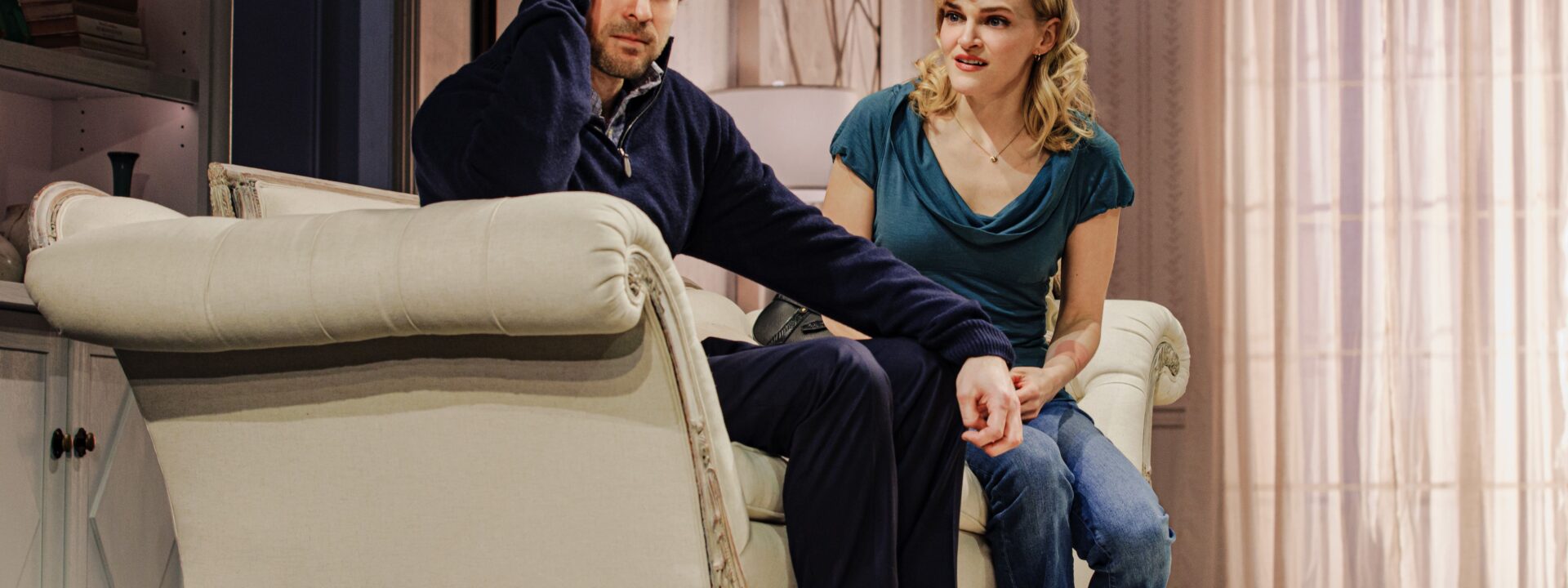
“I’m terrible,” says playwright Gina Gionfriddo. “I once joked to my daughter about leaving the door open and letting the murderers come in to kill us all. I have to watch myself.”
That sharp sense of humor might not always sit well with her family, but it’s exactly what drives Gionfriddo’s Becky Shaw, a biting comedy about a disastrous blind date that spirals into chaos. Eighteen years after its debut at the Humana Festival of New American Plays, the show—a finalist for the 2009 Pulitzer Prize for Drama—is now on Broadway at Second Stage’s Helen Hayes Theatre. This limited-run revival, directed by Trip Cullman, opened to rave reviews on April 6.
The story centers on the titular Becky Shaw (Madeline Brewer), a desperate yet cunning 35-year-old whose life has fallen apart after a string of failed relationships. Her plan? To marry into a better situation. As she tries to turn things around by seducing the sarcastic money manager Max (Alden Ehrenreich)—a misguided setup by her coworker Andrew (Patrick Ball)—everyone around her, including Andrew’s wife, Suzanna (Lauren Patten), and Suzanna’s mother, Susan (Linda Edmond), ends up paying the price.
Parts of Becky Shaw were loosely inspired by William Makepeace Thackeray’s Vanity Fair, which features another character named Becky—Becky Sharp—who is “super, super out there and blunt about trying to marry into a higher class,” Gionfriddo explains. She was curious about what it would mean for a 21st-century woman to pursue similarly mercenary goals.
The play tackles tough, complicated questions through its exploration of hypergamy, ex-baristas with savior complexes, narcissistic mothers, mail fraud, quasi-sibling relationships, and armed robbery: What does it mean to live a good life? Can we ever truly know the people we love? What do we owe strangers?
Gionfriddo, who often writes for crime TV series in Los Angeles—her credits include shows in the Law & Order universe, FBI: Most Wanted, and House of Cards—happened to be at home on the Upper West Side when Becky Shaw went into production. This allowed her to be “very, very involved,” attending most of the three-week rehearsal process and approving casting choices.
“Casting was an interesting process because actors in this play really have to be okay with not being liked,” Gionfriddo reflects. “And there certainly were actors who read the script and weren’t okay with that.” There was also concern about how audiences would react to some of the play’s edgier jokes. “I think we were all a bit worried that audiences might recoil from the nastiness of some of the humor,” she says, “but that hasn’t happened, which is a great relief.” It might be that with everything going on in the world today, a little coarseness doesn’t seem like such a big deal. Or maybe Becky Shaw is just really fucking funny.
While Gionfriddo’s most well-known plays, like After Ashley and Rapture, Blister, Burn, have been praised as dark comedies, she didn’t always see herself as a humorist. “I don’t think I would have ever said I was a comic writer, that I was funny, until college, which is when things sort of got hard for me.” Much of her inspiration comes from gay playwrights who lived through the AIDS crisis. “I just love that their humor was so dark… I think there’s a certain kind of humorist I respond to who cracks jokes to keep despair at bay.”
Pain is also a recurring theme in Becky Shaw. At one point, Suzanna criticizes Max for ignoring other people’s suffering when it’s convenient for him. “Unless you’re Gandhi or Jesus, you have a limited sphere of responsibility,” Max argues. “You have a plot of land…”The idea of a moral life is tending to your own plot of land. While Gionfriddo can easily name those in her own life—”obviously first my child, then my brother, my close friends”—the question of how much she owes the wider world still lingers. When Becky Shaw premiered in 2008, the Iraq War was the central moral issue of the day. Now, we don’t have to look far for a similar dilemma. “There’s a lot of dialogue asking how we can all go about our lives when we’re threatening to decimate Iran,” she says. “Part of me, like Max, thinks: I have a kid to raise. I need to pay my mortgage… And what could I even do? But the other side is that nothing changes if we all feel that way.”
What do we owe strangers? What makes someone “good”? Gionfriddo doesn’t claim to have the answers. “You may have been very victimized in your life; you may be a complete con artist,” Susan tells Becky in the final scene. “I don’t know. My sense is you fall somewhere in the middle.”
Because Becky Shaw lives in that murky, often uncomfortable zone of moral ambiguity, a tidy ending would feel false. Instead, the characters come onstage, ask questions, present conflicting views, make choices, and argue further before the lights go down. At that point, the written play may be over, but it seems likely that Becky, Max, Suzanna, Andrew, and Susan are still out there somewhere—making questionable decisions, falling in love, accidentally causing harm, and simply carrying on.
Frequently Asked Questions
Of course Here is a list of FAQs about the play Becky Shaw and its author Gina Gionfriddos approach to holding characters accountable
General Beginner Questions
1 What is Becky Shaw about
Becky Shaw is a dark comedy play about a newlywed couple Suzanna and Andrew who set up a blind date between Andrews mysterious coworker Becky Shaw and Suzannas cynical financially savvy stepbrother Max The disastrous date sets off a chain of events that exposes the selfishness manipulations and hidden vulnerabilities of everyone involved
2 Who is Gina Gionfriddo
Gina Gionfriddo is an American playwright and television writer She is known for her sharp dialoguedriven plays like Becky Shaw and Rapture Blister Burn which often dissect modern relationships ethics and social class with unflinching honesty
3 What does it mean that Gionfriddo holds everyone accountable in the play
It means she doesnt let any character off the hook for their bad behavior Every major character acts in selfish manipulative or morally questionable ways and the play forces both the characters and the audience to confront the consequences of those actions without providing a clear hero or villain
4 Is there a good guy or a bad guy in Becky Shaw
Not really Thats the point Each character has sympathetic traits and clear flaws Max can be cruel but brutally honest Suzanna seems fragile but is manipulative Andrew appears noble but is selfrighteous Becky seems victimized but is deeply calculating The play asks you to judge them all
Advanced Thematic Questions
5 How does the plays structure hold the characters accountable
The play is structured like a series of ethical debates or therapy sessions Characters are constantly forced to explain and defend their choices to each other in direct confrontational dialogue Theres no place for their bad behavior to hide its always being dissected by another character on stage
6 What are the main flaws each character is held accountable for
Max His emotional cowardice cruelty disguised as honesty and transactional view of human relationships