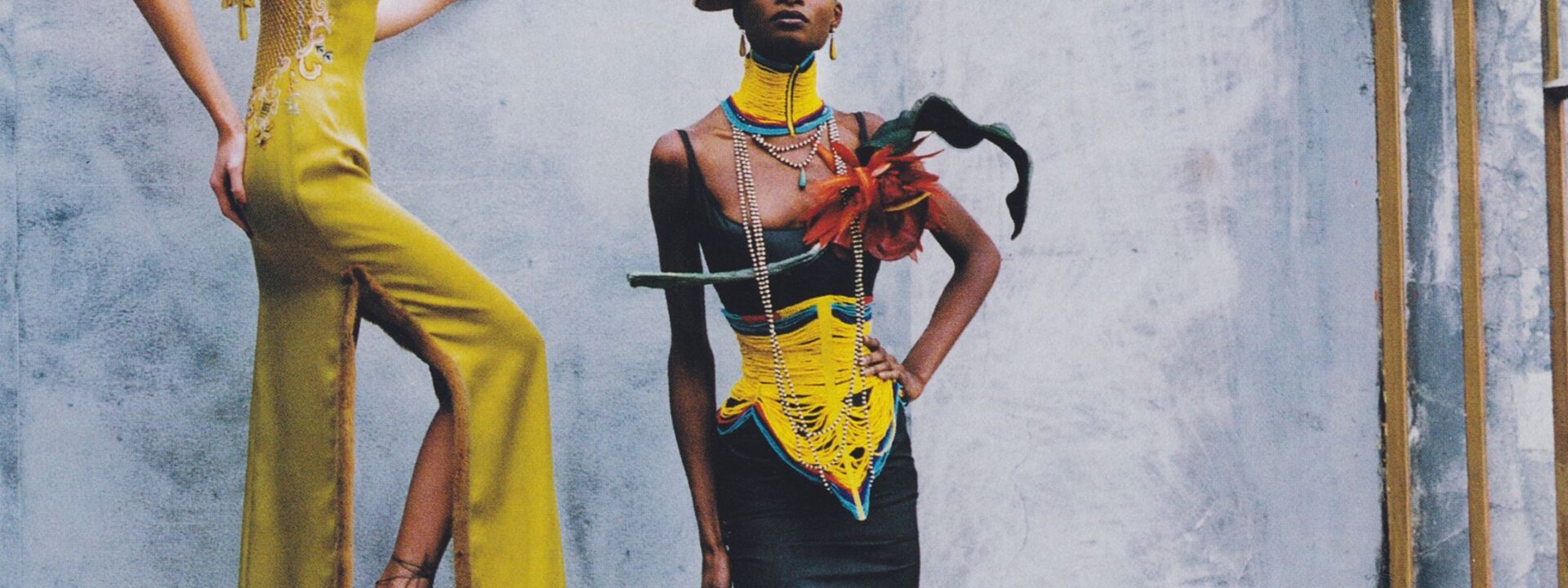
“Couture Clash” by Hamish Bowles and Katherine Betts first appeared in the April 1997 issue of Vogue. To see more highlights from Vogue’s archives, sign up for our Nostalgia newsletter.
Couture Clash: Diary 1—Agents Provocateurs
Is shocking British talent the spark couture requires? Or will it cause a disaster? Katherine Betts reports on the unfolding drama.
NEW YORK, TUESDAY, JANUARY 14
“Is that a real woman?” asks a short mother of two in a baggy Gap sweater, looking at an Avedon photo of a 1950s model. “Of course,” her friend replies confidently. “Look at that neck.”
We’re in the Costume Institute in the basement of the Metropolitan Museum of Art, and it’s crowded, mostly with women pressing close to the glass to marvel at Christian Dior’s exquisitely feminine dresses from the fifties. The audience gasps and murmurs, admiring how fabric curves aerodynamically around a hip or how sequins and seed pearls seem to burst from the waist of a carefully tailored bodice.
“Did you hear they could only be worn once because they were so delicate?” one woman asks another. The display cards explain Dior’s skill at updating historical styles—not unlike John Galliano. When I ask, the visitors here don’t recognize the names John Galliano or Alexander McQueen. They have no idea that Dior’s owner, Bernard Arnault, has taken a huge gamble on two rebellious London designers, and that in just five days, that gamble will either succeed spectacularly or fail completely. The pressure is intense, and rumors are swirling in New York fashion circles that Galliano has already upset the Dior seamstresses by asking them to replicate some vintage dresses.
PARIS, WEDNESDAY, JANUARY 15
A three o’clock appointment with Alexander McQueen at Givenchy. Very exciting. This is undoubtedly the hottest topic in Paris right now—the idea of this outspoken Londoner trying to revive the deeply dull House of Givenchy is highly entertaining. In the taxi to Avenue George V, I spot Clara Saint, a longtime collaborator of Yves Saint Laurent, on the street, gazing wistfully at the Givenchy building.
Inside, McQueen, wearing sneakers and cargo pants, tells me he has no intention of becoming the next Yves Saint Laurent. For a 27-year-old, he has remarkable nerve. We’re sitting in the grand salon, an elegant room that has seen better days, with vases of wilting flowers on an ugly makeshift coffee table. McQueen seems pleased with how things are progressing, especially with the ateliers. “I worked for Marc Bohan when he was at Hartnell, and it was the worst experience of my life. He was so rude to the ateliers. I think they really like me up there,” he says, pointing toward the ceiling and the Givenchy workrooms above. “They don’t see me as just some silly kid from London fussing over hemlines.”
Catherine DeLondre, the head of the atelier, appears to genuinely like McQueen, even after 33 years of loyalty to Givenchy. “At first we weren’t sure, but when we saw the pieces coming out of the atelier, we thought, ‘This is real couture.'”
“They were quite shocked that the clothes were so chic and so ‘McQueen,'” McQueen adds. What does that mean? “Wearable,” he laughs. “The difference between McQueen and Givenchy is that Givenchy isn’t about attitude; it’s about a lifestyle.” He’s starting to sound like Donna Karan.
He tells me the collection’s theme is the Search for the Golden Fleece and that everything will be in white and gold, like the old Givenchy couture labels. Nearly every piece incorporates a corset, some with over 200 bones. “Hopefully we’ve created some shapes that have never been seen before,” he says eagerly. I hope, for his sake, that’s true. When he shows me a white damask Maria Callas dress…With its built-in corset and big balloon sleeves, I can see this collection going in one of two directions: either very simple and chic, or a kind of Mugler for the 21st century. I call Thierry Mugler to get a preview. They say I can watch their hair and makeup rehearsal, but nothing else. Typical.
Ralph and Ricky Lauren have been in town, looking around for things to buy—sweaters, apartments, companies? Word is that Azzedine Alaïa has a graduate from Central St. Martins working for him and will present a small collection next week in his showroom. This rumor comes up every season, but Alaïa claims to have a loyal set of clients. He was offered the Dior job first, but he doesn’t work under anyone else’s name. He’s made his own contribution to fashion and won’t compromise that.
“Let’s face it, after the New Look, Dior was nothing special,” one Parisian insider tells me. “Nobody was buying those clothes.”
Thursday, January 16
“It’s very Dior, but not in-your-face,” says Galliano. It’s late afternoon, and he’s fitting Diana, the sixteen-year-old sensation from Frankfurt, into a fringed Prince of Wales pantsuit in his third-floor studio at Dior. With three days until the show, the place is a mess: jet beads, feathers, and bolts of fabric are strewn across the tufted leather sofas left behind by Gianfranco Ferré. A jungle remix of Alanis Morissette blasts from a boom box; several assistants bend over tables, carefully stringing beads into elaborate Masai-inspired chokers; another places leaves of organza on a dress dummy—that’s the wedding dress.
“They’re pretty technically groovy here,” says John, examining a white leather jacket so intricately cut it looks like lace. He says he’s inspired by the women who inspired Dior, especially Mizza Bricard. “She was Coco before Coco, always dressed in lilac, and when people asked, she’d say, ‘Cartier is my florist.’”
It’s a good line. Bricard, Boldini, orchids, African lilies—all these things are on John’s mind. But mostly he’s thinking about Christian Dior. “When he first started, Dior didn’t know how to get models, so he put an ad in the paper, and every hooker in Paris turned up.” This little story has been woven into the collection, so one section is about hookers, another about sexy, short “Miss Dior” suits, and another is very Chinese. Big surprise: Claudia Schiffer made up to look Chinese with a little black pageboy.
John seems very focused. He and his assistant, Steven Robinson, have been working on the collection for eight straight weeks. They took one day off for Christmas and tried to celebrate by roasting a turkey, but they forgot to turn the oven on. “It was awful. We were so tired we just ordered pizza,” says Steven, rolling his eyes. They also took McQueen out to dinner to “welcome him to Paris.” But that’s all they have to say about McQueen.
Rumor has it McQueen says he’s shutting the doors of the Beaux-Arts hall at 4:00 p.m. Monday afternoon and starting the Givenchy show on time. When asked about important magazine editors arriving late, he’s said to have replied, “I don’t give a fuck.”
He’s quoted in Le Figaro today saying he has “no respect for Hubert de Givenchy.” And what about Bernard Arnault? “He’s Gabriel and the devil. He’s a businessman who can do what he wants. When he asked me to do this job, I did it because I love fashion. I don’t give a shit about money. And when he asked to buy part of my London company, I said no way.”
Friday, January 17
I snuck behind enemy lines today to get a peek at Chanel. Karl didn’t seem at all afraid of the youthquake at Dior and Givenchy, only saying he thought McQueen was a bit disrespectful of Monsieur Givenchy.
Amanda Harlech, who defected from Galliano to Chanel, asked about John and lamented the fact that he doeShe won’t return her phone calls. I offer the relationship analogy: When you break up with someone, you don’t talk to them for a while—you let the wound heal. She wants the butter and the money for the butter, as they say in France.
SATURDAY, JANUARY 18
The mood is much heavier today on the third floor of Dior. Makeup artist Stephane Marais is discussing the angel/devil makeup idea with John. Steven is teaching the model Kara Young how to walk like a couture hooker. Doors are opening and closing, the music is blaring, and the beaders are starting to look glassy-eyed.
On my way out, I spot the boss, Bernard Arnault, standing on the corner of Avenue Montaigne in deep conversation with his wife, Hélène. They’re gazing up at the House of Dior, oblivious to the giant Calvin Klein sign looming behind them on a scaffold across the street.
I head over to Mugler’s couture house near the Marais for a preview. But Mugler isn’t receiving anyone in his attic studio today. Instead, I poke around the ateliers and watch seamsters (what do you call a male sewer?) sew sequins onto fishnet stockings. The culture here is decidedly futuristic and more macho than anywhere else. Instead of little old French ladies in white coats scurrying about, there are beefy 20-something guys in muscle shirts. One room on the fourth floor is devoted to computers programmed to cut patterns on a huge robotic machine that looks like a cross between a sunbed and a trampoline. The patterns are then mailed directly to the factory in Angers. This is modern couture.
SUNDAY, JANUARY 19
For all his talk about closing the doors at four on the dot, McQueen keeps his fans waiting for an hour. Some say it’s because Naomi was late, but I saw Naomi backstage hours before the show. It turns out the dressers don’t speak a word of English, and they’re having a terrible time trying to communicate with McQueen’s assistants about how to get the girls into the corsets.
The audience is already agitated when the show finally starts. Not even male model Marcus Schenkenberg, perched atop a balustrade wearing only a loincloth and a giant pair of wings, can keep them happy. Finally, Jodie Kidd stomps out in a huge white opera coat with real gold embroidery and a gold lace jumpsuit, her hair in an elaborate straw chignon. She’s followed by Georgina in a white, Sharon Stone-esque pantsuit with a transparent back, and Stella in a black snakeskin coat with exaggerated shoulders. By the time the feathered jumpsuit comes out, the Givenchy clients in the front row are rolling their eyes and folding their programs.
“It was hideous and irrelevant,” says Deeda Blair, a longtime Givenchy client and friend, after the show. “It didn’t amuse, and it didn’t enchant, and it had so little to do with the great history of Givenchy. I really don’t understand why Alexander McQueen would want to inflict that on women.”
“The ugliest I’ve ever seen,” pronounces a younger Givenchy loyalist. “Go back to art school,” whispers another. “Forget about corsets,” says Cathy Graham.
But not Mouna Al-Ayoub, the flamboyant Saudi divorcée. She raves: “It’s theatrical, and that’s what fashion’s supposed to be. It’s supposed to take you to a different world. The fear of not doing it right is exciting, too.” She has already reserved Jodie Kidd’s opera coat and Stella’s snakeskin coat.
Later in the evening, Gaultier gives us a witty couture spoof. Men in beaded jeans and corsets work the runway alongside women, parodying the old poses of fifties couture. There are two chic Night Porter-style black pantsuits, but the beaded men’s corset with matching beaded shower shoes is more Dennis Rodman than Charlotte Rampling.
All eyes are on John Galliano.
MONDAY, JANUARY 20
Lunch at the Hôtel Costes. The Hermès Kelly bags have migrated here from the Ritz. This must be the new hot spot.A French couture client rushes into the front room, buzzing about Fergie, who just interviewed Galliano for Paris Match for a reported $500,000. I try to listen as she talks about the collections. Suddenly, she exclaims, “If you think gold spray paint on your chest is couture, then McQueen is for you!”
McQueen’s reviews are in, and they are brutal. A particularly blunt “diary” in The Spectator mentions “giant nose-rings and… Oxfam maharanis” and describes it as “less Breakfast at Tiffany’s, perhaps, than dinner at Stringfellow’s.”
Twenty minutes until Galliano’s show. The entire lobby of the Grand Hotel has been transformed into a gray-and-white version of Dior’s couture salon, filled with 4,000 pink roses and 50 models. The anticipation is electric. Bernard Arnault is beaming. “I think this collection is fantastic,” he tells me before the show. “It’s very creative. There are a lot of wearable things, too, you know.” Beatrice Dalle, Dayle Haddon, Sydney Picasso, Fergie, Guy and Emmanuelle Béart, Charlotte Rampling, Marisa Berenson, Susan Gutfreund, Mouna, Nan Kempner, Cathy Graham—everyone is lined up in the front row, waiting.
Out come the Prince of Wales minisuits, the Masai corsets, the swingy, fringed pants, and a stunning pair of pink and chartreuse slinky satin dresses with Chinese embroidery. The models look beautiful, Manolo Blahnik’s fur stilettos are fantastic, and Claudia Schiffer as a China Girl steals the show. John takes his bow in a small black trilby hat and brings down the house.
“Forget all those other dresses I ordered this morning!” shouts Mouna across the lobby as clients and fans rush backstage to congratulate Galliano. “This is the show!” Back in the bar where John is greeting fans, Naomi and Shalom squeal with delight. Arnault is triumphant. Beatrice Dalle, with a cigarette dangling from her mouth, pouts: “Oh, there were some pretty things, but I prefer him on his own.”
TUESDAY, JANUARY 21
Jean Paul Gaultier tells me he has always wanted to do couture and that he spoke with Dior president François Baufumé two years ago. “I wasn’t totally disappointed, because Mr. Arnault wants to buy the designer out completely, and I already have an established ready-to-wear collection. I would have had more money and great ateliers, but their ready-to-wear isn’t very developed.” Gaultier is being very diplomatic. “They called me about Givenchy, too, but I said no. It’s not a fantasy, and you really have to fall in love. Plus, to go after John is not very flattering.”
Gaultier has created unisex couture, perhaps the freshest take on the old craft yet. “You know, more and more women and men do things together—they go to the same hairdresser, wear the same perfume, buy a lot of the same clothes,” he says. “So why not couture for men? Anyway, men have been going to Savile Row for couture forever.” So far, though, Gaultier has no male customers, even though Elton John attended the show.
Galliano receives rave reviews. The New York Times calls it a triumph. The unpleasant memory of McQueen’s giant nose rings at Givenchy is already starting to fade.
WEDNESDAY, JANUARY 22
Mouna grabs me after the Valentino show and asks if I want to come to her Dior fitting. “They better pay me to come to Valentino next time,” she mutters as she hops into her black Mercedes. “30 avenue Montaigne, La Couture!”
Mouna is in a frenzy about Dior. She can’t decide which dresses to order and is afraid she won’t get the ones she wants. “Sometimes you grab the directrice after the show and give her your numbers, but if a lot of people want the same dress, I might not get it.” Today, she’s going in with a fighting spirit. The directrice, Caroline Grouvel, greets us and whisks us away.She steps into a private fitting room where Mouna’s selections are hanging on a rolling rack. Up close, they look surprisingly ordinary. The way Mouna flips through them, as casually as if she were shopping at Bloomingdale’s, baffles me. This is couture? Aside from the dove-gray upholstered chairs and the attentive seamstresses, it doesn’t feel like couture.
Mouna takes off her Chanel couture coat (fall ’97) and begins thumbing through the look book. “Number 1, number 11, number 20, and, oh yes, number 22.” Madame Grouvel obediently writes down the numbers, and the outfits appear on command. Mouna has reserved the coveted pink and chartreuse dresses, the black Mae West lace and violet taffeta dress, the embroidered pants, the chartreuse moiré damask cotton opera coat (she’ll buy the runway sample at a discount), and the ivory lace dress that Esther wore. She also wants the short white tennis dress, the Prince of Wales suit, the lilac chiffon dress, Carla Bruni’s beaded Crazy Horse dress, and the black duchesse satin sheath.
The dresses are so tiny—made for sixteen-year-old models, remember—that Mouna doesn’t actually try them on. Instead, she slips her hands through the armholes, holds them up, and wiggles in front of the mirror. She immediately rejects the pants and the chocolate sheath; too strict. She’ll think about the opera coat (and negotiate the price) tomorrow. She wants the Carla Bruni dress for a couture museum she’s starting, but that will be negotiated tomorrow, too. She knows all the seamstresses and saleswomen here very well because she was a client of Bohan’s for fifteen years—back when, as she likes to say, she had to buy conservative clothes because she was married to a conservative man. “But now I’m free! And I can buy what I want! And why not?”
A saleswoman brings down the beaded black-and-white dress, and Mouna drops everything. “Divine, isn’t it?” She holds it up and tilts her head from side to side as she studies her reflection. “Can we make it long? No train. And we’ll repeat the pattern—black, white, white, black, yes? Can I see a sketch tomorrow? Then I’ll decide.” She tosses the $60,000 dress in a heap onto the couch and picks the black lace Mae West dress off the rack. She pauses in front of the mirror with the black lace dress and the jet-beaded corset. “Which one? The black lace? Or the white lace made in black?” The differences are subtle, but Mouna chooses the black lace because it’s irresistible. She’ll shorten the train and adjust the corset so the boning is more flexible. She runs through her order once more: ten pieces and two negotiations. She’ll return tomorrow to put down a 50 percent deposit to confirm the order. In twelve days, she’ll come back for the first fittings. She prefers four fittings—more than most—so her order will take about two and a half months.
“Usually I order ten evening dresses at Chanel and three everywhere else, but this time I’ll do ten at Dior and three at Chanel,” she announces. She reviews the collections so far this season, ticking off the houses she usually likes: too many feathers at Chanel, too conservative at Balmain, one dress at Saint Laurent, two at Givenchy.
We say goodbye on Avenue Montaigne. As I watch her speed off in her Mercedes, I think about the rack of Dior dresses and how hard it must be for an untrained eye to tell the difference between couture and ready-to-wear. And then I remember what Deeda Blair said when she heard the pearls were real at Chanel: “Who would know the difference unless you were at a dinner party for eight?”
Couture Clash: Diary 2—Eminences Grises
Not all the attention went to the newcomers. Those seasoned designers who know how to keep their clients happy had plenty to show—and say—this season. Hamish Bowles listens in.
TUESDAY, JANUARY 14, 11:30 A.M. 59, RUE SAINT DOMINIQUE
Sitting in his elegant Parisian pied-à-terre, where he’s come to escape the cold of his Burgundy house, MarcBohan is in a reflective mood. As the House of Dior’s designer for nearly 30 years, he established the house as a bastion of understated, uncontroversial Parisian good taste. “I tried to make things that suited and pleased the customer,” he explains, “not to create some striking change or a fun novelty every season. I thought that era was over. I kept the clientele. That was the main idea—not to make headlines. Now we have this funny phenomenon where nobody wants to dress people, only to generate publicity.”
What does Bohan think about the designers making their haute couture debuts this season, and about Galliano taking over the design reins at Dior? “I don’t really see what these young designers know about couture, because they never worked in a couture house,” he says crisply. “Ready-to-wear is about making clothes flat on a table. A couture dress is built up on a body. It’s a completely different way of doing things. You learn as an assistant—the way I worked with Piguet and Molyneux, the way Givenchy has worked. Even Dior started at Piguet.”
What does he think of Alexander McQueen’s work? “Put that in the hands of the average woman and they just laugh!”
And Galliano’s clothes? “They’re very exotic for the photographs—extreme in a costumey way. I’ve never really seen them on clients. I hope he won’t fall into the ‘wants to be Dior’ trap. Those old Dior clothes really belong in a museum; they have nothing to do with the women of today.”
3:00 P.M., 13 RUE DE LA GRANGE-BATELIÈRE
At the embroidery house of Lesage, innumerable workers are hunched over their frames, stitching frantically. François Lesage, who was honored with the Légion d’honneur in 1995, is a vital man, full of enthusiasm. The history of couture is alive in his mind and in the 60,000 embroidery samples in his archives. “I’m a chameleon,” he tells me. “I’m Saint Laurent for Saint Laurent, Lacroix for Lacroix, Galliano for Galliano. There is a complicity. We are more friends than customers. Karl trusts me; he says, ‘I know how to change my mind.’ McQueen I saw once,” he sniffs. “But it’s always good to have young designers—everybody is scared, everybody is watching, and that gives an intensity.”
Lesage feels that this season will crystallize an essential dichotomy in today’s couture world. “For me now, there will be two schools. On one hand there are designers like Oscar, Valentino—very classic, very customer-oriented. The rest will be press, press, press. Couture is a culture; in my youth I went to Patou, Poiret, Vionnet. The ladies would arrive at ten in the morning to order their lingerie. These women would turn clothes inside out to examine the finishing. Hardly anyone has that culture now. The new designers do not have a deep culture—they have a culture of the flea market.”
The market for Lesage’s magic is buoyant, however; the house repeated nine of Chanel’s extravagant Coromandel embroideries from last season—“more than some ready-to-wear orders”—and four of the extraordinary Chanel gold dresses whose embroidery alone cost nearly $200,000 each. “Even Givenchy made some repeats of those little-bit-crazy numbers!”
4:30 P.M., 31 RUE CAMBON
In Mademoiselle’s studio on the rue Cambon, I count 27 people fluttering industriously around Karl Lagerfeld. Lagerfeld’s dazzling new prize, the inspirational Amanda Harlech, has been seduced away from Galliano, whose longtime collaborator she has been. Although she’s still wearing Galliano’s Wallis blue dress, she’s shrugged a skinny black Chanel cardigan over it. “It’s about Chanel proportions and luxury pushed to absolute nervous-breakdown extremes!” Harlech says of the collection. “It’s hysterical Chanel,” confirms Lagerfeld. “The nonexistent dress, the exploded shoe!” This translates into shrunken jackets in aerodynamic…Tweed jackets paired with wide, flowing pants; chiffon dresses with sections and hems that resemble an inverted Chrysler Building. The classic Chanel boater hat has been enlarged to Edwardian proportions, and even the signature Chanel buttons have been swapped out—replaced with real pearls and diamond camellia clips, each costing $14,500. Amid the bold youth movements elsewhere, Lagerfeld is shrewdly focusing on effects only a couture atelier can achieve: impeccably tailored, weightless garments. “It’s about silhouette and The Unbearable Lightness of Being,” he says. When asked if he had read the book, he replies, “Of course not! From movies, I only like the stills, and from books, only the titles!”
11:30 P.M., HOTEL RITZ, 15 PLACE VENDÔME
I join Harlech for a midnight dinner in her suite at the Ritz. She has draped antique black lace over the headboard, tattered Indian silk handkerchiefs over the lampshades, and scattered battered Edwardian millinery roses, scraps of fur, embroidery fragments, and photos of her beautiful children across the chimneypiece. Harlech is visibly exhausted. After an afternoon of fittings for Chanel ready-to-wear, which flowed into couture appointments, she rushed off with Lagerfeld for more fittings at Karl Lagerfeld’s studio with his assistant, Eric Wright. Back at the Ritz, Lagerfeld called for about an hour to discuss a quick trip to Rome for Fendi on Saturday.
THURSDAY, JANUARY 16, 11:00 A.M., 44 RUE FRANÇOIS-1ER
During fittings for Balmain, Oscar de la Renta balances press inquiries about his inauguration dress for Mrs. Clinton (“She wanted to look sexy”) with social visits from Parisian grandes dames—and a few temporary American guests. De la Renta’s sleek suits and sophisticated evening dresses have a Kay Kendall vibe, perfectly tailored to please his clientele. Sales last season, according to the vendeuse, were “monstrously good.” “And we plan to sell even better this season,” de la Renta adds with a wry smile, “with all the disasters happening elsewhere!” Balmain, with lower prices than other couture houses, has attracted many former Givenchy clients who were put off by the brand’s avant-garde direction. These clients have also turned to Saint Laurent (which doubled its couture business last year), Lacroix (another record year), and Valentino. “Our clients don’t want to wear fancy dress,” says Balmain vendeuse Katia Smirnoff. “For them, couture is an investment. They want something comfortable and elegant. Last season, we sold every piece in the collection at least once, and all the most expensive embroidered items multiple times.” De la Renta notes, “The problem with fashion today is that the most important consumer is out of fashion. Fashion is only interested in people who don’t buy clothes.”
NOON, 2 AVENUE MONTAIGNE
Emanuel Ungaro echoes a similar sentiment, though he expresses it more forcefully. “It’s like playing with weighted dice,” he says, referring to Bernard Arnault’s apparent strategy of prioritizing publicity over clients at Givenchy and Dior. “I’m completely disgusted by that. They don’t care if they don’t sell a single dress. We are in two completely different businesses! I hope we have as much success after our show as they have had before theirs!” Ungaro’s house is deeply client-focused. Florence Grinda, his society liaison, takes the collection wherever there are buyers—in Saint Moritz, she sold pieces to the new super-rich Russians.
To find inspiration for his collection, Ungaro has defiantly retreated into a couture world he barely remembers. “It’s the dream of a woman who doesn’t exist anymore—Babe Paley, Gloria Guinness, Mona Bismarck, Daisy Fellowes.” Like Lagerfeld’s designs, Ungaro’s jackets and coats fit as effortlessly as pullovers, worn over unlined chiffon pants or lingerie dresses, allowing his clients to feel “dressed and undressed at the same time.”
FRIDAY, JANUARY 17, 10:30 A.M., 3 RUE DE MONTYON
At the h…At the Montex embroidery house, Annie Trussart is overwhelmed by last-minute orders from several new designers. “They have no idea how much work goes into this!” she exclaims. One embroiderer worked through the night until 7:30 a.m. to appliqué leaves onto McQueen’s jersey hose; Dior’s request for a stunning “Chinese shawl” sheath dress arrived less than a week ago; and before production could even start, samples had to be created, presented, and approved.
3:00 P.M., 73 RUE DU FAUBOURG ST-HONORÉ
Christian Lacroix wears a thrift-store sweater knitted with a Union Jack. “Nowadays, you have to be a little English,” he jokes. His wall of sketches is covered with inspirational images and richly textured fabric samples. “It’s always the same,” he says with a sigh. “I start out wanting everything clean, geometric, and neat. But I can’t resist adding more. I love everything too much—my customers too, it seems. I want to support the lacemakers!” A photo of romance novelist Barbara Cartland, dressed in deep pink and inexplicably holding a bright-blue spray can, sets the color tone for the collection. Françoise Lacroix explains the casting for the show: “We want unreal girls, like insects—blonde and pale, not material girls!”
4:30 P.M., 103 RUE FAUBOURG ST DENIS
Monsieur Lemarié, one of Paris’s last great plumassiers, creates silk flowers and plumes for the couture; he joined the house in 1946. In this season of sheer, delicate clothing, his workshops have truly shone—feathers are everywhere. Like Lesage, Monsieur Lemarié is a walking encyclopedia of couture history. “I worked with them all. Yves Saint Laurent and Laroche and their teams were my age, so I felt like part of the family. And Givenchy,” he adds with emphasis, “was the picture of a gentleman. Today, the techniques remain the same, even if designers are much more relaxed.”
Many pieces have already been delivered, but an extraordinary Papageno breastplate for Givenchy is receiving final touches. “There are always last-minute ideas,” he says. “That’s what makes it exciting!”
SATURDAY, JANUARY 18, 11:00 A.M., HOTEL RITZ
Donatella Versace, surrounded by the scent of tuberose (Versace’s Blonde perfume) and wearing a chunky green and yellow sapphire bracelet (a 1950s Tiffany piece), pairs red fishnet hose with the sleek Latino-inspired navy and red lace and jersey outfits that will open her brother’s show tonight. These quickly transition into sheer garden-party chiffons—but what looks like prints are actually painstakingly heat-sealed appliqués. “In this collection, everything is so light,” explains Gianni Versace. “The whole collection could fit in one bag. My clients want beauty, but things they can actually wear. They come to me for eveningwear. For beautifully made daywear, they can go to the boutique—or to Chanel.”
3:00 P.M., LE GRAND HOTEL, 2 RUE SCRIBE
The Nina Ricci show, first on the Chambre Syndicale’s calendar, offers a glimpse into the kind of old-world couture that will be challenged this week. Clients like Soraya, the former empress of Iran, Leslie Caron, and Princess Alexander of Yugoslavia admire Gérard Pipart’s intricate, bonbon-like creations, modeled by women of a certain age who twirl down the dusty-pink runway, pausing politely before key customers. Outside the Grand Hôtel, haute couture workers are picketing. Their pamphlets note the closure of five couture ateliers since 1990 (Lanvin, Guy Laroche, Philippe Venet, Grès, Cardin), a 35% drop in employees since then, and a failure to hire new apprentices. “If we continue at this rate, within a few years all these skills will be lost forever,” the handout warns.
7:00 P.M., HOTEL RITZ
Atelier Versace represents design for a completely different era and sensibility. Elton John and Mauri—Maurice Béjart and Versace sit side by side, basking in the success of last night’s performance—a new ballet for which Versace designed the costumes. Versace’s supermodels, unmistakable even behind the highwaymen’s lace eye masks they wear to open the show, stalk the runway in sleek clothes you can imagine them walking off in, or at least wearing to the party Versace will throw for them (and Elton John) later that night.
SUNDAY, JANUARY 19, 1:00 P.M., L’ESPADON, HÔTEL RITZ
Over lunch, I ask Valentino about Alexander McQueen. He waves a hand dismissively over the woven cabbage roses underfoot. “If he designed this carpet, I wouldn’t know!” Here is a man who can critique the costuming in Evita (“She was much more… flamboyant. She loved capes, fur hoods”) because he actually knew Eva Perón as a client at Jean Dessès, where he learned the art of couture the hard way. It must be galling to see a young designer rise so rapidly through the ranks, handed a wonderful couture atelier on a plate.
Valentino’s suave business partner, Giancarlo Giammetti, is more pragmatic. “I see Arnault’s point of view,” he says. “You can’t make money on couture, so you might as well make press. Now I give the vendeuses a quota of dresses they can sell to break even. Any more than that, we lose money.” Valentino can afford to pick and choose his clientele; one high-spending ex-Givenchy client told him she would dress with him, but only if he stopped dressing her husband’s best-dressed first wife. The suggestion was laughed off. “If I didn’t make clothes to please my customer, for her to wear—impossible,” exclaims Valentino dramatically. “It would be finished!”
In his fitting rooms, Valentino’s clothes—a tour de force of craftsmanship—can be marveled at up close. Well-bred little suits with slits that open prettily over pleated chiffon and tulle; giraffe-spotted jigsaw puzzles of lace and point d’esprit; evening dresses dripping with embroidered wisteria and ferns. No wonder some of these exquisite dresses have been four months in the making. There is no last-minute improvisation here.
MONDAY, JANUARY 20, 12:30 P.M., HÔTEL INTER-CONTINENTAL PARIS, 3, RUE CASTIGLIONE
At the Ungaro show, loyal clients are out in force. Liliane Bettencourt, the vicomtesse de Ribes, and Madame Balladur all wear last season’s tapestry knit jackets. Even proto-waif Jane Birkin has an Ungaro couture coat shrugged over jeans. The ubiquitous Madame Ricard (“the richest woman in Paris”), a flashy blonde with a Côte d’Azur tan, is recovering from the big fête she gave on Saturday night that had le tout Paris clamoring for invites. The models drift by to the sort of languid modern music that accompanies an aromatherapy session, taking off their jackets to reveal the diaphanous lace and chiffon dresses beneath. “It looks like my couture underwear!” says Nan Kempner.
9:00 P.M., 27, QUAI VOLTAIRE
At dinner at Le Voltaire that evening, couture client Pauline Karpidas sweeps by in Saint Laurent furs. “Dior was marvelous theater,” she pronounces. “But pas portable!”
Later that night, at Franca Sozzani’s festive birthday party at Les Bains Douches, Gianfranco Ferré and John Galliano embrace warmly. Issy Blow, relatively understated in McQueen’s asymmetric-hem pants, a twinset pinned with gold and diamond star bursts, and a Philip Treacy confection of black lace and feathers, looks at me earnestly and says, “Every time I see Anna Piaggi, she just looks right through me. Why on earth do you think that is?”
TUESDAY, JANUARY 21, 10:30 A.M., HÔTEL RITZ
The fusty brocade curtains and bed draperies at the Ritz have been veiled in tulle for the Chanel show, the chimneypieces heaped with branches of gardenia—very Harlech touches. The models look ravishing with their C.Z. Guest flips and soft powdered faces. The clothes fit like gloves, and they’re light as thistledown.Faced with these supremely elegant, airy little nothings, a witty friend acts out the Chanel couture client’s predicament this spring. “We’ve got ten minutes to go, and I can’t find my new Chanel dress!” she cries to her husband, who replies, “You’re wearing it, darling.” At the packed client show later that afternoon, the morning’s discordant channel-surfing music has softened, and Gianfranco Ferré is mobbed by photographers. Marc Bohan, sitting a few seats away, goes unnoticed.
6:00 P.M., LE GRAND HÔTEL
Christian Lacroix has said that his moonstruck clothes in extraordinary combinations of color and texture are primarily for the clients this season, and the press response seems tepid. However, Lucy Ferry, clad in vintage couture, is weeping with emotion. “I’m sorry, but nobody beats that. It’s the most beautiful thing I’ve ever seen. I just can’t live without those clothes.” We return for a second viewing and sit with the clients. This time the atmosphere is electric, with the ladies applauding every outfit deliriously.
9:00 P.M., MUSÉE DU LOUVRE, PALAIS DU LOUVRE
At Hélène David-Weill’s Musée de la Mode dinner, couture clothes are out in force. Maryll Lanvin and Sydney Picasso look stunning in Lacroix, Anne Bass and Nan Kempner sleek in Saint Laurent, the baronne de Waldner glittering in Balmain. Suzy Menkes, in ropes of fist-size Indian garnets, tells the Chanel-clad Mouna Al-Ayoub that she’s thrilled for once to be wearing jewels bigger than hers. “Yes, Suzy,” says Al-Ayoub, stroking the matchbox-size gems at her throat, “but these are diamonds.”
WEDNESDAY, JANUARY 22, NOON, HÔTEL RITZ
At lunch, the serious couture ladies are in raptures over Yves Saint Laurent’s collection. “I wanted every single thing,” says Nan Kempner. “When you look at those clothes walking down the runway, you’re looking at perfection. Both Yves and Karl came out with the message I expected. After all, it’s the client, not the press, who buys the clothes.” Madame Karpidas tells me, however, that with 48 hours to think it over, she’s revised her estimation of the Dior show. “After all, we are heading toward the new millennium. We must adapt to the new!”
2:00 P.M., LE GRAND HÔTEL
Henry Kissinger turns up for the Balmain show and sits between his rangy wife and Madame Pompidou. One witty and forthright client turns to me with her assessment. “Very pretty, but not a new idea in the show,” she says. “But I’m not here to buy ideas—I just want clothes to make my rear look smaller!” You can’t please all of the clients all of the time. Another impeccably dressed lady, who has carefully marked her Balmain program, tells me that she was bored by Chanel and “insulted” by the Dior show. “I just hope Arnault has a lot of money,” she adds.
4:30 P.M., LE GRAND HÔTEL
Valentino’s exquisite evening dresses are shown without visible underpinnings. Princess Marie-Chantal of Greece is enchanted, but one polished American client, for whom Hubert de Givenchy had all the answers, takes my arm as she glides by on her way out. “Help! That man could design for La Perla. It’s a desperate situation—what am I going to wear this spring?”
Frequently Asked Questions
Of course Here is a list of FAQs about Couture Clash A Look Back at the Fashion Industrys 1997 Upheaval designed to cover a range of interests from casual to expert
Beginner General Questions
1 What was the Couture Clash of 1997
It refers to a pivotal year when the traditional exclusive world of haute couture violently collided with the rise of celebrity culture minimalist trends and a new generation of designers fundamentally changing how fashion was consumed and perceived
2 Who were the main players in this clash
The key figures were Gianni Versace John Galliano and a wave of minimalist designers like Helmut Lang and Jil Sander The tragic murder of Gianni Versace in July 1997 became a symbolic turning point
3 What is haute couture and why was it under threat
Haute couture is customfitted handmade clothing produced by elite Parisian fashion houses By the 90s it was seen by many as an expensive outdated relic struggling to stay relevant against readytowear lines that were more accessible and commercially viable
4 How did celebrities play a role
1997 was a peak moment for red carpet fashion Celebrities like Princess Diana and supermodels began to rival fashion houses as style icons Designers started dressing stars specifically for major events to generate global media buzz
Intermediate Cultural Impact Questions
5 What specific events in 1997 defined this upheaval
John Gallianos appointment at Dior A young British avantgarde designer taking over the most historic French house signaled a dramatic shift
Gianni Versaces murder This shocking event marked the end of an era of flamboyant supermodelcentric glamour
The rise of Heroin Chic A controversial grungeinspired aesthetic in photography that clashed with traditional ideals of beauty and luxury
Princess Dianas dress auction A highly public event that questioned the sentimental and monetary value of fashion