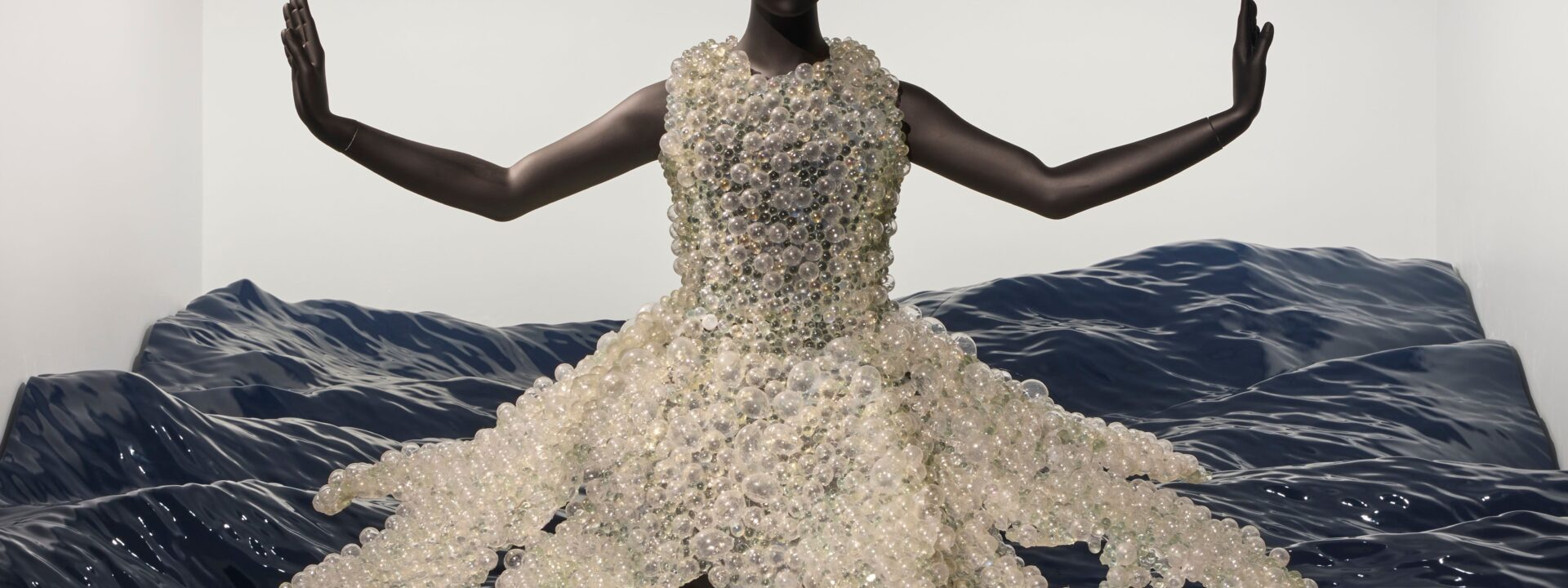
The first thing visitors see when they walk into Iris van Herpen’s new exhibition at the Brooklyn Museum in New York is her 2016 bubble dress—a forerunner to the 2026 version, which also blew bubbles and went viral after Eileen Gu wore it to the Met Gala last week.
Opening on May 16, “Iris van Herpen: Sculpting the Senses” builds on the original Paris show from 2023, organized by Cloé Pitiot and Louise Curtis of the Musée des Arts Décoratifs, but doesn’t exactly copy it. Working alongside the designer in New York are Matthew Yokobosky, senior curator of fashion and material culture at the Brooklyn Museum, and Imani Williford. They’ve adapted the show—van Herpen’s first major U.S. exhibition—to fit the space. Yokobosky calls it a mid-career retrospective, since this month marks van Herpen’s 19th year in business.
Nearly two decades in, the designer remains one of a kind. Van Herpen is one of the few who has convincingly and naturally brought technology into couture, showing how 3D printing can create something truly unique. She has also drawn from nature, crafting mycelium lace and, most recently, a living dress made of 125 million bioluminescent algae. This glowing wonder has made its way to Brooklyn, where it sits in a glass case and is regularly misted to stay fresh.
Van Herpen approaches fashion from a bit of a different angle. She was a dancer for years before studying at the ArtEZ University of the Arts in the Netherlands, which might explain her deep respect for the body. She avoids the usual celebrity-driven system and instead works closely with scientists, artists, and architects. Her practice is highly collaborative, and many pieces in her collections are co-credited. In these partnerships, aesthetics are only part of the picture—the focus is often on developing new materials, advancing techniques, and, believe it or not, functionality. “Of course, you see a lot of collaborations in fashion that are marketing driven,” van Herpen said during a recent walkthrough of the show. “But I think here, the collaborations try to push fashion to find new materials, new ways of making, and also to bring in sustainability to change how we work.”
“I love the collaborations I’m involved in because for me, the process is even more important than the final result,” she said. “The process is really ongoing research. It shapes me, it forms me, and by working with people from other fields, you truly share knowledge. When fashion stays in its own bubble, it doesn’t respond to the world. I think this exhibition is meant to show the connections between philosophy, science, fashion, and art, of course.”
Visitors are immersed in van Herpen’s world across 11 themed sections. While the Met’s “Costume Art” looks at the body’s surface and organs, “Sculpting the Senses” goes much deeper—down to the molecular level, not just of people but of the natural world too. The exhibition is well choreographed, moving from the micro to the macro. As Yokobosky notes, it starts with the blue of water and ends with the blue of the cosmos. Along the way, he added, “you start to see relationships between different life forms.” And also between art, nature, and fashion.
In the first half of 2026, an interesting trend has emerged: three exhibitions that directly pair garments with artworks. The Museum at FIT kicked things off with “Art x Fashion,” and now on display in the Met’s new Condé M. Nast Galleries is Andrew Bolton’s “Costume Art,” which opened to the public on May 10. In that show, all kinds of art are paired with clothing to highlight how central the dressed body is across the museum’s collections. “Iris van Herpen: Sculpting the Senses” completes this trio by including artworks too, though there are many fThere are fewer pieces than at the Met, and they serve different purposes—most often to emphasize the incredible materiality of van Herpen’s work and its organic, morphing shapes.
Take, for example, a 19th-century wooden Gothic corner chair placed near a 2011 dress inspired by Gothic European cathedrals and alchemy. Made in collaboration with architect Isaïe Bloch, the dress is constructed from copper-electroplated 3D-printed polyamide. A Naum Gabo sculpture appears in the Synesthesia section, while a giant fossil on loan from the American Museum of Natural History moves through time in the room dedicated to the idea of Skeletal Embodiment. Also on display is a version of van Herpen’s 2011 3D-printed skeleton dress, which is currently also on view at the Met. The designer explained this is possible because she makes copies of every piece that leaves the studio.
During the exhibition, van Herpen plans to create a dress in public. That’s just one of the many interactive and dynamic elements of the show, which includes moving mechanized garments, microscopes for examining material samples, and plenty of videos—including dressmaking footage projected on screens that unfurl from dress forms like oversized thought bubbles in the Atelier room. Further along, clips from fashion shows let visitors see these fantastical garments in motion.
As if that weren’t enough, there are several pop culture tie-ins. Beyoncé generously lent the dress van Herpen made for her “Renaissance” tour, and Grimes’s 2021 Met Gala look is on display, along with a Mother Mary costume the designer created for Anne Hathaway, who wore it to a premiere last month. (Made from a fabric that fades from red to black, it features pleats of various sizes and has a regal, ocean-like silhouette.) If a wall of muses—photos of celebrities wearing van Herpen’s designs—feels a bit self-indulgent, it’s a small misstep in a show—and a career—all about connections, continuity, and movement. A touch of serendipity comes from pairing a piece from the Brooklyn Museum’s own collection—a quasar-shaped mirrored glass installation called Extra Life by Rob Wynne—with a 2021 van Herpen dress named “Holobiont.” Both are made using individually numbered pieces and a matching template. Opposite Extra Life is a section where mannequins hang from the ceiling like bats or are suspended horizontally to mimic the weightlessness of space. The curator noted that the designer had suggested working with NASA to make them levitate.
Indeed, the exhibition feels airy and open, partly thanks to the spacious galleries, but also because many of the clothes have an exoskeletal structure or are designed to enhance movement. Actual or implied motion is everywhere in this show—make sure to see the mechanical headpiece and the Splash dress, which is frozen in a moment of suspended animation.
It’s worth noting that both “Iris van Herpen: Sculpting the Senses” and “Costume Art” are on view during the AI revolution, which has raised fears about machines and algorithms replacing the human touch. Whether a computer can create art is already being debated, but the body is central to our humanity, and nature may be the greatest artist of all. It was interesting, then, to learn that van Herpen grew up in the same area as the 16th-century painter Hieronymus Bosch, famous for The Garden of Earthly Delights (which has inspired designers from Alexander McQueen to Undercover’s Jun Takahashi). Van Herpen certainly doesn’t shy away from the darker aspects of life—a section of the show is titled “Mythology of Fear”—and yet her work demonstrates a deep…A relentless desire to use technology to work more sustainably. Nature is often called wild, but the designer noted, “collaboration and symbolism are much stronger forces in nature than competition.” It’s also more powerful than any machine. It seems we can learn a lot by returning to the roots of what makes us human—whether on a microscopic, physical, or philosophical level. In a divided world, Van Herpen’s message is about interconnectedness.
Water and Dreams
Seijaku dress from the fall 2016 Seijaku collection
Photo: Kim Weston Arnold / Indigital.tv
Water dress and neckpiece from the fall 2011 Capriole collection
Photo: Michel Zoeter / Courtesy of Iris van Herpen
“Water is the origin of life, where we come from. It appears in different forms in my work, like liquid shapes, bubble forms, or crystallized shapes. You see different looks that show different qualities of water.”
—Iris van Herpen
Sensory Sea Life
Hydrozoa dress, made in collaboration with Shelee Carruthers, from the spring 2020 Sensory Seas collection
Photo: Alessandro Lucioni / Gorunway.com
Arachne bodice from the fall 2022 Meta Morphism collection
Photo: Daniele Oberrauch / Gorunway.com
“We started in water, and now we move into the organisms that live in the sea. Many of these looks are designed for movement because I have a dance background, and that’s what inspires me about the underwater world: the transformative qualities of these organisms.”
—Iris van Herpen
Forces Behind the Forms
Magnetosphere dress, made in collaboration with Rogan Brown, from the fall 2021 Earthrise collection
Photo: Courtesy of Iris Van Herpen
Gaia dress from the spring 2021 Roots of Rebirth collection
Photo: Gio Staiano / Courtesy of Iris van Herpen
“Nature is the foundation of all my work—not just its beauty, but also in terms of biomimicry, like the intelligence found in nature. This section is really about the microscopic level of how structure forms in nature.”
—Iris van Herpen
Atelier
Magnetic Moon dress, made in collaboration with Jólan van der Wiel, from the fall 2013 Wilderness Embodied collection
Photo: Michel Zoeter / Courtesy of Iris van Herpen
Dress from the spring 2023 Carte Blanche collection
Photo: Courtesy of Iris van Herpen
“You can really see my brain here in a way… because this is how it starts, with experimenting on new techniques and materials. There will be videos showing the handwork in the atelier in real time, with no editing or cutting. Fashion is often shown as fast, but the real handwork is much slower than people are used to. I’m going to create a dress live in the atelier, and I’m inviting people in the city to join me in the making process, to really give a sense of the time and handwork that goes into it.”
—Iris van Herpen
Synesthesia
Dichotomy dress from the fall 2019 Hypnosis collection
Photo: Alessandro Lucioni / Gorunway.com
Narcissus coat from the fall 2022 Meta Morphism collection
Photo: Daniele Oberrauch / Gorunway.com
“Many people have mixed senses, and I have it in a subtle way—when I hear music, I can see patterns, and sometimes I use that in my design process. The works here are definitely inspired by synesthesia.”
—Iris van Herpen
Skeletal Embodiment
Crystallization top and skirt, made in collaboration with Daniel Widrig, from the spring 2011 Crystallization collection
Photo: Michel Zoeter / Courtesy of Iris van Herpen
Skeleton dress, made in collaboration with Isaïe Bloch, from the fall 2011 Capriole collection
Photo: Victor Virgile / Getty Images
“Here we go inside the body—not just the human body, but all kinds of bodies, including those of other organisms. Many of these inspirations are mixed into new hybrids, creating imaginary forms of skeletal structures. I think if you look at our evolution, it’s equally fascinating.”I think this room is really about how we’ve changed and been shaped by evolution—and how we’re connected to the other living things we come from. We tend to see humans as a completely separate species, but of course we’re not. —Iris van Herpen
Mythology of Fear
Alchemic neckpiece and skirt from the fall 2008 Chemical Crows collection
Photo: Michel Zoeter / Courtesy of Iris van Herpen
Snake dress from the fall 2011 Capriole collection
Photo: Michel Zoeter / Courtesy of Iris van Herpen
“This room draws on a lot of mythological stories that have inspired me over the years—some of the darker influences in my work.” —Iris van Herpen
Growth Systems
Cathedral dress, made in collaboration with Isaïe Bloch, from the 2012 Micro collection
Photo: Pixelformula.com / Courtesy of Iris van Herpen
Organicism dress from the spring 2020 Sensory Seas collection
Photo: Alessandro Lucioni / Gorunway.com
“Many of the looks you see here are inspired by a book called Entangled Life by Merlin Sheldrake. It explains the beauty of underground networks that act like huge communication systems. People also call it the Wood Wide Web—it’s like nature’s version of our internet. We’re above ground and see all these things up here, but there’s so much information happening that we can’t see.” —Iris van Herpen
Cabinet of Curiosities
Moiré dress from the fall 2016 Seijaku collection
Photo: Kim Weston Arnold / Indigital.tv
Coenesthesia headpiece from the fall 2018 Sympoiesis collection
Photo: Yannis Vlamos / Indigital.tv
“You’re inside my thought process here—all the inspiration, the shoes, the hats, the mannequins. You can see time-lapse videos from the studio showing how the handwork is done, and others of dance collaborations I’ve worked on.” —Iris van Herpen
Cosmic Bloom
Domitille Kiger, the French female world-champion skydiver, in a dress from the fall 2021 Earthrise collection
Photo: Courtesy of Iris Van Herpen
Symbiotic dress from the spring 2018 Shift Souls collection
Photo: Filippo Fior / Gorunway.com
Oceanix dress from the fall 2023 Architectonics collection
Photo: Isidore Montag / Gorunway.com
“In this piece by the Japanese collective called Collective Night, you see magnifying glasses pointing in different directions. When you look into them, you see the space behind in a different way. The section with the hanging mannequins feels like falling gravity in the cosmos.” —Iris van Herpen
New Nature
Aeriform dress from the fall 2017 Aeriform collection. Read more about it.
Photo: Yannis Vlamos / Indigital.tv
Loïe dress (inspired by the dancer Loïe Fuller), from the spring 2026 Sympoiesis collection
Photo: Daniele Oberrauch / Gorunway.com
Beyoncé performs in the Heliosphere Dress during her Renaissance World Tour in van Herpen’s hometown of Amsterdam, 2023.
Photo: Kevin Mazur / WireImage for Parkwood
“I think nature is always transforming, so some of these looks are my imagination of what nature might become in the next decades or even centuries.” —Iris van Herpen
“Iris van Herpen: Sculpting the Senses” is on view at the Brooklyn Museum, May 16 – December 6, 2026.
Frequently Asked Questions
Here is a list of FAQs generated from the quote by Iris van Herpen and the announcement of her Brooklyn retrospective
BeginnerLevel Questions
1 What does Iris van Herpen mean when she says fashion stays in its own bubble
It means fashion can become disconnected from real lifeignoring social issues technology or cultural changes She believes fashion should interact with the world not just focus on itself
2 Why is Iris van Herpen getting a retrospective in Brooklyn
The Brooklyn Museum is honoring her as a visionary designer Her work blends fashion with science art and technology making her a perfect fit for a museum that explores how creativity responds to the modern world
3 What is a retrospective in an art or fashion context
Its a big exhibition that looks back at an artists entire career For van Herpen it will show her most famous dresses from early designs to her latest futuristic pieces
4 Is this the first time Iris van Herpens work has been shown in a museum
No Her pieces are in major museums like the Met and the VA But this Brooklyn show is special because its the first major US retrospective dedicated entirely to her
5 What kind of clothes does Iris van Herpen make
They are often called wearable art She uses 3D printing laser cutting and unusual materials like plastic metal or even water droplets Her dresses look like they belong in a scifi movie or a biology lab
Advanced Questions
6 How does van Herpens quote explain the problem with fashion bubbles
Shes criticizing designers who only care about trends luxury branding or exclusive fashion weeks When fashion ignores realworld issueslike climate change inequality or new technologyit becomes irrelevant Her work tries to break that bubble by using science and nature as inspiration
7 What specific examples show van Herpens fashion responding to the world
She has created dresses that mimic microscopic organisms used bacteria to grow fabrics and collaborated with architects and engineers For instance her Skeleton dress was inspired by human anatomy and 3Dprinted to reduce waste directly addressing sustainability
8 Why is the Brooklyn Museum the right place for this retrospective
Brooklyn is a cultural hub