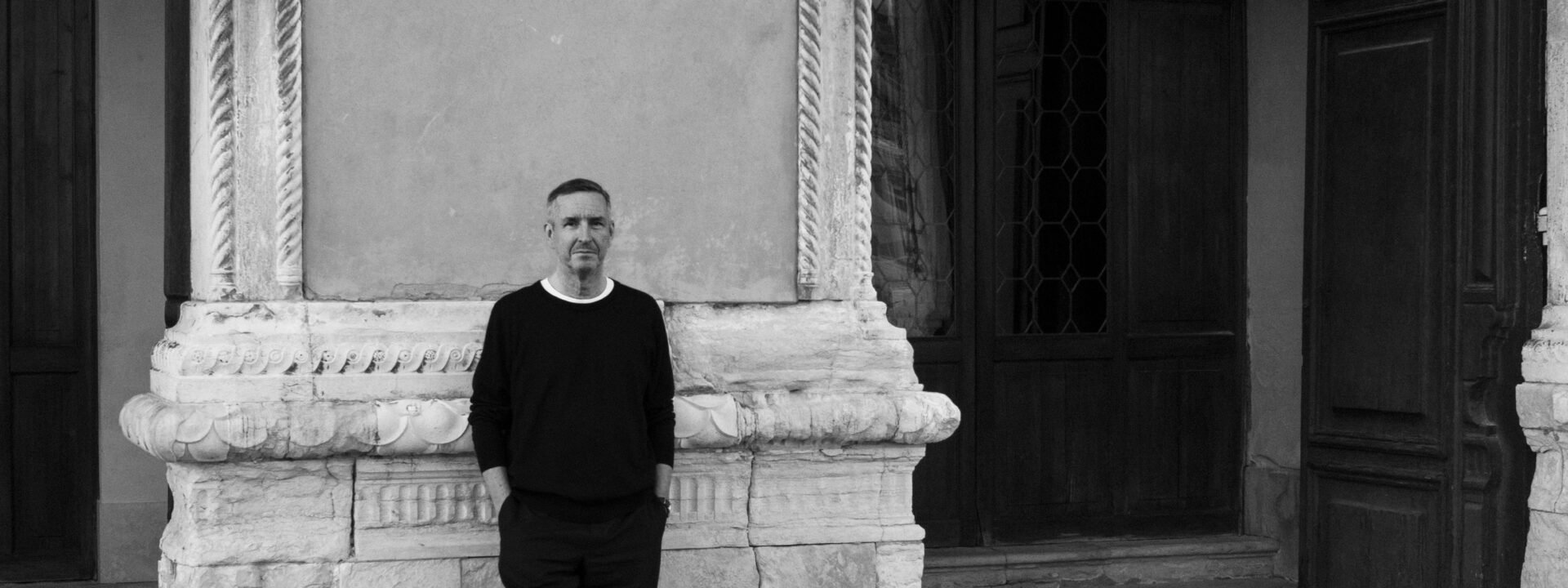
Few designers can claim an office within a 15th-century Venetian palazzo—a Gothic-fronted jewel with Baroque interiors, bifora windows fitted with antique leaded glass overlooking the Grand Canal, and sumptuous Tiepolo frescoes. Once lit by candles for masquerade balls and alive with the rustle of powdered wigs and taffeta panniers, the Rococo salons of Palazzo Pisani Moretta now serve as the stage where Dries Van Noten envisions his next chapter, having stepped down from his namesake brand in June 2024 after a remarkable 38-year career.
In May 2025, Van Noten officially purchased one of the Grand Canal’s most spectacular addresses. A post-fashion life in such a setting feels fitting for a man who, in 2017, was knighted a baron by King Filip of Belgium for his significant contributions to Belgian fashion and culture. Dries, of course, wears the title as lightly as one of his silk jacquards. He has more pressing matters at hand: the creation of the Fondazione Dries Van Noten, his second act conceived with his longtime partner Patrick Vangheluwe. This foundation will transform the palazzo into a cultural hub for creativity and craftsmanship, hosting presentations, collaborations, residencies, satellite projects, and educational programs for students and emerging makers. As a non-profit, self-funded cultural institution, it will open in April 2026 with its first presentation.
I met Van Noten in his office, where the stucco shades of pale pink and powder blue would have felt entirely at home on one of his runways. We spoke about his love for Venice, his devotion to craft, and why nostalgia for the fashion world, however tempting, has been set aside.
So, what drew you to Venice? The city is breathtaking, but not exactly the easiest place to navigate, quite literally. What compelled you, on a personal or cultural level, to dive into this Venetian adventure?
The story actually begins seven or eight years ago. When I was 59, I started thinking about the future—both of my brand and of Patrick and me as a couple. We knew we needed to find someone to take over the brand. Closing it wasn’t really an option; there was too much identity, too many elements that could continue under someone who respected its soul while bringing their own touch. The archive was complete, and our Antwerp team—many of whom had been with us for 20, 25, even 35 years—was deeply connected to the brand. Simply saying, “Sorry, I’m 65, goodbye,” wouldn’t have felt right.
So we decided to step down when I turned 65, partly because, having grown up in fashion—my parents owned stores, and I tagged along on buying trips since I was 12—it felt like fashion had been my life for more than five decades, and I wanted to see what else was out there. Covid delayed our plans by a year, so technically I stepped back at 66, not 65. But last year, we finally said, “Okay, we’re stopping. Time for something else.” We had some ideas.
You certainly don’t lack imagination. What were these ideas?
We’ve always been very fond of Italy. We even have a summer house on the Amalfi Coast. We loved the food, the people, everything. So choosing Italy felt almost inevitable. Then, as often happens, a bit of serendipity took over. A friend once stayed with us in Belgium in the little guesthouse on our property. After a lovely dinner, she mentioned, “I still have an apartment in Venice. Why don’t you come and stay?” From there, through a chain of events involving our friend Robert Carsten, we ended up staying in her apartment in a beautiful palazzo instead of a hotel, and suddenly Venice revealed itself in an entirely different light.
Usually, it’s…Venice is often treated like a weekend zoo visit—you see the surface: the postcards, the gondolas. But staying in an apartment revealed the city beneath the beauty: proud Venetians, bustling markets, fabulous fishmongers and butchers, and a young generation ready to carry it forward. Venice isn’t just a city of nostalgia; there’s energy, schools, students, and grassroots creativity bubbling under the surface. It’s not flashy like New York or London, and it doesn’t shout about being hip. You have to immerse yourself in its life to feel its subtle, layered magic. We were utterly captivated.
Dries Van Noten explains, “What I truly love about a garden is the quiet, the space to walk, the absence of traffic: no cars, no trucks, no traffic lights, no noise. Venice, in a surprising way, offers much the same.”
I know you describe yourself as an addicted gardener, and you have a beautiful garden at your house in Leer. So I have to ask, does Venice compete with your beloved roses?
People often ask if I miss my garden in Leer. They say, “Okay, Venice has lots of canals, but what about your garden?” And of course, I do miss it. But what I truly love about a garden is the quiet, the space to walk, the absence of traffic: no cars, no trucks, no traffic lights, no noise. Venice, in a surprising way, offers much the same. There are no cars here, no traffic to interrupt your day—just water, light, and space to breathe. I like to think of Venice as one great garden, with sun-dappled palazzos, glimmering reflections on the water, and hidden corners to explore.
Sure, I miss knowing exactly when the roses will bloom, and I still visit my garden in Leer. Our beloved dog Scott loves it there. But living in Venice feels complete in its own right. The pace is slower, more deliberate, yet the city is alive—full of exhibitions, concerts, events, and the simple pleasure of dinners at friends’ homes. It’s a perfect balance of serenity and vitality.
And what about the Fondazione? How did the idea come about?
The idea for the Fondazione grew from a simple desire: Patrick and I still wanted to do something meaningful. Life had given us so much, and we had worked like crazy, but through it all, there was one constant, one red thread running through everything we did: craftsmanship.
I’ve always been fascinated by embroidery. I spent a lot of time in India, working with artisans in villages rather than factories, thinking about how to preserve their skills without pushing even more people into already overpopulated cities like Kolkata. The same approach has guided my work in Europe: I’ve worked on hand-painted garments in Como, with small mills in Lyon still weaving on wooden looms from the 1920s, always valuing the human hand, the skill, the subtle imperfections that make each piece unique.
For me, the making itself has always been part of the story: carefully stitched lapels, visible details that celebrate the craft, the time, and the care invested in each garment. Craftsmanship has always been at the foundation of my brand.
Patrick and I often talked about how we might continue exploring this passion in a new way. Venice, with its layers of living craft and the way you see artisanal skills alive in daily life, seemed the perfect place. And so we began to develop the idea of the Fondazione Van Noten: a space to showcase and nurture the art of making in all its forms.
Craftsmanship is sometimes paraded in fashion as if merely mentioning it could save the industry from sameness. For many, it has become a talisman of authenticity and identity. Yet all too often it feels more like a buzzword than a lived practice.
What is craftsmanship, really? Many people like to define it narrowly—glass, ceramics, jewelry, basket weaving—but I see it much more broadly. To me, craftsmanship is anything made with soul, thought, and intention. It could be a chef pouring…Whether it’s a chef putting creativity into a dish, a perfumer composing a fragrance, a tailor sewing a garment, or even a plumber finding inventive solutions—as long as it’s guided by the maker’s own hand and mind, that’s craftsmanship. If someone else dictates every move, it’s something else entirely. That was the starting point for the Fondazione: a space to embrace multiple disciplines and voices. I’ve always loved combining contrasts in fashion—street and couture, ethnic and historical—to create a harmonious whole. It’s the same with a house: I’m just as happy finding a quirky plastic trinket at a local antique market as discovering 18th-century Venetian silver cutlery with a coat of arms. Beauty isn’t dictated by value alone.
We also want to expand beyond the obvious “top of the class” artisans or students. The middle group, the overlooked, the experimental—working with a diverse range of people, ages, and approaches keeps the process adventurous and full of surprises. We have lots of ideas, and I have absolutely no doubt about that. Your exhibition Dries Van Noten: Inspirations, first unveiled at the Musée des Arts Décoratifs in Paris in 2014 and later showcased in Antwerp in 2015, was a masterclass in visual wizardry.
We have plenty of space and, fortunately, plenty of ideas—so why limit ourselves to exhibitions alone? Our first step will be a presentation: a kind of elegant, static showcase where established names mingle with young talent across fashion, painting, music, and the many realms of artistic craft. That’s the way we do it. One role I see for the Fondazione is that of connector. Venice is already rich with organizations devoted to craft—from official bodies to independent groups, from Glass Week to Homo Faber. We have no desire to compete with them; on the contrary, we want to collaborate, weave threads together, and see what new patterns emerge. After all, craftsmanship becomes truly beautiful only when the barriers between art and craft are dismantled—what we call artistic crafts.
In this palazzo, the possibilities are endless. We might invite singers from the conservatory or international voices to perform. We could host a celebrated musician in conversation with young artists. Imagine visitors wandering room to room, each space offering a different voice or instrument, each young performer given ten minutes to reveal their talent. Perhaps one room even hosts a young winemaker from the Veneto, offering a glass before the journey continues. These are the kinds of combinations we envision. We have this palazzo—so let’s use it and share its beauty.
But do you ever find yourself missing the old rush, the creative director’s high-wire act at a thriving fashion brand? Do you miss the house you built? And is there still an umbilical cord tying you to it?
Patrick and I are still responsible for the brand’s beauty and perfume lines, as well as the visual identity of the stores we designed. We’ve been keeping busy: Milan, Brussels, a new space in London, and another in New York. We also continue consulting on the collections. Every now and then we have a meeting with Julian (Klausner), where he shows us what he’s working on and we offer our thoughts. The nice thing about consulting is that he can take our advice… or quite cheerfully ignore it. And surprisingly, I find that wonderfully easy to accept. Honestly, I don’t think he really needs me anymore; his work is already so strong. We collaborated for seven years, after all, so he knows enough. The consultation may not be essential, but if he ever has a question, I’m more than happy to answer.
In the palazzo, the possibilities are endless. And one of the roles I see for the space is to connect and collaborate with the various organizations in Venice.
Tell me—what do you make of fashion at this moment? I’m sure you still follow it in your own way; from where you stand now, how do you see the ind…What has changed in the industry, in your eyes?
You referred to it as “the industry,” and to me, that is exactly where things went wrong. Fashion lost its soul the moment it became an industry. Even as our brand grew, we still viewed it as a different kind of fashion house—one that refused to follow the usual market rhythms. People felt that. Our work didn’t always adhere to commercial logic; it followed what we believed was right. And being based in Belgium gave us a wonderfully healthy distance from the whole fashion circus. We often did things our own way—not out of rebellion, but out of necessity. We simply didn’t have the financial resources to do everything. In the ’90s, for example, we had to choose between fashion shows and advertising campaigns. We couldn’t afford both, so we chose the shows. That limitation became our signature. The runway, visually powerful and distinctive, became the language of the house.
What is your perspective on all the commotion and agitation swirling through fashion today? Do you still find it intriguing, or have you happily stepped away from that merry-go-round?
Of course I still follow fashion. I want to see what Matthew Blazy does, what Pierpaolo Piccioli does—just as I would visit the Guggenheim to see a new exhibition. Fashion is part of our culture, and it has always reflected the state of the world. So if fashion feels chaotic right now, it’s simply mirroring the times, and its transformation into big business reflects that as well. What puzzles me is this endless game of musical chairs among designers. But amid all the agitation, there’s a growing awareness that fashion doesn’t have to be a giant machine. There’s room again for young people, for smaller ideas, for shops and studios on a human scale. Ten years ago, students in Antwerp asked how to become Nicolas Ghesquière’s assistant. Last year they asked how to build a sustainable life making hand-knitted jumpers in Scotland. That shift says everything. Some even dream of becoming dressmakers—running an atelier in the city, with clients arriving with an idea, and together creating something.
So, Dries—do you ever miss being in the thick of the fashion whirlwind?
Not really, no. I don’t miss fashion itself. For me, it has become part of a much larger creative universe. Maybe I was too obsessed with it before; now I see it as one creative language among many. What fascinates me today is how people dress: mixing vintage with high street, basics with a few special treasures, old pieces with new ones. That, to me, is real style. You can sense people shaping their own identities through clothing, rather than obediently following whatever designers dictate. And I love that.
This interview has been edited and condensed for clarity.
Frequently Asked Questions
Of course Here is a list of FAQs about The Dries Van Noten Foundation in Venice designed to be clear concise and in a natural tone
General Information
1 What is The Dries Van Noten Foundation
Its a new cultural foundation in Venice created by the renowned Belgian fashion designer Dries Van Noten Its core mission is to celebrate display and support the art of craftsmanship in all its forms
2 Where exactly is it located
It is located in Venice Italy The foundation is housed in the historic Palazzo Diedo a 15thcentury palace in the Cannaregio district that has been carefully restored for this purpose
3 When will it open
The foundation is scheduled to open to the public in 2025
4 Is this a fashion museum
Not exactly While founded by a fashion designer its focus is much broader It will showcase craftsmanship across many disciplinesincluding but not limited to fashion textiles ceramics glassmaking woodworking and contemporary arthighlighting the skill and artistry behind them
Mission Focus
5 What does craftsmanship in all its forms mean
It means the foundation will look at skilled handmade creation without strict boundaries This includes traditional arts fashion and textile arts modern design and even contemporary art where material skill is central Its about the dialogue between the hand the material and the creative idea
6 What kind of work will be on display
You can expect a mix historical craft objects contemporary design pieces works by artists who employ masterful techniques and likely special commissions The goal is to create conversations between different fields and across time periods
7 Will it only feature established artists and craftspeople
A key part of its mission is support so it will likely also act as a platform for emerging talents artisans and makers helping to preserve endangered skills and foster new ones
Visiting Practical Info
8 Do I need to buy tickets
While final details will be confirmed closer to the opening most foundations of this nature have an admission fee to support their operations Its best to check their official website for ticketing information
9 Will there be rotating exhibitions or a permanent collection
The