Words and images by Nicolás Garrido Huguet
Alquimia Textil is a collaborative project created with fashion researcher and designer María Lucía Muñoz. It documents natural dyeing techniques practiced by the women artisans of Pumaqwasin in Chinchero, Cusco.
The project aims to bring visibility to and help preserve these ancestral dyeing methods, which require hours of meticulous manual labor and often go unnoticed in the wider textile industry. As traditional processes are increasingly replaced by industrial ones, we seek to highlight their value by revealing each step of the dyeing journey. The work also builds a direct connection with the local community and honors the artisanal labor behind these practices.
The photographs feature three natural dyes traditionally used in the region: qolle (Buddleja coriacea), a shrub or small tree whose flowers produce a range of yellows; ch’illka (Baccharis species), whose leaves and stems yield ochre and green hues; and cochineal (Dactylopius coccus), a small insect native to the Andean valleys, from which a wide spectrum of reds—from scarlet to crimson to deep purple—can be extracted.
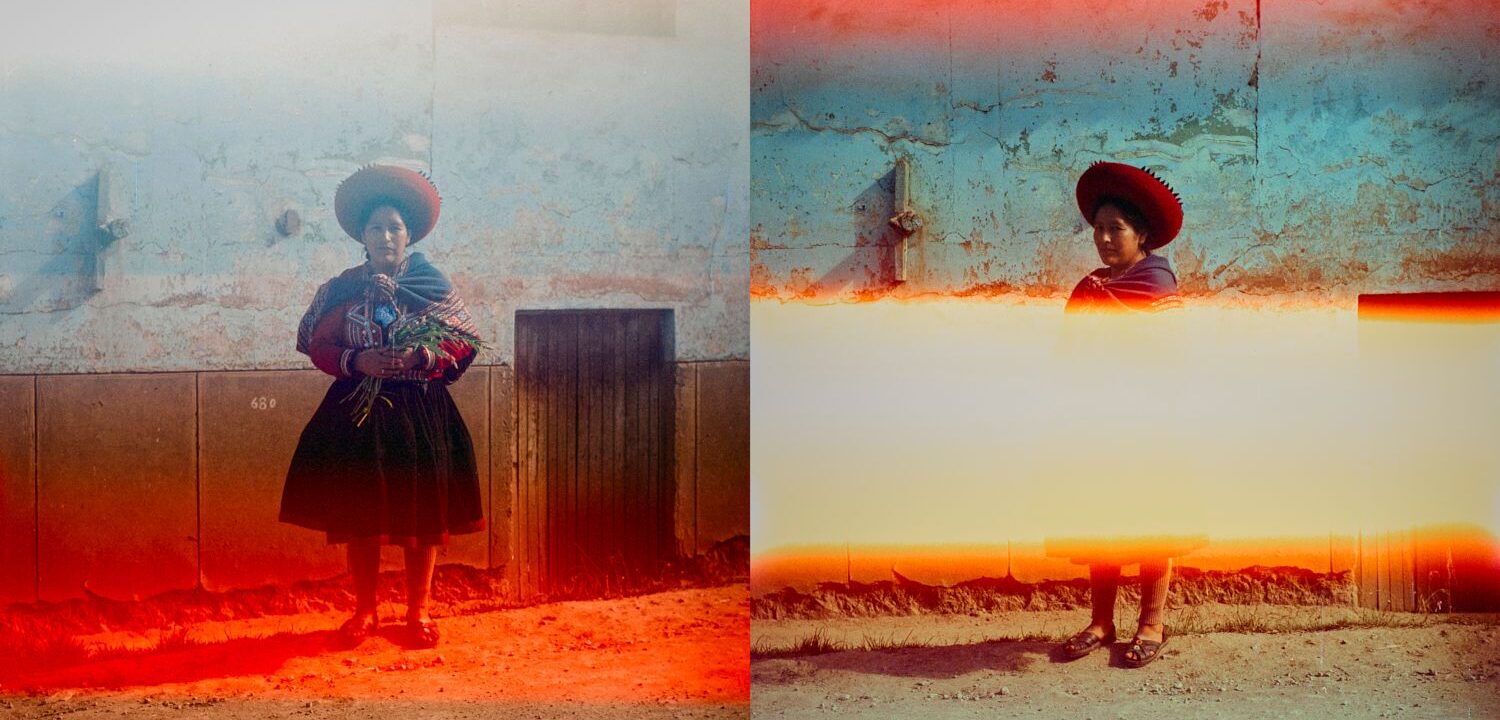
I photographed the entire dyeing process using both digital and analog formats but chose to present only the analog work. This decision came from a desire to align process and meaning: analog photography, like natural dyeing, is slow, hands-on, and grounded in the material world.
Without my knowing, both film cameras I used—one medium format (120 mm) and the other 35 mm, each borrowed from different friends—had light leaks. What first seemed like a technical flaw gradually took on symbolic meaning. These light leaks didn’t weaken the images; instead, they echoed the imperfect, unpredictable nature of traditional dyeing. This project doesn’t try to control every variable as industrial production does, but embraces uncertainty, staying true to the organic, intuitive rhythm of natural dyes. Made over open wood fires in small pots, without precise temperature control, these dyes yield results that are always shifting: colors that don’t bind as expected, fibers that react in surprising ways, and subtle influences from the surrounding environment.
I also used the alternative photographic process of Van Dyke brown printing, applying it to papers and fabrics previously dyed with the natural pigments mentioned above. This technique produces warm, earthy-toned images developed by direct sunlight, further emphasizing nature’s role in shaping the outcome. During developing and drying, residual chemistry from the dyes continues to act on the surface, creating textures and tones that are entirely unique and impossible to replicate.
I see a shared logic between analog photography and natural dyeing—both are slow processes rooted in transformation, guided by time, chemistry, and intuition. Bringing these two crafts together allows not only aesthetic exploration but also becomes a way to honor manual labor as a poetic gesture and a quiet form of resistance to industrial standardization.
This project received first place in the Environment category of the 2025 Sony World Photography Awards.
About the artist
Nicolás Garrido Huguet is a Peruvian photographer born in 1993. His work blends documentary, conceptual, and fashion photography, drawing from each to build narratives that reflect on identity and territory. His main interest lies in exploring humanHe explores identity in all its facets and its relationship with the environment through an intimate and sensitive lens. Working exclusively with analog formats, he values them as a more affective and unstable archive. In recent years, he has incorporated traditional alternative processes like Van Dyke printing and experimented with organic materials, integrating the physicality of the medium into his work. This approach transforms the image from a mere visual record into a physical trace, creating a dialogue with natural processes and turning each photograph into a unique object.
He holds a Bachelor’s degree in Communications from UPC University and completed the Annual Photography Program at Centro de la Imagen in Lima. In 2024, he co-inaugurated Alquimia Textil with María Lucía Muñoz at the Museo Galería del Banco de la Nación in Cusco, a project for which he received the 2025 Sony World Photography Award in the Environment category. His work has been published in the British Journal of Photography, MAPS #7923, and Héroes del Bicentenario by the Peruvian Association of Photojournalists (AFPP). It has also been featured in group exhibitions such as El Momento Indefinido at Galería Fisura and No Future at the Cultural Center of the University of Lima.
Garrido Haguet is currently developing documentary projects focused on Latin American cultural heritage, with a special interest in ancestral crafts and ancient traditions that form part of his country’s intangible heritage, viewed through a contemporary lens. These projects seek to create a dialogue between memory and photographic experimentation.
Frequently Asked Questions
Of course Here is a list of FAQs about Textile Alchemy by Nicolás Garrido Huguet designed to answer questions from curious beginners to experienced practitioners
Beginner Foundational Questions
1 What exactly is Textile Alchemy
Textile Alchemy is an artistic and philosophical practice developed by Nicolás Garrido Huguet It views textiles not just as material but as a medium for transformationcombining techniques like natural dyeing embroidery weaving and mending with personal narrative and symbolic meaning to create deeply meaningful pieces
2 Im a complete beginner with no sewing skills Can I still practice this
Absolutely Textile Alchemy is about the intention and process as much as technical skill Many practices like bundle dyeing with flowers or simple visible mending are accessible starting points The focus is on connecting with the material not perfection
3 What are the main benefits of practicing Textile Alchemy
Practitioners often report benefits like reduced stress and mindfulness a deeper connection to personal history and the environment a sense of creative empowerment and the tangible satisfaction of transforming and preserving textiles
4 What materials do I need to get started
You can start with what you have Basic needs include natural fiber fabrics needles and thread natural dye sources and perhaps some found objects or old clothes you want to transform
Process Technique Questions
5 Whats the difference between regular mending and alchemical mending
Regular mending aims to repair invisibly Alchemical mending treats the repair as a highlightusing contrasting thread decorative stitches or patches that tell a story The flaw becomes a feature and a record of the objects life
6 Can you give a simple example of a Textile Alchemy project
A classic beginner project is creating a memory cloth Take a plain handkerchief or scrap of linen and slowly add to it over time stitch a line with thread dyed with coffee attach a button from an old shirt embroider a symbol that represents a personal moment It becomes a diary in cloth
7 Where do I find natural dyes and are they difficult to use
You can find them in your kitchen and garden Onion skins y