In 1994, a meeting to consider Martin Parr’s membership in the photo agency Magnum quickly became the stuff of modern photographic legend. Philip Jones Griffiths, a veteran of the Vietnam War, was incandescent. “His photographs titillate in some way, but the fact is they are utterly meaningless,” he thundered, further reproaching Parr for “kicking the victims of Tory violence.” After viewing a show of his pictures, Henri Cartier-Bresson, a surviving founder of Magnum at 86, was equally blunt: “I have only one thing to say to you. You are from a completely different planet to me.”
On reflection, after he was accepted by a single vote, Parr took Cartier-Bresson’s words as something of a compliment. Being from a completely different planet had always been his calling card.
Since he first picked up a camera and exposed a few frames—his first photo essay, as a 16-year-old, was four snapshots of Harry Ramsden’s fish and chip shop outside Leeds—Parr scrutinized the world around him with deadpan bemusement, as if planet Earth really were a final frontier, remote and unmapped, and he a latter-day Prospero, inviting us to marvel at its wonders or shrink from its curious improbabilities.
For Magnum, the terrestrial landscape was cratered with war, famine, and catastrophe; for Parr, the front line was a new one, more immediately to hand: “I went out and went round the corner to the local supermarket…” He dared to be dull.
It was probably The Last Resort (1986), his full-throttle color document of the working class caught in the downturn of the Thatcher years, yet finding pleasure where it could—in this case, the litter-strewn, defeated seaside resort of New Brighton, Merseyside—that made his reputation, for better or worse. His detractors flung everything at him: cynicism, fascism, opportunism, voyeurism, snobbishness. But an imperturbable Parr, rarely troubled by self-doubt, was developing a grander vision: “I just like to show the world as it is, with all its foibles and ambiguities.” And not far from the surface—though sometimes you had to scratch hard—was a profound sympathy for the human condition, not so far removed from Cartier-Bresson’s lofty ideals, just expressed differently. In 2013, Martin Parr became president of Magnum.
He had spent half a lifetime as a documentary photographer before making his mark on the fashion world. Why did it take him so long? For a photographer with such a discriminating gaze and a well-honed sense of deconstructive irony, surely this world had offered any number of rites and rituals to pick apart long before now.
From high-concept absurdities to street-level realities and all the fickleness in between, he navigated it with skill. “I love playing the game of fashion photography without knowing what the rules are,” he said. He didn’t shatter the crystal or puncture any egos—a disinclination, perhaps, to bite the hand that fed him, with clients like Gucci, Paul Smith, and Balenciaga—but he was incorruptible nonetheless. I think he grew to like it for all its contradictions; it was self-evidently amusing, and he made new friends along the way. “Everyone wanted to work with Martin. You saw him on mood boards everywhere. And he was fun!” says fashion editor Ursina Gysi. As a quietly spoken, nondescript Englishman—he dressed, as someone once said, like a junior accountant—it was entirely possible for him to be both cynical and affectionate at the same time.
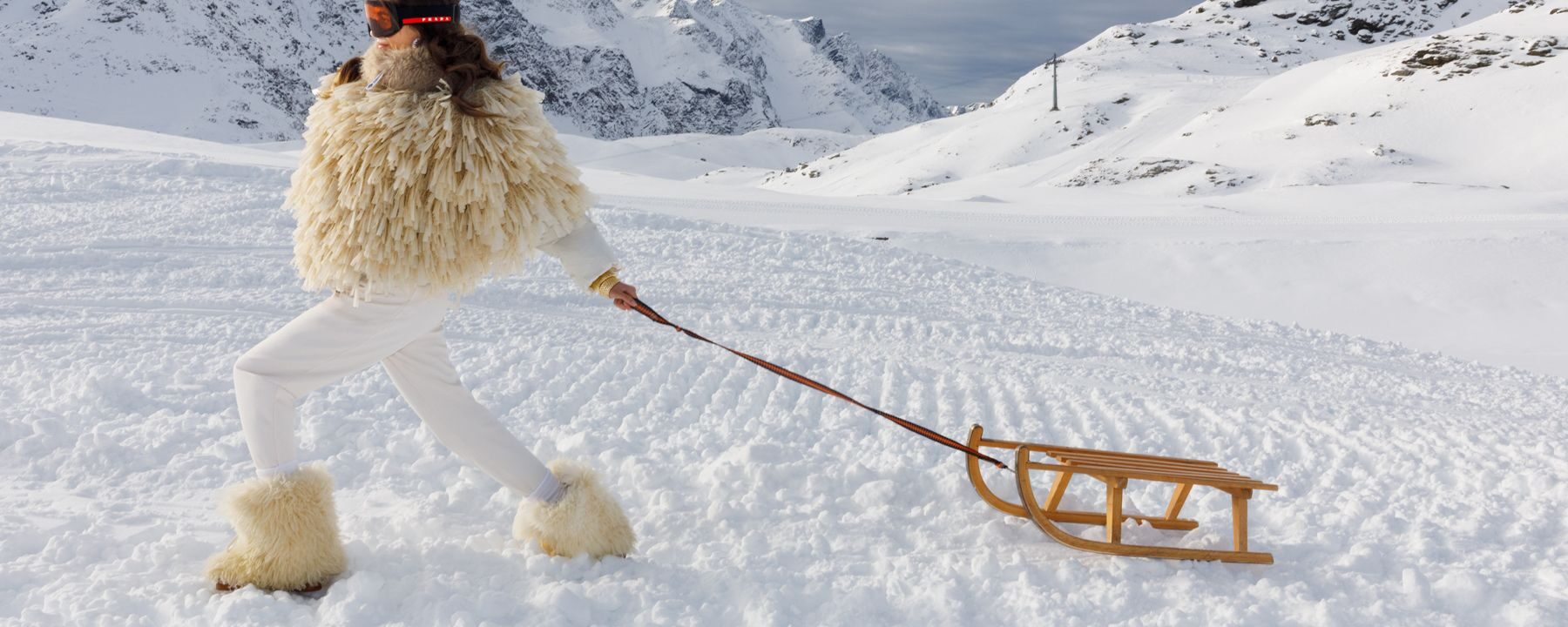
Parr published a memoir last September, written with Wendy Jones. He called it Utterly Lazy and Inattentive: Martin Parr in Words and Pictures, its title taken from a long-ago school report (Surbiton County Grammar; he barely scraped into that, too). He had been working on it for 15 years but sped it up as if he knew there was not much time left. Although he had been ill for a while, Parr’s death in December at 73 was unexpected. The pictures on this page are from his last fashion assignment: a Vogue Italia portfolio.With the Winter Olympics approaching next month across the Alpine regions of Lombardy and northeast Italy, these are quite possibly the last photographs he took, as he died just two days later.
“He knew exactly what he wanted,” says Gysi. “His eye was so sharp. Ten clicks of the shutter and he’d captured it. I was so lucky to work with him. He was so true to himself, so authentic. The still lifes we shot were all his own ideas, carefully planned and wonderfully quirky. He was brave to be up in the mountains. You know, I think he rather enjoyed the chaos that comes with all this…”
Though a relatively recent addition to our world, Martin Parr was also much loved at British Vogue. “His eye was our collective eye,” says model Karen Elson, who worked with him several times. “Where others saw tacky, gaudy, and unpolished, he saw beauty.” In 2020, he created one of the most unexpected cover images—his first and last for British Vogue: a spring lamb standing on a mound of soil beside the A96 outside Aberdeen. Inexplicable, really, yet somehow perfect. So like the man himself.
Photographs: Martin Parr.
Models: Marta Freccia, Cala Moragas, Cheikh Diakhate, Alessio Pozzi.
Styling: Ursina Gysi.
Hair: Paolo Soffiatti.
Make-up: Stephanie Kunz.
Set design: Viola Vitali.
Photo assistant: Nathan Vidler.
Stylist assistant: Camilla Chiarolanza.
Hair assistant: Giacomo Selvaggio.
Make-up assistant: Giulia Sterza.
Set design assistant: Giulia Del Bello.
Production: Squalo Produzioni.
Location: Sunny Valley Kelo Mountain Lodge.
With thanks to Carlota Ruiz de Velasco.
Photo: Martin Parr, © Martin Parr/MAGNUM PHOTOS
Frequently Asked Questions
Of course Here is a list of FAQs about Martin Parrs Vogue shoot in the Italian Alps designed to cover a range of interests
General Beginner Questions
Q Wait Martin Parr shot for Vogue I thought he photographed chips and ice cream
A Yes While famous for his colorful satirical photos of everyday British life Parr was commissioned by Vogue Italia in 2021 for a special project blending his unique eye with high fashion
Q What was the shoot actually about
A Titled The Great Escape it was a fashion spectacle that placed highfashion models and luxurious clothing in the stark snowy landscape of the Italian Alps It contrasted glamour with the mundane realities of a ski holiday
Q Where exactly did it take place
A The shoot was set in and around the resort town of Cervinia Italy in the Alps known for its dramatic mountain scenery
Q Who was featured in the shoot
A It featured top models like Anok Yai and the styling was done by legendary Vogue editorinchief Edward Enninful
Concept Style Questions
Q What was so special about his approach for a fashion shoot
A Parr used his signature style bright flashheavy photography closeups and a focus on awkward candid moments He didnt just show the clothes as beautiful objects he showed them being worn in a real slightly chaotic environment
Q Can you give an example of a Martin Parr moment in the shoot
A Absolutely Instead of a serene model on a peak Parr might photograph her clutching a hot drink with gloves on standing next to a brightly colored ski lift or a pile of slushy snow capturing the unglamorous but real side of being in the cold
Q What was the main concept or contrast he was exploring
A The core concept was the clash between high fashion and mass tourism It questioned the seriousness of fashion by placing it in a playful everyday context
Advanced Critical Questions