A year after the fires that devastated Los Angeles, Vogue Business examines fashion’s recovery and rebuilding efforts as part of our series, Refashioning LA, which looks at where the city’s fashion industry is headed in 2026.
One year ago today, Elyse Walker evacuated three of her Los Angeles stores—two in the Palisades and one in Calabasas. “It’s been our hardest year in business. After Covid, I never thought I’d say that again, but it’s been a really crazy year,” Walker said near the end of 2025. “Pacific Palisades was our baby. That’s where the entire Elyse Walker brand started.”
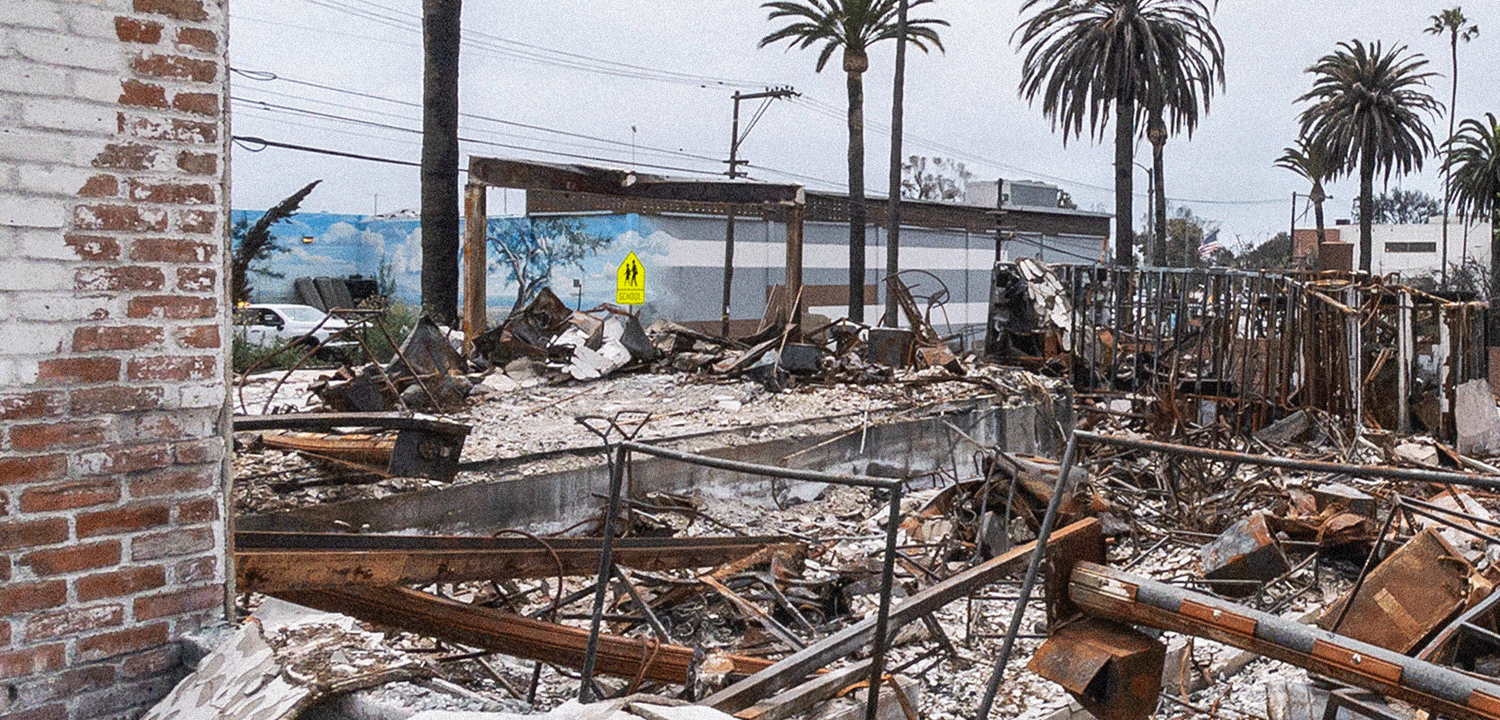
Her store was among 7,000 structures destroyed across Pacific Palisades, Malibu, and Altadena after the Palisades and Eaton fires tore through the Los Angeles hills on January 7, 2025. Driving up the Pacific Coast Highway a year later, the damage is still stark: empty stilts line the beach where houses once stood, many now isolated. In the hills, the land remains barren, though many lots show signs of rebuilding, with construction markers and wooden frames beginning to rise.
“It feels painful. There’s a pain in us from it, and we’ve been devastated by this fire,” says Nina Garduno, founder of the LA brand Free City. “It was as bad as it looked.”
In the weeks after the fires, media coverage was intense but gradually faded as the immediate crisis gave way to a difficult new reality for many Angelenos. While the world moved on, those affected have been working through the aftermath—dealing with insurance, assessing physical and mental health impacts, and now navigating permits to rebuild.
“People pay attention right after. But recovery happens in phases: immediate, intermediate, and long term,” says Kikka Hanazawa, co-founder of the nonprofit Fashion Girls for Humanity. Now, in this intermediate phase, those who lost homes and businesses are preparing to rebuild.
The fashion industry, both in LA and beyond, has stepped up to help. Shortly after the fires, local brands gathered donations for those who lost everything. Then-14-year-old Avery Colvert created the donation site Altadena Girls to support teenage victims of the Eaton fire. In October last year, Vogue World: Hollywood raised $4.5 million for the Entertainment Community Fund to aid members of the LA costume community affected by the fires. That same month, Fashion Girls for Humanity held an online auction to fund rebuilding efforts, offering prizes like tickets to a Thom Browne show and a meeting with Shopbop’s senior fashion director, Caroline Maguire.
“They’re broad, experience-based auctions that we’ve been doing for a while, and they’ve been successful. This time we raised over $100,000,” says Hanazawa, who co-founded the organization in 2011 with Julie Gilhart, Miki Higasa, and Tomoko Ogura in response to the Japanese earthquake and tsunami. Since then, they’ve supported numerous disaster relief efforts. Funds raised for the fire recovery will go as grants to schools in the Palisades and Altadena. “We like tangible results, actually building something,” Hanazawa says. “We try to bridge between emergency needs and long-term recovery.”
Hanazawa, who lives in the Palisades, remembers the day the fires began. “We’re in a wildfire-prone area. Every year we get warnings, and often firefighters manage to control the fires. But January 7 was different.” She was supposed to haveA meeting was scheduled for 11 a.m., but beforehand, I received a photo showing Pacific Coast Highway completely gridlocked. “Within 30 minutes, my street was jammed with cars,” Hanazawa recalls. “I realized this wasn’t a regular wildfire. We needed to evacuate.” She returned home the next day to find her house had survived, though many of her neighbors’ homes did not. “I saw a lot of homes burning with no firefighters or anyone around to stop the spread. I’ve never seen anything like that,” she says.
Walker is now coming to terms with losing her ‘work home,’ even if her actual house was spared. “Losing the original store—the foundation for all our other locations—was unfathomable,” she says. “But when you consider that around 7,000 structures burned, most of them homes, it’s hard to feel sorry for yourself. You didn’t lose your home.”
At the time of the fires, Walker’s two Palisades stores accounted for 45% of sales and 48% of profit. To keep the business going and retain as many staff as possible, she fulfilled about 80% of orders. She expects to end the year with sales down just 16-18% and profits down about 10%. “We were pretty bold, and we were very lucky,” she says.
Returning to normal will take a long time. “Everything was lost overnight—your dentist, restaurants, coffee shops, schools, your friends’ homes. It really tore our community apart,” says Hanazawa. Many neighbors haven’t returned, even those whose homes survived, and some have left the LA area entirely.
This is partly why Elyse Walker is reopening in the Palisades this summer. “Rick Caruso called me and said, ‘Elyse, I know you’re looking for a location in Santa Monica or Brentwood to get your team back to their work home, but I have an idea,'” Walker recalls. He invited her to join his rebuilding efforts. It was the first time she’d cried since the fires. “We built the Palisades for 25 years, and now I know what my next 25 years will be.”
The Aftermath
This time last year, brands were first ensuring the safety of employees and contacts, then dealing with the immediate business impact. While media attention has faded, recovery efforts on the ground continue.
Rebuilding is slow. “There’s a lot of red tape,” says Hanazawa, noting that zoning and policy changes make approvals difficult. The first home in the Palisades was only authorized to rebuild in December, and it had already been under construction before the fires, so some approvals were already in place.
The process is tough on affected communities. A year isn’t long, and the road ahead is lengthy. “Mental health issues are something I’m very concerned about,” Hanazawa says. She isn’t alone in this worry. As physical rebuilding progresses, locals are considering the mental toll the past year has taken.
To address this, Altadena Girls opened a new permanent space in Pasadena’s Old Town neighborhood in October. It supports teens in Altadena who no longer have familiar pre-fire spaces like homes and schools. The space includes a free boutique with dignity-first essentials (like feminine products), a multi-purpose room, and specialized areas such as a music studio and podcast space. “People have told me, ‘Coming here feels so therapeutic. I want to come back tomorrow.’ In such a chaotic time, girls just wanted peace of mind, to have fun, and be with friends,” Colvert told Vogue.The time to reopen is approaching. “After the fires destroyed our community, it’s really important that we have a space where we can just be ourselves, without any pressure to act a certain way,” said one resident.
“People pay attention right after a disaster, but recovery happens in phases: immediate, intermediate, and long-term.”
As brands plan to reopen in 2026, many are still dealing with insurance claims. Most tenants at Palisades Village—which included brands like Bottega Veneta, Saint Laurent, Alo, and Aesop—are focused on cleanup and working with their insurers, according to Corinne Verdery, CEO of Caruso, the real estate company that owns the property. Walker filed quickly with The Hartford insurance company last year. “We were claim number one for the LA fires,” she said, which started on a Tuesday. “We were already looking at new spaces by Friday.”
Since Palisades Village remained standing—thanks in part to owner Rick Caruso’s private fire crews—it’s in a better position than many businesses to begin rebuilding. Verdery notes that 66% of Caruso’s marketplace was undamaged. Many brands are now deciding whether to repair smoke and water damage or undertake more extensive renovations. Caruso is taking a “conservative approach,” gutting most of its owned spaces and redoing common areas down to the soil. “We want everyone to feel safe coming back,” Verdery said.
For Walker, the disaster had some unexpected bright spots. She opened a temporary store in the Hamptons to redirect inventory and employees from the Palisades location. It performed so well that she’s now opening a permanent store in Southampton—its second month was the company’s highest-grossing ever, outperforming larger stores on Madison Avenue and in Newport Beach. She was also pleased that teams from other stores, like Newport Beach, got to learn from the experienced Palisades sales staff.
This experience will shape how Elyse Walker operates going forward. Rather than rotating staff monthly, the company plans to implement a program for employees to swap between stores. “When we get back to normal in the next 12 months, we don’t want to lose what we learned from this rotation and from learning from each other,” Walker said. “Because getting a weekly or monthly recap is different from living it.”
Starting Over
Palisades Village is set to reopen next August. Verdery says Caruso has recently shifted focus. “We’ve turned the corner from recovery and cleanup to excitement about reopening and bringing this community back together,” she explained, adding that the company is treating it as a brand-new project. Walker has been helping Caruso bring back existing brands and attract new ones to the Palisades. She notes that “a couple” of brands with pre-fire leases are still undecided about returning. In December, Erewhon announced on Instagram that it would return to the neighborhood and is beginning its remodel.
Hanazawa is uncertain how quickly foot traffic will recover. “The whole area burned down except for Caruso’s Village. It’s going to take five to seven years at least for the town to recover,” she said. “I hope people will start shopping again, no matter where stores are located, but we need to rebuild homes in the area. Otherwise, foot traffic won’t easily return.”
Construction is underway in the Palisades as of January 2026.
Even once rebuilding begins, it’s not guaranteed that former residents will move back, Hanazawa added. “The reality is, it takes a long time. For many young families with kids, once they settle into a different town, city, and schools—and start making new friends—it’s not easy to return, even if their house is rebuilt,” she said. “So the reality is that the community was lost. Probably many people won’t come back.”
Still, some Palisades residents and businesses remain hopeful.Tenants have already started asking about the reopening date, Verdery says. “Things definitely shifted after the summer of 2025. People whose homes only had smoke or water damage were able to get them cleaned up and move back in, so the momentum changed. The conversation turned to, ‘Can you reopen sooner than next summer?'”
Walker is also confident that LA residents will make the trip as a show of support, whether they live nearby or not. “I truly believe people in LA will come out, drive over the 405—even through some traffic—to support all of us,” she says. Caruso is rolling out incentives to attract visitors, including a new restaurant from chef and Mozza Restaurant Group co-owner Nancy Silverton. “She doesn’t have a restaurant on the Westside yet, so people there are really excited to visit her here—without having to drive across the 405 to her Melrose location,” Verdery adds.
Ultimately, Walker expects people will simply want to see how things are coming along. “If nothing else, people are going to want to go up there and say, ‘What’s going on up here?'”
Smaller independent businesses face a longer road to recovery, having to rebuild from scratch. Still, Garduno remains optimistic. “I have faith the city will bloom again. In Malibu, you could see new shopping areas and developments starting to happen, and then everything just stopped,” she says. “But I think this summer, or maybe next summer, it will come back in a humble but really beautiful way.”
Frequently Asked Questions
FAQs How LA Fashion Is Recovering After the Fires
General Impact Recovery
Q How badly was the LA fashion scene affected by the recent fires
A The impact was significant especially for smaller independent designers and manufacturers Many lost studios inventory equipment and important archives The disruption also affected supply chains and local retail
Q Is the LA fashion industry actually recovering
A Yes but its a gradual process Recovery is being driven by community support fundraising efforts a shift to digital platforms and a strong collective will to rebuild Many brands are coming back though some have permanently closed
Q What are the biggest challenges designers face in rebuilding
A The main hurdles are financial logistical and emotional
Support Community
Q How can I support LA fashion designers right now
A The best ways are to shop directly from their online stores share their work on social media donate to verified relief funds and attend local popups or markets once they resume
Q Were there any relief efforts specifically for the fashion community
A Yes Organizations like the CFDA and local groups set up emergency funds and grants There were also charity auctions and initiatives where bigger brands donated proceeds to help affected designers
Q Did the fires change how LA designers work together
A Many say it strengthened the community Theres been more collaboration resourcesharing and a collective push to advocate for better support systems for independent creatives
Business Creative Shifts
Q Have designers changed their business models because of this
A Many have accelerated existing trends focusing more on directtoconsumer online sales using digital lookbooks and diversifying their production locations to avoid having all their eggs in one basket
Q What about sustainability Did the fires impact that focus
A Ironically the loss has reinforced the importance of sustainable and responsible practices for some Theres a deeper conversation about local resilient production and the environmental factors behind such disasters
Q Are fashion events like LA Fashion Week still happening
A Yes but often in adapted formats Some events have become more digital or have