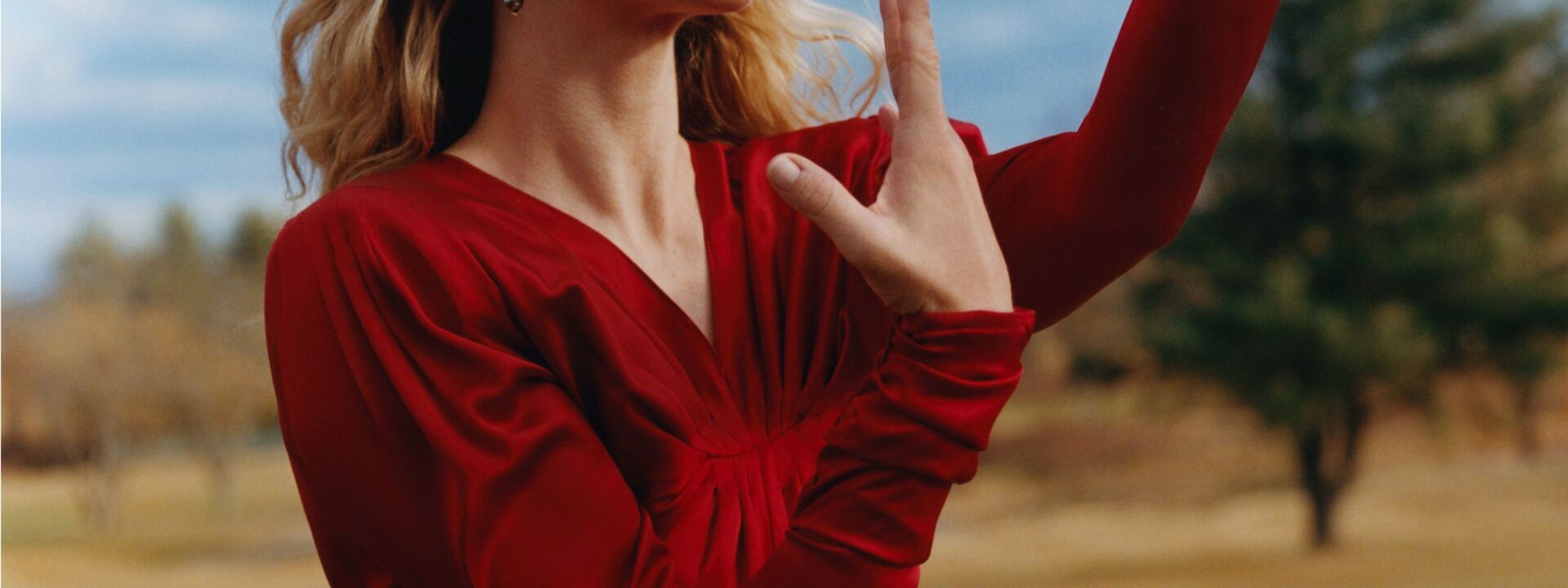
At Amanda Seyfried’s suggestion, we meet in the middle of nowhere—or rather, at a discreet and casually elegant upstate restaurant. Perched on a rise at the heart of the sprawling property, it overlooks a painter’s delight of fields, woods, and distant hills, a mosaic of brown and gold on this cloudy late-fall day. When the actor slips in the door—tiny, barefaced, looking like a teenager in jeans and an oversized button-down, her enormous, intensely green eyes alight in her luminous face behind waves of blond hair still damp from the shower—she greets the staff warmly.
In a few weeks, she’ll turn 40, celebrating with a roller-skating birthday party at the local rink. “I’ve never had a party for myself,” she says excitedly, then adds, “I just tore my meniscus, and I’m not supposed to skate. But there’s other things to do.” She’s eager to share the details: Manhattans will be the signature drink; the DJ will play ’90s and early-2000s pop; there’ll be a caricature artist and a photo booth. Mostly, Seyfried seems thrilled that her sister, Jenni, 43, is coming all the way from California to surprise their mom, who lives with Amanda’s family and works as her nanny. “My mom doesn’t know—it’s so fun—it’s so good…! My mom doesn’t get any surprises.” (A few weeks later, she tells me her sister “came into the house in a cow-head mask—Halloween decorations yet to be put away—and it was so out of context my mom struggled to understand her presence at first. It was really funny.”)
Within our first few minutes together, Seyfried reveals several key things about herself. She’s someone who accentuates the positive (mentioning her torn meniscus only in passing, though it must be both painful and a disappointment for her party plans). She acknowledges she’s “very controlling” (even as she speaks to me, fully engaged and never looking away, she’s simultaneously fixing our wobbly table by slipping little pink Sweet’N Low packets under the offending leg). And she’s grounded, surrounding herself not with glamour but with family and close friends. “It surprises me,” Jenni says, “that she can still access that part of her that wants to do simple, quiet things.”
Seyfried has had a busy year. Her recent roles show she’s evolved into a performer of remarkable range and depth, taking on risky, complex characters—far from her lighthearted turns in Mean Girls (2004) and Mamma Mia! (2008). In 2021, she earned an Oscar nomination for Best Supporting Actress for her role as Marion Davies in Mank. Not long after, her riveting portrayal of Elizabeth Holmes in Hulu’s The Dropout won her an Emmy for Lead Actress in a Limited Series in 2022. Last year brought the release of Long Bright River, an eight-episode Peacock drama in which she plays a Philadelphia cop navigating the opioid crisis.
More recently, there’s The Housemaid, Paul Feig’s blockbuster adaptation of Freida McFadden’s best-selling novel, where she plays Nina, the wealthy, volatile employer of maid Millie (Sydney Sweeney). “Amanda turns a note that could be marginal into something that changes her whole performance,” says Feig, who had long wanted to cast her. “If you push Nina too far, she becomes a cartoon. In any lesser actor’s hands, she could be a sketch—but Amanda turns her into a three-dimensional character.” Indeed, Seyfried’s balance of intensity and subtlety makes Nina strangely familiar, a layered person we in turn envy, fear, hate, pity, and even understand.Eventually, I even came to admire them. “I actually felt bad for Sydney and Brandon [Sklenar],” Seyfried says with a sly smile, referring to her costars, “because I get to play, and they can’t. They couldn’t play. Well, Sydney feasts a little bit at the end. But I feast the whole time.” She describes working on The Housemaid as “like capturing lightning in a bottle,” and says of Feig that “he, like Mona, appreciates and honors the absurdity of humanity.” (A sequel is set to start filming this year.)
And, of course, there is her performance as the title character in Mona Fastvold’s sweeping musical biopic about the 18th-century founder of the Shaker religion, The Testament of Ann Lee. (For both Long Bright River and The Testament of Ann Lee, she earned a Golden Globe nomination for best actress.) The Testament of Ann Lee is a film unlike any other—expansive, ravishing, deeply moving—and Seyfried’s layered, visceral performance is its center. Fastvold, who also directed The World to Come (2020), frequently collaborates with her partner, Brady Corbet, who directed The Brutalist. Together they wrote The Testament of Ann Lee, which resembles The Brutalist in its ambition and scale and is equally gloriously shot. But this film is in every way a deeply feminist—or, as Fastvold says, “feminine”—film, telling the story of an unsung radical female icon in early American history.
A few days before I meet Seyfried, I get together with Fastvold at Rucola in Brooklyn’s Boerum Hill neighborhood—a café where strollers are parked, kids are clambering, and the music is oddly loud. Ethereally beautiful, with platinum hair, Fastvold radiates calm, a complement to Seyfried’s quicksilver curiosity, though both women have about them an inspiring clarity.
Fastvold, who is Norwegian, confesses that she was amazed to discover that Ann Lee, who was born in humble circumstances in 1736 in Manchester, England, before migrating to New York, is largely unknown, even to Americans. “I thought maybe children learn about Ann Lee in school: ‘This is one of our first feminists in America,'” she says. “Then I realized the only thing people knew about the Shakers was cottagecore design.” Fastvold, though, was passionately inspired by Lee’s biography and imagined a film that would dramatize not only her story, but the kinds of convictions that contributed to the founding of this country. “Some stories are telling you they want to be big and expansive and have scope and scale,” Fastvold says, “and Ann Lee definitely wanted a grand story.”
An illiterate laborer and cook, Lee joined the Shaking Quaker sect in 1758. After bearing and losing four children, she spent time in a mental hospital and became a visionary. In 1774, she led a group of her followers from Manchester to New York City. They sailed in a barely seaworthy ship that almost foundered and established their settlement at Niskayuna, in what is now a suburb of Albany, New York, little more than an hour’s drive from Seyfried’s farm. Known to her congregants as “Mother Lee,” alternately nurturing and firmly authoritative, Lee regarded them as her children, continuing to enlarge the community with her brother William’s help until her death in 1784.
Fastvold’s film follows Lee from early childhood in Manchester to Niskayuna and beyond. Beautifully shot in 70 millimeter—one critic has likened its stills to Caravaggio paintings—The Testament of Ann Lee is punctuated by otherworldly singing of original Shaker hymns arranged by Daniel Blumberg, the brilliant composer who scored The Brutalist, and by sensual, eloquent group dances, choreographed by Fastvold’s close friend Celia Rowlson-Hall. Fastvold wanted to convey the visceral details of women’s embodied experience, including sex, birth, and breastfeeding.
For Fastvold, Seyfried was an obvious choice for the role. The two had met socially long before, but first worked together on…Amanda Seyfried and Mona Fastvold worked together on the Apple TV series The Crowded Room (2023), an experience Seyfried describes as “slightly chaotic.” But, she adds, “in the midst of the drama there was Mona—clear and sound—leading with the grace and curiosity of a true artist.” Reflecting on the series, Fastvold says, “I really saw her dramatic range. And, of course, she’s an incredible singer and mover. I saw all the parts come together for her to play this role.”
The Testament of Ann Lee offered Seyfried more creative freedom than she had ever experienced as a performer, and she responded with total devotion. “She just trust-falls into my arms when we’re working together,” Fastvold notes, “and it’s the greatest gift you can get as a director.”
Both Fastvold and Seyfried were dedicated to fostering a unique atmosphere during filming, which primarily took place in Hungary in the summer of 2024, with additional scenes shot in Sweden and at the Hancock Shaker Village in Massachusetts. “We had a very strong idea around how we wanted the set to be,” Fastvold explains. “We needed things to be really warm, creative, nurturing.” That sense of “togetherness” was echoed by Seyfried’s co-star Thomasin McKenzie, who plays one of Ann Lee’s closest companions and serves as the film’s narrator. “Amanda is someone who fosters that feeling of community. She makes you feel like part of something, she really invites you in. There’s no filter to Amanda Seyfried, and that’s beautiful to be around.”
McKenzie observed that this project felt different from others—for one, cast and crew brought their families along. In Seyfried’s case, that included her husband, two children, and their elderly family dog, Finn. The children “had summer camp together with our various different spouses taking turns helping out, doing little field trips with them,” Fastvold recalls.
Seyfried cherishes the memory of the final, challenging weeks of filming, after their families had returned to the U.S. and the women remained to complete their work. “We had to physically hold each other. It related to the actual context, to this woman I was portraying—she lived from a place of nurturing. Mona and I lived together the last two weeks, and we were all just mothers and women and artists, and we missed our families. I’d wake up in the morning and she’d have this candle going—she’s very Scandinavian—and this little JBL speaker, playing really beautiful jazz.” And late at night: “We have a video of Mona singing, humming to herself, and it’s probably 2 a.m. at that point, and she’s undoing my braids….”
Despite her successful career, home life remains a priority for Seyfried. Fastvold remarks, “It matters to her that she chooses projects that she cares about, because what she wants is to be with her family, obviously, to be on her farm.” Seyfried, who considers herself something of a homebody, structures her work to maximize time at home. While filming Long Bright River in New York City over several months, she made sure to preserve time with her children: “It’s the privilege I have at this point in my career,” she explains. “I can say, ‘Listen, I’ll make this work, but… I have to sleep with my kids Friday night, Saturday, Sunday—I have to go to bed with them.’ That’s my only rule. And it does fuel me. I mean, it probably helps them, but it definitely helps me.”
The younger of two daughters raised in Allentown, Pennsylvania, Seyfried began her career in TV commercials at age 10. “Our mom was incredibly supportive,” says her older sister Jenni. “She spent a lot of time taking her to auditions.” Seyfried landed her first speaking role at 15.She first appeared in a recurring role on All My Children, then played Regina George’s sidekick Karen Smith in Mean Girls—the character whose breasts can predict rain. I ask about the challenges of growing up in the unforgiving public eye. “I didn’t get more famous or recognizable in any way until I was 18,” she says. I point out that many might consider 18 pretty young for fame. “But I wasn’t the star,” she replies. “I didn’t become super-famous overnight. I was just somewhat recognizable and appreciated.”
Her peers from that era—Lindsay Lohan, for example—led much more public lives and struggled with issues like addiction, body dysmorphia, and depression. Seyfried, meanwhile, faced a different set of challenges. She tells me she suffers from “really extreme” obsessive-compulsive disorder, which was formally diagnosed when she was 19. “I was living in Marina del Rey at the time, shooting Big Love,” she says—she played a supporting role in the first four seasons—“and my mom had to take a sabbatical from work in Pennsylvania to live with me for a month. I got my brain scans, and that’s when I started medication—which I still take every night.” Her condition meant that while professional rejection didn’t unnerve her (“It’s the nature of the beast”), she couldn’t handle other risks that might unsettle her, like “drinking too much alcohol, or doing any drugs at all, or staying out too late.” She laughs: “I would make plans and then just not go. I guess I did make choices… I didn’t enter that realm of nightclubs. I gotta give credit to my OCD.”
Seyfried has always stayed close to her family—her sister Jenni lived with her in Los Angeles and worked as her assistant. “I never had many famous friends,” she says. She’s close with her longtime makeup artist Stephanie Pasicov and her agent Abby Bluestone, who helped her find her upstate farmhouse 12 years ago. (“I’ve been with her since I was, like, 16, which is, I know, rare—we fight like sisters. She knows more about me than I do.”) Her dearest friends, who will gather for her 40th birthday party, have been in her life for years. And of course her husband, actor Thomas Sadoski, whom she met in 2015 when they starred together in the Off-Broadway production of The Way We Get By, will be with her, along with their eight-year-old daughter and five-year-old son.
When the restaurant owner stops by our table, they catch up like old friends, slipping into a conversation about a cow Seyfried spotted a few days earlier on the edge of the property. The owner expresses surprise—cows aren’t allowed on the lawns. “It was in the tree line,” she clarifies, and then emphatically adds, “There was a cow, and it was brown.” Later, when the server returns with a plate of chocolate chip cookies, Seyfried points out some newly arrived animals apparently grazing in the distance: “I’m sorry, there’s a fucking cow out there,” she says cheerfully. “They’re not made up. You need to tell him.”
Farm animals loom large in Seyfried’s life—arguably, they’re part of her family too. The Seyfried-Sadoski household lives on and runs an animal rescue farm that’s registered as a 501(c)(3) nonprofit. “When I say it’s a rescue, it’s fully a rescue—it’s my dream.” Assisted by one trusted caretaker who lives nearby, they tend to various breeds of chickens. She brings me a gift of six perfect little eggs with cream-colored shells, laid that morning by her Silkies. “People just give us chickens,” she explains, bemused. They have pond ducks and barn ducks (“One of them got eaten the other night—it was probably a fox”); they have goats, mostly donated; they have cats, including a couple recently saved from the ASPCA (“One is so old and decrepit that he just has diarrhea all the time, but he still purrs when he’s petted”).They have their beloved 16-year-old Australian shepherd–border collie mix, Finn, who she describes as “a big guy and brilliant, brilliant, and he still runs like an asshole.” They also have a pony, a donkey, and six horses. She shares their names and origins, noting, “They usually come with problems, or they’re really old, or they’re lame, or whatever.” Seyfried, who rides occasionally but admits she “never will get comfortable on a horse,” prefers simply hugging them while standing on her own feet.
Seyfried and Sadoski’s young daughter and son attend the local village school. “He’s in kindergarten, she’s in third grade, and their classrooms just happened to be next to each other this year…. I want to bottle it up,” she adds, aware of how quickly children grow. When asked if her children understand what she does for work, she hesitates: “My world’s moving so fast, and there’s so many things I have to do each day,” she explains. “There’s no way I can express what I’m doing. I just make very clear every day: ‘I really would rather be home with you.’” At the same time, she wants them to know she loves her work: “I’m having a great time, right? It’s not painful suffering.”
Sadoski is also an acclaimed actor—perhaps best known for his roles in The Newsroom and Life in Pieces—and will be working on a theater production in the spring. She says he “sacrifices a lot for me. He also knows that, in this moment, the opportunities I’m being afforded are insane…,” she trails off. “I do say no a lot,” she assures me.
Seyfried’s current life is rich and full. Last summer she filmed The Life and Deaths of Wilson Shedd, directed by Tim Blake Nelson (“His notes were poetry—me and my fellow actors would be like, ‘Tim, do you have any more notes?’”); she’s producing a documentary she’s passionate about; she’s working on an animated Cinderella for Netflix; and, of course, she’s promoting Ann Lee.
Toward the end of our long lunch, Seyfried, who knows she was “born to sing,” explains the essential importance of her embodied experience in this exhilarating middle of her life. She initially struggled, she says, with the film’s Shaker hymns: “I couldn’t hear it. I couldn’t see it. But at that point I was just like, something needs to change within…. It’s just a new perspective on what this woman is, and why she sings. She doesn’t sing the way I sing; she’s singing to get closer to God…. I had to wrap my head around singing from a place within me that doesn’t care about how it sounds.”
She describes recording one of the songs for the film in London with composer Daniel Blumberg and cellist Okkyung Lee: “She was playing, and he was playing. I just sat there, and I had to sing it. I didn’t have headphones, and I didn’t have a microphone. I couldn’t hear it. When Daniel and I went into the studio booth to hear it back, it sounded so clear. I was singing from my body, not with my ear. What a fucking thrill.” She pauses, then explains: “And that’s my whole perspective in the world now: I’m listening for truth, I’m listening for what’s real. I’m trying to listen in a different way.”
In this story:
Hair by Tamás Tüzes; makeup by Emi Kaneko; manicurist, Gina Edwards; tailor, Olga Kim at Carol Ai Studio Tailors.
To get the cover look, try:
Teint Idôle Ultra Wear foundation, Teint Idôle Ultra Wear concealer, Blush Subtil in 1000 Berry Bisou, Lash Idôle Flutter Extension mascara, Lip Idôle lip liner in 26 Don’t Be Chai, L’Absolu Rouge Drama Ink lipstick in 221 Dramatized Nude. All by Lancôme.
Set Design: Sean Thomson. Spinning wheel, rocking chair, and side chair provided by Shaker Museum, Chatham, New York.
Movement Director: Celia Rowlson-Hall.
Location: INNESS.
Production: [Remaining text appears to be cut off.]Produced by Hen’s Tooth Productions.
Video: Director of Photography, Basil Fauchier; Lighting Director, Liberto Fillo; 1st Assistant Camera, Cindy Chen; Post Production, Chapter Post; Editors, Gennesis Pantaleon and Dester Linares; Color Grading, Dmitry Litvinov; Sound Composition, Henry D’Arthenay.
Frequently Asked Questions
Of course Here is a list of FAQs about Amanda Seyfried discussing her role in The Testament of Ann Lee written in a natural conversational tone
General Beginner Questions
Q Who is Amanda Seyfried and what is she nominated for
A Amanda Seyfried is an acclaimed actress She was nominated for a Golden Globe for her performance in the TV series The Dropout Here shes discussing a different upcoming project
Q What is The Testament of Ann Lee about
A Its an upcoming film where Seyfried plays Ann Lee the 18thcentury founder of the Shakers a Christian sect known for their ecstatic worship celibacy and simple living
Q What does ethereal magic mean in this context
A It refers to the otherworldly spiritual and almost mystical quality that Seyfried and the filmmakers are trying to capture in portraying Ann Lees visions and the Shaker communitys faith
Q Is this movie based on a true story
A Yes Ann Lee was a real historical figure who led the Shaker movement from England to America in the 1770s
About the Role Performance
Q Why did Amanda Seyfried take on this role
A She has expressed a deep fascination with complex spiritual female figures and stories that are often left out of mainstream history She was drawn to Ann Lees intensity and conviction
Q What was the biggest challenge in playing Ann Lee
A According to Seyfried capturing the internal state of a mysticconveying her divine visions and profound faith in a believable grounded waywas a significant acting challenge
Q Did she have to do any special preparation for the role
A Yes She likely studied historical accounts of Ann Lee and the Shakers their worship practices and may have worked with movement and dialect coaches to embody the character authentically
Q How is this role different from her past characters like in Mank or The Dropout
A While those roles were based on real people in the 20th century Ann Lee is a much older more obscure historical figure from a deeply religious context requiring a focus on spiritual rather than corporate or social ambition
About the Film Production