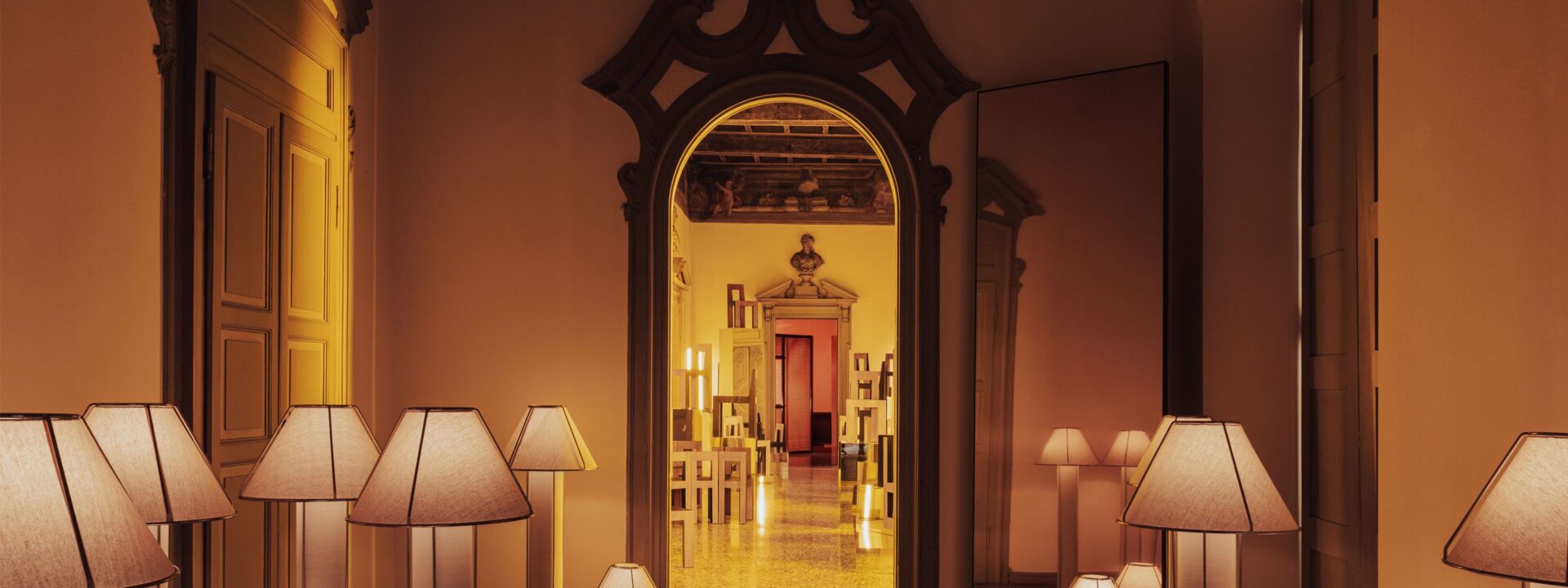
Every April, for one special week, Italy’s financial hub turns into a hotspot for furniture and interior design. If you’re not zipping between the 350-plus Milan Design Week side events on a Vespa, you’re easily walking 20,000 steps a day. Around Milan, the most popular events have lines stretching around the block, and during aperitivo hour, crowds spill out onto the streets.
There’s the official fair and trade show, the interiors-focused Salone del Mobile (or simply Salone), along with satellite events like Alcova, which highlights international and emerging talent. Several neighborhoods—including Brera and Isola—run their own design festivals at the same time, and nearly every shop and gallery puts on a special offer or installation to draw in the crowds of potential buyers.
Fashion hasn’t always had a strong presence here, though. But now, Salone is just as “over-packed” with brand activations as fashion week, says Caroline Issa, a regular attendee and CEO of Tank Magazine. More than 30 fashion brands appeared on this year’s schedule, including Dior, Louis Vuitton, Hermès, Prada, Gucci, and Jil Sander. It makes sense: Salone is a global event that’s only getting more popular, with enough parties to create serious buzz and enough money floating around to make it worth a brand’s time. But standing out in such a packed schedule is no small task, and those who show up have to work hard to justify their presence.
“Sometimes, the fashion activations can feel too gimmicky or overdone, too off-topic, without the credibility to feel genuine,” says Issa. “It seems like some brands are doing something just to have a press release about their participation.”
Aesop staged ‘The Factory of Light’ at Santa Maria Del Carmine.
Photo: Aesop
This year, fashion and automotive brands stepped up their presence even more, with many attendees complaining about the increasingly commercial nature of Salone and the struggle to find truly groundbreaking, underrepresented talent. People at other art fairs report something similar: fashion brands have also been drawn to Art Basel and Frieze lately, seeing the chance to win over high-net-worth individuals. Writer, designer, and Missoni family member Margherita Maccapani Missoni says Salone in its current form has “two layers that are drifting further apart”—the professional furniture world and the “mega-marketing moment” that every brand seems eager to cash in on.
“Salone was originally a fair, and that’s still there. Then, the Fuorisalone [the decentralized side program] started to take shape, as all these creative people from the design world were in town at the same time, so fun parties and gatherings began. The more popular it got, the more fashion started to take part,” Missoni says. “I actually see it as a great opportunity. It also happens at a time of year when fashion is very active, with major collections launching, so I don’t mind the crossover.” (One of the more surprising crossovers this year was a sale of ceramic Bambis hosted by Maccapani Missoni’s mother, Angela Missoni, from her personal collection.)
In such an oversaturated market, what does it take for a fashion brand to succeed at Salone?
Reimagining the classics
There are no set rules for brands showing up at Salone. Jewelry brand Completedworks presented a collection of furniture; newcomer Oxblood, by Off-White alumna Giulia Luchi and tattoo artist Dr. Woo, used the chance to launch its Milan flagship; and Bottega Veneta commissioned an in-store installation by Kwangho Lee, his first using the brand’s signature leather.
While some brands took the opportunity to celebrate contemporary designers, others looked into their own archives, releasing re-editions of house icons. Armani presented the second edition of Armani/Archivo, reproducing 13 historic looks just a few months after its founder’s passing.At Palazzo Fendi, creative director Maria Grazia Chiuri hosted a private event for Very Important Clients (VICs) to celebrate the re-release of 20 classic Baguette bag designs. While anti-fur protesters demonstrated outside, guests were captivated by artisans hand-sewing tens of thousands of tiny beads onto the bags. “Throughout design week, there seemed to be more focus this year on existing, paying customers, rather than general brand awareness and freebies,” says luxury experience strategist Doina Ciobanu, noting the re-editions and capsule collections available for purchase. “VICs were getting that really private, tailored, special experience that members of the press would usually get.” Fendi also announced the winner of the Fendi Design Prize and launched 20 re-editions of its iconic Baguette bag.
Across town, Tod’s reimagined its signature Gommino loafer as a tribute to four iconic Italian furniture designers. One pair featured a graphic black-and-white print with geometric blue and yellow charms on the laces, inspired by the Kristall table designed by Michele De Lucchi for Memphis Milano in 1981. Another pair had melting, cutout smiley faces with red borders, influenced by Gaetano Pesce’s 1998 Crosby chair. “Milan Design Week offers a unique setting where creativity and artisanal excellence can be explored beyond traditional categories,” says Diego Della Valle, chair and CEO of Tod’s, in an interview with Vogue Business. “By reinterpreting the Gommino through the aesthetic codes of Italian design masters, we highlight its timeless style and its ability to constantly reinvent itself.” After Tod’s was involved in the ongoing investigation into Made in Italy supply chains late last year, this was also a chance to reaffirm the brand’s dedication to craftsmanship, he adds. “Live demonstrations of our Tod’s artisans at work reinforce one of our key messages: that true luxury lies in the human touch, in the precision of hand-stitching, and in the passing on of artisanal knowledge.”
Craftsmanship and personalization were also the focus at Range Rover. The automotive leader staged an exhibition called “Traces,” showcasing its bespoke service, which allows clients to design one-of-a-kind cars inspired by cherished memories. For example, one display took cues from the rare freshwater pearls in Scotland’s River Tay, applying a two-tone mother-of-pearl sheen to the hood, decorating the leather seats with custom oyster embroidery, and finishing the Range Rover lettering with 24-karat gold. In a world where luxury prices are rising and ongoing crises make the industry’s existence feel more stark and harder to justify, this was a clear sign that emotion—and the chance to work directly with artisans—are essential to luxury today.
Building out the brand universe
For many luxury fashion brands, Salone is an investment in world-building that goes beyond commercial fashion products.
In the peaceful cloisters of the Chiostri di San Simpliciano, Gucci hung 12 custom tapestries that tell the brand’s history. One showed a young Guccio Gucci in a porter’s uniform, representing the founder’s time working at The Savoy hotel in London. Another featured former creative director Alessandro Michele in shining armor on a horse, with a model carrying his signature severed head behind him. And there was Demna designing from a gaming chair, with the archetypes from his La Famiglia collection.
Several fashion brands put their best literaryI put my best foot forward and won over some of the more intellectual design fans in the room. Jil Sander opened its showroom to the public for Reference Library, an installation created with interiors magazine Apartamento and multidisciplinary agency Studioutte. In the dimly lit space—a former theater where Jil Sander holds its fashion shows—60 silver pedestals were softly lit by small reading lamps. Each pedestal held a book, chosen by someone connected to the brand, along with a short note about what the book meant to them and how it influenced their creative work. Guests were given a pair of clean white gloves before entering, to protect the rare books from sticky hands (temperatures reached 25°C during Salone).
Among the tastemakers involved were filmmaker Sofia Coppola, singer Lykke Li, and art curator Hans Ulrich Obrist. Jil Sander’s creative director, Simone Bellotti, picked a book from his childhood, Il Barone Rampante, which he said “feels almost like a metaphor for creative work in its purest form.” Academy Award-nominated filmmaker Celine Song recommended Perfume by Patrick Süskind, calling it “the book that taught me everything I know about what a character should be and how a story should end.”
Jil Sander displayed 60 books, each recommended by tastemakers connected to the brand.
Photos: Jil Sander
In a similar spirit, the Prada Group brought back its Miu Miu Literary Club, and the Prada Frames symposium returned for a fifth year, this time held at the historic Santa Maria delle Grazie. The talks covered a wide range of high-minded topics, from how knowledge is created to political imagination and the link between images and identity. Tying into the ‘Future of AI’—a series of articles published on Vogue Business last week—I especially enjoyed Professor Wendy Hui Kyong Chun’s thoughts on artificial intelligence. She encouraged the audience to “think historically, not nostalgically” and “technically, not technologically.”
Looking beyond luxury
It wasn’t just luxury brands making their mark on Milan Design Week. H&M Home launched its collaboration with American designer Kelly Wearstler at the 17th-century Baroque palace, Palazzo Acerbi, which had been closed to the public for a long time. This seems to be a key ingredient for drawing the long queues that are now a hallmark of Salone: offering exclusive access to Milan’s hidden gems. “The best part of Salone is usually how private homes and spaces open up for the public to peek inside,” says Tank Magazine’s Issa. “The Borsani Residence opened for Interni Vostra, which was a wonderful surprise.”
The brands that managed to stand out had one thing in common: they created experiences that put design first and the brand second. For example, H&M’s sister brand Arket marked its collaboration with Egyptian artist Laila Gohar by building a fairground carousel, where the traditional horses were replaced with oversized, surreal fruits and vegetables. In the Giardino delle Arti, guests sipped free coffee while spinning on giant figs and eggplants. “The carousel really stood out,” says Missoni. “Activations like this work because they create fun, unexpected experiences.”
Arket teamed up with Egyptian artist Laila Gohar on a fairground carousel, swapping horses for surreal fruits and vegetables.
Photo: Arket
A number of other mid-market brands also staged activations this year. C.P. Company released a limited-edition capsule with Italian kitchenware icon Alessi. Nike hosted “an immersive exploration of the brand’s enduring obsession with Air” at the Dropcity center for Architecture and Design. And fellow sneaker brand Asics SportStyle launched its Gel Kinetic 2.0 shoe during a three-day pop-up at Garage 21, as Anissa Jaffery—who leads PR and brand collaborations for EMEA—told Vogue Business deputy director Elektra K.At The Scoop, Aesop—the luxury skincare brand owned by L’Oréal—offered a welcome break from the sun, welcoming guests into “The Factory of Light” at Santa Maria del Carmine. After a refreshing hand wash and a sample of Aesop’s new hand serum, visitors walked through a light-filled scaffolding structure designed by Australian architect Rodney Eggleston, who has created most of Aesop’s retail stores. The installation reused actual scaffolding covers from the renovation of iconic buildings around the city, with printed copies of the building facades on them. Inside the sacristy, over 10,000 salvaged Aesop fragrance bottles formed a flowing wave of amber glass. On top of this sat the brand’s first venture into lighting design—a table lamp that will be sold online.
Aesop’s first piece of furniture—a table lamp—is shown above on a wave of discarded fragrance bottles.
Photo: Aesop
“In a world full of overstimulation, Aesop spaces have always embraced a softer, more thoughtful approach to lighting. In every store, the lighting is designed to encourage calm, disconnection, and a feeling of refuge and home,” says brand president Garance Delaye. “At Salone, what matters isn’t instant impact, but what stays with you.”
Frequently Asked Questions
Here is a list of FAQs about fashion making its way into Milans famous furniture fair
1 What exactly is the Milan Furniture Fair
Its the worlds biggest and most important trade fair for furniture and design held every year in Milan Italy
2 Why is fashion showing up at a furniture fair
Furniture and fashion are both about lifestyle aesthetics and selfexpression Brands are blurring the lines to create a complete world for customers not just a sofa or a dress
3 Isnt this just a marketing gimmick
Partly but its deeper than that Fashion houses like Versace Fendi and Armani have been making furniture for years Now theyre using the fair to launch new collections and show how their design philosophy translates into home decor
4 Can I buy a dress at the furniture fair
No you wont find racks of clothing Youll find furniture rugs lighting and home accessories designed by fashion brands The fashion is in the design languageprints textures and silhouettesnot the garments
5 What are some examples of fashion brands showing furniture
Versace shows baroqueinspired sofas and chairs
Fendi Casa offers luxury sofas and beds with the same leather and tailoring as their handbags
Dior has created iconic chairs and ottomans
ArmaniCasa sells minimalist elegant homeware
6 How is this different from regular furniture
Its usually more expensive more luxurious and uses highfashion materials The designs also often borrow from a fashion houses signature patterns
7 Who benefits from this trend
Fashion brands get to expand their brand into peoples homes
Furniture buyers get unique highstatus pieces
Interior designers get fresh bold inspiration
The fair gets more media attention and a younger trendier crowd
8 Is this a new thing
Not really Armani started ArmaniCasa in 2000 But its become a