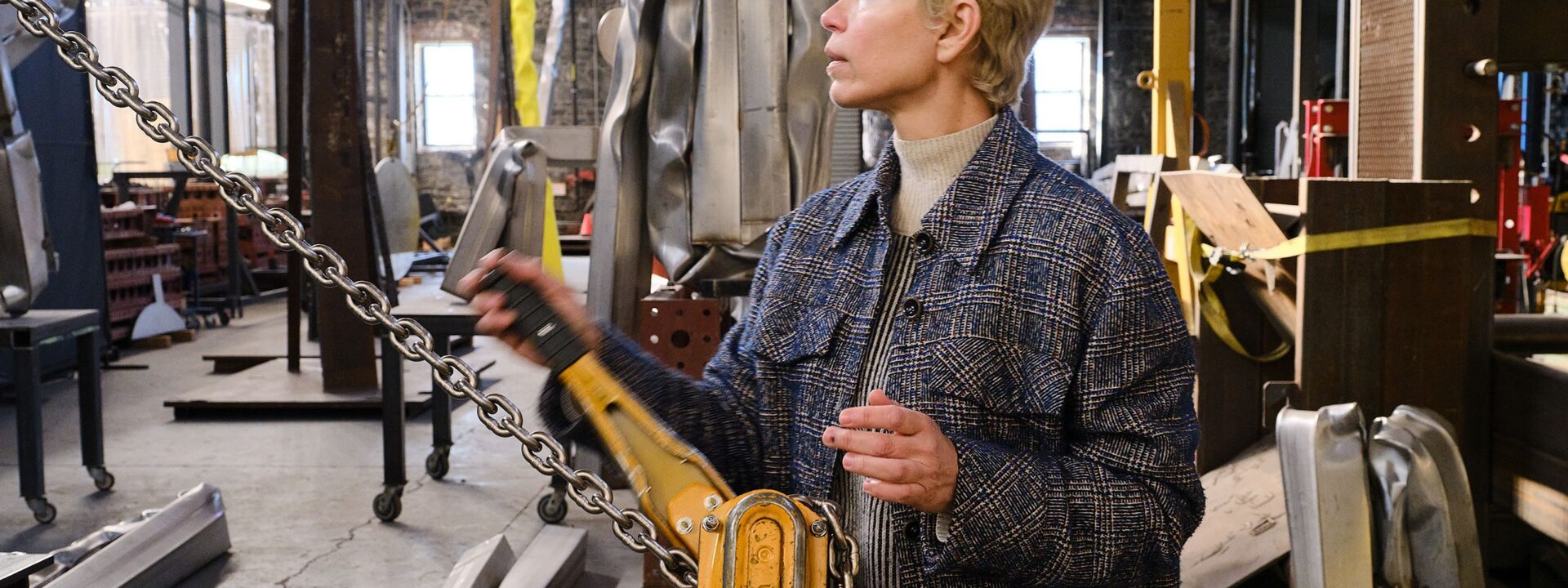
On a gray November day, Carol Bove is in the second-floor office of her Brooklyn studio, showing me a small-scale model of the Guggenheim Museum, where she will have a retrospective this spring. Her improbable steel works defy all expectations of how the material should behave.
“So that’s the High Gallery,” she says. Inside are tiny 3D-printed versions of seven new sculptures she’s making for the show. Even at a 1:12 scale, they carry an air of both delicacy and heft—a contradiction that has become a Bove signature. She turns to look out the window at the shop floor below. “And those,” she says, breaking into a grin, “are the works.” A team of studio assistants pulls the plastic sheeting off two 14-foot-tall assemblages of raw and painted steel.
Bove has worked in this Red Hook studio for a decade but has lived in the neighborhood since 2000—eight years after she first arrived in New York from California, where she grew up. This waterfront enclave is also where she has raised her two children: a daughter, now 19 and attending McGill University, and a son, a high school sophomore.
On the cavernous shop floor, we scoot past forklifts and cranes to reach the base of one of the freshly unveiled sculptures. It is made from a slab of rusty steel rescued from a scrapyard in New Jersey and a crumpled rectangular steel tube painted blush pink. “The collaging of those elements really expresses the depth of the material,” Bove, 54, tells me. “They feel like they’re from completely different worlds.” Such contrast is intentionally disorienting. Using not just steel but a wide array of materials—including driftwood, peacock feathers, and stone—Bove has long placed perception at the heart of her artistic practice: What do we notice, and what do we overlook?
“There is a little bit of this je ne sais quoi to her sculptures, where you just can’t look away but also can’t quite explain them,” says Mary Mitsch, a director at Gagosian, the gallery that has represented Bove since 2023. (Mitsch also worked with Bove at her previous gallery, David Zwirner.) Recently, Gagosian has staged solo shows of her work in Beverly Hills, New York, and Gstaad, Switzerland, and its presentation of her sculptures at the 2024 Frieze London was hailed as a highlight of the fair. Though Bove’s art has appeared in some of the world’s most venerable institutions—including the Museum of Modern Art, the Venice Biennale, and the niches of The Metropolitan Museum of Art—the Guggenheim survey, which will include more than 100 works, will be the first to unite her earlier, quite different pieces with the steel sculptures for which she has become known.
It will also make an argument for her centrality in sculptural history. “Traditionally, steel sculpture was thought of as a very masculine endeavor,” says curator Katherine Brinson, who has been working with Bove on the retrospective for close to a decade. “You think about all those monumental, externally sited sculptors—Richard Serra and so on. And I think Carol is putting a very feminist lens on that tradition.”
Bove does not shy away from the legacies of artists like Serra, John Chamberlain, and Alexander Calder. But her own experience and instincts have carried her into uncharted territory: she is, for example, the first woman to chair the board of SculptureCenter—a position she has held since 2020.
If the macho world of sculpture is where Bove has established herself, it was not an easy path.Sculpture felt like a boys’ club in college, so she didn’t pursue it. Her early work involved found objects and smaller materials she could handle alone. When she began creating larger pieces that required fabrication, she sent her designs to an outside company. After that company closed, she hired some of its former employees to work with her directly. “It was just one step at a time,” she says. Today, she is considered one of the most important American sculptors of her generation. Arlene Shechet, whose 2024 exhibition at Storm King brought a vibrant dose of color and volume to the Hudson Valley sculpture park, acknowledges that engaging with this art historical lineage is challenging. “Both Carol and I are playing with the big boys,” she says.
HANG ON
A work in progress is left to dry after a coat of industrial urethane paint.
Photographed by Nicholas Calcott.
She is warm, quick to laugh, and a deep thinker about many subjects. An early riser who loves lists, she has used the same black Filofax since 1992. “This is everything,” she says, holding the dog-eared planner like a family heirloom.
When we meet, she wears a denim work shirt and light-wash jeans. A streak of electric blue eyeliner across her lower lids is a daily ritual. “I would have to be so sick not to do it,” she tells me. With her short blond hair and hazel-brown eyes, she might be played by Michelle Williams or Carey Mulligan in a film. She has two sweet cats, Torah and Anita, for whom she built a passageway from the shop floor to a storage room through the concrete ceiling—further proof of her “extraordinarily generous” nature, as described by Brinson.
ALL ERAS
Her show at the Guggenheim will be the first to unite her older bodies of work with her large steel sculptures.
Photographed by Nicholas Calcott.
She doesn’t have many hobbies, at least not ones easily separated from her art. “Anything that I get really into ends up being part of my work.” However, discovering audiobooks was a recent revelation. “I kind of didn’t realize how dyslexic I am until now,” she says. She listens during long drives upstate to her studio in the Catskills. Lately, she’s been into Tolstoy, and while doing administrative work, she plays Alice Coltrane.
Born in 1971 in Geneva to American parents, she moved to California as a toddler and eventually settled in Berkeley, her mother’s hometown. “It was the ’70s, and everybody there was experimenting,” she says. At the time, Berkeley had two types of people: politics people and consciousness people. Unsurprisingly, she grew up around the consciousness folks. Early encounters with outsider art in the mudflats of nearby Emeryville, along the San Francisco Bay shoreline, were formative. Art could be weird, and it could be made by anyone.
She attended a co-op school influenced by the Human Potential Movement—think Esalen for kids. “It worked for me,” she says, though she sometimes felt frustrated in art classes. “They would just say, ‘Do whatever you want.’ And as children, we claimed that we wanted more instruction.”
High school was more difficult. Struggling with undiagnosed ADHD, she dropped out after her junior year. She earned her GED and enrolled at the California College of the Arts, but “I wasn’t really together enough to be in school.” After leaving, she worked odd jobs around the Bay Area before moving to New York City in 1992. A few years later, she enrolled at NYU to finish her bachelor’s degree.
MODEL HOME
To prepare for the Guggenheim show, she and her team made multiple scale models of the museum.
Photographed by Nicholas Calcott.
“I applied as a painter, but when I got there, I felt too inhibited. It was too intimate f“I wanted to create things and have an audience for the process,” she explains. She tried photography next, though it wasn’t quite right either—yet developing film taught her about color. “I’d ask, ‘What’s wrong with this print? Is it too green or too cyan?’ The first time I heard that, I wondered, what even is the difference between green and cyan?”
She completed her studies in 1998 and started making art in an unauthorized loft near the Manhattan Bridge, but she felt she was holding back. “I was too afraid to explore what truly mattered to me. I felt some shame, worried that what I really wanted to examine might be inherently uninteresting.” Eventually, she decided, Let’s just try. That’s how her Playboy drawings began.
STEEL LIFE
Bove’s studio is in a building dating to 1859.
Photograph by Nicholas Calcott.
The Playboy drawings—soft, pastel-toned portraits of models like Sharon Tate, reminiscent of Victorian cameos—are seen as Bove’s first mature body of work and will be among the earliest pieces in her Guggenheim show. To create them, she looked at issues from the 1960s and early ’70s; she actually found a stack of the magazines in her parents’ closet, alongside rejection letters her mother received for her poetry submissions. Bove’s return to Playboy wasn’t solely about eroticism; it explored the blend of sex and art, words and images. The drawings helped unravel the contradictory world she was born into. At the time, Playboy published writing by Ursula K. Le Guin, James Baldwin, and Alan Watts, and advocated for progressive causes like birth control access and opposition to the Vietnam War. But what about the nude photographs? Was posing for Playboy empowering or demeaning? The drawings flowed from her, leading to more work. “It’s been really continuous since then,” Bove says. “Everything is connected to that.”
A STRONG VISION
Turning Bove’s “foggy notions” into large steel sculptures requires a big team and a long timeline.
Photograph by Nicholas Calcott.
Soon after, in the early 2000s, Bove gained wider recognition in the art world with her conceptual bookshelf installations. On repurposed Knoll tables and other mid-century modern furniture, she arranged her dreamy Playboy drawings and well-worn paperbacks from the ’60s and ’70s alongside found objects like driftwood and shells. These meticulous tableaus resonated deeply. “Although the show looks casual, even accidental, it is anything but,” wrote New York Times critic Holland Cotter in 2003. “Every inclusion is meaningful, every placement minutely calculated.”
In 2012, Bove appeared to take a sharp turn into outdoor sculpture. Until then, she had followed a conceptualist rule: only use pre-existing items. “At a certain point,” she says, “I wanted to make something with different qualities—something slick, not romantic.” The first “glyph”—her term for large, white powder-coated loop-de-loop steel works—appeared in a manicured garden at Documenta 13 in Kassel, Germany. The next year, in 2013, two more were installed on an unfinished section of Manhattan’s High Line, alongside other sculptures she made from salvaged I-beams, concrete, and brass. “Carol’s project was absolutely my favorite. I’ve been on the High Line for over 14 years, but that project was really special and unique,” says Cecilia Alemani, director and chief curator of High Line Art. The contrast between the wild, self-seeded landscape and these glossy white interventions created an intriguing puzzle. “As people walked through, they would discover these objects almost like relics of a strange civilization,” Alemani says.
Back on the shop floor in Red Hook, Bove points out pieces of steel in various stages of work. Some have just come from the junkyard; others are waiting to be sandblasted.In the hermetically sealed paint room, it’s their turn. A large team—currently about 20 people, the largest her studio ever has—spends a minimum of five months to bring Bove’s large steel sculptures from “foggy notions in my mind” to completion. Nearby, a stack of newly built, stackable benches awaits; she plans to install them in the Guggenheim to offer museumgoers a place to rest.
PILLARS OF THE WORK
Bove’s studio.
Photographed by Nicholas Calcott.
She aims to make the art-viewing experience more comfortable, both physically and psychologically—perhaps a lingering sense of being an outsider inspired this. From that desire came her idea to paint the museum’s spiraling interior ramp wall in a gradient, shifting from inky gray at the bottom to white at the top. “There’s a really anxious moment that I notice, sort of like, ‘How much more is there?’ And I’m hoping this will actually make people feel more psychologically safe because you know where you are,” she says.
“Some of the most memorable exhibitions in the Guggenheim’s rotunda have been what I like to call the keys-to-the-castle mode, where we really allow an artist to take on Frank Lloyd Wright’s amazing architectural masterpiece and infuse it with their own creative language,” says Brinson. She points to Matthew Barney’s “The Cremaster Cycle” in 2003, James Turrell’s light-filled fantasia in 2013, and even Hilma af Klint’s blockbuster 2018 show as examples. Bove is the first artist to gradually lighten the rotunda’s wall color, but it aligns philosophically with the building’s ethos—an “optimistic ziggurat,” as Wright called it.
PRECIOUS METAL
Bove didn’t always work with steel. Her earlier art often featured small found objects like books and driftwood, arranged in careful tableaux. “It was just one step at a time,” she says of her evolution.
Photographed by Nicholas Calcott.
Bove has long been drawn to various spiritual practices, especially Zen Buddhism. The Buddhist concept of “no-self”—the idea that there is no permanent, unchanging version of a person—came up several times in our conversation, mainly to explain the seamless connection between Carol Bove the person and Carol Bove the artist. To illustrate, she walks me over to a piece she made in 2015 titled Legal Status of the Moon, where a peacock feather, a seashell, and other found objects are delicately suspended on a platform. If you remove all the displayed parts, she explains, “it’s just kind of junk. It all has to be put together to make it work.”
Before I leave the studio, I ask Bove about a beautiful little vase on the table between us, holding a Japanese lily. She made it, and others like it, from stainless-steel scraps left over from the High Gallery sculptures. “Making and finding weird vases—I think that’s my chief hobby,” she says, finally naming a pastime for me. They’ll be on display at the museum in March.
Frequently Asked Questions
Frequently Asked Questions About Carol Boves Retrospective
BeginnerLevel Questions
Q Who is Carol Bove
A Carol Bove is a highly influential contemporary artist best known for her sculptural work She creates complex arrangements using materials like steel driftwood peacock feathers and found objects
Q What is a retrospective in art
A A retrospective is a major exhibition that looks back at an artists career showcasing a wide range of their work from different periods to show their development and impact
Q Why is this exhibition a big deal
A This exhibition is significant because it gathers her most important works in one place allowing critics and the public to fully assess her career Its the kind of show that solidifies an artists legacy and establishes her place among the greats
Q Where can I see this retrospective
A Major retrospectives typically travel to leading museums You would need to check the specific exhibitions schedule which might include institutions like the Museum of Modern Art in New York or other major international museums
Q What does her sculpture look like Is it like classical statues
A Not at all Her work is abstract and assemblagebased Think of carefully balanced steel beams polished metal shapes combined with organic materials like shells or books creating a dialogue between the industrial and the poetic
Intermediate Advanced Questions
Q What themes or ideas does Carol Bove explore in her work
A Her work often explores themes of display history and perception She references 1960s and 70s counterculture the aesthetics of modernism and how context changes the meaning of an object Shes interested in the feel or vibe of a specific cultural moment
Q The article says it establishes her among the greats of sculpture Who are these greats and how does she fit in
A The greats refer to seminal sculptors like David Smith Louise Nevelson or Anthony Caro Bove fits in by redefining what sculpture can bemoving beyond monolithic forms to create immersive environmental arrangements that engage with art history architecture and design
Q What is her signature style or technique
A She is known for a style called