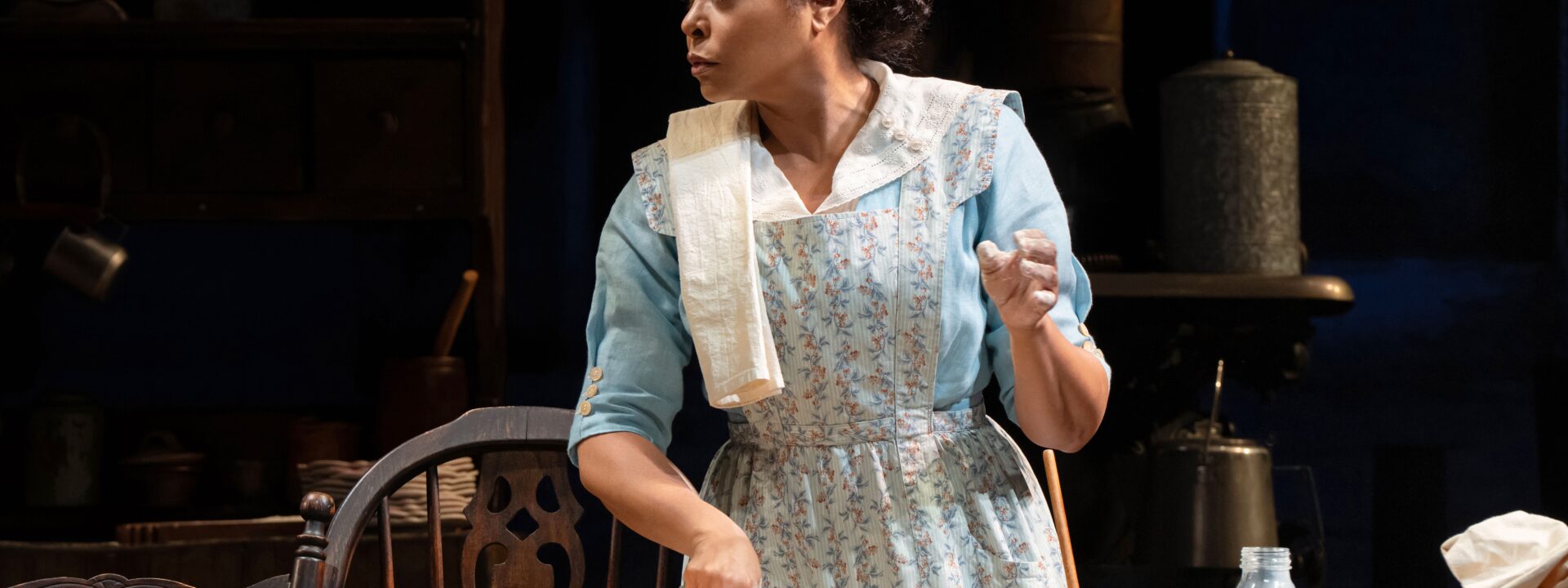
When Taraji P. Henson first walks onstage in the 2026 revival of Joe Turner’s Come and Gone, the audience greets her with long, enthusiastic applause. It’s a moment that moves her every single time.
“It brings me to tears,” Henson says. “It’s so overwhelming because this isn’t a movie theater. Broadway is a destination. It’s not like, ‘Oh, I’ll go to the AMC in Sherman Oaks’ or ‘I’ll meet my friends at the AMC in Beverly Hills.’ You have to come to New York. And people are coming—they’re flying, they’re taking buses, they’re caravanning to see little old me, this girl from southeast D.C. who just had a dream.”
At the Ethel Barrymore Theatre, Henson is making her Broadway debut as Bertha Holly. She runs a cozy Pittsburgh boardinghouse with her husband, Seth (played by Cedric the Entertainer), in 1911, during the Great Migration. There, lost souls like the mysterious Herald Loomis (Joshua Boone) seek shelter and come to terms with their troubled pasts.
Henson describes Bertha as “the glue” of the place. Even though she doesn’t have children of her own, she’s a devoted mother figure to her boarders. She does everything she can to make them feel at home—whether that’s cooking soulful, home-style meals or simply listening without judgment.
“Bertha is the moral compass and the North Star,” Henson says. “She talks about love and laughter during a very dark time. The Great Migration was full of hope, but a lot of people didn’t make it. Coming up north wasn’t easy. People were searching for lost family members, reconnecting with their spirituality and identity, and trying to find some sense of freedom. A lot was going on, but when you come to the Holly house, you’re going to get fed. You’re going to get loved on.”
The role came at just the right time. Debbie Allen, the play’s director, called Henson, “and I said yes right away.” She’d been offered Broadway roles before—like Shug Avery in The Color Purple—but other projects always got in the way. “I was either on Empire or doing a movie,” she explains. “So this time, it was perfect. That’s why I think the play found me. In some way, spiritually, I feel like I was meant to do it.”
In fact, Henson has adapted pretty quickly to the rhythms and demands of live performance. “If you’re emoting on stage or telling a joke, you know right away if the audience feels it. In film, you have to wait until they yell ‘cut,’ so it’s a delayed reaction. And you also have no control. You can put fire in the can, baby, but then they can go into the editing room and chop and screw up your performance. But when I’m on that stage? There’s no editor.”
Henson loves the “adrenaline rush” of performing live, even if it sometimes means making mistakes. During a recent show, she dropped a bag of flour in the middle of a scene. “That’s the thing about theater—you have to keep going,” she says. “I can’t break character. I have to clean it up the way Bertha would. Every day is different, and you’re right there in the moment. You have to stay focused and figure it out.”
Paul Tazewell’s period-specific costumes also help her feel grounded in the play’s world. “He’s as elegant a person as those costumes,” Henson says. “One of my dresses has over 20 snaps on it. There were no zippers back then, so there are no shortcuts. We’re all in corsets. I’m strapped in, which I like because it helps with movement. I have horrible posture, so the first thing the corset does is make me stand up straight. It was amazing working with Paul—what an incredible eye for detail.”
Henson first encountered August Wilson, who died in 2005, when she was aA student at Howard University, she looks back fondly on the time the legendary playwright came to speak to her Acting 101 class. “We were young, aspiring actors at ‘The Mecca,'” she says. “Being around that kind of greatness, something I could actually reach out and touch, made me believe I could really make my dreams come true.”
Years later, in 2013, she stepped into Wilson’s world professionally. She played Molly Cunningham, one of the guests at the boardinghouse, in a radio production of Joe Turner’s Come and Gone for WNYC. The show, which also starred Keith David and S. Epatha Merkerson as Seth and Bertha, was directed by Allen’s sister, Phylicia Rashad. The recording was part of a project to record all ten plays in Wilson’s American Century Cycle, which also includes Ma Rainey’s Black Bottom, The Piano Lesson, and Fences.
If asked, Henson says she would happily reprise her role as Bertha for a film. “I think it’s amazing that Denzel and his production companies are turning these plays into movies,” she says, referring to the series of Wilson adaptations that Denzel Washington has brought to the big screen. “To truly understand August Wilson and what he did for our culture, by capturing this incredible century-long portrait of the Black experience, you need to see it. I can’t wait until they’re all part of cinema history.”
Offstage, Henson prefers to leave behind the intense, “boot camp” energy of her demanding theater schedule. “You really have to rest and take care of yourself,” she says. “Performing eight shows a week, especially those emotional scenes, is exhausting. So when I have free time, I’m at home with my dogs.” She enjoys cooking and recently tried the viral one-pot chicken soup recipe that’s been popular online. But her specialty is collard greens. “If I’m traveling or working on location, the first thing I do when I settle in is make myself a pot of greens.”
Her work outside of acting is also moving forward. Henson’s Moscato brand, Seven Daughters, is an official alcohol partner of the Broadway production, and she’s refining the products in her haircare line, TPH by Taraji, which she has fully owned for a year. “You can still buy the popular products that everyone loves, but I’m reformulating some things. It’s all mine now, so I really get to do what I want with it. I’m so excited.”
Her next film, Why Did I Get Married Again?, in which she stars alongside Jill Scott, Sharon Leal, and Tasha Smith, comes out later this year. “I had a lot of fun with that one because we filmed it in Lake Como. It was very sexy, girl. I love my character, honey. She even wears Schiaparelli.” Another film, ‘Tis So Sweet—Smith’s feature-length directorial debut—has Henson playing Chicago bakery owner Lenore Lindsey.
Henson finds that all of these projects support and strengthen each other. “To headline a Broadway play, the audience has to trust you,” she says. “It’s just like when you buy a movie ticket. These people like the work I do because I make them feel something. They come to my movies, they watch my TV shows, and now they’re coming to see me on stage.”
Joe Turner’s Come and Gone is currently in previews at the Ethel Barrymore Theatre. It opens on April 25.
Frequently Asked Questions
Here is a list of FAQs about Taraji P Hensons next move written in a natural tone with clear answers
BeginnerLevel Questions
1 Is Taraji P Henson retiring from acting
No While she has talked about being tired of the industrys pay gaps and lack of support for mental health she has not announced a retirement She is still open to great roles especially those that challenge her
2 What is her next movie or TV show
She recently starred in The Color Purple and Fight Night The Million Dollar Heist Her next confirmed project is the crime thriller The Black Book and she is attached to star in the film Baby Dont Hurt Me
3 Is she working on a new season of Empire
No The show ended in 2020 and there are no current plans for a revival or spinoff She has said shes moved on from that chapter
4 Does she have any new business ventures coming up
Yes She is expanding her haircare line TPH by Taraji into new products and is actively working on her mental health initiative the Boris Lawrence Henson Foundation with new community programs planned for 2025
5 Is she going to direct a movie
She has expressed interest in directing but as of now she has not officially announced a directorial debut She remains focused on producing projects through her production company TPH Entertainment
AdvancedLevel Questions
6 How is her Boris Lawrence Henson Foundation evolving
The foundation is moving beyond just talk therapy She is launching a new Healing in Color program focused on providing free wellness retreats and traumainformed care for Black women and children in underserved communities
7 What kind of roles is she looking for now
She has stated she wants roles that feed her soul rather than just pay the bills She is specifically looking for complex layered characters that explore motherhood mental health and systemic injusticesimilar to her role in The Color Purple
8 Why did she say she was tired of Hollywood
In a 2023 interview she pointed to the pay disparity between Black actresses and their white counterparts