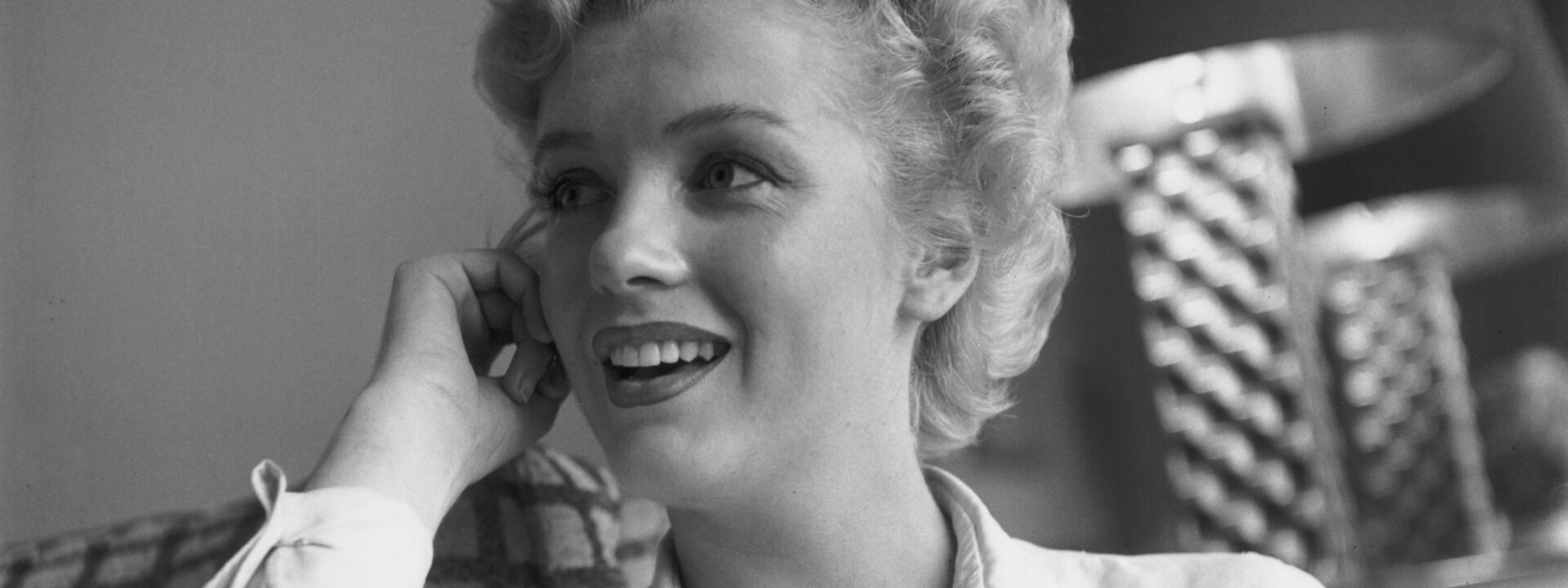
“Norman Mailer’s Marilyn Monroe,” by Jean Stafford, first appeared in the September 1973 issue of Vogue. For more highlights from Vogue’s archives, sign up for our Nostalgia newsletter here.
EDITOR’S NOTE: Norman Mailer—who reads newspapers the way others look in mirrors, just to check he’s still himself—stirred up a wave of publicity with his quasi-biography Marilyn. It’s a big, glossy, heavy book, filled with Mailer’s rushed and overstuffed prose, alongside photos of Marilyn Monroe taken by two dozen photographers—some nearly as famous as she was. The book was published by Grosset & Dunlap, who, like Mailer, faced legal threats from authors and publishers whose work he borrowed from. Star Mailer and Star Monroe seem like a match made in heaven. But since he never met her in this life, Jean Stafford—who did meet Marilyn Monroe and tells us about it—thinks he should have waited until the next one.
One hot July afternoon in the early 1950s, I met Marilyn Monroe in Westport, Connecticut, at a house where I was having lunch. She’d been brought there by her temporary manager, fashion photographer Milton Greene, to learn how to water-ski. Milton was a friend of my host, Joseph Thorndike, whose house was tucked away on Long Island Sound—chosen because it was quiet enough not to draw a crowd. Miss Monroe probably wouldn’t have drawn one anyway, unless the town crier had announced her name. At the time, she looked as ordinary as the crowds sunbathing at nearby Compo Beach. Without makeup, her face was unremarkable. Her hair needed a good comb and brush. She was noticeably plump, and her figure was almost unappealing. She struck me as a Slavic waitress on her day off from a truck-stop diner. She was so quiet and mild that I don’t remember a single word she said—and it’s possible she didn’t say any.
I saw her again ten years later on the set of The Misfits in Nevada. By then, though she was deeply troubled inside, she looked as ethereal as mist, as bright as a shooting star—so thoughtful, so lost, so heartbroken that she could have brought out the mother instinct in a stone. She was complicated, no doubt about that. But whether she was as complicated as Norman Mailer makes her out to be is another question. And it’s even more questionable whether Norman Mailer—our self-proclaimed expert on so many things (did you see the TV cameras pan to him at the Watergate hearings?)—is the right person to write her definitive biography. Or to analyze her as the ultimate symbol of an America that killed John F. Kennedy, Robert Kennedy, and Martin Luther King, and helped Richard Nixon rise to power. Mr. Mailer loves the word “existential” even more than he loves slang for sex. So, since I don’t know what “existential” means (and I’m too set in my ways to find out), I may have read his book on Miss Monroe with an inappropriate sense of fun.
Of Maurice Zolotow’s biography of Marilyn Monroe, Mailer writes: “…his material is reamed [using this word is, if not wrong, at least questionable] with overblown, hollow anecdotes that can’t be trusted just from the way they’re written—a feature writer reheating old stories from other feature writers. So it’s a book with fewer facts than factoids (to join the hungry ranks of those who coin words)—that is, facts that didn’t exist before they appeared in a magazine or newspaper. They’re not so much lies as products meant to stir emotion in the Silent Majority. (It’s possible, for example, that Richard Nixon has spoken only in factoids during his public life.)” I’d hate to have to untangle that prose—it’s about as reliable as a banana peel.
Having joined the hungry (odd choice of word) ranks of those who…Once Mr. Mailer coins a word like “factoid,” he becomes so attached to it that you’d think he hadn’t come up with a new term in ages. “Factoids” and “factoidals” pop up every few pages in what he calls his “Novel Biography.” There are far more of them than anyone needs.
Of course, we know he’s deliberately being annoying to live up to his reputation as America’s most irritating writer. We also know he has a point to make—even if it’s not exactly groundbreaking: that no biography of someone who lived as publicly, yet as secretly, as intricately, and as narrowly as Marilyn Monroe can ever be more than loosely faithful to the truth. It’s hard to tell what he’s really after. He doesn’t seem interested in scraping away the factoids to reveal something valuable. Even though he knows his facts are fake, he still repeats them and examines them with a kind of pompous nosiness, using his own crude language to both treat sex like a sacred ritual and reduce it to a free-for-all. The sacred gets drowned out by the profane.
As a result, Mailer is no better than Zolotow. He serves up a messy mix of other writers’ studies of the elusive Marilyn—whom he never met—and throws in his own ramblings about insanity, Richard Nixon, police (who lie and bully the innocent; they’re pigs), Richard Nixon, narcissism, Richard Nixon, Method Acting, Richard Nixon, astronauts, Richard Nixon, “psychohistory” (my quotes), and Richard Nixon.
Still, the bittersweet story survives all the pompous writing. We read reluctantly, but with amusement, amazement, and sadness. We feast our eyes on the beautiful photos of the baby-doll goddess and remember her endlessly foolish and endlessly sweet little voice. As a comedienne, Marilyn Monroe had us in stitches. In Gentlemen Prefer Blondes as Lorelei Lee, and in Some Like It Hot as Sugar, she brought a wit that was almost wise, and all the more delightful because it came from someone who seemed like the ultimate dumb blonde.
Our secondhand memories of her—a fatherless child with a crazy mother, shuffled between foster homes, raped as a kid, married too young at barely sixteen—made us tear up, but also cheered us. What guts she had to keep going and fight her way (the American way) from the very bottom to the very top! Her second marriage, after a two-year courtship that kept us on edge, was to Joe DiMaggio. It seemed so perfect, like a royal match arranged by ambassadors from the worlds of America’s most popular sports and entertainment. What the subjects of this dazzling monarchy didn’t yet know was that the queen had intellectual ambitions. Years before she met DiMaggio, she had seen Arthur Miller at a Hollywood party and was captivated by the man who created Willy Loman—she, too, was a salesman, and Willy’s story was her own. Later that evening, she breathlessly told Natasha Lytess, her coach and confidante: “You see my toe—this toe? Well, he sat and held my toe, and we just looked into each other’s eyes almost all evening.” She had apparently taken off her glass slipper, and he had taken it with him, planning to see if it fit later, when she would grow tired of DiMaggio’s manly world of sports and gin rummy lived out in stadiums and at Toots Shor’s. After that toe-holding encounter, she and Miller met now and then and kept up a sporadic correspondence. She told him she wanted a hero to worship, and he suggested Abraham Lincoln, writing, “CaCarl Sandburg… has written a magnificent biography. (The late John Berryman once called this book Sandburg’s only work of fiction.)
From the start, her life was a Southern California story: Norma Jean Baker, born out of wedlock, was baptized into the Foursquare Gospel Church. Later, in one of her foster homes, she was introduced to Christian Science. As Mailer puts it: “Her mind—muddy, drifting, fevered, full of disconnected desires and sudden flashes of vision—couldn’t help but respond to the idea that ‘Divine Love always has met and always will meet every human need.’ That offered the hope of a future success measured not by ability, but by need. The more she needed, the more she would get—if only she could trust the voice of her instinct, which was the expression of Mind.”
As the young bride of her first husband, Jim Dougherty, Marilyn was an enthusiastic homemaker. In one of his most vivid metaphors, Mailer writes: “…she throws herself into the role of the loving wife, and works at keeping a spotless apartment much like Joseph Conrad must have once thrown himself into learning English.” But she was a terrible cook. Dougherty remembers meals of nothing but peas and carrots—the colors pleased her. When he went to sea during the war, she briefly worked at a defense plant but soon quit to start her public career, first as a model for cheesecake magazines called Laff, Peek, See, Salute, Sir. She worked hard, and despite flaws in her looks—her blonde hair was almost brown, her nose a bit bulbous, and a slight misalignment marred her mouth—she had such radiant skin and her voluptuous movements promised so much that she quickly caught on and was always in demand. When the war ended, Marilyn left Jim, got an agent, dyed her hair as pale as an angel’s, changed her name, her nose, and her jaw, and signed a contract with Twentieth Century-Fox. But her big success took time. It was three years before The Asphalt Jungle showed she was an actress to be taken seriously, and six before real fame came with Gentlemen Prefer Blondes. The Divine Mind took its sweet time.
Although she was a dedicated worker, Marilyn Monroe was frustrating to those she worked with: she was always late, and she couldn’t remember her lines. Plagued by insecurities, she also suffered from insomnia and turned to drinking and pills. Her skin would grow dull, she would gain weight, she would collapse on set, and filming would have to go on without her until she recovered and came back—but she always did.
During the nine months they were married, DiMaggio tried to pull Marilyn away from the movies. He was a simple, conservative, loving man who wanted a wife, a proper home, and children. But she couldn’t—and wouldn’t—listen. Her ambition for stardom was her guiding star, and she kept her eyes fixed on it without blinking. It was a shame, people said, that she and DiMaggio couldn’t make it work. Still, they were intrigued when she moved from Hollywood to New York and began studying with the famous Method teachers, Lee and Paula Strasberg, hanging out with intellectuals, and reading serious books. They had to give her credit: she was one of a kind when, deeply in love with Arthur Miller, she left Mary Baker Eddy for Judaism and learned to make gefilte fish and chicken soup. After they married and she had a miscarriage, her fans mourned. It’s been said that she had so many lovers and probably so many abortions that she couldn’t have children. It’s interesting to wonder what kind of mother she would have been—sometimes doting, likely, because of her own losses, and other times, for the same reason, indifferent.
Miss Monroe’s attention span wasn’t long. She and Arthur Miller had been married for three and a half years when her sweet eyes fell on…Yves Montand, with whom she made Let’s Make Love. If he responded to her charms at all, it was probably only in a half-hearted way. But from that point on, the Miller household began to fall apart: she was horribly rude to Arthur in public, took more pills, and became suicidal. By the time they started filming The Misfits, which he had written for her, it was clear their relationship had reached its breaking point.
The script for The Misfits was thin, sentimental, and lacked humor. But the cast, directed by John Huston, was impressive—it included Clark Gable, Montgomery Clift, Eli Wallach, and Thelma Ritter. Filming took place in and around Reno during the summer, in temperatures of 100 degrees or more. It’s surprising that Gable’s death was the only one directly blamed on the relentless, shade-less heat. During this time, Marilyn kept everyone waiting for hours while she sat in her air-conditioned trailer or walked through the rattlesnake-infested sagebrush, accompanied by her ever-present coach and chaperone, Paula Strasberg. When I saw them, Strasberg wore a modified brown chiffon wimple and carried a bag that looked as fully equipped as a boxer’s cut-man kit. Things got worse, and work finally came to a halt when Marilyn’s doctor admitted her to a hospital in California. The entire production was suspended for two weeks, and so were the salaries of the crew of over a hundred people.
For the last two years of her life, Marilyn drifted aimlessly between New York and California. In the closets of her New York apartment, her many evening dresses and fur coats hung on wire hangers—a detail of surrender to despair as sad and shabby as any I’ve ever heard. But she wasn’t done with her trials and errors yet: she had an affair with Frank Sinatra and at the same time rekindled her relationship with Joe DiMaggio. Through Peter Lawford and Sinatra, she met the Kennedys, and at a huge birthday party for JFK at Madison Square Garden, she sang “Happy Birthday” to the delight of twenty thousand guests.
Maybe Marilyn had an affair with Bobby Kennedy. Maybe, on the night she died, she was calling his brother, whom she might have liked even more. Maybe she was deliberately killed to prevent a White House scandal. But these are theories too far-fetched and too immoral to entertain for more than a minute or two—except for Norman Mailer, his followers, his greedy publishers, and the undiscriminating judges of the Book-of-the-Month Club. She died, as it seems, the way she appeared to have died: by putting an end to her insomnia, her fears, and her bitter, unforgivable disappointments with a dozen too many pills and a fifth too much vodka.
For all her self-taught, ruthless, self-centered toughness, Marilyn Monroe remained helplessly vulnerable at her core. The brittle outer layers were bound to crumble, leaving the raw orphan exposed—too starved for love ever to be satisfied or ever to give back. She had, and she was, the American dream. And she died stark naked on her bed in crazy Southern California.
Mr. Mailer and his publishers should receive a hundred lashes with a bullwhip and then be put in the stocks for this ghoulish digging up of a wretched, unlucky creature. My friend Ann Honeycutt said to me on the phone the other night, “Wherever that poor woman is, I hope she’s wearing a white dimity dress and has learned to read A Child’s Garden of Verses, and nobody is trying to push Tom Paine on her.”
Frequently Asked Questions
Here is a list of FAQs about Jean Staffords review of Norman Mailers biography of Marilyn Monroe written in a natural conversational tone
BeginnerLevel Questions
1 What is From the archives Jean Stafford reviews Norman Mailers overly sexual biography of Marilyn Monroe
Its a famous scathing book review written in 1973 by novelist Jean Stafford She tore apart Norman Mailers book Marilyn arguing that he focused way too much on Monroes sex life and not enough on her as a real person or an artist
2 Why is this review still talked about today
Because its a perfect example of a critic calling out a male author for exploiting a female subject Its also a masterclass in witty brutal writing People still debate whether Mailers book was art or just sensationalism
3 Who was Jean Stafford
She was a Pulitzer Prizewinning American short story writer and novelist She was known for her sharp elegant prose and her nononsense attitude which she brought to book reviewing
4 What did Stafford think was wrong with Mailers book
Her main complaint was that Mailer turned Monroe into a sex symbol and a psychological case study ignoring her talent hard work and intelligence She felt he was using Monroes tragic life to make himself look like a deep thinker
5 Is this review easy to read
Staffords language is sophisticated but her main point is very clear Even if you dont know every reference youll immediately get her sarcastic angry tone and her core argument
IntermediateLevel Questions
6 What did Stafford say about Mailers writing style in the biography
She famously called it puffy pretentious and often meaningless She mocked his psychoanalyzing of Monroe and said he wrote like he was trying to be a poet but it just came off as ridiculous
7 Did Stafford think Monroe was a victim or did she blame her
Stafford didnt blame Monroe She argued that Mailer and other male writers were the ones victimizing herby reducing her to her body and her daddy issues She saw Monroe as a smart funny woman who was trapped by the sexist culture of Hollywood