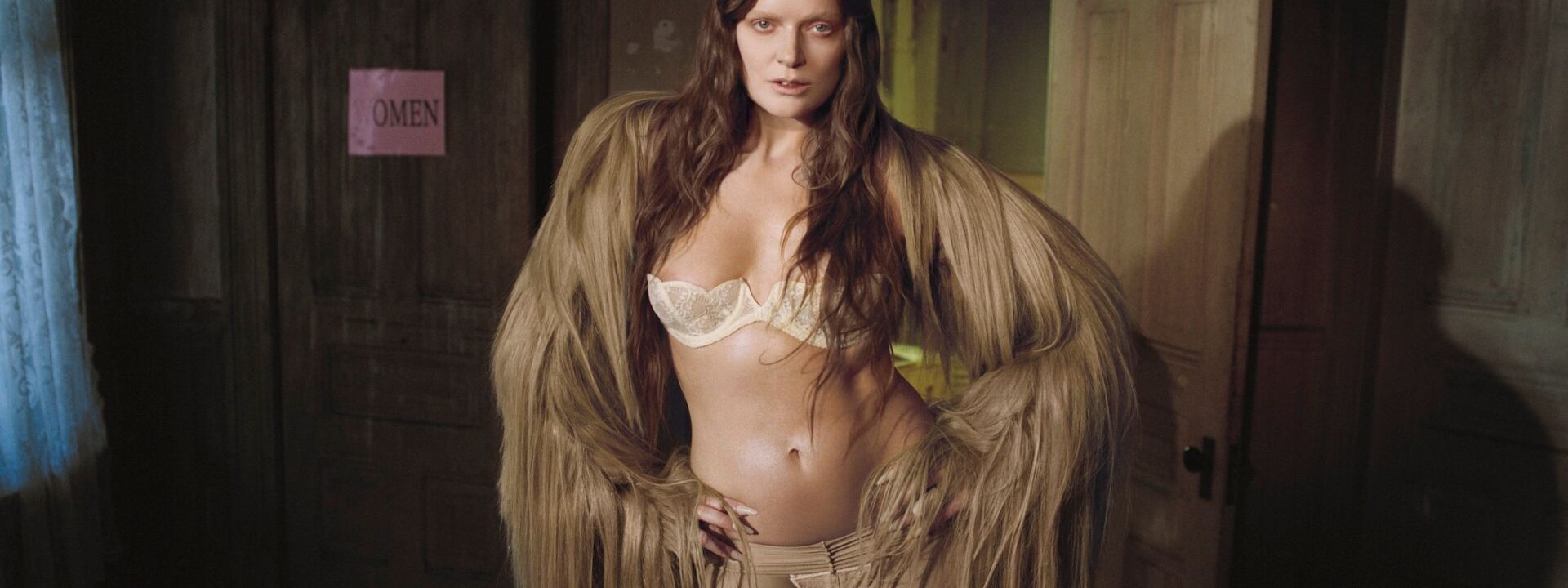
When I speak to Tove Lo, she has just landed in New York. She’s DJing a New York Fashion Week party before heading to Nashville, where she’ll start preparing to get back onstage. Somehow, it’s been almost three years since she finished touring Dirt Femme, and she’s missed it more than she realized. There’s the discipline of it, she says: building a set with her band, training to do something extreme night after night. But there’s also its opposite. “The unleashing you have to do of mind, body, soul, and voice is so powerful,” she tells me. When she finally returned to the rehearsal room, something clicked. “I was like, Oh wow, this is that thing…I need this to feel leveled.”
That tension of discipline and abandon, control and release is the right place to begin with Tove Lo—real name Ebba Tove Elsa Nilsson—who came to pop with her neon-glowing 2014 debut Queen of the Clouds, a heady, radical-feeling soundtrack for feeling both vulnerable and voracious on the dance floor—a genre in itself these days. Her sixth album Estrus, out today, represents a more mature inflection of honesty from the sad-girl-pop pioneer.
The word “estrus” refers to the period when a female mammal is in heat, and the album begins with an even neater mission statement: “I’ve got a lot of feelings but no solutions.” The four years separating Estrus and 2022’s Dirt Femme—her first album released independently—is the longest she’s ever taken between records; she deliberately resisted rolling immediately into the next phase of the album-tour-album cycle. “It was such a magical journey of doing it on my own terms,” she says. “It was a lot of work, but I felt energized by it. I felt like, I’m going to need a second before I even try to recreate whatever this was.”
She returned to the studio with Ludvig Söderberg, her longtime collaborator, at the end of 2024, and for a month, nothing worked. Lo panicked. “We couldn’t get a single song that felt right, and that has never happened to us,” she says. “Did I suddenly have nothing to say?”
The problem, she eventually realized, was that she was trying to write from the outside in: “I wrote from that place of how I wanted to be perceived and not from what I needed.” Söderberg told her to come back when she was ready, “to just be real.”
Six months later, she picked things up again in Sweden, staying at the summer house she has returned to since childhood. “I think I need to be somewhere that is more where I’ve been also not an artist, if that makes sense,” she says. LA is “kooky and dark and weird,” a place where she’s made some of her best, most anthemic music, but every version of herself has existed in Sweden: childhood summers, burnout, falling in love, breakups, grief. “It calms me, but it also brings everything up to the surface at once.”
Lo is now more than a decade into a career that began with the startling candor of mega hit songs like “Habits (Stay High)” and “Talking Body.” “If I had a song take off on that level again, I would actually handle it way better now. I could probably enjoy it way more,” she reflects. She has been famous long enough to have lived through several versions of the pop star people imagine her to be. Yet when she initially tried to account for that history—to ask herself who Tove Lo ought to be at this point—it stopped her writing altogether. “My strength actually lies in writing very unaware of how I’m being perceived,” she says. “I have to return to the girl in the bedroom, to whatever feeling is most urgent, embarrassing or inconvenient, and describe it before she has the chance to sanitize it. A lot of feelings that you’re not supposed to admit to, or aren’t meant to share in the public.”
Age, inevitably, has had a part to play in those feelings. “I’m a grown woman now,” the 38-year-old says, laughing. She’s been married for six years. “I feel like I’ve been told that I’m supposed to have it all together and have the answers and know what to do… and”I’m so not there.”
Photo: Charlie Denis
For Lo, the revelation of Estrus is that the idea of a final, fully integrated adult self is a fiction. “Am I just learning now that no one will ever know everything?” she wonders. Questions and conflicting ideas about her body, identity, and direction run throughout the record. “My body’s like, ‘Maybe one,’ and my mind is like, ‘No,'” she says about having children. The feeling of two characters constantly fighting inside her has been a theme in her therapy for years. “One is messy and impulsive and loves to cross the boundary,” she explains. “The other is Type-A, perfectionistic, and ferociously hard on herself.”
On “If I Could I Would,” she watches these two figures clash and revisits the body-image struggles that defined her teenage years. “When I lean into the messy one, I feel better because she’s not as hard on me and not as mean,” she says. “But I also need the other one to balance me out.”
The song speaks plainly about bulimia and anorexia, directly confronting her long-standing issues with control. “When you’re bulimic, the goal is to be anorexic because all you want is that discipline to not eat and be thin, but you keep losing control and binging. And again, this problem is never about food, it’s always about something else. I wanted to have that word in that song because it’s a powerful word, and it was such a big part of my teenage years.”
“Die for My Art with a Lonely Heart” examines the idea that the work should always come first—a belief that was once unquestionable for Lo. Success has given her the security to question and move past it. “If you don’t want to die alone, you need to take care of the people you love in your life too,” she says. “If I was just doing this isolated, on my own, with no one I could really lean on and no one could lean on me, then I don’t think it would sound very good.”
This is not to suggest Tove Lo has become terribly sensible, though. Estrus is still made for dark, sweaty rooms, with propulsive electro-pop that draws on the Swedish indie and dance music Lo grew up loving (The Knife and Robyn are among its reference points). The album’s only guest is Stromae on the hypnotic “Des Fleurs.” Her relationship to hedonism, however, has changed. In her 20s, partying “could be destructive. I’d feel like shit and think, I need to get fucked up.” She still loves going out, still loves meeting strangers, discovering music, and vanishing into a crowd. “It’s how I decompress. The difference is that I’m better at choosing the moment.”
Lo, in a similar spirit to peers like Charli xcx and personal icons like Lykke Li, approaches the dance floor with both reverence and reflection. “I love the way that dance music builds tension and edges you for a long time before there’s the release with the drop,” she says. Euphoria requires patience, and a trust that if you stay inside a feeling long enough, eventually something will break open.
Those feelings can come thick, fast, and primed for pop bangers. The warmth of marital love and feeling so known by someone can be just as true as something more feral and unknowable. “I like your teeth, could watch you eat for days, a fancy steak, I’ll pay,” she sings on “I’m Your Girl Right?” For one of the album’s most spontaneously written songs, “Cake,” Lo was lying in bed late at night nursing what she calls a “bruised ego.” She wrote the words like a poem, already hearing their phrasing, then brought them to her producer with Viagra Boys and Swedish indie music as reference points. The beat took four minutes. “I just had it all,” she says. “It just came. Sometimes a little bit of anger or jealousy, when it is playful, can be such a good drive.”
“If I stay true to making the music that I know I worked my ass off for and love the albums I’m making, I think I’ll keep feeling the success,” she says. That requires “forever changing.” She all but sinShe builds her main argument around “Source of Life”: “feral fragile numb ecstatic sad euphoric catatonic horny repulsed proud shameful good demonic contradictions.” Tove Lo’s Estrus is out now on Pretty Swede Records.
Frequently Asked Questions
FAQs Tove Lo Queen of the Clouds no answers era
Quick note Theres no Tove Lo album or song officially titled Many Feelings and No Answers The phrase is often used by fans to describe her overall vibe raw emotion heartbreak and unanswered questions in songs like Habits Talking Body and Moments These FAQs assume thats what you mean If you meant something else let me know and Ill adjust
1 What is Tove Lo has many feelings and no answers about
Its a fan phrase describing Tove Los music Her songs are full of intense emotions love heartbreak partying regret but they rarely give neat solutions She captures the feeling without pretending to have the answer
2 Who is Tove Lo
A Swedish singer and songwriter Full name Ebba Tove Elsa Nilsson Born in 1987 in Stockholm Shes known for honest often explicit pop songs about love sex and mental health
3 Is Many Feelings and No Answers an actual album
No Her debut album is Queen of the Clouds Other albums include Lady Wood Blue Lips Sunshine Kitty Dirt Femme and Heathen Chemistry The phrase is fanmade not official
4 What does no answers mean in her music
It means her songs dont tie things up neatly She asks questions like Why do I keep doing this or Will you stay without resolving them Thats the point the feeling matters more than the answer
5 What are her most popular songs
Habits Talking Body Heroes with Alesso Cool Girl Disco Tits Glad Hes Gone and No One Dies from Love
6 Why do people connect with her lyrics
Because theyre brutally honest She sings about messy feelings addiction casual sex jealousy loneliness without judging herself Listeners feel seen instead of preached to