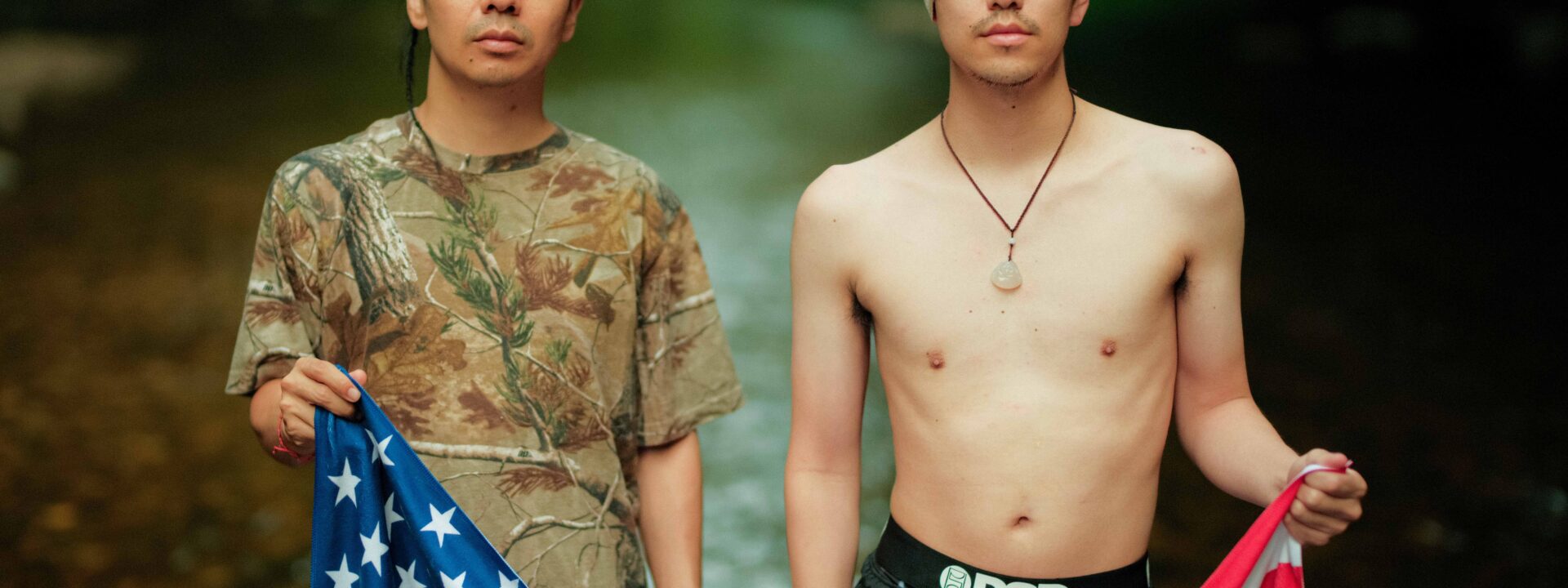
On view at CPW in Kingston, New York, the debut exhibition Sống by award-winning poet and novelist Ocean Vuong is a collection of photographs spanning several years, arriving in the present through portraits of his younger brother. Sống—meaning “to live” in Vietnamese and evoking in English William Blake’s Songs of Innocence and of Experience—narrates care and the struggle to stay afloat amid grief following his mother’s death. Vuong’s personal story intersects with the historical, intergenerational grief of the diaspora that followed the Vietnamese Resistance War Against America.
A practice he has long cherished, photography began as a way to help friends get free skateboards and gear or to earn money at punk concerts. Through his digital camera, it became a way to capture his family in unguarded moments. It is a method of documenting the present that, as he says, remains open to mistakes—generous and inventive precisely because of them.
As an exercise in staying present, confronting vulnerability, and resisting rigid, binary perspectives, Vuong’s photography depicts everyday moments within his immigrant working-class environment. It elevates the mundane into a realm where grief and memory can be faced, and where attention is paid to everything (and everyone) that tends to be forgotten, dismissed, or discarded.
I’d like to start by asking: how did your desire to photograph begin? When you write, you seem to work through images. So when you photograph, is there still a connection to writing, or is the process more immediate, more instinctive?
That’s a lovely question. I think both. Photography is a very descriptive medium. The camera captures, the photograph describes. So there are two different objects at work.
For me, writing is a matter of description. It’s putting objects next to each other so that they resonate. There’s always a connection there. The major difference in composition is that writing is deeply considered, full of doubt and placement. A sentence arrives quite slowly, a bit cooked, a bit considered. Whereas the photograph can be very serendipitous. A lot of luck can happen in photography, and in ways that I think Susan Sontag put best: there’s no luck in writing. No one writes a good sentence by accident. I like that photography is more forgiving of error and imperfection.
Maybe you cannot control photography, or you can control it less. And I see a connection with your work, which reveals a deep vulnerability. Photography has a direct, almost unguarded language. So my second question is: how do you navigate this different form of vulnerability, and does it expose something that writing cannot? Or does it simply reveal it in another way?
I find photography to be more vulnerable because it proves where I stood, what I looked at in time, whereas so much of my writing is from memory. Memory can be very foggy, and there’s a lot of fabrication, openness, and invention in the sentence because you can control what comes in and what stays out.
But with the camera, you can’t always control. You still need the world to be a photographer. You don’t need the present to be a writer, whereas you always need the present to be a photographer. To sit down and dream up a text, you have to go back into your mind or your memory, so you forsake the present.
Speaking of reality in the present, you collaborated with your brother. I wanted to ask: how did this collaboration begin, and what was it like to portray yourself together in front of the camera?
Well, it felt really natural. I’ve always been photographing my family, mostly for my own reference, but also to show them themselves.
Growing up in the ’90s as immigrants, photography was very expensive. You had to buy film and develop it, and for people working in factories and nail salons, it was a tremendous luxury to be photographed. So every photograph was very staged; everyone stood facing the camera…Facing the camera, aware of its presence. Everyone said cheese.
When I got a digital camera, I began photographing my family. It felt like a luxurious act to capture my mother candidly while she worked, or my brother playing in the river. For me, it was a new kind of abundance—being able to take pictures of my family when they weren’t paying attention to the camera. I could capture more honest versions of themselves.
So was that a form of redemption in a way? Or did you simply start because you enjoyed it?
I started because I was a photographer before I was a writer. But I didn’t think of it as art. I didn’t think anything could be art. Growing up, I believed there were very few options for someone from my neighborhood: work in a nail salon, work in a factory, join the army, or enter the Job Corps, a training program for construction or HVAC work. I thought becoming an artist required permission—like being handed a card. I looked in my wallet and I didn’t have that card. I sort of stumbled into the art world and the writing world.
I took photos of my friends’ bands and of them skateboarding—very functional pictures. You’d take them to the local skate shop so your friends could get sponsored, which meant free skateboards and shoes. Then one day, I looked through the photography section at the library and discovered the work of Daido Moriyama, Chris Killip—who photographed punk shows in England in the ’60s and ’70s—and the Italian photographer Luigi Ghirri.
I learned from Ghirri because he focused on subjects that many writers ignore. I never believed there was only one way to tell stories. So a lot of my writing includes dead ends. In my novels, characters do things that don’t add up to anything. They have conversations in parking lots or cars that go nowhere—which is considered a major faux pas in Western storytelling, where everything must add up and be efficient.
But photography taught me that you can take a picture of a mattress in a field, something you’d rarely see in a novel. Photography and its tradition showed me what you can focus on, where you can slow down and describe, while most literary rules would tell you to move on and get to the point. Photography taught me there’s a lot of power in what happens along the way to the main subject.
In your work, both writing and photography, when you portray diaspora, there’s an optimism rooted in compassion. Has photography helped you stay connected to compassion rather than harmful illusions?
There’s no easy answer, because we’re already too late to pick one side of the archive. The photographic archive is already full of images that lead to disillusionment, propaganda, and seduction—especially in advertising, press photography, and state-sponsored narratives. What’s truth? What’s a lie? Historically, photography borrows the feeling of truth and reality to tell lies, to persuade people to do things.
Any art that frames just a small part of the world, like a photograph, leaves the rest out. It’s like using a hole punch to take a tiny piece out of the world. Whenever you do that, you’re working with myth rather than reality.
To me, photography is much closer to poetry. If you look at a poem and ask what it’s about, in a class of thirteen students, each will have a different answer—and all of them are right. No one is wrong. Whenever you take such a small part of the world to represent the whole, you’re dealing with something closer to myth than reality. Photography is no different.
One of my favoriteArtist and filmmaker Trinh T. Minh-ha notes that the camera is a European invention. It’s no coincidence, she suggests, that the continent that launched colonialism also created an object that literally objectifies people. Whenever you work with a camera—whether in film, cinematography, or photography—you are objectifying the world. There’s no pure or innocent way around that. Every photographer has dipped their hands into that power; they’re stained by it. I appreciate that acknowledgment, because in writing—and in academia too—there’s often a fantasy of achieving an absolute ethical position. Academia can be very binary, promoting an ideal of purity through peer review, rigor, repetition, and deep thought. But as Trinh T. Minh-ha says, once you pick up a camera, your hands are already red. So the real question becomes: what do you do with red hands?
—memorial (2023) © Ocean Vuong
So, do you see your photographic work as a way of staying in between, resisting binarism and reduction?
Yes, because any artistic practice involves creating a hierarchy. What I find most valuable about art is that it allows one person to propose a different hierarchy than what the dominant culture upholds. In the same way, photographers like William Eggleston, Luigi Ghirri, or Nan Goldin took pictures of people and subjects that society deemed unworthy of reproduction—and they did it anyway. That act reorients our sense of hierarchy; it offers a different lens through which to see.
I don’t know if it’s redemptive, or if it’s enough. I hesitate to claim that any art form can be “enough” in the face of historic violence. I don’t believe an art practice can fully recoup that violence and loss, but it can resituate the narrative—and that remains vitally important.
—Mom and Nicky (2021) © Ocean Vuong
I’ve noticed that in your work you often photograph photographs. You’ve described your writing as an echo, and said that On Earth We’re Briefly Gorgeous is not a novel but the ghost of a novel. Do you feel your photography might also be a kind of ghost of photography?
Absolutely, 100%. We’re all haunted—America is haunted, history is haunted, our memories are haunted—and a photograph is still an object that can be photographed. Replicating and restructuring it reveals an archive that families, especially immigrant families, salvage and preserve. Sometimes these images are their only tangible link to the past.
In my family’s photographs, there are diaristic notes on the back. My grandmother, the only literate person in our family, would write down strange musings. She’d note what happened that day, or who did what, and sometimes she’d include existential reflections. She used the back of the photograph as a way to tabulate time.
I’ve always found that beautiful. Here was a woman with no formal education, who spent her life working various jobs and living in poverty, yet she had an innate sense for hybrid texts. Nowadays hybrid texts are fashionable, but my grandmother was doing it in the ’80s—writing alongside the image. The idea of keeping a notebook felt too foreign to her, so the photographs became more than just photos; they became objects that carried memory and text. I wanted to document that, too.
—Thuy’s altar (2020) © Ocean Vuong
You live outside the city, saying you chose to be away from a major urban center to experience life and real people more closely and to stay in touch with reality. How does that choice shape your artistic practice today, especially in this tense political moment in the U.S.?
One of America’s most enduring challenges is to truly know itself. The country is so large, and it has a very imbalanced media system where coastal cultural centers control much of the narrative. Living in a city makes practical sense for a writer—there are opportunities and exchanges. But it’s no accident that many New Yorkers say, “I’m not from America, I’m from New York.” There’s truth in that, but also a kind of deprivation. You can end up in a bubble where your values are constantly echoed back to you.
Much of my family…My family still lives here. America loves a good escape story. In movies and books, it’s always about the great getaway—leaving town and reinventing yourself. As an immigrant, I don’t really have that option, nor do I want it, because it’s a fantasy.
I live in this country because my family is here in Connecticut. I came to America with nine refugees, and they still need my support. I can’t abandon them. But I also value being around people who don’t share my values, who disagree with me. That’s part of an artist’s task: to know the unknown.
Sometimes you hire someone to fix your windows and they show up wearing a Trump hat. You have to deal with it, to have a conversation. It brings me closer to the reality of the world. And sometimes you realize you have more in common than just your beliefs. Many people have been drawn into a binary way of thinking, picking left or right, when in fact we have more in common than politicians want us to believe.
Nicky on the Mill River (2024)
© Ocean Vuong
Do you discuss your work with them?
Not really. Most of my family doesn’t know my work. Many are working class. Reading The New Yorker isn’t central to their lives. Reading a book takes eight or ten hours, and most of my family works ten- or twelve-hour shifts. When would they have the time?
I actually like that they don’t care. They haven’t for thirty years, so why would they now? I find that fortunate, because some writers can’t leave their persona at the door—it takes over the household. My family thinks I’m a teacher, which is better. In Vietnamese culture, teachers are noble and respected. But if I said I’m a poet who spends all day looking out a window moving words around, they might think I’m crazy.
Did your photographic work change your relationship with your family? Was it more understandable for them?
They’re excited but still puzzled. They’ll say, “Okay, but why are these on a wall?” As if to say, we have photos—they should be in an album in a closet, to take out once in a while. It’s still strange to them that strangers would go to a museum to look at photographs. But I think that’s good, because it makes me question myself too: why would anyone want to look at this?
Ocean Vuong: Sống is on view at CPW, from January 31 to May 10, 2026.
Frequently Asked Questions
Of course Here is a list of FAQs about Ocean Vuong on memory loss and reclaiming history through photography designed to be clear and conversational
Beginner General Questions
1 Who is Ocean Vuong and why is he connected to these themes
Ocean Vuong is a VietnameseAmerican poet novelist and essayist His work is deeply rooted in exploring memory intergenerational trauma the legacy of the Vietnam War queer identity and the immigrant experience He often uses vivid sensory language that works like a photograph to capture fleeting moments and buried histories
2 How does photography relate to memory and loss in his work
Vuong uses photography as a powerful metaphor Photos represent fragmentspieces of a story that are frozen often incomplete or even missing They symbolize both what we try to hold onto and what has been lost or exists outside the frame
3 Can you give a simple example from his writing
In his novel On Earth Were Briefly Gorgeous the narrator Little Dog describes old family photos He talks about reading the silence in themthe stories his mother and grandmother dont tell about the war The photograph is a starting point for reclaiming the history that isnt visible in the image itself
4 What does reclaiming history mean in this context
It means actively piecing together a personal or family narrative that has been shattered by war displacement or silence For Vuongs characters its not about finding a perfect official history but about using fragmentslike photos memories and storiesto build a version of the past that acknowledges both beauty and trauma
Deeper Analytical Questions
5 Why is the idea of the frame so important
The frame of a photo decides what is included and crucially what is excluded Vuong is interested in what lies outside that frame the untold suffering the queer desires the refugee journey the words left unsaid Reclaiming history involves imagining and giving voice to those missing pieces
6 How does he connect photography to the body and trauma
He often describes memories and trauma as being developed in the body like a photograph in a darkroom The body itself becomes an archive Sc