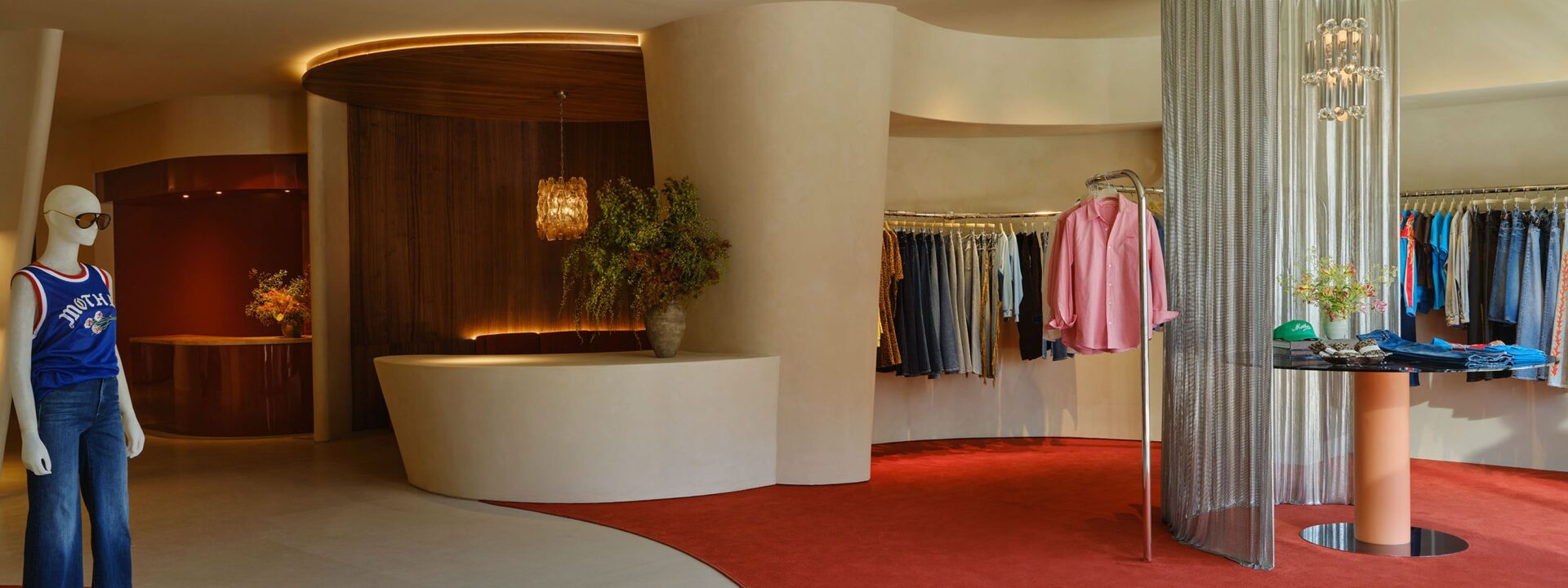
The first thing you notice at Mother’s flagship store in Beverly Hills isn’t the denim—it’s the curves. The walls bend like Richard Serra sculptures. A sunken conversation pit anchors the floor. Boudoir-style mirrored fitting rooms, inspired by Halston’s famous atelier, are designed to show off your backside from every angle. For a Los Angeles brand built on obsessing over how jeans flatter the body, the architecture feels almost autobiographical.
Photo: Courtesy of Mother
The humor at the heart of this contemporary brand is also front and center. At the entrance, a glass display case holds a “Cabinet of Curiosities” that will change monthly alongside Mother’s cleverly named collections. The opening installation features vintage telephones titled “Call Mother,” described as “found telephones, synthetic lace, existential dread and approximately 41 missed calls.”
“It started with the idea of a 1970s house with a conversation pit and everything curved around it,” says co-founder and creative director Tim Kaeding during a tour of the Canon Drive store. “We wanted the store to feel like an adventure. The best stores are the ones where you wander a little. You turn a corner and find something you weren’t expecting, then another corner and there’s something else. The layout follows one continuous path inspired by a sublime spiral,” he says, sounding a bit California mystical—which is part of Mother’s branding and will show up in store programming like birth chart and tarot card readings, alongside crystal displays and tequila tastings.
Mother founders, Tim Kaeding (left) and Lela Becker (right).
Photo: Courtesy of Mother
The team has nicknamed the space “Big Boy.” Leopard print jeans, “Wild Thing” sweatshirts, red flame-emblazoned letterman jackets, and lighter case necklaces hang in the front as part of Mother’s fall collection. The denim bar—which Kaeding calls the most boring part of any store—is further back, past shelves of new Mother Beverly Hills store merch that includes matchbooks, pens, hats, and bags.
Pen merch specifically created for the Beverly Hills store.
Photo: Courtesy of Mother
The 3,850-square-foot space marks a milestone for the 16-year-old company, which has quietly become one of fashion’s biggest denim success stories, with annual sales approaching $200 million, according to industry sources.
The timing comes after an especially painful setback, one that cost the business millions of dollars. Mother had been preparing to open its first retail location in 2025 before the Palisades wildfire destroyed it just days before opening.
Read More
Fashion Takes Stock of Damages as LA Wildfires Rage
By Christina Binkley, Hilary Milnes, and Madeleine Schulz
New team members had been hired and billboards leased. A vintage 1970 El Camino was purchased for the opening to serve ice cream out of the trunk, and thousands of branded frozen treats had already arrived. “We’re still eating them,” Kaeding jokes.
Rather than abandon retail, Mother doubled down. “It took less time than you’d think to gather ourselves,” he says. “The machine was already moving.” LA is the brand’s spiritual home, and the place they wanted to open the first flagship. More than 90% of the brand’s manufacturing still takes place in LA, a rarity in an industry that long ago chased lower production costs overseas. And the company remains privately funded, even as it prepares to roll out stores on Bleecker Street in New York in November and Pacific Palisades in February 2027, before expanding globally.
Photo: Courtesy of Mother
Companywide sales are up 18% year-on-year, driven by a surge in e-commerce, which has grown 207% over the past five years and now accounts for nearly 40% of gross revenue. Even more telling, 89% of online sales have been at full-price this year, signaling strong brand equity at a moment when much of the apparel industry is dependent on promotions. InteInternational e-commerce is growing even faster, up 35% so far this year. Wholesale, the channel that built Mother’s reputation, is also still expanding. Sales are up 14% year-over-year, including 15% growth domestically, despite the disruptions. Domestic wholesale has nearly doubled in the past five years. International wholesale, which makes up just over a fifth of the business, remains a big opportunity.
“The Saks bankruptcy and merger affected us, but it motivated us more than it held us back. It made us want to control our own destiny,” says Lela Becker, co-founder and president of Mother. “And the tariffs were crazy from a logistics and operations standpoint. But despite everything, we just keep moving forward.”
Years of direct-to-consumer (DTC) data have guided the company in picking retail locations. “Our customers are more concentrated here than on Melrose,” Kaeding says about deciding to open in Beverly Hills. A café inspired by roadside stops the team has visited in Europe serves coffee, matcha, tea loaves, and other snacks, encouraging visitors to stay a while. “Mother needs to serve milk and cookies at 3pm,” he laughs.
Photo: Courtesy of Mother
Kaeding, a veteran denim designer who worked at Gap and 7 For All Mankind, founded the brand in 2010 with Becker, a former sales executive at Citizens of Humanity who also built Los Angeles’s Sea showroom.
The pair entered a crowded, premium denim market during what Becker calls “a gold rush,” with a new LA jeans label seemingly launching every week. But instead of just focusing on great product, Kaeding obsessed over identity, drawing inspiration from the storied sportswear brands he grew up with in the ’70s and ’80s, like Nike, Esprit, and OP.
“It wasn’t about making jeans,” he says. “It was about building a brand. Once you have a brand, you can make anything.”
That philosophy explains why Mother has always stood out from the crowd. Kaeding insisted that every jean fit, wash, and collection have a story. He remembers arguing with a former colleague at another company who claimed product names didn’t matter. “I was like, ‘What are you talking about? The name is everything,'” he says, mentioning some of the more memorable ones like The Bruiser, The Bookie, and The Goodie Goodie.
The original fits were named after archetypes: The Looker, The Rascal, The Runaway, and The Drama. Customers weren’t just buying denim; they were choosing alter egos. Over the years, the vocabulary has expanded to include irreverent T-shirt slogans (like “Milf and Cookies,” introduced as part of a campaign fronted by Martha Stewart) and collection titles (such as “Hail Mary” for a collegiate sports theme), some of which occasionally made department stores uneasy.
Instagram content
“We offend a lot of people,” Kaeding admits cheerfully. “Motherfucker” tube socks? They’re bestsellers. “See You Next Tuesday” T-shirts? Quickly pulled by one retailer, but also bestsellers.
Language has always been central to Mother’s success. “We lock ourselves in a room after we design everything and pick all the names until it’s done,” Kaeding says. “It’s exhausting.”
If words gave Mother personality, denim established its authority.
When skinny jeans dominated the early 2010s, Mother introduced high-waisted, light-wash flares that looked radical by comparison. Later, its Crop Step Fray helped reignite interest in wider-leg silhouettes. Throughout shifting fashion cycles, Kaeding has often preferred embracing the silhouette that initially seems wrong.
“Fashion is all about changing. If you don’t change, you’re out of business.”
“When you think, ‘That just looks so ill-proportioned,’ that’s exactly what you should do,” he says, crediting Becker’s adventurous personal style for pushing him toward barrel legs and other fits before they hit the mainstream. “Fashion is all about changing. If you don’t cha”Change, and you’re out of business.” Today, he believes denim is in its healthiest period in decades, where skinny, flare, barrel, straight, and bootcut styles can all thrive together.
For Mother, that freedom has also fueled growth beyond jeans, expanding into ready-to-wear, accessories, and home goods like candles and vases. Shoes and bags are next on the list, with beauty as the ultimate goal. Mother also offers a carefully selected range of third-party brands, such as Alix of Bohemia, La Prestic Ouiston, and Sablyn, which help widen its fashion appeal.
Behind it all is a hands-on manufacturing hub in LA called Mother Ranch, featuring six buildings and 200 employees. Mother even bought one of its longtime sewing factories to keep it from disappearing, using it to produce about 20% of its output and what it now calls “Mother Maker.” “We really want to have direct contact with the people who touch and make the clothes,” Kaeding says.
For Becker, whose business duties increasingly involve overseeing the company’s rapid growth, retail has become a fresh creative outlet. “For 15 years, we’ve been building this world through the clothes, campaigns, and stories we tell. Now, you can actually step into it, which is pretty amazing,” says Becker. “The store has also given us a whole new creative playground. We have new teams, new ideas, and so many more ways to bring Mother to life. It feels like the world we’ve been building all these years suddenly got a lot bigger.”
With just enough playfulness to remind us that even after all this time, Mother still knows best.
Frequently Asked Questions
Here is a list of FAQs about Mothers Homes first standalone store written in a natural helpful tone
General Store Details
Q What exactly is Mothers Home
A Its the home goods and lifestyle offshoot of the popular LAbased clothing brand Mother Think of it as the brands aesthetic applied to your living spacethink candles ceramics furniture and unique decor items
Q Is this the first store theyve ever opened
A Yes this is their firstever standalone brickandmortar location Previously their home goods were only available online or in tiny corners of their clothing stores
Q Where is the store located
A Its in Los Angeles specifically in the artsy neighborhood of Los Feliz The address is 1763 N Vermont Ave
Q What are the stores hours
A They are open daily from 11 AM to 7 PM Monday through Saturday and from 11 AM to 6 PM on Sundays
Q Do I need to make a reservation to shop
A No reservations arent needed Its a regular retail store so you can just walk in during business hours
The Products Shopping Experience
Q What kind of products can I actually buy there
A A little bit of everything for the home Youll find their signature candles and fragrances artisanmade ceramics and glassware vintage furniture pieces unique books and quirky decorative objects you wont find anywhere else
Q Is the merchandise the same as whats online
A Not exactly While they stock many online favorites the store also carries exclusive oneofakind vintage items and limitededition pieces that are only available in the physical space
Q Is it just a store or is there something else to do
A Its more than just a shop They have a beautiful fragrant scent bar where you can test all the candles Theres also a cozy outdoor courtyard in the back where you can relax and they often host community events like flower arranging workshops
Q I love their clothing brand Will the store sell jeans and tshirts