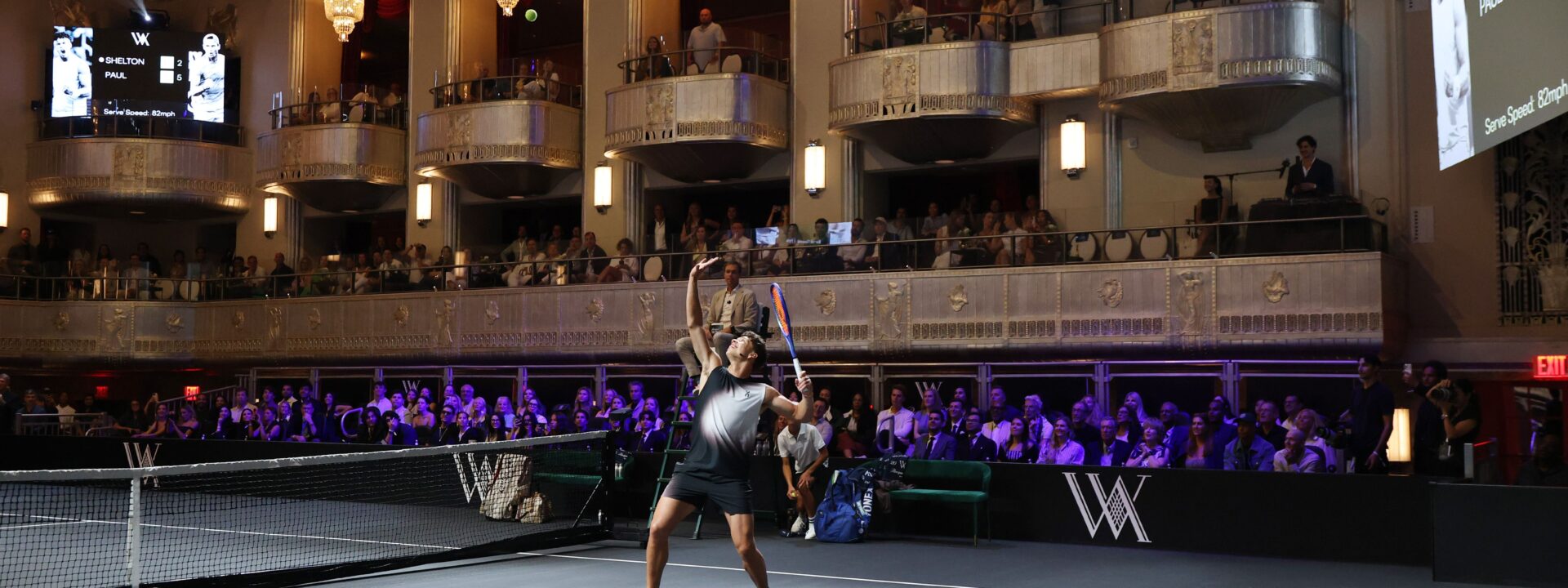
In the week before the US Open main draw, all kinds of quirky things happen in New York. For example, tennis courts pop up in unexpected places. This year, Racquet magazine hosted events at a temporary court at the South Street Seaport; Wilson threw a party to launch their new Defyer racquet at the private Town Tennis Club, hidden inside a residential building on a quiet street near Sutton Place; and Serena Williams, Matteo Berrettini, Taylor Fritz, and Caroline Wozniacki played pickleball in the grand ballroom of the Lotte New York Palace Hotel, right across from St. Patrick’s Cathedral in midtown.
But the most impressive setting was probably the full-size tennis court set up in the Grand Ballroom of the newly renovated Waldorf Astoria—a place that once hosted everything from Elvis and the Beatles concerts to the Tony Awards—for Thursday night’s Waldorf Astoria Ballroom Tennis Invitational. This elegant exhibition (with part of the proceeds going to Big Brothers Big Sisters of America) featured Leylah Fernandez taking on Maria Sakkari, and Americans Ben Shelton and Tommy Paul battling it out on court. There was also a spread of food, from spiced lamb lollipops and wagyu hot dogs to caviar, a huge raw bar, and custom cocktails. Plus, there was a serving alley with a radar gun, so you could see how fast your serve really was. (Sadly, mine topped out at just 70 mph—about an hour later, Ben Shelton hit the fastest serve of the night on the ballroom court, at 141 mph.)
The players started off a bit nervous—“I just hope I don’t shank a ball and smash a chandelier,” Tommy Paul said just before the cocktail hour—but it turned into what might be the start of a new Manhattan tradition. “Here’s hoping this is just the first of many, and maybe I’ll even get invited back,” Ben Shelton said from the court.
Ben Shelton in action during the Waldorf Astoria New York Ballroom Tennis Invitational. Photo: Getty Images
As for the matches: Fernandez edged out Sakkari in a mini-tiebreak, 6-5, while Paul beat the big-serving Shelton, 6-2. Former pro Sam Querrey acted as the playful chair umpire, and Andy Roddick—still the last American man to win the US Open, back in 2003—served as a kind of comedic host. The crowd, limited to about 400 lucky tennis fans, was then treated to a mountain of desserts: summer berry Eton mess, red velvet tartlet, cheesecake trifle, and more. But I had a 9 a.m. appointment back on the ballroom court with Stan Wawrinka the next morning, so I headed home to (try to) sleep.
Since it’s not every day you get a private one-hour clinic with a tennis legend and three-time Grand Slam champion (including the US Open, exactly a decade ago), sleep didn’t come easily. But I was back at the Waldorf ballroom at 9, where I met the so-called Stanimal, also known as Stan the Man. (These private clinics are part of the extra offerings from the Waldorf Astoria Racquet Club.)
Stan had already had a busy week: On Monday, when the US Open wild cards were announced, he—shockingly—wasn’t on the list. (Wild cards, given at the tournament directors’ discretion, allow lower-ranked players—due to a lighter schedule, injury, or other reasons—to enter the main draw. And while Stan is winding down his amazing career and retiring at the end of the season, he saw this year’s Open as a chance for an emotional goodbye to the city he’d come to love even before winning the tournament in 2016.)
Stan Wawrinka celebrates with the US Open trophy after beating Novak Djokovic in the 2016 final. Photo: Getty Images
The tennis world was outraged; another wild-card player pulled out due to injury, Stan got a wild card after all, and everything was back to normal.He was back in the world, but he’d flown home to Switzerland right after the first wild-card announcement on Monday night, only returning the day before we met at the Waldorf.
Needless to say, he came ready to play. For an amateur—really, for almost any amateur—hitting with a pro is both a once-in-a-lifetime thrill and a nerve-wracking test. You desperately hope your game is at least decent enough to avoid embarrassing yourself and your family name. My own experiences have ranged from truly awful (hitting balls off the frame of my racquet with Andre Agassi on the court at Arthur Ashe Stadium) to so-so (with Andy Roddick on the same court a few years earlier). But sometimes, it’s not the overall performance that sticks with you, but a single shot, lucky or not—like when Garbiñe Muguruza drilled a forehand straight at me during a doubles match at an indoor court in midtown, and despite the sheer terror, I managed to deflect it into a winning drop shot.
Thankfully, this morning my game held up. At the same time, Stan was generous, feeding balls right onto my racquet and offering simple but clearly hard-earned tips that made everything feel easier. I won’t bore you with the details, but basically: prepare and get my racquet back earlier; plant my feet and body more solidly, not just before but throughout the shot; keep my head down, focus on the ball, and don’t gawk to see where my brilliant shot is heading. These are all things I was teaching at age 14, when I started a brief teenage stint as a tennis instructor in my tiny hometown. The fact that I still hadn’t fully absorbed them was both frustrating and, oddly, a testament to why tennis is the greatest sport in the world.
Between practice sessions, Stan and I drank water—me gulping, him sipping—and chatted easily. I asked if he used a sports psychologist, and he said no, but he did see what he called a “regular” psychologist. “For me, it’s more about whether you’re happy and feeling good off the court. We all go through emotions off the court—happy, sad, anxious, nervous—and that affects how you play on the court. When I’m happy and my mind is free out there, I play better.” Then it was back to serving practice—and yes, I need to slow down my whole routine, toss the ball higher, wait for it, and then reach up for it.
On Monday, Stan will face the tough Matteo Berrettini in the first round of the US Open. If he gets past Berrettini, he’ll likely meet Novak Djokovic next. Whatever happens, I hope he plays free and calm. A legend like him deserves the best possible farewell from New York after a brilliant career.
And the fact that he helped me fix my game—with care, patience, encouragement, and full, enthusiastic commitment? That’s something I’ll never forget.
Frequently Asked Questions
Here is a list of FAQs about having a private tennis lesson with Stan Wawrinka in the Waldorf Astoria ballroom written in a natural tone
General Questions
Q Wait is this actually real A tennis lesson in a hotel ballroom
A Yes it was a real private event It was a unique promotional or VIP experience where Wawrinka traded the clay court for a temporary indoor court set up in the Waldorfs grand ballroom
Q How do you even set up a tennis court in a ballroom
A They use a special temporary flooring system laid over the ballroom floor with a portable net and professional lighting Its the same tech used for tennis exhibitions in arenas and convention centers
Q Was it a fullsize court
A It was likely a fullsize singles court but with very little room around the baseline The ballroom walls and chandeliers were definitely out of bounds
Q Who was this for
A Usually these events are for highend clients corporate sponsors or winners of a luxury auction or contest Its an intimate experience not something the general public can book
The Experience The Lesson
Q What was it like hitting with a Grand Slam champion like Wawrinka
A Surreal The pace and spin he puts on the ball are on another level Even when hes taking it easy the ball kicks off the court so hard that it forces you to react faster than you ever have before
Q Did he actually coach or was it just a hitaround
A He was genuinely engaged He gave real technical tips especially on his famous onehanded backhand He focused on footwork and staying low even in such an odd setting
Q What was the biggest challenge of playing in a ballroom
A The depth perception With low ceilings and walls so close its hard to judge the balls arc Also you were terrified of hitting a chandelier or a 10000 piece of art
Q Did he use the chandeliers as target practice