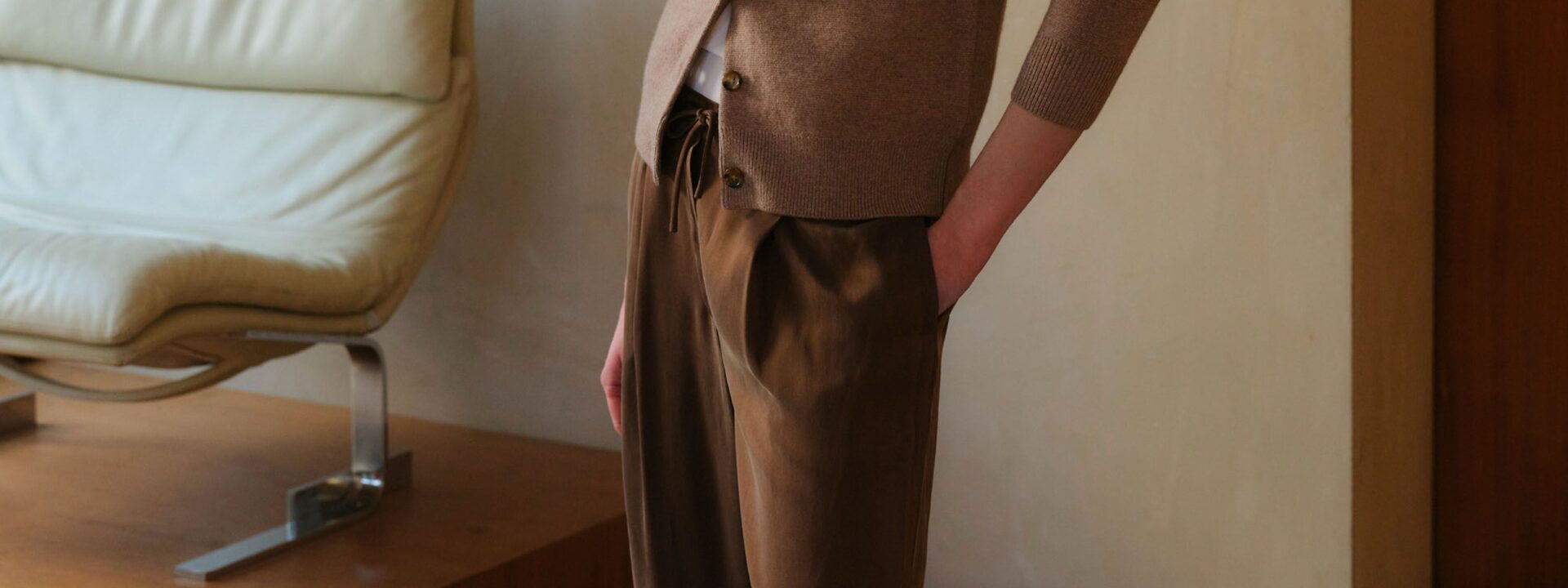
Jed Coleman and Will Coulton see themselves as outsiders in the fashion world. Coleman first gained recognition as the co-founder of London’s Caravan restaurants and coffee roasters, while Coulton comes from a background in management consulting. As London-based New Zealanders, neither knew the traditional rules of running a fashion business. Yet they are the founders behind Rise & Fall, one of the UK’s fastest-growing brands, often called the fashion insider’s best-kept secret.
“We thought the whole high-fashion scene was a bit absurd,” says Coleman. “The prices and the pretentiousness didn’t make sense to us. It seemed strange that so many people in the industry couldn’t actually afford the clothes. We also disliked how it exploited people’s desire to feel better by owning certain things. We just wanted to create durable, everyday products and cut out all the extra noise.”
That outsider perspective—and their pragmatic approach—has largely been an advantage. “It’s a blessing and a curse,” Coleman admits. “You come in with fresh ideas, but you also lack experience, so you can make mistakes.”
The suede trench coat has become a standout product for Rise & Fall. Priced at £450, it’s relatively expensive but still much more affordable than similar items on the market.
To create their practical clothing, Rise & Fall has blended elements from very different parts of the fashion supply chain. They’ve adopted Shein’s on-demand production system, worked directly with luxury factories, targeted budget-conscious shoppers like mass-market brands, and always prioritized quality materials. Along the way, Coleman and Coulton have had to make some compromises—like hiring a creative director to translate their straightforward vision into something appealing to luxury customers, and carefully balancing trends with timeless design. Now, eight years in, with annual sales between $10 and $20 million, mainstream shoppers are starting to take notice.
Can the Shein model ever be sustainable?
Like Shein, Rise & Fall uses a just-in-time model, relying on AI to predict demand by testing new products in small quantities before placing larger orders. Some factories can fulfill reorders within 48 hours. Coleman notes this works well for slower-moving items like knitwear and bedding but is trickier with woven fabrics. It’s also easier when factories are vertically integrated; otherwise, fabric sourcing can slow things down.
Coulton points to the knitted hood that went viral a few years ago as a good example. “We launched that product right as the trend was starting. We began with maybe a hundred units in a few colors in November. By the Christmas order cutoff, we’d sold several thousand, at least half as pre-orders. Every batch sold out immediately. What started as a small accessory grew to 40% of our orders in the weeks before Christmas, because we could ramp up production quickly.”
Initially, Coleman and Coulton found luxury suppliers by purchasing access to shipping databases, later expanding through word of mouth. Persuading these factories to accept small orders was another challenge. “We sell them on where we see the business in five years, not just the first order,” says Coleman. “Our prices offer great quality for the cost, so there’s potential for high volume. If you price a jumper at £1,000, you’ll sell far fewer than if it’s £150.”
Rise & Fall’s goal is for factories to handle everything from the sStock is provided for free, and the brand pays only after it sells. Whether this is fair to suppliers depends on your perspective, says Coleman. “If a supplier has agreed to it, I think it’s fine. Many suppliers are willing to fund business growth this way because they are much larger and can handle it. Plus, many have insurance, so if we don’t pay, they still get compensated. Alternatively, they use factoring, where they sell the invoice to a third party and receive 97 cents on the dollar immediately. It’s an interesting shift of risk. We also place small orders, so the risk is minimal compared to their overall business size. There will come a time when the tables turn as we grow, and we’ll need to be more mindful of how hard we push them.”
Rise & Fall employs a few more strategies to keep prices low without sacrificing quality, says Coleman. First, the brand works with a limited selection of materials and often keeps undyed fabric in stock to move quickly without having to predict which colors will sell in advance. It has also avoided wholesale, which can easily double retail prices and undermine a brand’s long-term value through deep discounts during seasonal sales.
Accessories have become a low-risk way for Rise & Fall to experiment with trends and prints, says Hasseck, pointing to this season’s silk bandanas.
Quality starts with materials
Working with the same factories as luxury brands doesn’t guarantee luxury quality. Most factories adjust their output based on the price demands of the brand they’re working with. This is where Rise & Fall’s original vision diverged from reality.
“We thought we’d be buying more off-the-shelf products, operating like a marketplace, but we quickly realized that doesn’t work. The quality wasn’t good enough, and the shapes and colors weren’t right,” says Coleman. “Manufacturers want clear instructions on what to make and how, so about half our team are now product developers, designers, and compliance specialists. It’s a huge part of the business.”
It all starts with materials. Rise & Fall uses a streamlined selection of fibers: cashmere, merino wool, a cashmere-merino blend, cotton, silk, leather, linen, and organic denim. “I hate polyester, and microplastics are a real problem, so we stick to natural fibers,” says Coleman. “Of course, there are better options like baby cashmere and vicuña, but they’re extremely expensive, so we avoid those. For each material, we specify the micron count and fiber length and create detailed tech packs so everything is made to our exact specifications. All materials are either Oeko-Tex or organic certified.”
“The whole point of this business is that we offer the same quality at half the price,” adds Coulton. “If we fail on that product promise, there’s nothing left.”
Rise & Fall has developed a visual language that hints at its luxury positioning, even if the price challenges customers’ understanding of what luxury means.
The quality-signaling conundrum
Rise & Fall is built on the promise of luxury products without the luxury price tag, but how do you convince consumers of that in a crowded e-commerce landscape where they can’t physically assess the quality?
It starts with pricing, says Coleman. The brand’s product pages feature comparisons, likening the quality of Rise & Fall products to higher-priced brands. Take this season’s hero product, the suede trench coat. The Rise & Fall version retails for £325, which the brand compares to Zadig & Voltaire (£750), Nour Hammour (£1,120), and Frame (£1,450). Similarly, a cashmere polo priced at £165 is compared to a £525 version from Johnstons of Elgin; an £80 merino wool vest is compared to a £195 version from Theory; and a £250 silk dress to a £600 version from Toteme.
This approach has earned Rise & Fall a few “angry letters” from other brands, says Coleman, butHe’s willing to take that risk. “If we’ve made an error, we’ll gladly fix it. But picture them challenging us with the advertising standards board and losing. What if they ended up proving our point—that the products are of comparable quality for half the price? That would be a dream come true for us.”
However, Coulton notes that direct comparisons can sometimes put customers off. “We get a lot of negative comments calling it cheap marketing, but we believe our target customer wants to know how these products stack up against other brands. People have often assumed that a higher price means better quality, and we’re showing that’s not always the case.” In fact, Rise & Fall raised its prices in 2022, he adds, to make the quality seem more credible. For example, a king-size cotton duvet set went from £125 to £170, aligning better with what customers expected to pay for that level of quality. As a result, conversions increased by 20%.
Beyond pricing, creative director Natalie Hasseck, who joined in 2022, points out that visual cues can also signal higher quality. “I quickly saw that ‘quiet luxury’ was becoming mainstream, so we needed subtle style choices to avoid following that path,” she explains, referring to how even fast-fashion brands have embraced the aesthetic. This attention to detail started with the logo, which features an intricate ampersand incorporating an infinity symbol, and extends to the products, all carefully designed in-house. “The brand needed its own character. To me, luxury is about having a distinct point of view.”
The ‘buttermilk’ bedding has become a signature for Rise & Fall. Homeware currently makes up about 60% of the brand’s business.
What comes after quiet luxury?
Hasseck was brought on to add a sense of aspiration and emotion to the otherwise practical product line. When she joined, she had just closed her fashion rental business, On Loan, and the opportunity to shape a brand that at the time offered only “two sets of white bed sheets” was too compelling to pass up. She describes building Rise & Fall’s identity like a sculptor carving away at a block of stone. “It took me a while to fully grasp the concept and turn that factory-direct model into something customers would truly want,” she says.
Hasseck has a talent for spotting trends, which she attributes to “obsessive observation.” Her specialty is color. Early on, she introduced “buttermilk” to the palette—a warm white with a hint of yellow—which has since become a signature shade across both bedding and clothing. “I noticed interior designers were moving away from cool whites toward warmer, limewashed tones, and there wasn’t any bedding to match,” she explains. “My only regret is naming it ‘buttermilk’—I’ve said it so many times it makes me cringe, but if we change it, we’ll lose track of sales data.” Her latest fascination is kelp green, a shade that’s nearly black but actually a deep teal. “It’s going to be huge. I can feel it.”
For the most part, Rise & Fall keeps its designs fairly classic. While thoughtful and modern, the products are meant to be timeless, which explains their success within the quiet luxury trend. But tastes are changing, Hasseck says, and Rise & Fall now has to consider what’s next. “The next phase is about texture and print. There’s been a lack of tactile appeal, and people are starting to crave that feeling again,” she explains. “But print isn’t always conducive to longevity, which is central to our brand.” Accessories have offered a safer way to experiment with trends and prints—for example, the printed silk bandana is consistently sold out.
An honest ambition
Rise & Fall is open about its goals. With over £7 million in venture capital funding, the brand is poised for growth.Rise & Fall is comfortably generating revenue in the tens of millions, according to Coleman, with a goal to reach nine figures by 2029. Since its founding, the brand has averaged over 100% annual growth, but such rapid expansion has its limits. “It’s too difficult to sustain that pace with physical products,” says Coleman. “Apparel, for instance, grows faster than homeware but is more complex and has slimmer margins.” Now, the company is aiming for 50% growth this year and beyond—a rate it finds more manageable.
This approach also explains why Rise & Fall has softened its sustainability messaging. “We don’t want to be inauthentic,” Coleman explains. “We’re a business built on consumption. Our success depends on people buying more. So we focus on offering better versions of the products you already need, rather than putting sustainability at the forefront.”
Instead of encouraging constant overconsumption or relying on planned obsolescence, Rise & Fall is expanding its range horizontally. The goal is to engage the same customers as they make considered purchases across different categories. Alongside homeware and apparel, the brand recently introduced extra virgin olive oil—all part of its mission to offer everyday little luxuries. “Acquiring a customer is expensive, and loyalty is hard to come by,” says Coleman. “That’s why we’re broadening our offerings. It’s all about those small, daily indulgences.”
Frequently Asked Questions
Of course Here is a list of FAQs about how Rise Fall is making luxury fashion more accessible designed to sound like questions from real people
Beginner Definition Questions
1 What is Rise Fall
Rise Fall is a fashion rental platform that allows you to rent authentic highend designer clothing and accessories for a fraction of their retail price typically for a 4 8 or 12day period
2 How does renting make luxury fashion more accessible
It removes the biggest barrier the skyhigh purchase price Instead of spending thousands on a single item you can access and wear that same item for a special occasion or to try a new style for a much smaller onetime fee
3 Is this just for onetime events like weddings
Not at all While its perfect for weddings and galas many people use it for vacations important work events date nights or simply to experiment with a luxury brand theyve always admired without the longterm commitment
Benefits How It Works
4 What are the main benefits of using a service like Rise Fall
CostEffective Wear a 3000 dress for a 150 rental
Sustainability Youre sharing items which reduces waste and the environmental impact of fast fashion
Variety You can wear a completely new highend outfit for every major event without your closet overflowing
Convenience Items are delivered cleaned steamed and ready to wear and you send them back in a prepaid bag
5 How do I know the items are authentic
Reputable rental platforms like Rise Fall have strict authentication processes They source directly from brands trusted retailers or carefully vet items from their community of lenders They guarantee the authenticity of every piece
6 What if an item doesnt fit me
This is a common concern Platforms provide detailed size charts garment measurements and often have customer reviews mentioning fit Some including Rise Fall offer a Backup Size option or a short window to exchange for a different size if available Its crucial to order with enough lead time
Common Concerns Problems
7 What happens if I spill something on a rented dress
Accidents happen Youre generally responsible for minor