Recently, I heard something I wouldn’t have believed possible a year ago: “I held back from liking a critical post about Trump. What if we want to visit the U.S. again soon?” My partner said this, sounding embarrassed. Rumors are going around Copenhagen about people having their phones checked at passport control or being denied entry for speaking out against the American president. We talked about how strange it was to even have this conversation—that voicing an opinion, especially about the U.S., could become an issue.
But we agreed enough was enough. If anything is going to change, we need to speak up—even if it’s just with a small “like.” So when Vogue asked if I would write about how Danes feel regarding Trump’s idea of acquiring Greenland—which has been part of the Kingdom of Denmark since the 19th century and autonomous since the 1950s—I couldn’t possibly say no.
I grew up with a heroic image of the United States. Partly because you were heroes—helping save us from Nazi Germany—and partly because Hollywood assured me that if things went wrong, Tom Cruise would jump out of a plane to fight the bad guys. Deep down, I’ve always believed that. With only six million people, we wouldn’t stand much chance if someone wanted to harm us—at least not without strong alliances. We have the EU, NATO, and such a close relationship with the U.S. that our prime minister in the 2000s went jogging with President Bush in Washington (a much bigger story here than in your media). Danish soldiers have also fought alongside Americans, including in Afghanistan.
I also grew up feeling that you did everything—from wearing Uggs to practicing Reformer Pilates—at least two years before we did. When I was editor-in-chief of a fashion magazine in the 2010s, I convinced management that the magazine couldn’t effectively be published unless I attended New York Fashion Week every season. Sitting at Pastis in the Meatpacking District, watching well-dressed New Yorkers, was just as inspiring as attending a Marc Jacobs show. This was before Noma, Ganni Girls, Scandi chic, and Copenhagen being named the world’s coolest city.
Our media and dinner conversations are full of attempts to understand Trump. “If you listen to a podcast about something Trump said about Greenland on Thursday, it might be outdated by Friday,” said the father of my son’s classmate at a dinner club last week. Is he exaggerating now to get his way later? Should we take him seriously but not literally? Is it all just a distraction from what’s happening in the U.S.?
I asked a friend in communications if she ever believed Trump would take over Greenland by military force. “No,” she said. “It’s not just land; it’s people. Would they become American citizens against their will? I don’t see that happening.” But we both agree that Trump and his administration often say things that are factually wrong—and that makes us uneasy. “It reminds me of a manipulative friend I had in school who lied so convincingly that I almost wondered if I was the crazy one,” she said.
At the Copenhagen Fashion Week opening reception on Monday afternoon, there were just as many cheek kisses and champagne glasses as always. Editors, designers, and PR people mostly talked about the cold and which dinners they’d attend that week. But when I asked if Trump’s statements about Greenland troubled them, they nodded.
“It affects me personally on two levels,” said the co-owner of a fashion agency and PR firm. “It’s really difficult to plan budgets for our brands. We have to consider…”I worry about whether we might end up in such an uncertain situation that Danish consumption declines, and we don’t know whether new tariffs will be introduced for brands that sell in the US. On a more personal level, there are evenings when I’m breastfeeding my three-month-old daughter—that’s often when I catch up on the news. Denmark is the kind of country where we feel safe leaving our baby sleeping outside in a pram while we sit in a café, and I wonder if it will still feel that safe here when my daughter someday has a child of her own.
A magazine editor I spoke with wondered about those in Trump’s inner circle—what they might be whispering in his ear, what commercial interests they may have, and why no one is telling him to stop. “Our own political system is structured around many smaller parties that must find compromises across the board, so one person would never be able to amass that much power,” the editor noted.
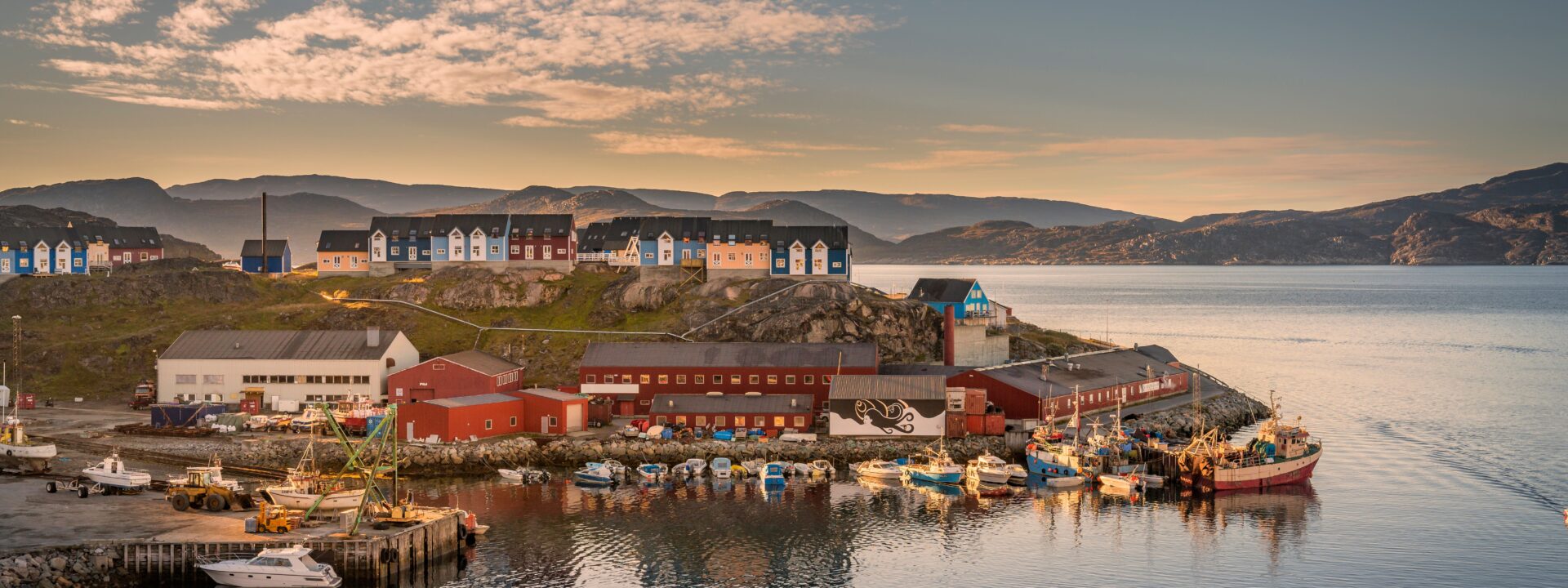
Lately, I’ve also begun to hear more people say that maybe this was what it took to get Europe to stand together, and to make us Danes take a real interest in Greenland. That rings true for me. Apart from a couple of doctors who moved there for the good pay, I didn’t know anyone who had—until now. The closest I’ve ever come to the island was as a child, putting together a jigsaw puzzle of our royal family standing in the snow in Nuuk, wearing Greenlandic national dress.
Denmark behaved like the colonial power it was as recently as the 1970s, when several thousand Greenlandic women were fitted with IUDs without their knowledge. They are now receiving compensation. And when there was a demonstration for solidarity with Greenland a couple of Sundays ago, Greenlanders and Danes took to the streets together, holding the Greenlandic flag. But back in the 1700s, Denmark was the one wielding its might in Greenland.
Of course, Greenland has come to rely on Denmark’s support; a society of 56,000 people can hardly manage on its own in the modern world. But as our foreign minister said on Fox News: “You can trade with people, but you can’t trade people.” It’s a good rule of thumb.
Frequently Asked Questions
Of course Here is a list of FAQs about how Danes are discussing Trumps interest in Greenland with clear and concise answers
Beginner General Questions
1 Why is Greenland in the news again
Because former US President Donald Trump publicly confirmed his interest in buying Greenland while in office and has recently reiterated that interest calling it a great real estate deal This has reignited the discussion in Denmark
2 Can the US actually buy Greenland
No Greenland is not for sale It is a selfgoverning territory within the Kingdom of Denmark Both the Greenlandic and Danish governments have repeatedly and unequivocally stated this
3 What was the immediate Danish reaction to Trumps original proposal
It was met with disbelief and ridicule The thenDanish Prime Minister Mette Frederiksen called the idea absurd and it caused a brief diplomatic spat leading Trump to postpone a state visit to Denmark
4 Do Danes and Greenlanders see this as a serious proposal
Most see it as a political talking point rather than a serious geopolitical proposition However they take seriously the underlying issues it highlights sovereignty colonial history and greatpower interest in the Arctic
Advanced Nuanced Questions
5 Beyond the jokes what are Danes really concerned about
Danes and Greenlanders are discussing 1 Arctic sovereignty and security as climate change opens new shipping routes 2 Greatpower competition in their backyard and 3 Respect for Greenlands right to selfdetermination
6 How does Greenland itself feel about this
Greenland is firmly against the idea They see it as a reminder of a colonial past where their homeland was treated as a commodity The discussion has strengthened local calls for full independence from Denmark but on their own terms
7 Whats the Thule Air Base connection
The US already has a major strategic military base in Greenland Thule Air Base Danes discuss whether Trumps interest was really about expanding the US military footprint using a purchase as a blunt tool for negotiations that are normally handled diplomatically
8 Is there any Danish political divide on this issue
The divide is less about party lines and more about perspective