SCENE BUT NOT HEARD
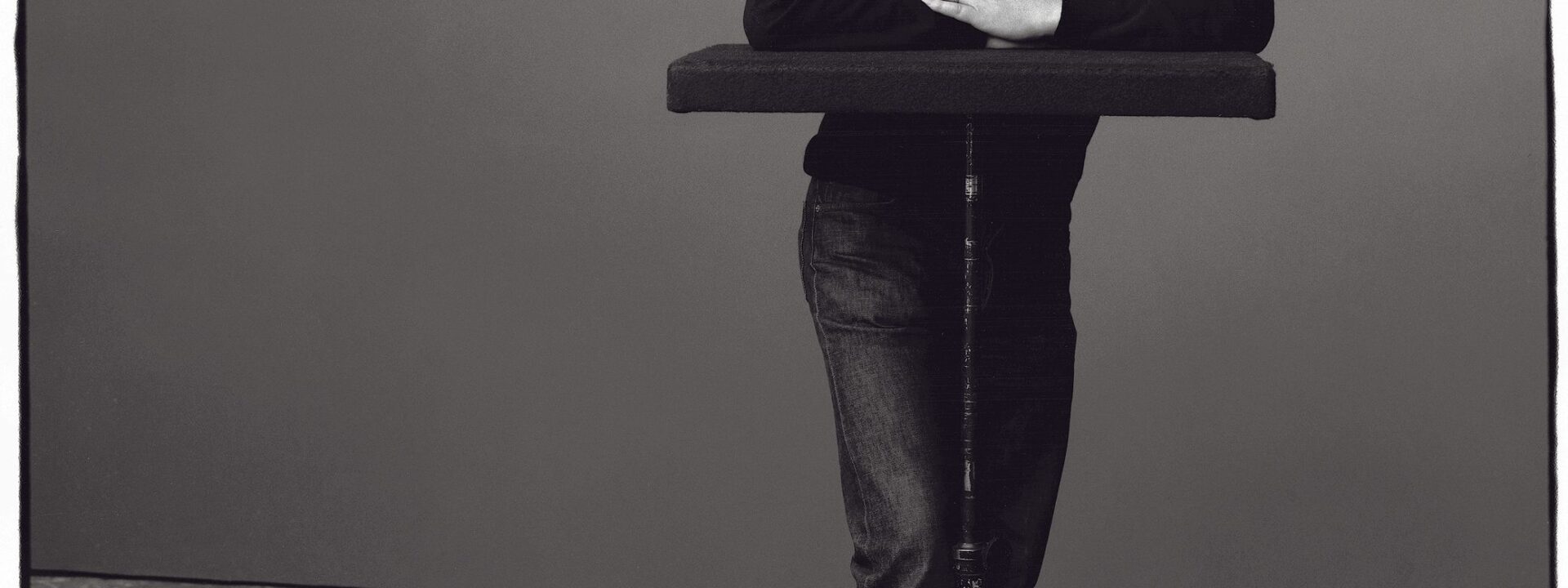
Actress and icon Chloë Sevigny embodies the cool, detached style that pairs perfectly with Helmut Lang’s designs. She wears a sheer top and skirt by Helmut Lang. Opposite: the reclusive Austrian designer himself. Hair by Didier Malige for Frédéric Fekkai Beauté; makeup by James Kaliardos. Fashion Editor: Grace Coddington.
“Scents & Sensibility,” by Sally Singer, originally appeared in the May 2000 issue of Vogue. For more highlights from Vogue’s archive, sign up for the Nostalgia newsletter.
Backstage at the Helmut Lang fall 2000 show, a fashion situation—distinct from a fashion moment—is unfolding. The world’s most in-demand model, Gisele Bündchen, has chosen not to join Stephanie Seymour, Claudia Schiffer, Tatjana Patitz, Cecilia Chancellor, and the other notable beauties gathered on Pier 94 in Manhattan for the runway. Helmut has allotted the popular Brazilian model just one walk, and she and her demanding entourage (is anyone more agitated or vocal than a celebrity handler taking indirect offense?) are displeased and have decided to leave altogether.
Helmut—who, according to Simon Doonan of Barneys, “casts his shows like a Fassbinder film”—is unfazed. When Kate Moss was the most sought-after model, he similarly limited her to one appearance per show. Using the top model more often would have felt like following a tacky trend, and Helmut despises anything tacky. This makes his next move all the more puzzling: listed on the show’s publicity sheet, alongside credits for hair, makeup, and music, are scent credits (Helmut Lang Parfum for women, Helmut Lang Eau de Cologne for men). Observers wonder how this symbol of strict individualism could resort to the industry’s most obvious commercial tactic: promoting a fragrance no one can actually smell at the show. Does the emperor have no nose?
The question grows sharper this month, as Helmut Lang launches these very fragrances online. While computers have advanced, a scratch-and-sniff feature hasn’t been invented yet. So why sell a scent that can’t be sampled? The answer is that this launch is, in part, a statement about launching. It takes to an extreme the idea that consumption is driven by brand recognition—”Helmut Lang”—rather than by the product itself. As Richard Gluckman, the architect behind Lang’s stores and homes, notes, “The Internet launch is one step removed from the actual experience.” In other words, you’re invited to disregard your senses, quite literally.
This isn’t the first time Lang has challenged public and industry expectations. In early 1998, he became the first designer to move a fashion house from Europe to America. Once here, he was also the first major designer to skip the New York fashion week, instead presenting his collections on CD-ROM and online, pushing the notoriously tech-wary industry to catch up. Then, in summer 1998, he decided to show his spring ’99 collection ahead of the European shows—a daring move that caused established New York designers like Calvin Klein to frantically reschedule, leaving the once-sacred fashion calendar as disrupted as a pair of Helmut Lang distressed jeans.
Ah, the jeans. Was there ever a bolder fashion gamble than charging luxury prices for paint-splattered, dirt-hued denim? Yet, as always, the industry eagerly followed his lead. Lang’s friend Kim Stringer, fashion director of Japanese Vogue, says that on a Sunday in Tokyo she spotted 20 or 30 pairs of these Jackson Pollock-inspired jeans around town. “I actually just bought a pair myself,” she admits with a hint of apology.”What can I say? They’re the right length, the right color, and the gold smudge is perfectly placed. It’s truly elegant.”
The emperor may have no clothes, but wherever he goes, the fashion crowd follows. Just try squeezing into Lang’s tiny boutique in Milan during fashion week. Drawn by affordable prices and early access to the new season—Helmut Lang clothing is made in Italy—a pack of fashionistas heads straight from Malpensa Airport to Via Sant’Andrea. Battling jet lag, melatonin withdrawal, and each other, they shop. A seasoned editor-in-chief happily declares that a hot-pink T-shirt with extra-long sleeves makes him “feel like an aristocrat.” A glamorous editor in Prada grabs two suits and a jacket, calling them her “entire work wardrobe” for the season. People who have access to every designer in the world are going wild for sweatshirts, jeans, and pale khaki suits. Only after satisfying their craving for Lang do they cross the street to Prada.
Perhaps it was this frenzy that finally led Patrizio Bertelli, head of Prada and husband of Miuccia, to buy a majority stake in Helmut Lang in 1999. For Miuccia Prada, Lang’s design sensibility is all about deceptive simplicity: “He has elegance, and at his best, a very specific detail adds an edge in a very simple way,” she says.
Fashion professionals adore Lang’s clothes. “They’re my uniform in life,” gushes Cecilia Chancellor, praising their understated, lived-in, and effortlessly functional grace. “His clothes let your personality shine through,” says Stephanie Seymour, “yet they’re original and have a distinct style.” Narrow cashmere coats come with dangling straps that double—or even triple—as belts, coat hooks, and backpack-style straps. Straight-cut trousers sit low on the waist, are slim and lengthening, and never cling to your imperfections. Parkas with shearling hoods feel both sporty and angelic, while organza puff dresses in deep emeralds and amethysts are classically pretty yet strikingly modern.
Artist Jenny Holzer—Helmut Lang also has strong appeal in the art world—describes his look as “functional, effective, minimalist, and nicely stripped down. His suits have all the essentials, and then there’s something better, or worse, about them than you’d expect.” In short, Helmut Lang creates insider clothing for those in the know. “Everything about him is secretive and for the cognoscenti,” says Doonan. A passerby might admire a pair of attractively worn leather motorcycle trousers but would never guess who designed them.
“It’s the opposite of logomania,” Lang explains. “We stand for something modern yet traditional, well-made, and just feels right. Our clients trust us; they know when we release something, it’s been carefully considered.” Lang is a handsome, long-haired man in his 40s who works in a black-and-white office filled with attractive young staff wearing the black trousers and white shirts their boss favors. The effect isn’t one of flashiness but of the coolest gathering of architects you could imagine. What’s being built is the intangible cathedral of the Helmut Lang brand, and the latest spire reaching for the sky is the new perfume line.
Lang first became aware of “how much we’re surrounded by smells and how important scents are to all cultures” at the Florence Fashion and Art Biennale three years ago. There, he created a fragrance evoking sweat, starch, and skin to accompany Jenny Holzer’s intimate narrative of love gone wrong. From this unconventional collaboration grew a genuine interest in the possibilities of fragrance and a partnership with Procter & Gamble. The results are surprising—His friend and perfume tester, photographer Elfie Semotan, notes that people have a strong reaction to the new fragrance, finding it “stimulating, interesting, erotic.” For a woman, wearing Helmut Lang’s scent means embracing something old-fashioned, vaguely Parisian, and—as Lang puts it—”quite voluptuous. It’s a scent that isn’t on the market right now.” Indeed, Helmut Lang Parfum lacks the grapefruit or grassy notes common among its competitors. Helmut Lang Eau de Cologne (for men), which the designer himself wears proudly, also “doesn’t exist at the moment” and sits “on the borderline of aftershave.” Lang views these scents as “the beginning of a perfume tradition.” In the coming months, he plans to open a Gluckman-designed perfumery in SoHo to sell his creations in a physical, non-digital space. A department-store boutique will follow, but distribution will remain selective: “It is not a mainstream commercial product,” Lang says. “I think it should develop slowly, the way old perfumes did.” He takes particular pride in the packaging—a heavy molded-glass bottle with a European heft that feels oddly contemporary. “Being modern,” Lang reflects, “is about the right mix of things—certain elements have to be traditional, certain things have to be new. It does not mean having no roots at all.”
Lang’s own roots are famously humble. Raised by his grandparents in a remote Alpine village (think Heidi, edelweiss, yodeling), he studied business in Vienna and entered design without formal training. By the mid-eighties, he was showing in Paris, infusing severe, minimalist silhouettes—avant-garde at the time—with Austrian touches like lederhosen, horn buttons, and wedding lodens. Linda Dresner, owner of boutiques on Park Avenue and in Birmingham, Michigan, recalls Lang’s 1986 debut collection for its “oversize cotton shirts and some sort of lederhosen. There was some quaint twist that attracted me to the clothes.” Christian Lacroix remembers “very elegant, very couture clothes. A sharp geometry was already at work, very neat and abstract.” Jenny Capitain, the German fashion editor who assisted Lang with his first Paris shows, says, “In the beginning, he had two Viennese pattern-makers and Austrian fabrics. The quality was amazing.”
SCARLET WOMAN
“Well dressed and well groomed is the attitude of the time,” says the designer. (And fantastically sexy, one might add.) Red turtleneck, skirt, Helmut Lang. Hair by Sally Hershberger for Sheer Blonde; makeup by Denise Markey for Club Monaco Cosmetics. Fashion Editor: Elissa Santisi.
The Tyrolean influence faded after a few seasons; today, Austria’s presence in Lang’s work comes through old friends from Vienna who continue to model his sleek, sexy suits despite having careers as doctors and lawyers. But the quality of his clothing and the clever fusion of classic and unconventional elements remain unchanged. Take, for example, Lang’s approach to the current trend for opulence. While other designers are offering precious furs and gold accessories for next fall, Lang presents ragged, wild shearlings in a golden-honey hue that redefine modern luxury and glamour. He creates a cocktail dress in pale carnation-pink organza with four trailing strips of cloth like party streamers—it looks grand, not girly. He places a feather on a high heel, and it appears bold, not fragile. “Last season, things were already starting to be very polished,” Lang observes. “Part of the attitude of the time is that you have the opportunity to be very well dressed and well groomed. After the whole sportswear trend, it just feels very right again.” His instinct for what feels right is inspired and inspiring: Lang has always been an influential voice in fashion.Helmut Lang has always gone against the grain of mainstream fashion. In the 1980s, he introduced a style vocabulary—understated tailored suits, clever low-key layering with sheer tanks, tees, and dresses, and everyday technofabrics that worked for easy evenings—that would come to define the 1990s. To find the origins of this year’s “lady” look, just think back to his blush pink knee-length silk-feather coat with matching skirt from spring 1998. “I think he’s a great stylist,” says designer Kostas Murkudis, who worked with Lang from 1985 to 1992. “When you see the motorcycle pieces or the NASA-inspired items”—like the space suits from fall 1999—”you know he’s tapped into the right clothes at the right moment and given them a fresh twist.”
This knack for reinvention is also evident in Lang’s marketing strategy, which remains entirely his own even after the sale to Prada, guided by his counterintuitive sense of what fits his brand. That often means avoiding the obvious, like directly showcasing the product. When launching “a denim line with edge,” his ad campaign featured only Robert Mapplethorpe photographs with no jeans in sight. His taxi ads simply displayed “HELMUT LANG” alongside a small mug shot or two of his Austrian model friends. (The new campaign, running on a thousand cabs, does away with images altogether.) For his accessories line, he provocatively placed a photo of a messy pile of his feathery bags—reminiscent of a fox in a henhouse—in National Geographic (which he calls “the printed equivalent of the Internet: all kinds of people read it, and nobody throws it out”). Lang isn’t actually trying to reach the masses, though. He follows his whims—and, in his overt populism and egalitarianism, achieves that coolness that comes from avoiding what’s obviously trendy. It’s a daringly confident strategy that reveals unshakable self-belief. “When it’s a strong brand name,” he says, explaining the online launch of his perfumes, “you buy it and you try it.”
Lang’s certainty about the value of his name allowed him to give up corporate independence without losing peace of mind. Even after Prada’s rocky split with Jil Sander, Lang remains unfazed about partnering with the Italian giant. “After I moved to New York, I had to decide to take things to the next level,” he says. “I always wanted a partner to handle the business side—my soul wasn’t in it. Merging with Prada was an acknowledgment that they know how to do it and at what level of quality.” With Patrizio Bertelli’s expertise and capital, new Helmut Lang boutiques are now being planned by architect Gluckman for London, Los Angeles, Paris, and various cities in the Far East, and the Milan store will soon move to a larger space. Besides the perfumery, Lang plans to open a small made-to-measure salon in SoHo, where he’ll design unique looks and tailor ready-to-wear pieces for a perfect fit. This venture—the opposite of his impersonal online initiatives—promises to be an ideal outlet for his talent for modern tailoring. “It has nothing to do with couture,” Lang says, “which to me is old-fashioned. Luxury has been redefined every decade. It’s time to define it anew.”
Housewares are also in the future—”something very strong and high quality; it’s still good to have handwoven linen”—but for now, the real benefit of the Prada sale is the breathing room it gives the designer. “The last four or five years were really crazy,” Lang says. “Now I focus on the artistic side, and that leaves me enough space for life.” In his view, creativity and a low-key existence go hand in hand: “You have to know what’s going on in life to create fashion.””You have to have a normal life.” These days, a normal life for Helmut Lang means a loft in downtown New York and a $15 million property in East Hampton, which he acquired ahead of Jerry Seinfeld. You won’t find these homes featured in magazines, as Lang keeps his private life out of the spotlight. “I’m not from that old school of designers,” he explains. “Basically, if you allow everything, you’re always on a promotion tour.”
Instead, Lang surrounds himself with a close-knit group of longtime friends. With them, he enjoys McDonald’s Quarter Pounders—”maybe three times a week,” according to his friend, Viennese internist and model Wolfgang Ruisz—and browses Chelsea flea markets for old books on painting and botany. After years of dividing his time between Vienna and Paris, Lang appears to have settled down. Austria’s recent shift toward the far right hasn’t exactly drawn him back. When the topic of Jörg Haider comes up, he only mutters despairingly, “What is there to say?”
Even though his daily life is now grounded in the U.S., Helmut Lang’s essence remains deeply rooted in Central Europe. “He has the Austrian habit of being very cautious about everything,” Ruisz notes. “He wants everything about his clothes to work.” On a more intangible level, it may be Lang’s inherited sense of Central European melancholy and anonymity—think Kafka, think Musil—that allows him to foresee and shape a borderless brand. This brand resonates powerfully, yet mysteriously, with the nomadic fashion world.
Helmut Lang can sell a perfume that no one can sample beforehand, simply because what he’s really offering is the spirit of the times in a bottle. He succeeds because his followers trust that not only is this emperor wearing clothes, but they are exceptionally fine ones. Kim Stringer recalls, “I met Helmut ten years ago, and he told me then that you have to be really careful about what you put your name to. You have to believe in it. You can’t just put a napkin out with your name on it, because your name—your brand—is all you have.”
Frequently Asked Questions
Of course Here is a list of FAQs about Helmut Lang and his philosophy based on the referenced Vogue profile
Beginner General Questions
Q Who is Helmut Lang
A Helmut Lang is an influential Austrian fashion designer known for revolutionizing minimalist and avantgarde fashion in the 1990s and early 2000s
Q What is his famous quote about being modern
A He believed that being modern is about the right mix of things Its about thoughtful curation not just wearing new or trendy items
Q What does the right mix of things actually mean
A It means combining different elementslike high fashion with utilitarian basics luxury fabrics with industrial materials or masculine with femininein a way that feels personal intelligent and ofthemoment
Q Was Helmut Lang only about minimalist allblack clothing
A While minimalism was his foundation he was famous for mixing in unexpected elements sheer fabrics leather feathers and innovative treatments that challenged the simplicity of his silhouettes
Advanced Philosophical Questions
Q How did Langs mix challenge traditional fashion in the 90s
A He broke down formal barriers He mixed tailoring with sportswear used unconventional materials like rubber and metal and presented fashion as an intellectual and personal uniform rather than just seasonal trends
Q Whats an example of this mix from the Vogue profile
A The profile describes his work as combining the austere and the sensual For instance a precise cleanlined coat might be paired with a sheer delicate top or a skirt made of leather strips creating a tension between strictness and vulnerability
Q How is this different from just eclectic styling
A Langs mix was never random or purely decorative It was controlled architectural and intentional Every piece no matter how contrasting served a unified vision of modern clarity and subtle rebellion
Q Did Helmut Lang see fashion as art or utility
A He saw it as both His clothes had a utilitarian almost uniformlike practicality but the intellectual concept behind the mixthe proportions fabric innovations and cultural referenceselevated them to an artistic statement
Practical Application Legacy