“And we’re going to do it.” I loved that about this story. They went knowing there was a good chance they wouldn’t make it. But if they did, they’d be rich. And if they didn’t try, they’d be broke. That’s the kind of thing “real men” do. Junger says, “It’s guys like Clooney who are the successful captains. The kind who can charm the work and courage out of their men, who understand that the men are lonely, they miss their girlfriends, they’re scared. The other kind of captain is a tyrant. He would have been a terrible tyrant.”
Clooney remembers when he did a stint on Sisters and had to set the producers straight about a few things. “This was a show for women,” Clooney explains. “And it was a great show.” But he wanted to make sure his character—Sela Ward’s love interest for a season—was, as he puts it, “a real guy.” There were more than a few times he had to go back to the writers and explain, “Uh, straight guys don’t talk this way.”
Clooney gets it—this retro guy-chick thing. Right down to his Rat Pack friends: He feels so 1960, it’s no wonder he remade Fail Safe. This is a man who, on- and offscreen, can fix your transmission but also knows what wine to order with dinner. The kind of guy who’ll hold the door for you—and check you out when you walk through it.
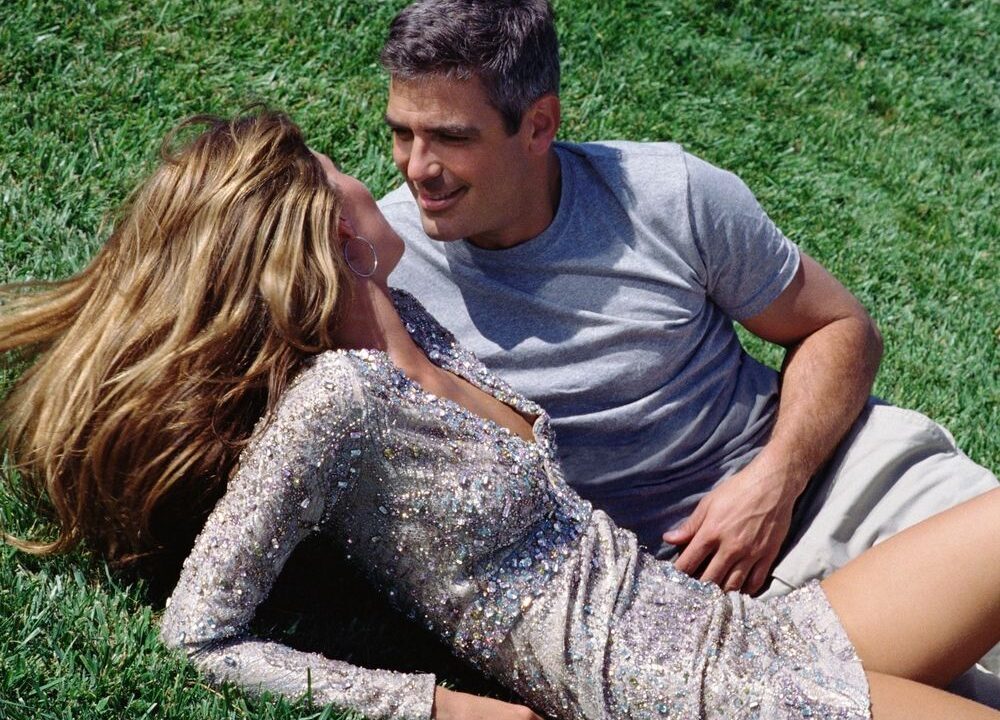
“He was a little shy at first,” says Gisele. “I thought, Oh, a movie star. But then, wow! He was fabulous!” Dress by Dolce & Gabbana. Shirt and pants by Prada.
Photographed by Herb Ritts, Vogue, June 2000. Courtesy Herb Ritts / Trunk Archive.
Back at the Smoke House, the Boys are on the subject of weddings. This should be a touchy topic for Clooney, since every gossip columnist in the country is obsessed with his inability to commit. But Clooney sees it as another chance to riff. He didn’t buy motorcycles for any of his friends who are “in their childbearing years,” he says—he didn’t want to tick off their wives. He’s still mad at Tommy for choosing New Year’s Day to get married. “We were all soooo hungover,” he moans. (“I had to pick a date I’d remember,” Tommy shoots back.) Grant tells how George gave the toast at that wedding and “had everyone in tears” with his warm wishes for the bride and groom, then ended by saying he hoped they’d have lots of children so that someday he could “date their children’s friends.”
Weddings are obviously very special to the Boys. When Richard Kind (the Spin City costar, who is the second most famous of the group) got hitched, the Boys took the little cameras the bride had put on each table into the men’s room and took turns photographing one another with their pants pulled down.
“There’s this thing about guys that is attractive,” Clooney had told me a few weeks earlier in his office on the Warner Bros. lot. “There’s no question that there wouldn’t be wars if there weren’t guys. So we are stupid; there’s no question about it. We do all the dumb things. But there’s this thing we also do that I like. There’s this camaraderie that I really do love.”
Tonight the Boys are also calling it “camaraderie.” How else to explain the time Clooney found a Gay Pride bumper sticker and put it on the car of one of the Boys, “and he drove around for weeks without realizing it!” Or the time one of the Boys left a gag message rhyme on his machine: “It’s eight o’clock and I like…”—well, you can imagine—which Clooney then managed to rig so that it became his outgoing message during a two-week trip the Boys took to Hawaii.
By the time they get around to the story of the pig (that would be Max, Clooney’s 160-pound pet that he’s had for twelve years, “the longest relationship of my life, by far, but we don’t have sex anymore”), we are joined by several other members of the Fail Safe production, including Stephen Frears, the famed British director (Dangerous Liaisons, The Grifters, High Fidelity), and Anne Coates, the distinguished British film editor (Lawrence(like Lawrence of Arabia, Erin Brockovich). They arrive just in time to hear enough of the Boys’ bonding stories that Anne eventually turns to George and says, “So basically, it’s like you’re gay.” Clooney smiles mischievously. “That’s right,” he says with a lisp. “But you like girls,” says Anne. “It’s called a beard, Anne,” Clooney jokes. Eventually, the conversation turns serious. Clooney tells everyone how he can’t sleep because he’s so worried about Fail Safe. Anne gently tries to help by suggesting a series of relaxation exercises (imagine a green tree on a black background). Someone else asks what he does when he can’t sleep. Another round of laughter! It’s inevitable that they’ll end up talking about the pig. Clooney got Max when he was living with Kelly Preston, who later married John Travolta. He thought she’d love the pig, but “she wasn’t really an animal lover,” as Grant puts it. She just didn’t appreciate the pig the way the Boys do. “Remember the time you fed him bacon and felt so bad about it?” says Grant. “It wasn’t bacon; it was Honey Baked Ham. It wasn’t right, I know, but he loved it!” It’s only when George is absorbed in other conversations—about Fail Safe—that the Boys drop the act and talk movingly about George. How he’s the most loyal friend in the world. How he never treated them any differently, even as he began to earn millions and they (or at least some of them) continued to struggle. How the only difference in their friendship now is that they can’t go to restaurants together without George being approached all night, and how sometimes when they’re on their motorcycles, paparazzi in vans follow them. Tommy once told a reporter that if you spend enough time with George, you’ll see a “sadness” about him, a “loneliness.” Clooney’s never forgotten that. “Are we on ‘There’s a sadness in George’?” asks Clooney, turning in his chair. Several weeks earlier, Clooney sat in the office of his production company, Maysville Pictures—named after the Kentucky town of fewer than 8,000 people that his family is from—talking about his life and career, and his firm belief that you can’t have it all. But he says that’s OK, because he has most of it. And as he told Barbara Walters and everyone else, he has no desire to replicate himself by having children. Still? He laughs. “I don’t know. I don’t have any interest in them. I just don’t think it’s something you can do casually.” The interesting thing about Clooney on his own is his utter earnestness. Gone are the masturbation jokes, the bravado, the Guy Thing. He arrived at his office in his work uniform—khakis, a T-shirt, and two-day-old stubble—looking as if he had just gotten out of the shower. Outside, just a few feet away, his former cast members from ER are rehearsing. On his way in, he stops to talk with Noah Wyle, who’s outside grabbing a smoke. “Want anything? Quaaludes? Acid?” he jokes. His office is decorated with a bike, a putter, votive candles, and framed pictures of himself on magazine covers. “People sent me those,” he explains. “Where are you from?” he wants to know, and the topic turns to Maysville and his aunt Rosemary. It was from her that he learned his first lesson about fame at the age of seven, when she went from being the hottest thing going to not, and ended up in a mental hospital. His uncle George, his namesake and favorite relative, taught him about class and style. Uncle George was a roguish, dashing guy with an alcohol addiction who dated all the beauties in Kentucky but never married, regaled little George with stories of his days as a bomber pilot in World War II, and on his deathbed, looked up at his nephew and summed up his life: “What a waste,” he said, then passed away. Maysville, says Clooney, is where the Clooneys get buried. “We’re all buried in the Maysville cemetery.” But he says he won’t be. “I don’t like the idea of being in the ground somewhere for people to come by.… I want to get cremated. Sprinkled over somebody’s omelet or somethiHe spent his early years not in Maysville but fifteen miles down the river in Augusta, an even smaller town with a population of 1,400. His family moved there when he was thirteen, and his parents still live in the same house. Before that, he had lived in five different cities across Ohio, Indiana, and Kentucky as his father moved from job to job.
Clooney’s father, Nick, was—and still is—his role model. Clooney once described him as “the Johnny Carson of Cincinnati,” a man who built his career in live TV and still works at 66 as a radio show host in Cincinnati. “My father was as big as you can be in a local market.” He was a TV journalist, hosted numerous shows, and was someone who would quit his job and move his family before letting himself be compromised by some snot-nosed TV executive. Clooney was raised to believe you do the right thing, no matter the cost. Sometimes, when his father quit on principle, they’d go from “a mansion to a trailer—literally, a trailer.” But Nick always ended up back on top.
Clooney’s mother, Nina, was a runner-up in the 1959 Miss Kentucky pageant. She met her husband when he was emceeing the Miss Lexington contest. He was 24; she was nineteen.
When George was thirteen, his family settled in Augusta. A few months later, he got Bell’s palsy, a disorder with stroke-like symptoms. The left side of his face became paralyzed. “It scared the hell out of me,” Clooney says, and it made him the butt of jokes at his new school. Just days before the illness struck, he and his dad were watching a Saturday matinee, The Pride of the Yankees, about Lou Gehrig and his struggle with the disease that would later bear his name. Clooney sobbed as the bat fell from Gary Cooper’s hands in the movie. The next day, the Clooneys were in church. “We were up in the balcony, and suddenly my tongue went numb.” Then they went to Frisch’s Big Boy, as they always did after Mass, and when he tried to drink a glass of milk, it poured out of the side of his mouth. “I was convinced I had Lou Gehrig’s disease.”
Because the Clooneys were “very well known” as a family, and it had been drilled into them never to make a scene in public, Clooney tried to hide his condition. He learned to cope through humor—especially when the kids at school teased him. A year later, the palsy went away.
He entered Augusta Independent High, where there were only 23 kids in his graduating class. His former baseball coach insisted that George was so handsome that girls would line the streets to watch him walk home. George shrugs it off. “Yeah, all 22 of them.” By his own admission, he was a lousy student but still managed to be second in his class (“There were only 23 kids,” he points out). His high school girlfriend—with whom he still keeps in touch—was first in the class.
But George had no idea what to do with his life. He wanted to be a professional baseball player and even got a couple of tryouts with the Cincinnati Reds. (“I only lacked skill,” he says, laughing. “That was the only thing holding me back.”) It wasn’t until his cousin Miguel Ferrer (Aunt Rosemary’s son) was in Lexington shooting a movie that never got released that Clooney, then nineteen, realized his true calling.
He became determined to make enough money to move out to L.A.—and he earned that $300 (plus some of his college tuition) by cutting tobacco, selling insurance door-to-door, and working in a department store selling women’s shoes. “Now, that was a fun job,” he says sarcastically. “These weren’t gorgeous women coming in with long legs. I was selling Naturalizers to old women with hammertoes.”
When, in 1982, he decided to drive his old beat-up Monte Carlo to L.A. to become an actor, his father told him he was nuts. Aunt Rosemary told him he was nuts. But at least she let him camp out in her house—an arrangement that came to an ugly end when she decided her nephew was a screwup. They have since reconciled.It was around this time, after he had worn out his welcome with Aunt Rosemary, that he met most of the Boys. Clooney (center) with members of his ER cast: Anthony Edwards, Julianna Margulies, Eriq La Salle, Sherry Stringfield, Noah Wyle, and Gloria Reuben. Photo: Courtesy Everett Collection
Clooney did a lot of bad TV before he got his big break as the tortured, testosterone-fueled Dr. Doug Ross on ER. Overnight, he went from being a guy who could get laid by anybody to a famous guy who could get laid by anybody. But Clooney takes great pride in the fact that he kept his commitment to ER for five years, even though he could have sold out and gone straight to the movies. It was a lesson he says he learned from his dad. “You honor your contract. It’s your job. It’s the right thing to do.” At the end of the day, says Clooney, “even if you’re spooned up next to the woman you love, it’s still about what you did that day or didn’t do that day. And whether you can sleep well and live with your decisions.”
Three years ago he made a decision to take on tabloid TV—to force them to stop buying private paparazzi photos of stars. It was ironic in a lot of ways: Clooney is one of the more press-friendly people in Hollywood. But to him, that was precisely the point. “I did it for my father,” says Clooney today. Clooney understood the difference between the “real” media, of which his father was a card-carrying member (the hero in their home was Edward R. Murrow), and the tabloid media. What enraged Clooney was not the usual press coverage but the invasion of daily privacy that he felt shows like Hard Copy trafficked in. He got a slew of Hollywood stars to help him: They wouldn’t talk to Entertainment Tonight until Hard Copy (which was owned by the same company) stopped stalking them. Clooney won that war. “Hard Copy’s off the air,” he says proudly.
But even without tabloid TV, the drama of Clooney’s love life is still an obsession to the public. And in many ways—though he’s loath to admit this—to him. There’s a guilt to George Clooney that is almost touching. Ask him about his ex-wife, Talia, and he talks about how bad he felt about the breakup, which came just before he hit it big. “I was the one who got, um, famous later in life. You know? So it seemed very unfair to my ex-wife to then have to go to the grocery store and see me on every magazine. I know it would have been strange for me if everywhere I went there were pictures of my ex-wife. So I always felt like it was my job to take responsibility for all the things that didn’t work.” The failure of that marriage so bothered him that he developed a bleeding ulcer. He also tried therapy for the first and only time. “You can use therapy to justify pretty much anything you do,” says Clooney. “And they’ll say, ‘Well, you’re not wrong to feel that way.’ Sometimes you want them to go, ‘You’re a real jerk. Why would you do that?'”
When he broke up with Balitran last year, he also had enormous guilt (even though, by all accounts, she bolted on him). “She pulled up roots and came here for me,” says Clooney. “So I felt it became something of my responsibility to make sure that even though we’re not still together, her life is not bad because of that, you know? So I made sure that she had a great place to live. And I made sure that she had cash. And I still talk to her and make sure that, you know, she has a lawyer who will help her with her visa. We still keep in contact—even though we’re not really in a relationship.… ” He takes a deep breath. “Quite honestly, I don’t want to be sitting in the lap of luxury and hear, ‘Well, Celine had to go back to Paris because of the lawyers, or because her visa kicked out or she didn’t have any money.…'”
So, you’re a good ex-boyfriend? “Well, yeah. I’m a much better ex-boyfriend than I am a boyfriend.”
It’s near midnight when Clooney decides it’s time to blow the Smoke House and go home and not get some sleep. He pays the tab, says goodnight to the Boys, andHe heads for the door and climbs into his Bronco. He tells me how lucky he is to have his friends, his wealth, and a career he never could have imagined. “I don’t believe you can have it all. Do you really know anyone who does?” He goes quiet for a moment and runs his hands through his hair a couple of times. “I mean, who’s really successful and happy in every part of life?” he asks, before shifting into gear and driving off alone to the big house in the Hills. In this story: Gisele’s hair, Jimmy Paul for Clinique; makeup by Virginia Young for Aveda; George Clooney’s hair, Waldo Sanchez; grooming by Tracy Warbin.
Frequently Asked Questions
Here is a list of FAQs about From the Archives Catch George Clooney if You Can covering the basics common issues and practical tips
What is From the Archives Catch George Clooney if You Can
Its an archived entertainment article or feature about George Clooneys early career rise to fame and the challenges of catching himwhether in interviews on set or in the media
Is this a movie or a TV show
Neither Its a written piece from an archive not a film or series
Who is George Clooney
An American actor director producer and philanthropist He became famous for TVs ER and films like Oceans Eleven Syriana and Up in the Air
Why is it called Catch George Clooney if You Can
Its a playful title It suggests Clooney is elusive busy or hard to pin down for an interview or story
What does From the Archives mean
It means the content was previously published and is now being reshared or republished from an archive
What time period does this cover
It likely covers Clooneys early to midcareer especially the years around his rise in the 1990s and 2000s
What can I learn from it
You can learn about Clooneys career path his public image how the media covered him and what made him hard to catch as a subject
Is it suitable for beginners
Yes If youre new to Clooneys work it gives useful background and context
What are the benefits of reading it
It offers historical context behindthescenes insight and a sense of how celebrity journalism worked at the time
What are some common problems with archived articles like this
They can be outdated missing links behind paywalls or written in an old style that feels less relevant today
Why might George Clooney be hard to catch
Hes known for being private selective with interviews and often busy with filming directing and activism
Does the article include interviews
Possibly Archived features often include quotes or interview material but not always