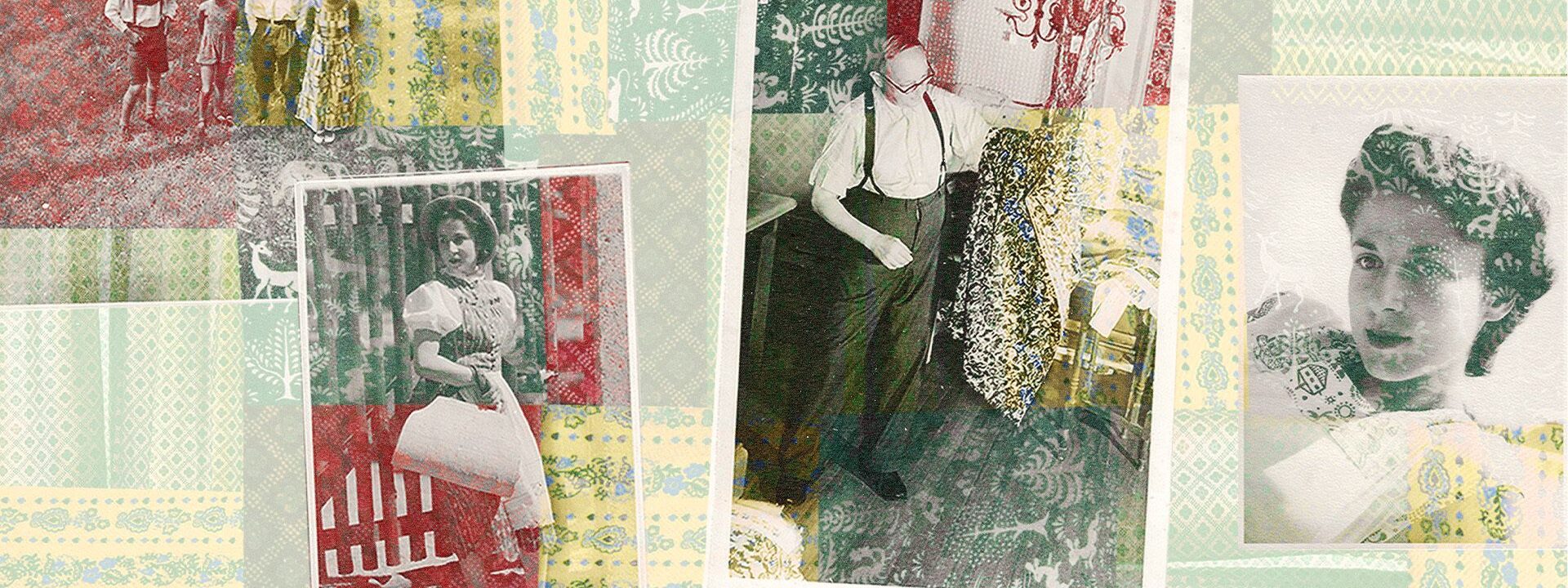
When Audrey Gelman started looking for wallpaper for her Hudson Valley inn, The Six Bells, she didn’t expect it to lead her on a deep journey into her own family’s past. Among the historical prints her interior designer, Adam Greco, showed her, she was especially drawn to the Bavarian folk patterns from the Wallach Project. After Greco shared the story behind the family, Gelman says, “I just became obsessed with it.” She adds that she bought up anything Wallach-related she could find on eBay.
The Wallach House of Folk Art Munich was founded in 1900 by two Jewish brothers, Julius and Moritz Wallach. Their brother Max later joined them, and the business grew into a busy European textile and fashion hub, even helping to make the dirndl popular in Germany. But like other Jewish-owned businesses in Germany, the Bavarian textile store was taken over by the Nazis in 1937 and officially seized on August 1, 1938. Still, the Wallach House stayed active in the area. Until 2022, the brothers’ original textiles were produced by Josef Fromholzer, who worked there from age 12 into his 90s. (Fromholzer died in 2023.)
Not all the brothers survived the war. Max was killed in Auschwitz, while Moritz fled to New York and Julius wandered through Europe and Canada before settling in Pennsylvania. But nearly 90 years later, the Wallachs’ descendants have reclaimed their family legacy and their textiles. A group of the brothers’ great- and great-great-grandchildren from across the United States, Greece, and Brazil came together to found the Wallach Project, which preserves and reimagines their original printmaking work.
Gelman is also the granddaughter of Holocaust survivors, which created a bond with the Wallach cousins. Her great-grandparents, who ran an inn in what is now Belarus, were killed by the Nazis along with most of their town. Her grandfather managed to escape and later fought against the Nazis in the Russian Army. Gelman had never publicly explored her own family history, but she was moved by the Wallach Project’s story. So she reached out to Jamie Hall, Max’s great-grandson and the chair of the Wallach Project, to suggest a possible collaboration. “I just reached out cold,” she says. “I got on a call and I told him a little bit about my own story.”
The cousins behind the Wallach Project were eager to work with Gelman and The Six Bells to bring their family’s original prints back into everyday use. On June 24, they will release a collection of modern home goods—including curtains, throw pillows, dog beds, placemats and napkins, pinafores, and makeup pouches—featuring three of the same prints originally made in the Wallach workshop.
It’s a unique chance for descendants to create something joyful out of tragedy. Amelia Rosenberg, Moritz’s great-granddaughter and deputy chair of the Wallach Project, notes that preserving the legacy of the Holocaust is something the third generation (and beyond) is especially suited to do. “I think there’s a generational thing that happens with history and with things like a genocide, where this level of removal allows us to reconnect because we don’t have the immediate pain,” she says.
That pain has kept many of them from knowing their own history—including the story of the original Wallach House. “The history felt to me like a tale, like a mythical thing. People didn’t want to talk about it in depth, it wasn’t passed on,” says Cora Sanches, Julius’s great-great-granddaughter and director of the Wallach Project.
Hall, who grew up in the UK and now lives in Greece, agrees. “For me growing up, all I really knew about history wasThe Holocaust. But the story didn’t go back further, to this incredible history,” he says. “I saw objects around the house—wood blocks on the wall, tablecloths—but I think it was too painful for my grandparents to really talk about them.”
By bringing their family’s pre-war history back to life, the cousins are also telling a story that goes beyond the Holocaust. “This is my way of honoring my family and their legacy, and trying to build that cultural inheritance here in Brazil,” Sanches says.
Tara Donne
Tara Donne
Descendants of Holocaust survivors rarely have many—if any—physical objects that connect them to earlier generations. That’s something Gelman and the Wallach family are well aware of. For them, this collection makes sure that these items, made with their family’s unique prints, aren’t lost over time. “It’s something you actually interact with,” Rosenberg says. “If you look at something as just an artifact, it stays an artifact. But if you use it in your daily life, it becomes something different—it becomes part of your own story too.”
For Gelman, it helps add a new chapter to a story filled with trauma. “There’s so much pain, death, and sadness in my family’s story,” she says. “It’s rare to get to do something that’s joyful and genuine, and that creates something new—not just something for a museum. There’s something really meaningful about that, because it feels like it’s creating life.”
Wallach family photos.
Courtesy of Amelia Rosenberg
Frequently Asked Questions
Here is a list of FAQs about The Six Bells and the Wallach Project focusing on how they use textiles to reconnect with family history
BeginnerLevel Questions
1 What exactly is The Six Bells and the Wallach Project
Its a creative community project that uses textiles to explore and share family histories The name comes from a specific pub and a family name but the project is about helping anyone connect with their own roots through craft
2 How can sewing or quilting help me reconnect with my family history
Textiles often hold memoriesa grandmothers handkerchief a fathers work shirt or a wedding dress By repurposing mending or embroidering these fabrics you physically handle the past It turns memories into something you can touch stitch and pass on
3 Do I need to be a good sewer to join
Not at all The project welcomes all skill levels Many people start by learning simple stitches or just bringing a piece of fabric that means something to them The focus is on the story not the perfection of the stitch
4 What kind of textiles do people use
Anything with a personal history old clothes handkerchiefs upholstery scraps ribbons or even fabric from a wedding dress Some people use new fabric but embroider it with dates names or family symbols
5 Is this just for people with Jewish or Eastern European heritage
No While the Wallach family history is Jewish and Eastern European the project is open to anyone who wants to explore their own family story through textiles The methods work for any background
Intermediate Advanced Questions
6 How does the project actually run Do you meet in person
Yes there are inperson workshops at community centers or libraries and also online sessions Participants bring a fabric object or photo and facilitators guide them through techniques like story stitching or patchwork that maps a family tree
7 Whats story stitching
Its a technique where you embroider symbols dates or patterns that represent specific family events or traits For example a red thread for a wedding a blue wave for a journey across the ocean or a