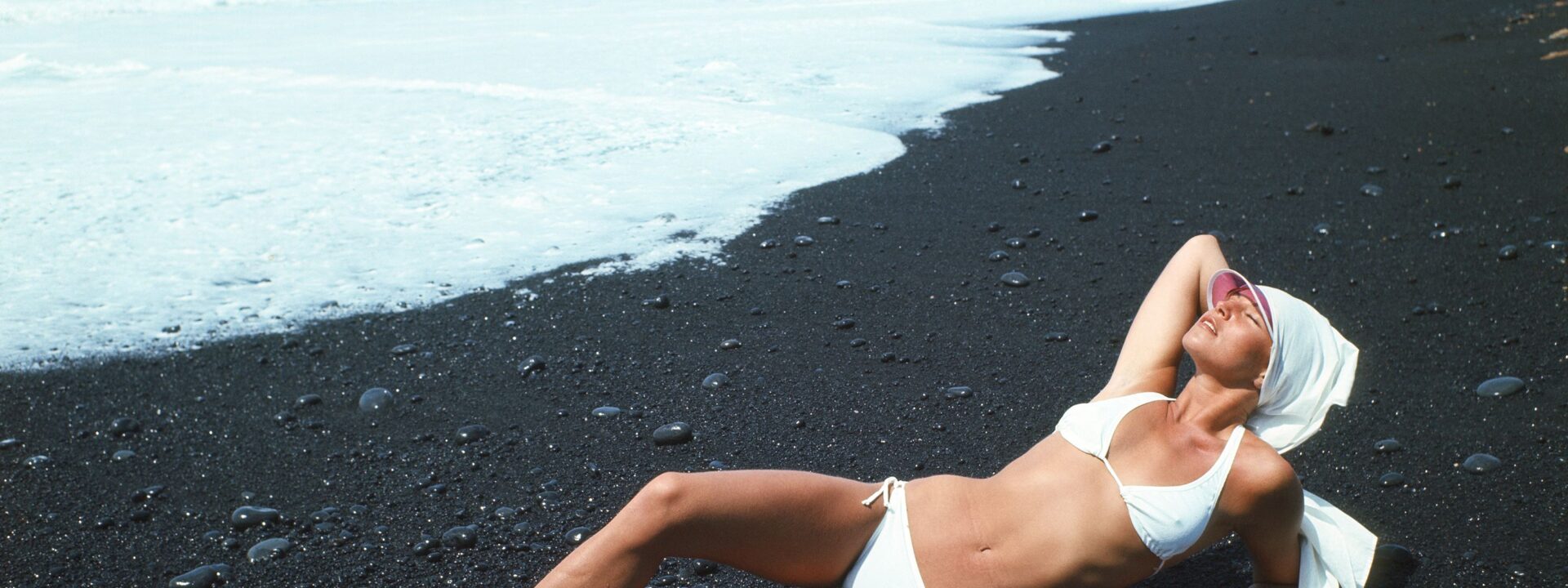
“Swim at Your Own Risk,” by Lynn Yaeger, first appeared in the June 2002 issue of Vogue. For more highlights from Vogue’s archives, sign up for our Nostalgia newsletter here.
So, this is what hell feels like: not what Jean-Paul Sartre described, but you, alone, under the bright lights of a fitting room, staring at your pale skin in a three-way mirror while wearing a bathing suit.
“It’s the thing women say they hate doing more than anything else in the world,” says Necha Treitel, a saleswoman in Bergdorf Goodman’s swimsuit department. “You see the most amazing bodies, but you end up spending a long time in the dressing room with them—they need a lot of reassurance.” Over the past few seasons, Treitel has had much more to offer her customers than the usual Lilly Pulitzers and Gottexes. Runway designers, who until recently focused on evening wear and boardroom attire, have now turned their attention to the beach. The result is a swimsuit market full of playful Moschinos, sexy Cavallis, camouflage Gallianos, and butterfly-covered Guccis.
Unfortunately, just as a pair of Louboutin flip-flops costs much more than the ones sold in bins, high-end swimwear comes with a price tag that’s anything but modest. But that doesn’t seem to bother the growing number of women who think wearing designer bathing suits is just as important (and fun) as walking around the pool in the latest Jimmy Choos and a new Cartier watch. Why else would some Palm Beach residents spend $1,045 on this year’s Leonard of Paris caftan and a matching $385 Leonard maillot, when another floral cover-up would work just as well? For the same reason not every fringed purse is a Balenciaga.
“This is the exact same print we sell on our third floor,” says Treitel, holding up a sheer silk-chiffon Chloé peasant blouse ($375) meant to go over a Chloé swimsuit ($235) with a matching pattern (featuring dinosaurs, seabirds, and what looks like a chubby guy sitting on a beach). “This Missoni cover-up could definitely double as a dress!” she adds, showing off a sleek piece in the brand’s signature flame-stitched stripes.
“Look at this La Perla!” Treitel laughs, holding up a creation made of two metal-mesh squares that looks like a deconstructed evening bag. You might think this piece is meant to cover the sheer top of a tiny $635 La Perla suit, but no—it’s actually designed to cover the bottom of the bikini, front and back.
“Yes, we made that!” admits Gianluca Flore, La Perla’s CEO. “But really, everything else we have, I promise, can go in the water.” Flore has curly brown hair, Mediterranean-blue eyes, and an Italian accent. He refuses to admit that swimsuit shopping is scary. “What do you mean?” he asks, looking a little hurt. “How can it be a nightmare? Because it’s based on emotion?”
La Perla may tap into our subconscious desires (does anyone really know why she suddenly wants an army-green beaded bikini?), but the company never forgets what makes a suit functional. “We understand the cups, the bottoms,” Flore says, “because we started as a lingerie company.” In fact, from a design perspective, La Perla’s tiny suits are impressive feats of delicate engineering, as remarkable as the Ponte Vecchio.
La Perla began in an apartment in Bologna 50 years ago, and the company still keeps a European outlook. “What we noticed, as a foreign company, was that ten years ago in America, people used bathing suits as something to wear in the water,” Flore observes, raising an eyebrow in slight disbelief. “That wasn’t the case in Europe. There, they thought about the lifestyle behind the beach. When they shopped, they looked for the lifestyle.”
Flore says his company doesn’t follow trends—it sets them. If that’s true, watch out for what he calls the “chainkini”—a two-piece with a bra held together by a thick chain that could, if needed, double as a weapon.
Sarah Hailes, a buyer for Harvey Nichols in London, agrees that swimwear has become a fashion statement. “It’s not just about the beach anymore,” she says. “It’s about looking good by the pool, at a beach club, or even just lounging at home.” She notes that customers are willing to spend more on suits that make them feel confident and stylish, even if they never actually go in the water.
For many women, the appeal of designer swimwear goes beyond practicality. It’s about status, self-expression, and the thrill of owning something exclusive. As Treitel puts it, “When you put on a beautiful suit, you feel like a million bucks—even if you’re just standing in a fitting room.”The co-owner of Kirna Zabête, a SoHo boutique decorated in bright primary colors that make it look like a day-care center for debutantes, has a soft spot for Tomas Maier’s swimwear. Maier is the accessories designer behind those gorgeous woven-leather totes at Bottega Veneta. In his other line, he creates swimsuits that cost up to $325 and form-fitting silk caftans priced at a steep $595. Despite these high prices, the sleek, athletic style of Maier’s one-pieces and bikinis has earned him a devoted following from Sardinia to Southampton. “It’s perfect,” Hailes says. “The perfect cut, the perfect fit, the perfect colors: camel, chocolate, burgundy. And oh, his one-ply cashmere cover-ups! They’re the best on the market.”
Hailes’s customers buy a new swimsuit every year, “like boots in the winter,” and her store takes a tough-love approach to the fitting room experience. “You know, we have three-way mirrors in every fitting room, so you can see yourself from every angle. I mean, why fool yourself?” she says. “And we even have a skylight. Natural light. It might not always be super flattering, but it gives you a true sense of how you look.” Isn’t that a bit traumatic? “Oh, please,” she says with a shrug. “You have your chocolate cake, you do a few sit-ups.”
No cake at all, and more than a few sit-ups, are needed for women who want to look good in the almost impossibly tiny beachwear at the new Jean Paul Gaultier boutique on Madison Avenue. One of the shop’s salespeople admits these suits “would make a Brazilian blush.” Leaning into a glass display case, the salesman pulls out an extravagance as small as it is bold: a fluorescent-orange bikini made of molded rubber, covered with 3-D flowers in the same color. “This is the best bathing suit in town,” he says, gently touching its rubbery shape. “It’s more of a lounging suit. For looking glamorous by the pool.”
This item looks a lot like a bathing cap. “Actually,” the salesman says, “there’s a matching cap too. We should be getting it in any day now.” The total price is a whopping $430. Gaultier was nice enough to price the pieces separately: $180 for the bottom, $250 for the top.
That kind of whimsy is what makes high-end designer shopping so fun. “You could wear just the top with suede pants,” the salesman suggests, “or maybe even put it under a suit jacket.” Here’s another idea: Wear it the way Gaultier showed it on his Paris runway, with your face painted blue.
Of course, sometimes a willingness to spend big money isn’t about brand obsession at all. It comes from a more basic source: pure lust.
Ambika Conroy designs tiny swimsuits for that group of elegant hippies who, if they had to wear clothes at all, would rather slip into a tiny crocheted bikini than anything even slightly practical.
Only 22, Conroy was working as a photo assistant when she taught herself to crochet during downtime on fashion shoots. Her original inspiration was a super sexy Helmut Newton photo from the 1970s of a woman in a bikini: She wanted that suit, and the only way to get it was to make it herself. “I thought most of the bikinis I could find were ugly,” she explains in her sweet voice.
Models and stylists noticed what Conroy was doing, and soon her tiny, jeweled creations found a home—barely clinging to the backsides featured in the pages of the Sports Illustrated swimsuit issue. Without a discreet bit of Lycra, Conroy’s work can sometimes seem more like jewelry than clothing. “I grew up in India, and I love gems,” she says. Conroy says she personally dunks all her creations in the tub to make sure they’re seaworthy—and if the silver tarnishes a little, she doesn’t mind. “I like it that way,” she says. “It looks antique.”
Turquoise, green chrysocolla, and silver ready to tarnish are strung together in the tiny Ambika outfit that model Yamila Diaz-Rahi wears in this year’s Sports Illustrated. The suit wasIt was supposed to be exclusive, just for the photo shoot. But one excited reader loved it so much that he tracked down the designer and ordered it for his girlfriend. Conroy charged him $1,800.
Frequently Asked Questions
Here is a list of FAQs about Lynn Yaegers article on the luxury bikini trend from the early 2000s written in a natural conversational tone
1 What is this article about
Its about the craze for superexpensive designer bikinis in the early 2000s Lynn Yaeger explores why people were spending hundreds of dollars on tiny swimsuits
2 Who is Lynn Yaeger
Shes a famous fashion writer known for her witty sharp and slightly quirky style She wrote for The Village Voice and Vogue and she has a very distinct nostalgic voice
3 Why was the luxury bikini such a big deal back then
It was a status symbol In the early 2000s designer logos were huge A bikini by Gucci Dolce Gabbana or Versace wasnt just for swimmingit was a flex like wearing a designer handbag to the beach
4 Did the article actually like the luxury bikini or was it making fun of it
A bit of both Yaeger is famous for observing ridiculous trends with a mix of fascination and gentle mockery She seems amused by the idea of spending a fortune on so little fabric but she also appreciates the fantasy and glamour of it
5 What were some specific examples of luxury bikinis mentioned
She typically references highend Italian and French brands Think bejeweled Gucci triangles logoprinted Fendi sets and barelythere Dolce Gabbana styles that cost as much as a nice coat
6 Whats the main problem with a luxury bikini according to the article
The impracticality Youre paying a premium for delicate fabrics metal hardware and embellishments that can rust fade or fall apart the second they touch saltwater or chlorine Its a swimsuit that cant really be used for swimming
7 Is this article still relevant today
Yes in a nostalgic way The early 2000s fashion cycle has come back around Plus the idea of investment swimwear is still a topic of debate so Yaegers take feels surprisingly current