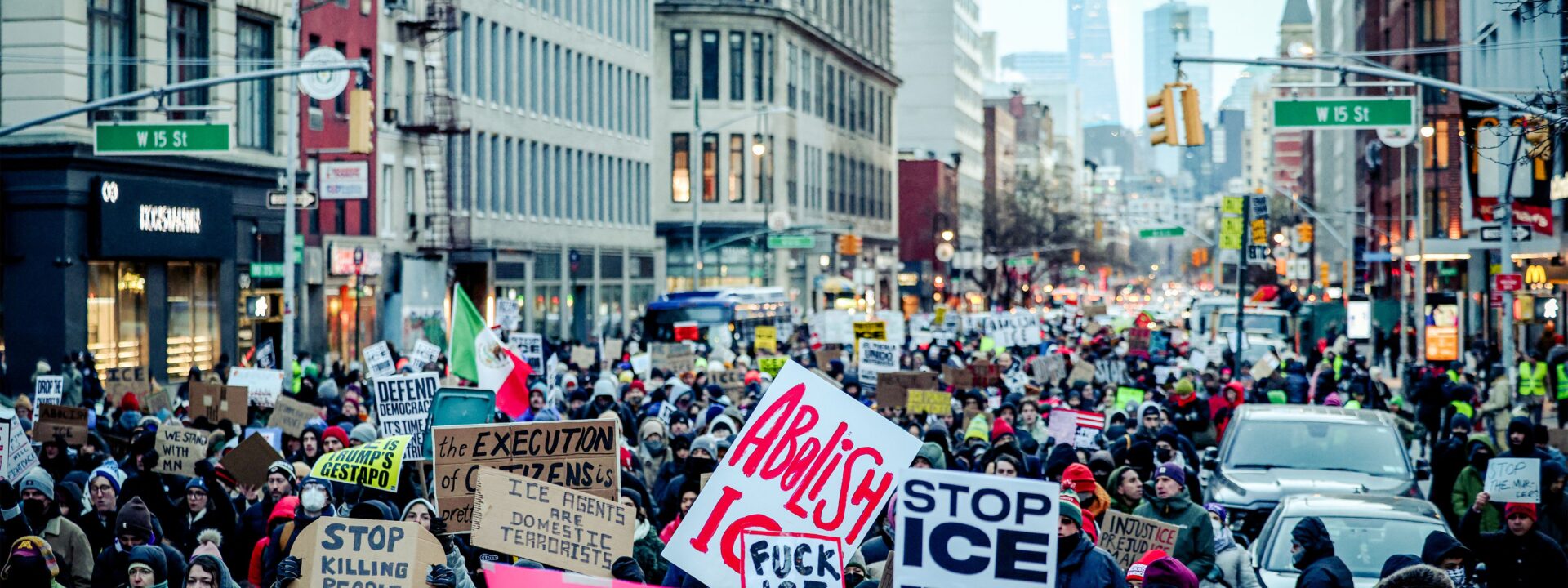
Today is not a typical day for businesses across America. While Fridays are usually one of the busiest and most profitable shopping days of the week, many stores nationwide have closed their doors as part of a National Shutdown.
This nationwide strike expresses opposition to ICE and aligns with demonstrations taking place in numerous cities. Typically, such actions are limited to specific industries—like the 2023 SAG-AFTRA strike, which lasted 118 days and delayed Hollywood productions for years, or the ongoing New York Nurses Strike that began on January 12. However, today’s strike marks the first general strike since the Strike for Black Lives in 2020.
Businesses learned about the strike in various ways. Lily Kaizer and Kate Corcoran, the team behind the bi-coastal vintage store Happy Isles, heard about it through a video shared by Patti Harrison. Zulaikha Aziz, founder of the fine jewelry brand Mazahri, saw calls to action from former U.S. Secretary of Labor Robert Reich and the Somali Student Association at the University of Minnesota. Albert Mendez, founder of the Austin-based concept store Rocha, said it was a topic of conversation at the Paris market. Many others simply noticed people sharing their participation on social media, which first alerted them to the strike’s potential.
“My feed was blowing up with calls to action,” says Megan O’Neill, owner of the emerging shoe company Nayla. “As much as Instagram can be a pain, it’s really incredible for igniting a movement.”
Unsurprisingly, most of the brands participating in the strike—which spans industries like restaurants, fitness studios, and fashion—are small, independently-owned businesses. This comes at a particularly tough economic time, with a dramatic decline in vitality for small businesses. For each of these brands, closing for the day is a significant risk.
For New York-based handbag and accessories designer Brandon Blackwood, the decision to close came with business implications. “We postponed our Valentine’s Day drop, which is a huge moment yearly for the brand,” he says. This involved moving internal meetings, adjusting the launch calendar, and coordinating with the warehouse to manage inventory and packing stations. “From a logistics standpoint, it’s manageable, but it does require intention and alignment across the teams. Everyone understood why we were doing it, which made it easier.”
Brandon Veloria Giordano, cofounder of James Veloria, was inspired by his immigrant mother to close. “She wanted to open her own small business, a hair salon, but was never able to do it in her short life,” he says. “I know there are countless other stories like my family’s, so it only feels right to show solidarity with our immigrant community.”
Kathleen Sorbara, owner of the Williamsburg shop that bears her last name, felt compelled to participate following the killings of Alex Pretti and Renee Good. “My business’s DNA has always aligned with my personal beliefs,” she says. “I think that’s the beauty of being a small business owner—I don’t have C-suites to report to.” While Sorbara’s doors are closed, she plans to pay her employees as if it were a regular workday.
“It’s been meaningful to see so many small businesses come together in a unified way,” says Mendez, adding that when he heard about the strike while in Paris, he felt excited. “I’ve been protected, supported, and cared for by immigrant communities my entire life, so we wholeheartedly condemn the assault on not only undocumented immigrants, but also U.S. citizens.”
Each business we spoke to echoed the sentiments of Laurel Pantin, who runs a 30,000-follower Substack and the brick-and-mortar store Earl in Los Angeles. “The risks of not speaking out are way more grave than potentially losing a client over my beliefs,” she says. “I’m not worried about losing customers or subscribers to my newsletter by speaking up.”I speak openly about what I believe is right, and I act on those beliefs. I know this may mean that not everyone around me will support what I’m doing—and I’m at peace with that.
Happy Isles had to reschedule ten bridal appointments booked for that day, which was especially challenging since many of their brides travel from out of state. “Closing for a day is a small sacrifice,” Kaizer and Corcoran wrote via email. “We are ready to keep putting our values first. There’s more to life than money or pleasing customers whose morals don’t align with our own.”
Frequently Asked Questions
Of course Here is a list of FAQs about Inside the National Shutdown The Fashion Industry Strikes to Protest ICE designed to cover a range of questions from basic to more detailed
Beginner Definition Questions
1 What was the National Shutdown in the fashion industry
It was a oneday work stoppage and social media boycott on February 14 2020 Hundreds of fashion brands publications and influencers paused normal business to protest US Immigration and Customs Enforcement and call for its abolition
2 Why did the fashion industry protest ICE specifically
Organizers highlighted ICEs role in family separations detainment of children and inhumane conditions in detention centers They argued that the industry which relies on global talent and immigrant labor had a moral duty to take a stand against these policies
3 Who organized the shutdown
The action was organized by a coalition of activists and fashion professionals prominently led by the account fashionforICE on Instagram which served as a central hub for information and resources
4 What did participants actually do on the day of the shutdown
They did not conduct normal business This meant not posting commercial content on social media not sending promotional emails not holding market appointments and using their platforms instead to share educational resources about ICE and immigrant rights organizations
Intermediate Impact Questions
5 Did any big brands actually participate
Yes Major participants included brands like Everlane Reformation and Mara Hoffman as well as influential publications like Vogue Teen Vogue Business of Fashion and The Cut Many independent designers and influencers also joined
6 What was the goal Was it just about one day of silence
The primary goals were to 1 Raise public awareness about ICEs actions 2 Redirect industry and consumer spending to immigrantled organizations via donations and 3 Spark longerterm political engagement and policy change within the industry
7 Was it effective
It was effective in raising awareness and generating significant media coverage about the intersection of fashion and politics It mobilized millions in donations for groups like RAICES and the ACLU However critics argued it was a oneday symbolic gesture that didnt address the industrys own complex ties to global labor and immigration