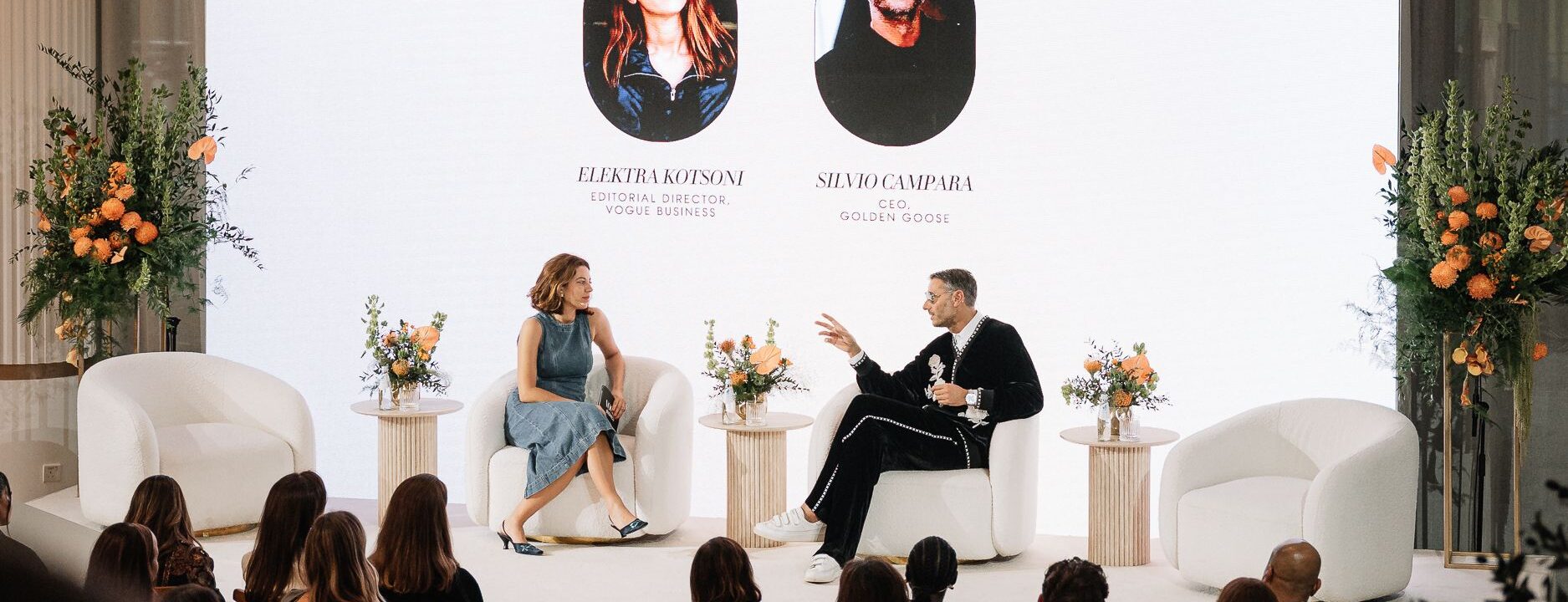
As Dubai solidifies its status as a fashion capital in a region of sustained growth and long-term opportunity, it was fitting to bring Vogue Business Fashion Futures back for a second edition. Hosted in partnership with Dubai Design District (d3), the event coincided with Dubai Fashion Week, welcoming over 150 guests—including fashion leaders, entrepreneurs, and sustainability advocates—for a series of conversations and panels centered on “building in uncertainty.”
The discussions explored the relationship between legacy and innovation, and how long-term partnerships are fostering more resilient growth models in the region and beyond. The event was held at Thea, a French Mediterranean restaurant located within d3, Dubai’s iconic global creative ecosystem developed by TECOM Group PJSC.
From Family Business to Investment-Ready Brand
The event opened with a welcome note by Khadija Al Bastaki, Senior Vice President of Dubai Design District, who highlighted Dubai’s growing strength as a creative hub. She also announced that Italian brand Golden Goose would be joining the d3 community, before introducing the brand’s CEO, Silvio Campara, as the keynote speaker.
In conversation with Vogue Business and Vogue Runway deputy director Elektra Kotsoni, Campara traced the journey of the family-founded label into a global brand with strong cultural and commercial value. Under his leadership, Golden Goose attracted strategic investment from global private equity firm HSG, which acquired a majority stake in the company last December for over €2.5 billion.
Campara joined Golden Goose in 2013. The brand was founded in 2000 by husband-and-wife duo Alessandro Gallo and Francesca Rinaldo, best known for its star-motif sneakers. What drew him to the brand was its underlying philosophy. “When I first met Alessandro, he told me: ‘Golden Goose should be a platform of items that age with you. They get wrinkles, because those wrinkles make the items special,’” Campara shared with attendees. Today, the brand maintains a 60% retention rate, which Campara attributes to staying true to its philosophy in every decision.
His advice to entrepreneurs: “The most important thing in a business is philosophy, and staying true to it. Numbers come second. If you start with numbers, you will fail.” He added that consistency and customer happiness form the foundation of any successful fashion business.
Brands of the Future
The first panel, titled “Discovering the Brands of the Future,” explored how brands are being identified, built, and scaled amid global uncertainty, with a particular focus on the Middle East as a cultural and commercial market. Featuring Grace Khoury, SVP of Fashion at Chalhoub Group; Camille Perry, co-founder of London-based womenswear brand Tove; and Khairunnisa Suhail, creative director of UAE-based athleisure brand The Giving Movement, the discussion repeatedly emphasized one principle: future-ready brands are built by placing the customer—not the product—at the center.
Moderated by Vogue Business’s Elektra Kotsoni, Khoury noted: “We are not brand collectors. Success begins with understanding what makes the consumer feel something emotionally and culturally, rather than simply exporting a global playbook.” She stressed that cultural intelligence is especially critical during periods like Ramadan, which requires planning nine to 12 months in advance. While localized initiatives such as suhoor gatherings may not yield immediate commercial results, they help build long-term relevance and trust.
Suhail echoed the importance of listening to the customer. “Building a brand…”Building a brand in the Middle East means building with the region, not for it,” she said, emphasizing the importance of understanding local lifestyles, fabrics, colors, and preferences. As The Giving Movement is a homegrown brand, its creative director, Khairunnisa Suhail, sees one of her key roles as protecting the label’s core design principles—minimalism, timelessness, and fit—throughout its growth.
The panel included discussions with Grace Khoury, SVP of fashion at Chalhoub Group; Camille Perry, co-founder of the London-based womenswear brand Tove; and Khairunnisa Suhail.
Meanwhile, Tove’s Camille Perry shared her experience navigating global volatility—from the pandemic and Brexit to current US tariffs. “Tove was conceived not as a geographically defined brand, but around a global woman,” she said. “So our expansion into the Middle East followed the same principles of community-building, connection, and listening.”
The discussion made it clear that brands built on cultural understanding, consistency, and emotional resonance are the ones most likely to endure.
Why Enduring Collaborations Matter
For the second panel, Vogue Business Middle East correspondent Sujata Assomull moderated a conversation on “Long-Term Partnerships: Why Enduring Collaborations Matter,” featuring Aida Al Busaidy, associate VP of consumer advocacy at Dubai Corporation for Tourism and Commerce Marketing (DCTCM); Yasmeen Sami, d3 director of brand strategy and partnerships; and Mette Degn-Christensen, director of the design fair Downtown Design.
While fashion loves newness, it is long-term partnerships that underpin the most successful businesses—building credibility, resilience, and real impact. “[Indian fashion designer] Manish Malhotra decided to open a store in Jumeirah almost 20 years ago, when many didn’t believe in the city,” Al Busaidy said. “The long-term visions and partnerships from back then are why we continue to develop these relationships today.” (Malhotra, the closing designer for Dubai Fashion Week, is also the first Indian designer to open a flagship store on Luxury Avenue at The Dubai Mall.) Al Busaidy added that government support and strategic collaboration have helped Dubai cultivate cultural narratives while attracting global talent.
Downtown Design, the Middle East’s leading contemporary design fair, now in its 12th edition, has become a key fixture on the international design calendar. Degn-Christensen outlined the fair’s evolution. “We went through Covid together, with d3 and DCTCM,” she said. “It wouldn’t have worked without long-standing partnerships. You learn, adapt, and innovate with partners over time.” She cited the UAE Designer Exhibition, where Dubai-born multidisciplinary designer Omar Al Gurg first showcased, as a testament to nurturing local talent; he has since become a mentor and curator.
Then, Yasmeen Sami outlined d3’s approach to building and sustaining strategic relationships. “Maintaining long-term partnerships is our new sustainability,” she said. “We curate opportunities that provide global platforms for regional creatives, while evolving existing relationships to ensure relevance.” Sole DXB is one of the few cultural festivals that Dubai’s younger generations have stayed loyal to, and it remains one of the most-anticipated events on the city’s annual calendar. Sami explained how d3 acts as a connector for such collaborations, facilitating introductions and access to wider ecosystems.
The evening closed to loud applause as Al Busaidy summarized: “Dubai is a place where things happen. We’ve built an ecosystem that blends infrastr…We have the structure, talent, and opportunity. It’s time for the world to see what this region can achieve—and we’re already making great progress.
Frequently Asked Questions
Of course Here is a list of FAQs about the Vogue Business Fashion Futures event in Dubai designed to sound like questions from a real person
General Beginner Questions
What is Vogue Business Fashion Futures
Its a major industry conference and networking event focused on the future of fashion specifically in the highgrowth markets of the Middle East Africa and South Asia It brings together global brand leaders regional innovators and experts to discuss trends technology and strategy
When and where did it take place
The 2024 edition was held at the Atlantis The Royal in Dubai
Who typically attends this event
Attendees include executives from global luxury brands founders of regional fashion and beauty labels investors tech entrepreneurs sustainability experts and media
I missed it Can I watch any sessions online
Yes Vogue Business often publishes key takeaways interviews and sometimes recordings or livestreamed panels on their website and social media channels after the event
Is this just about clothing
No it covers the entire fashion ecosystem including beauty retail technology sustainability investment and cultural shifts
Content Themes
What were the main topics discussed this year
Key themes included the rise of modest fashion as a global force the strategic importance of the Middle Eastern consumer the practical application of AI in design and retail building authentic brands in new markets and the evolving definition of sustainability and circularity
Was there any talk about AI in fashion
Yes significantly Discussions moved beyond hype to practical use caseslike using AI for personalized customer service trend forecasting and optimizing supply chainswhile also debating its impact on creativity and jobs
What was said about sustainability
The conversation focused on action over buzzwords Topics included regenerative materials tackling greenwashing building a circular economy in regions with developing infrastructure and how sustainability is becoming a core value for younger consumers in the Middle East
Did they discuss the Middle Easts specific role in fashions future
Absolutely A major theme was the regions shift from being just a luxury shopping destination to a cultural and creative hub Discussions highlighted homegrown talent the influence of regional aesthetics on global trends and the power of the Middle Eastern consumer to drive brand strategies worldwide
Advanced IndustryFocused Questions