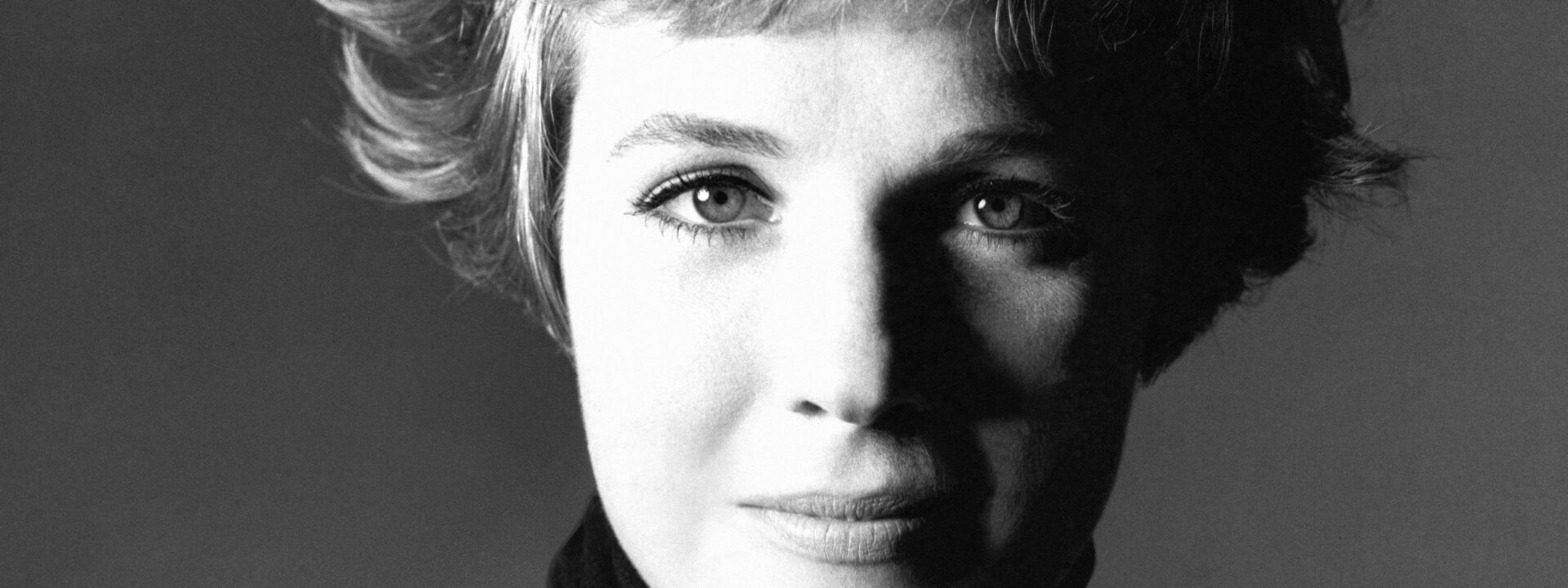
“Julie Andrews” by Gloria Steinem was originally published in the March 1965 issue of Vogue. For more highlights from Vogue’s archive, sign up for our Nostalgia newsletter here.
The secret to Julie Andrews’s success is simple: she somehow manages to be both regal and awkward, witty and scatterbrained, a dewy-eyed ingénue and an old theater pro, sweet-tempered and sharp, level-headed and wacky, monumentally sexy and perfectly ladylike—all at once.
Take, for example, her recent effect on the jaded regulars at a New York discotheque. She walked in wearing a plain white blouse and dark skirt, a stark contrast to the glittering jewels and plunging necklines around her. “How sweet!” one woman remarked. “Who’s Miss Goody Two-Shoes?” said another. She danced a few sinuous frugs, her face a picture of girlish concentration on getting the steps right—while the rest of her got it very right indeed. By then, it was clear that a five-foot-seven sensational figure was hidden beneath that schoolgirl outfit, and her translucent English skin glowed with excitement. “I don’t think she has any makeup on at all,” one woman observed. A man watching her dance asked who she was. “That’s Julie Andrews?” he exclaimed. “But here she’s quite sexy, and on stage she seemed so… so cool.”
When the music switched to a waltz, Miss Andrews led her partner and two other couples in a deadpan, outrageous parody of an English hesitation waltz. Appreciative laughter rippled through the crowd. Miss Andrews fixed the laughers with the aloof stare of a dowager peering through an imaginary lorgnette. More laughter followed. “Who,” asked a gossip columnist, “is that man she’s with?” “Her husband,” his neighbor replied. She left the dance floor with her friends, adding a small vaudeville exit step as she went. The man who found her sexy stopped her to say hello and rave about her Hollywood success; Miss Andrews listened with delight. “Obviously,” the man’s wife whispered to the columnist, “all that ladylike act is just a pose. She’s just another starlet.” The man introduced his wife. “Oh,” Miss Andrews said enthusiastically, “what a perfectly marvelous dress!” Glancing down at her own blouse, she added that she felt rather silly dressed so plainly, but she and her husband had decided to come at the last minute. She straightened her skirt and looked uncertain. “Never mind,” said the wife, now completely charmed, “you look beautiful.”
The evening went on. Miss Andrews drank brandy and soda sparingly (“I always think brandy is so much healthier than gin, don’t you?”) and danced often. In between, she played a favorite game with her friends: one person pantomimes a famous movie moment, and the others have to guess the film. First she was Joan Crawford in Sudden Fear, then Sydney Greenstreet in The Maltese Falcon, and she was equally convincing as both. The rest of the group—including movie buffs Stephen Sondheim and Mike Nichols, along with her husband, designer Tony Walton—howled with laughter. People at nearby tables caught the spirit and smiled too. Mr. Sondheim mimicked Gary Cooper in The Fountainhead, and Miss Andrews guessed it. (“You know,” the wife remarked, “she’s one of the few beautiful women who looks genuinely friendly.”)
Even the stern columnist smiled by now. He was still smiling as he watched her get ready to leave, covering her cotton blouse with a full-length pastel mink coat. “She’s the kind of girl,” he said, searching for the right words, “that you could take home to Mother. Provided, of course, that you could trust Dad.”
Had she heard, Miss Andrews would have been delighted that anyone was worried about trusting Dad. After a year as the marzipan heroine of The Boy Friend, three years in My Fair Lady, and another as Queen Guinevere in Camelot, she was…Feeling hopelessly typecast as a lady—and a singing lady at that. (“My problem,” she explained gloomily, “is that everybody thinks I’m a square.”) A television special called Julie and Carol at Carnegie Hall gave her some relief: she still sang, but she clowned around too. “Carol Burnett is one of my closest friends,” she said. “With her, I can talk dirty and act wacky and not be a lady at all.” Her role in the film Mary Poppins—as the magical nanny who is “practically perfect in every way”—earned her an Academy Award nomination and Hollywood stardom, but she was still singing and still came across as terrifyingly, if idiosyncratically, well-bred.
“Please don’t think,” she explained, “that I’m not proud of those roles and very grateful for them. I love musical theater and don’t want to drop it. I adored doing Mary Poppins; it opened a whole new world for me, and I’d like to do a film every year. But thank God for Emily. Without her, I might have sung ‘I Could Have Danced All Night’ forever.”
For those who didn’t know her and couldn’t see her in discothèques, the film The Americanization of Emily—released just one month after Mary Poppins—was their first introduction to the unladylike, uncool, and non-singing Miss Andrews. Some critics had doubts about the film itself, but they all welcomed her enthusiasm, wit, and faintly tangy quality as a blessed relief in a world of saccharine ingénues. And Emily was no lady. As an English girl surrounded by American soldiers in London, Miss Andrews played love scenes that might have shocked Eliza Doolittle. Most of all, the screen did justice to qualities lost on the stage: a face that registers every emotional nuance and a rare kind of close-up radiance.
In her third movie, The Sound of Music, Miss Andrews sings again, but by the time it’s released this month, she’ll already be at work on a fourth called Hawaii, in which she will hardly sing, if at all. After that, she’ll film Peter Shaffer’s play The Public Eye in London.
And after that? Well, she has plenty of secret ambitions. For instance:
– To make a real old-fashioned Western. (“If I didn’t sound British, I’d make a super singing cowgirl. Maybe Yves Montand and I could be strangers who come to town.”)
– To portray the life story of a burlesque queen. (“That should put an end to the lady image.”)
– To play Salomé in the opera. (“All that blood and lust—marvelous!”)
– To sing light opera. (“I did so many drastically cut versions as a child; I’d love to get my voice in shape for one good crack at the real thing.”)
Miss Andrews, now twenty-nine, has been singing since she was eight, when her mother and stepfather—a vaudeville team in the English provinces—discovered she had a rare voice with a range of four or five octaves. She performed with her parents on BBC broadcasts and army-camp tours, and looks back on all of World War II as one continuous soprano rendition of “The White Cliffs of Dover.”
After the war, she kept singing on television, in vaudeville, musical revues, and children’s shows. She met Tony Walton during a performance of Humpty Dumpty, in which she played the egg. She was thirteen; he was a year older, and they began writing to each other. Ten years later, in 1959 (by then the egg had hatched into Eliza Doolittle), they married, and now have a very blond two-year-old daughter named Emma Kate.
“Tony is undoubtedly the biggest single influence on my life,” said Miss Andrews. “He even kept Hollywood from changing my nose, which may—who can tell?—have made the difference between success and failure. ‘Touch that nose,’ he said, ‘and I’ll kill you.’”
There was, in fact, some concern about how the very English Miss Andrews would fare in Hollywood. The answer is just another proof of her unpredictability: she loves it. She loves the weather and the space…She adores salads and the freedom of driving around in her own little car. She even loves workdays that start at 6 A.M. “Between scenes,” she explained, “I practice singing, write letters, or read—no time is wasted. By the end of the day, I really feel like I’ve accomplished something!”
Success in films has given Julie Andrews more confidence than all her years in My Fair Lady. (“I feel a little less like a scared beginner. I can try to make it on my own now.”) But she still gets dismayed from time to time by what she sees as her own shortcomings—like her trouble remembering names, even when they belong to her employers.
After one such incident—she saw a Broadway playwright she’d recently had dinner with and called him by the name of a Hollywood director she barely knows—she suggested this description: “Miss Andrews is tall, has long arms, and makes faux pas.”
Frequently Asked Questions
Of course Here is a list of FAQs about From the Archives The Secret to Julie Andrewss Success designed to sound like questions from a real audience
General Beginner Questions
Q What is From the Archives The Secret to Julie Andrewss Success
A Its typically a documentary interview compilation or archival article that explores the key factors behind Julie Andrewss legendary and enduring career in film television and theater
Q Whats the main secret they talk about
A While theres no single secret these pieces usually highlight her exceptional vocal discipline relentless professionalism ability to embody timeless grace and remarkable resilience in overcoming personal and professional challenges
Q Is this about a specific movie like Mary Poppins or The Sound of Music
A It uses those iconic roles as prime examples but the focus is on the consistent qualities and work ethic she applied throughout her entire career from Broadway to Hollywood
Q Why is Julie Andrews considered such a success
A Beyond her iconic roles and perfectpitch voice she is revered for her versatility her dignity and class as a public figure and her ability to connect with multiple generations across decades
Deeper Advanced Questions
Q Does the archive material show how she dealt with career setbacks like losing her singing voice
A Yes a key part of her story is her resilience Advanced looks often cover how she handled the vocal cord surgery that changed her voice pivoting to acting directing and writing childrens books showing success isnt just about one talent
Q What specific professional habits or disciplines are highlighted
A Archives often reveal her meticulous preparationextensive vocal warmups deep script analysis and a strong collaborative spirit with directors and costars She was known for being thoroughly prepared and reliable
Q How did her early training in British music halls and vaudeville influence her later success
A This bootsontheground experience is frequently cited as crucial It gave her stage presence timing versatility and a strong work ethic from a very young age long before her Hollywood fame