“Eggs Unscrambled,” by Jeffrey Steingarten, first appeared in the May 2003 issue of Vogue. To explore more highlights from Vogue’s archive, you can sign up for our Nostalgia newsletter here.
“There are thirteen ways to cook an egg,” said Didier Elena in the kitchen. He listed them in French: “Oeufs sur le plat, oeufs frits, oeufs pochés, oeufs mollets, oeufs cocottes, oeufs moulés, oeufs à la coque, oeufs brouillés, oeufs durs, omelettes, and oeufs froids.” In English, these are baked, fried, poached, soft-boiled (five to seven minutes), coddled, molded, very soft-boiled (three minutes), scrambled, and hard-boiled, along with omelets and cold eggs set in a meaty, clear aspic. He reached thirteen by including two dishes that rely entirely on eggs: sweet and savory soufflés, and the light, egg-based sauce called sabayon.
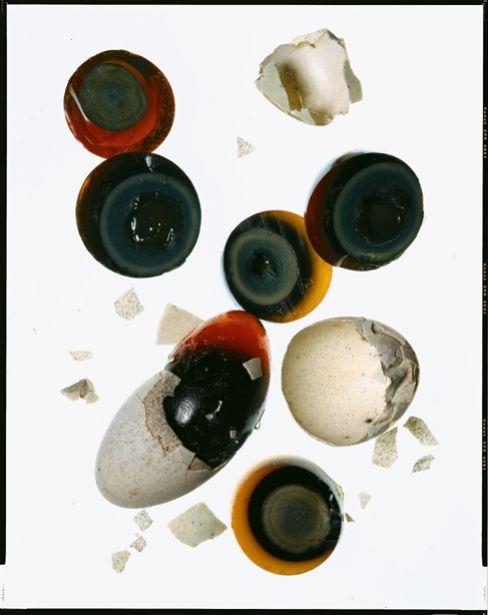
“Actually,” Didier noted, “there are 422 ways to cook an egg.” Most are variations on those core thirteen. He recommended Le Répertoire de la Cuisine by Louis Saulnier, first published in Paris in 1914. This book is a collection of over 6,000 names and brief recipes that capture the essence of haute cuisine (now referred to as fancy Freedom cooking) from ninety years ago. I own a copy but have never fully grasped it. What amazes me most is the French (or more precisely, the Freedom People’s) talent for inventing 6,000 distinct names for anything. Yet, even after creating 422 egg dishes, they never attempted—and perhaps never even imagined—the striking “1,000-year-old eggs” shown in Irving Penn’s remarkable photograph on the facing page. These are Chinese, of course, made by coating duck eggs in a paste of salt, wood ash, lime, and black tea, then burying them in rice husks inside large ceramic jars for 100 days. I suppose they just look a thousand years old. Thousand-year-old eggs can be quite tasty: peel, quarter, and serve with a dipping sauce of soy, vinegar, rice wine, and minced ginger.
As for me, I had nothing more ambitious in mind than the simple omelet. I confessed to Didier that I needed to start from scratch, as I had never managed to make a decent omelet. Finally, I was ready to confront this shortcoming. Saulnier lists 85 types of omelets, from Américaine, Andalouse, and Archiduc to Turque, Vichy, and Victoria. They vary only by their fillings and sometimes their toppings or accompaniments. One of the most enticing is the omelet Brillat-Savarin, stuffed with diced woodcock and black truffles and served with a rich game gravy. Then there’s the Durand, where eggs are mixed with mushrooms and artichoke bottoms warmed in butter; the finished omelet is rolled around asparagus tips and surrounded by a tomato glaze.
My goals were humbler. I just wanted to learn how to make the simplest little omelet. “Omelet-making is at once very simple and very difficult,” Saulnier writes. “The whole process should be done speedily, and requires long practice to attain perfection.” That’s the usual line. I needed hands-on guidance, and Didier Elena seemed the ideal teacher. At 31, as chef de cuisine at Alain Ducasse in New York’s Essex House hotel—one of the city’s top restaurants—Didier is a masterful cook with rigorous classical training. I called him, and he agreed to my plan. I would visit the Ducasse kitchen a week later.
In the meantime, I revisited my cookbooks. Omelets can be sweet or savory, flat or folded into an oval. I was focused on the savory oval kind, often called a plain omelet: beaten eggs cooked in butter and shaped into a neat, compact form.
The perfect plain omelet is tender, light (almost fluffy), moist (but not runny), and naturally sweet. Mine have always been tough and rubbery, sometimes dense, dry, and slightly bitter from too much browning. A proper plain omelet should have little to no browning.
Most cookbooks, including the best French basics by Julia Child and Madeline Kamman,Richard Olney says to start with a very high flame, melt some butter, pour in the beaten eggs, and then either scramble them for a while (following various scrambling techniques) or let them solidify slightly into a flat pancake. Then, you delicately lift the edges to let the uncooked egg flow underneath. Finally, you gather the eggs or roll or fold them. To get the resulting packet out of the pan, there’s an official technique that involves hitting the pan’s handle with your fist. None of these methods has ever worked for me.
Some omelets are made lighter by separating the yolks and whites, beating the whites, and folding in the yolks. Some people add cream, milk, small chunks of butter, or water to the beaten eggs. Most advise using a well-seasoned iron pan that you never wash and never use for anything but omelets.
Around this time, I spoke with TV producer Geoffrey Drummond, who lent me a classic collectible—the famous omelet episode from Julia Child’s early The French Chef series on WGBH in Boston. Julia demonstrates how to cook a perfect little omelet without any tools, just by shaking the pan in a magical way. I tried it once. I wonder if it’s bad for your stove to let molten egg drip inside and bake onto all the parts. She makes it look like so much fun.
I began to find the entire subject of eggs endlessly fascinating. As a haphazard and sloppy researcher, I read piles of information about eggs that turned out to have little relevance to making an omelet. One or two of those piles were still extremely useful:
Brown and white eggs are the same on the inside. An egg’s color depends on the breed of the hen. Araucana hens from South America lay eggs in lovely pastel blues and greens. Some are pink. Windfall Farms at the Union Square Greenmarket here in Manhattan sells such eggs, though they nearly always run out by the time I feel like strolling over to the market. They act as though they enjoy running out. I’ve read about dark-yellow eggs but never seen one. Why would anybody settle for white or brown?
Shirley Corriher, in her excellent book Cookwise, writes that a chicken’s egg will be the same color as her ears. Although I doubt chickens have ears, I’m eager to test Shirley’s idea at the earliest opportunity. She says you first have to brush aside the feathers.
Do you know the best way to open a raw egg? I do. Gently tap it against your counter, side first. Then turn it over and open it with your thumbs. No need to use the rim of a bowl or the edge of your counter, both of which will just drive shell fragments inward and dribble egg everywhere.
Chairman Mao did not invent the sinister expression, “You can’t make an omelet without breaking eggs.” The French did. At least by 1859, they were using the proverb, “On ne saurait faire une omelette sans casser des oeufs.”
You can test an egg’s freshness by laying it on its side on the bottom of a bowl of cold water. If it simply lies there, it is very fresh. If it tilts upward at about a 45-degree angle, it is a week old. If it floats to the top, it is probably rotten. Why? The empty space inside the flatter end of an egg, known among poultry farmers as the air cell, gets larger over time. An eggshell is perforated with 6,000, 8,000, or 17,000 microscopic pores (depending on whom you read). As the egg loses moisture and some of the carbon dioxide dissolved in the white, oxygen seeps in and the air cell grows larger; this causes that end to float. Why don’t I believe that anybody has actually counted all those pores under a microscope, one by one?
Your chances of getting salmonellosis from eating an egg are extremely small. The federal Centers for Disease Control tell us that in the Northeastern United States, where most salmonella-infected chickens can be found, one out of 10,000 eggs is infected. How many eggs do you have to eat before you have a 50 percent chance of eating an infected egg?Using statistical methods I vaguely remember from college, I estimate the answer is 6,931 eggs—nearly one egg a day for 20 years. The risk comes from eggs that are soft-cooked or raw. You would need to eat 6,931 undercooked eggs to be in danger. Undercooked chicken is actually a thousand times more likely to be infected.
When a hen is allowed to keep her eggs after laying them, she stops once she has a certain number and waits for them to hatch. By taking her eggs away, we can make her lay continuously. In modern egg factories, most laying hens live in cages measuring just under eight inches on each side. One worker can manage 100,000 caged hens but only 15,000 hens roaming freely in a barn. The average commercial flock has about 1,000,000 laying hens. Personally, I only buy free-range eggs.
Eggs are among the most nutritious foods because, as Harold McGee notes in On Food and Cooking, they are designed to be food. They nourish the chick just as milk supports a calf or a seed sustains a seedling. However, nutritionists have been uncertain about the risks of eating eggs. Egg yolks contain a lot of cholesterol, some of which becomes serum cholesterol in our bloodstream when we eat them. The American Heart Association recommends keeping daily cholesterol intake below 300 milligrams. A large egg yolk has about 213 milligrams, and extra-large eggs have even more. So, the AHA would limit you to about two omelets a week, with a mostly vegetarian diet the rest of the time.
I think this advice is misguided. If your serum cholesterol is low, why worry about dietary cholesterol? If it’s over 220, then by all means cut out cholesterol sources or take medication. I prefer pills because they allow me the freedom to eat what I like. It would be unreasonable to do otherwise. Besides, the science behind the AHA’s recommendation may be outdated; we’re learning that people vary widely in how their bodies respond to food.
Storing eggs in those individual slots in the refrigerator door does two things: it ensures your eggs get jostled dozens of times a day (in my case, about 100 times), and it removes the protection from refrigerator odors that the egg carton provides.
What we call a chicken descends from a Malaysian jungle bird—or maybe it was Indian. It spread widely due to the popularity of cockfighting, not because people enjoyed chicken salad. The arena for cockfighting is called a cockpit. There was one in a basement across from my house when I moved back to Manhattan years ago, but gentrification gradually erased most traces of Hispanic culture from our neighborhood.
Eggs are graded for quality according to USDA standards. Only grades AA and A are found in supermarkets; grade B eggs are used industrially. Eggs are graded soon after they’re laid, so grading doesn’t indicate freshness. They are “candled”—shone through with a bright light to check for blood spots (harmless), cracks, the thickness and opacity of the white, and the firmness of the yolk. The last two qualities are important for fried and poached eggs. For scrambled eggs and omelets, the less expensive grade A eggs work just fine. Freshness still matters for flavor.
Though I could have spent another week reading about eggs, book learning wasn’t going to help me make an omelet. It was time for my lesson with Didier.
It was early afternoon, seven hours before dinner, yet the kitchen at Ducasse was buzzing with energy. Didier—tall, blondish, and well-fed—took a black iron pan with high, curving sides, placed it near the edge of the hot, flat cooktop, filled it halfway with coarse salt, and shook it back and forth every so often. After half an hour of this, Didier poured out most of the salt.He vigorously rubbed the inside of the pan with a kitchen towel—a step I later learned at home creates a fine, clean, smooth cooking surface. In a nod to his native Monaco, Didier used olive oil instead of butter. He moved the pan to a hotter part of the stove while briskly whisking two and a half free-range eggs from Four Story Hill Farm in Pennsylvania with a little salt, pepper, and more oil for about thirty seconds. He then drizzled a bit of egg into the pan to test the heat. When it set almost instantly, he poured in the rest of the eggs all at once.
With one hand, he shook the pan back and forth. With the other, he held a fork flat against the bottom and scrambled the eggs in quick, small circles, forming little clumps—or curds—while the pan’s motion kept everything cooking evenly. After letting it settle briefly, he began rolling the omelet away from him using the back of the fork. It didn’t roll up neatly like a carpet; instead, he gently coaxed it along, often working in several spots at once. Every so often, he squared off both ends to achieve what he and his mentors considered the most elegant shape. When only about an inch remained, he tilted the pan and let the far edge meet a warmed plate, flipping the omelet onto it.
Here, haute cuisine technique came into play. Didier draped a clean kitchen towel over the omelet, pressing and shaping it here and there. The result was an ideal, picture-perfect omelet—straight, proudly puffed, about six and a half inches long and two and a half inches wide, with squared ends and not a speck of oil or runny egg in sight. We soon discovered it was light, sweet, and delicious.
Could I put this lesson into practice, or would I fail again?
“A shoddy workman blames his tools,” I hummed ironically as I walked into the J. B. Prince Company on East Thirty-first Street in Manhattan, searching for an omelet pan just like Didier’s. I always blame my tools—or at least use my mediocre results as an excuse to expand my collection of kitchen toys. I left the shop with three iron pans: one expensive cast-alloy model and two cheap pressed-steel ones. None were exactly like Didier’s, but all measured about 22 centimeters across the top, 18 across the bottom, and just over 4 centimeters high—what Didier had told me was standard for a single-serving omelet pan. That’s roughly 8.7 inches wide, 7.1 inches across the bottom, and a little more than 1.6 inches tall.
From my twenty-year-old American cast-iron skillets, I know it can take a year of seasoning before nothing sticks. But I didn’t have a year before my next omelet attempt. So I had my three new pans meticulously washed, coated them with vegetable oil, placed them upside down on a baking sheet in a 350°F oven for an hour, and let them cool overnight inside. I should have waited longer. The next day, the eggs bonded stubbornly to the metal—impossible to fold, roll, or even scrape out of the pan. It was the perfect moment for Didier’s salt trick… whenever I found the time.
Instead, I turned to my small nonstick pan and placed it over medium heat, just as Didier had. That’s when things started looking up. My omelets kept improving.
As long as the pan was nonstick and small enough that the eggs didn’t spread out and clump too quickly—and the heat stayed at a steady medium—it became harder and harder to make a truly bad omelet. Most food science books note that coagulating protein at lower temperatures yields more tender curds, and adding a little water or cream makes an omelet even more tender. I suspect old recipes called for high heat mainly to prevent sticking.
And maybe all that practice helped, too. I now make…I enjoy making omelets for fun whenever I have a spare moment, experimenting with different techniques from the recipe I’ve written below. Sometimes I even try cooking over very high heat, though that forces me to rush as if my life depended on it—not my favorite way to cook. Now, if only I could get my hands on a woodcock and some rich gravy…
A Plain Omelet
Ingredients:
– 1 to 2 tablespoons very good, fresh, unsalted butter, preferably softened at room temperature
– 3 large or extra-large chicken eggs, any color
– ¼ teaspoon fine salt
– Two grindings of fresh black pepper
– 1 tablespoon water or cream (optional)
– 1 tablespoon cold butter
Special equipment:
– A thick, nonstick frying pan, 9 inches across the top or 7 inches across the bottom
– A 1- to 2-quart bowl
– A dinner fork
Instructions:
1. Place the pan over very low heat. Add 1 to 2 tablespoons of the softened butter and let it melt slowly and completely.
2. Meanwhile, crack the eggs into the bowl. Add the salt, pepper, optional liquid, and, if you like, the remaining softened butter. (Harold McGee notes that adding liquid makes an omelet more tender by slowing protein clumping. Didier once showed me a trick: he beat one egg with several tablespoons of water to make a large, fluffy omelet—though it tasted quite bland.)
3. Beat the eggs vigorously with the dinner fork for about 30 seconds, or around 40 strokes. You can use a whisk, but many warn against overbeating, which can thin the proteins.
4. Raise the heat under the pan to medium or medium-high. Swirl the melted butter occasionally and heat it just until it starts to brown. (This enhances the aroma. The butter will be a bit hot for slow cooking, but if the heat is only medium, the pan will cool down quickly.) Give the eggs another quick whip, then immediately pour them into the pan.
5. Agitate the eggs. There are several ways to do this—try them all; it’s fun! If the eggs aren’t clumping quickly enough, turn up the heat a little. The cooking should take no more than 30–40 seconds, but starting at a lower temperature is easier.
Method A: As soon as the eggs spread out, hold your fork flat against the pan and sweep in broad circles, starting from the outside and moving inward in smaller circles. In about 20 seconds, after four or five sweeps, the eggs will be ready for the next step.
Method B: Let the eggs settle briefly. Once they start to coagulate at the edges, use a wooden spoon to pull a cooked section toward the center, allowing uncooked egg to flow outward. Move around the pan in about 60-degree increments, repeating quickly. In 20–30 seconds, the eggs should form moist, large clumps. Keep the pan moving back and forth. This is the method used at Mme. Romaine de Lyon, the famous old omelet restaurant in Manhattan, where co-owner John Benson gave me a five-omelet lesson two weeks ago.
Method C: Follow Didier’s (and Escoffier’s) method: Immediately begin scrambling the eggs by moving your fork (held flat against the pan) vigorously in small circles while moving the pan back and forth to redistribute the eggs. Once or twice, go around the outer edge to prevent overcooking. Stop while the eggs are still moist and before they form large clumps.
6. Now form the omelet by rolling or folding. To roll: Use the back of the fork to push the near edge of the cooked eggs about a quarter of the way across the pan, then pause for a few seconds. Carefully roll the near edge away from you, half an inch at a time. It may not roll evenly—just work in segments. Stop when you’re about an inch from the far edge.Place the pan about an inch from the far edge of the plate. To fold the omelet, some people can manage it just by shaking the pan. But even at places like Mme. Romaine de Lyon, they simply use a spatula to lift the near third of the omelet over the center, then flip it over. Whether folding or rolling, hold the pan at a 45-degree angle and bring its far edge to meet a dinner plate held at an angle in your other hand. Gently push or shake the omelet so its far edge slides over the pan’s rim and onto the plate. Quickly tilt the pan almost completely over the plate to flip and release the omelet, with the folded flap underneath.
Cover the omelet with a clean kitchen towel or paper towel. Using your hands, gently shape it into a neat, plump form while soaking up any excess liquid—such as butter, uncooked egg, or moisture released from overcooked egg whites.
Spear a pat of cold butter with a fork and glide it over the surface of the omelet to give it a glossy finish and enrich the flavor.
Serves one, or perhaps one and a half.
Frequently Asked Questions
Of course Here is a list of FAQs about From the Archives Jeffrey Steingarten Masters the Omelet written in a natural conversational tone
Beginner General Questions
Q What is this articlevideo about
A Its a classic piece where food writer Jeffrey Steingarten obsessively researches and tests techniques to create the perfect French omelet focusing on the method championed by chef Jacques Pépin
Q Who is Jeffrey Steingarten
A He was a famous food critic and writer known for his witty meticulous and sometimes obsessive approach to solving culinary mysteries He wrote for Vogue magazine
Q Whats so special about a French omelet compared to a regular one
A A French omelet is known for being pale yellow incredibly smooth on the outside tender and slightly runny on the inside and rolled into a tight oval or cigar shape
Q Do I need special equipment
A The most important tool is a good nonstick skillet A fork is also key to his technique
Technique Method Questions
Q What is the single most important tip from this article
A Constant vigorous stirring and shaking with a fork while the eggs cook This creates tiny soft curds that result in the signature creamy texture
Q How many eggs does he use
A Steingarten firmly uses three large eggs as the ideal amount for an 8inch pan seasoned with salt and pepper
Q What about butter How much and when
A He uses a generous amountabout a tablespoon The pan should be hot enough so the butter foams but doesnt brown before the eggs go in
Q Whats the archival trick with the fork
A He holds the fork parallel to the pans bottom to stir and lift the eggs gently preventing large curds from forming
Q How do you get that perfect shape
A Once the eggs are just set but still wet on top you tilt the pan and use the fork to fold about a third of the omelet over itself then roll it out of the