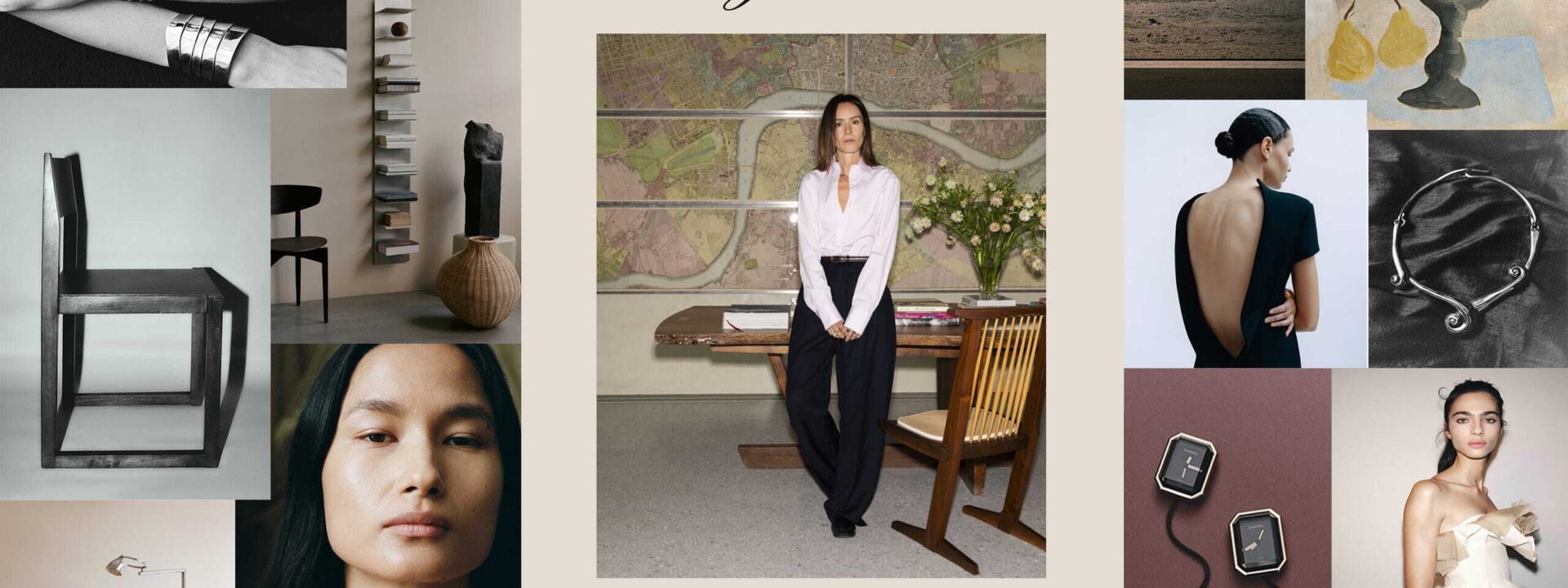
Eagle Eye is here to explore the gaps—between how we dress and how we live; between the spaces you’re drawn to and the coat you keep reaching for. Each month, London-based designer and creative director Alex Eagle will bring in her network of friends and experts to dig into the “why” behind a certain theme—why we’re drawn to certain things, and how those instincts quietly take shape over years without us even noticing. It’s a column rooted in interior design, with many branches (and, of course, a curated selection of shoppable products too).
For me, style has never been just about clothes. It’s shaped by everything else: the exhibitions we go back to, the books left open on a table, the objects we choose to live with. A perfectly cut jacket can feel as thoughtful as a piece of sculpture. A well-edited room can have the same clarity as a wardrobe that actually works. Once you start seeing those connections, you can’t stop… which is either a gift or a mild obsession, depending on who you ask. This column is a place for me to gather those references. Not in an academic way—more like how you’d talk about them over dinner: a little obsessively, with someone who gets it.
I chose modernism as a starting point because it has always felt less like a movement and more like a foundation that reshaped how we see culture. It feels especially relevant right now: We’re living in a world that’s constantly moving—loud and overwhelming. Modernism pushes back against that. At its core, it’s about editing and stripping away until what’s left feels inevitable—not bare, not cold, just right. The principles of modernism—honesty in materials, integrity in construction, a quiet focus on longevity—feel almost radical today, in a world of more, more, more, and then a bit more on top.
It helps that the original modernists were genuinely, objectively chic: Le Corbusier with his clean, disciplined way of living; Eileen Gray designing her own house and filling it with pieces she made herself; Charlotte Perriand in her apartment, surrounded by her own furniture; Barbara Hepworth in her studio in St. Ives. Plenty of contemporary labels like The Row, Rier, and Auralee Tokyo also follow similar modernist principles.
At Salone del Mobile this year, there was a clear return to restraint, with a focus on material integrity: chrome, glass, and steel appear in furniture, interiors, and increasingly, fashion—often left exposed to highlight the raw quality. Right now, I’m looking at designers like Christopher Dresser and his abstract teapots. On a smaller scale, Josef Hoffmann’s cutlery is a great way to bring modernism into your everyday life, while architectural silver jewelry—like Sophie Buhai’s designs—revives 20th-century modernism through wearable sculpture.
The beautiful thing about anchoring your taste to an art movement is that it changes everything. You’re not a shopaholic. You’re a collector. You’re not swapping one white shirt for another; you’re making a thoughtful commitment to simplicity and quality. Modernism is especially useful for this because restraint is literally the whole point. (My therapist might see it differently. Then again, she is one of the chicest people I know.)
For me, modernism is also deeply personal. I have always wanted to build a spA mindset that values thoughtful accumulation over sudden change. Fewer, better things—objects and clothes that stand on their own, that can be used, worn, and lived with over time. In fashion, it’s the piece that doesn’t try to make a statement but still wins every time. In interiors, it’s space, light, and the object that truly earns its place.
Save to wishlist
Save to wishlist
Serge Mouille ceiling lamp – $8,495, DESIGN WITHIN REACH
Save to wishlist
Save to wishlist
Phaidon Breuer book – $150, DESIGN WITHIN REACH / $150 $98 (35% off), AMAZON
Save to wishlist
Save to wishlist
David Mellor stainless steel grinder set – $310, THE PRIMARY ESSENTIALS
Save to wishlist
Save to wishlist
Loro Piana Alba slippers – $1,100, NET-A-PORTER
These things are always more interesting as a conversation than a monologue. So I asked a few people whose taste I trust—and whose answers I knew would be more interesting than my own—to share their thoughts on this month’s theme. Bettina Korek has run the Serpentine Galleries in London since 2020 with a kind of open-minded rigor that I find truly rare. She thinks about culture the way the best designers think about space: what you leave out matters as much as what you put in. Lily Atherton Hanbury, co-founder of Le Monde Béril (and an architecture graduate of the University of Pennsylvania), I’ve known for years. Her eye for beauty is the kind you can’t really teach. And Sophia Roe, stylist and founder of The Garment, brings something I find quietly compelling: a sensibility that is both instinctive and fully thought through. I learn something every time I talk to any of them.
Is there one object, space, or piece of work—old or new—that you think perfectly captures the modernist spirit?
Lily Atherton Hanbury: Le Corbusier comes to mind first because he turned modernism into a belief system. His work broke completely from past traditions and rules, shaped by a rapidly changing world and the constant, ritualistic nature of daily life. Sleek, simplified forms inspired by movement and the machine age were transformed through a renewed connection to nature and the human body. He believed design could elevate the experience of living. If I had to pick one example that reflects this, it would be Chandigarh. It was so comprehensive, created a new language, and still feels incredibly current today.
Sophia Roe: Donald Judd. His work matters because it’s thoughtful. I think that’s what makes it lasting—it doesn’t force itself on you. And the simplicity isn’t really about aesthetics as we understand them today. It exists on purpose, without needing any further explanation, and that’s a high standard.
Bettina Korek: For me, it’s the Serpentine Pavilion. Not just one of them, but the whole program. Baudelaire said modernity is the transient, the fleeting, and the contingent. I think that’s exactly what the Pavilion is. Each one is a complete work, part of a series that never ends. Every year, an architect who has never built in the U.K. creates something different on the lawn of Serpentine South. That openness and endless continuation is the modernist spirit to me. It’s not a style—it’s an ongoing experiment.
Save to wishlist
Save to wishlist
Braun crystal tabletop clock – $61, WAYFAIR
Save to wishlist
Save to wishlist
Rimowa Classic trunk – $2,400, RIMOWA
Save to wishlist
Save to wishlist
Alex Eagle hexagonal flute glass – $162, ALEX EAGLE
Save to wishlist
Save to wishlist
Khaite Iryl dress – $4,200, KHAITE
Where do you find modernism crossing into your own work or life in a way that surprises you?
BK: Modernism is often told as one person’s story. I’ve come to see it as something much more alive and diverse. Hans Ulrich Obrist often references Édouard Glissant, writing about how culture happens through contact between people, places, and traditions—not one stream, but many coming together. That’s where modernism lives for me. I really loved that before the Artemis IIWhen asked about their legacy, Reid Weissman said, “I hope we are forgotten. Because if enough comes after, the beginning stops mattering. Modernism isn’t an arrival—it’s a kind of relay. Something you pass forward.”
SR: For me, it shows up through constant editing—removing rather than adding. Even in how I dress or build images, I start with something instinctive, then strip it back until it feels honest. Modernism is about function and honesty, which is something Danes do well. I like when there’s room for projection. And strangely, that restraint tends to make things feel more intimate, because it leaves space for interpretation.
LAH: It doesn’t surprise me that our design process relates to modernist principles. But maybe it highlights that the thread running through our collections is the belief that design can shape how you live. The core idea of Le Monde Beryl is beauty in movement: shoes that literally support the human body as it moves through the world. Our first shoe was based on a Venetian gondolier slipper, with the idea that it would elevate daily living through functionality.
[Save to wishlist items listed]
If someone wanted to bring a bit of modernism into their life, where would you suggest they start?
SR: Modernism needs room to breathe. I think people often treat it as an aesthetic, but it’s really a mindset. It comes down to editing—letting each object be useful, with endurance and purpose. That aligns closely with how minimalism works in fashion. A well-cut fabric with the perfect weight and finish brings ease. Modernism is similarly grounding and reassuring.
LAH: Look at architecture, buildings, and how spaces are used in daily life. I studied architecture but don’t work with it day to day—yet it shapes so much of how we think about our collections. For example, we recently developed a curved heel (on our Mica Mule) inspired by stationary buildings designed to feel like they’re in motion. When I was brainstorming, I looked closely at Adam Richards’ Nithurst Farm.
BK: You could find something made by a living maker. I think that’s new—it represents someone’s idea of how an everyday thing could be different.
[Save to wishlist items listed]
Frequently Asked Questions
Here is a list of FAQs about Eagle Eye on Modernism written in a natural conversational tone with clear simple answers
BeginnerLevel Questions
1 What exactly is Eagle Eye on Modernism
Its a focused way of looking at Modernist art architecture and design Think of it as putting on a pair of binoculars to spot the key ideas techniques and hidden details that make Modernism different from earlier styles
2 Why should I care about Modernism
Because it changed everything Modernism broke away from old rules It shaped the look of our cities furniture logos and even websites today Understanding it helps you see why things look the way they do
3 Whats the main idea of Modernism
Form follows function This means that the purpose of an object or building should determine its design not decoration Its about being honest simple and using new materials like steel glass and concrete
4 Can you give me a simple example
Sure A classic Modernist chair is sleek uses metal and leather and has no extra carvings or frills Compare that to a Victorian chair with lots of wood curls and velvetthats the opposite
5 Is Modernism the same as modern art
Not exactly Modern art is a broad term for art made from the 1860s to the 1970s Modernism is a specific philosophy within that period that values progress innovation and rejecting tradition
Intermediate Practical Questions
6 How do I spot Modernist architecture with an eagle eye
Look for
Flat roofs
Large windows
Open floor plans
Lack of ornament
White or neutral colors
7 Whats the biggest mistake people make when looking at Modernist art
They think its just a mess or anyone could do it The trick is to ask