It’s a Monday afternoon in January, and designer Rachel Scott sits in her eighth-floor office at the Proenza Schouler headquarters on lower Broadway in New York. She’s only about five months into her groundbreaking role as creative director of the brand—the first Black woman to be appointed to such a position at an established fashion house. The space, spread over two floors, is expansive: employees’ dogs roam freely as about 80 people go about their work, keeping the company running smoothly.
In the careful balance Scott has created for herself, today’s location would suggest she should be focused entirely on Proenza Schouler—on advancing its legacy while ensuring its future also reflects her long-standing interest in craft, storytelling, and belonging. But of course, things rarely go according to plan: she’s on the phone with her superintendent at the Canal Street building that houses Diotima, the womenswear brand she founded in 2021 during the pandemic and in the wake of George Floyd’s murder. “I didn’t have the money to really start it, but I had a tiny, tiny bit of savings—I was going to buy a piece of land in Jamaica,” she says. “But then I thought, well, maybe in 10 years I can make the money back.”
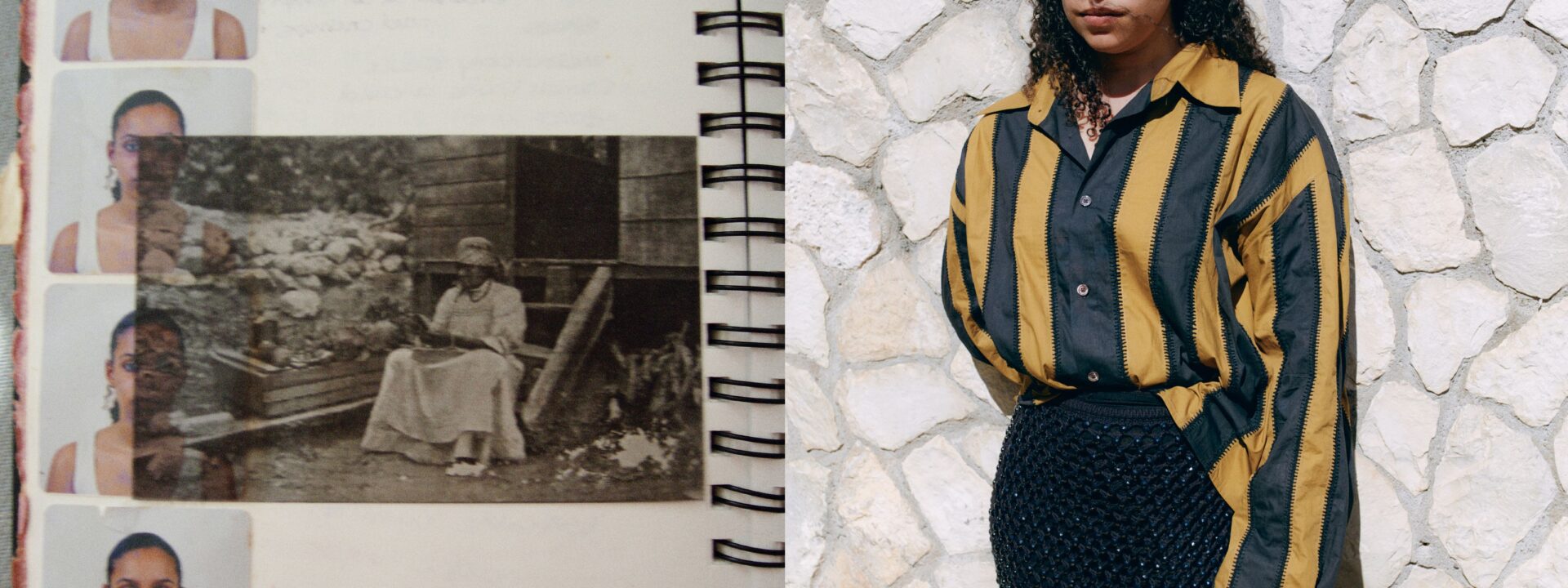
To understand everything Scott brings to Proenza Schouler, you have to understand Diotima. It is her protest, her activism, and her autobiography. Diotima celebrates the beauty of Jamaica—where Scott was born and raised—as far more than sunny beaches and a melodic patois. In particular, it highlights the artistry of hand-stitched crochet that women on the island create in their homes and small shops. Their skill in this delicate, meditative work represents generations of knowledge, and Scott allows them to express their individuality through patterns and shapes. While the fashion industry has long embraced poetic narratives about Europe’s lace makers and tailors, Scott is making a case for the poetry of Jamaica—and in doing so, she’s also challenging the historical flattening of Black culture into a monolith, instead presenting it as a story defined by nuance, breadth, and individuality.
“Diotima is belowground work,” she says. “Aboveground, you’re on the streets; you’re very visible. Belowground, you’re not. Obviously, I’m not doing any kind of crazy political organizing out of the studio,” she continues, “but I think the message you put out into the world in a not-obviously-political sphere is just as important.”
But right now, in the Diotima showroom just a few blocks away from where we sit, the heat isn’t working. “It’s freezing in there,” Scott tells her superintendent over the phone—though she herself looks quite cozy in a black knitted skirt and sweater, with her long, wavy dark hair draped over one shoulder. While Diotima may no longer be a one-woman company run out of her home in Crown Heights, as it once was, the label remains tiny, with just a handful of employees—a break-even project, she says, which, for a fashion company that’s barely five years old, counts as a near miracle.
“I feel like I know him very well,” says Scott, laughing. “He’s very Jamaican.”
This fact of birth has helped shape Scott’s point of view, and even her career path, as Jamaica’s professional limitations propelled her around the world—a creative nomad seeking educational opportunities in the arts. The country’s history of colonialism has also fueled her desire for ownership, independence, and stability, even as its majority-Black society has given her the confidence to believe that she belongs wherever she chooses to be.
Her work “resonates very much within the realm of the artists I’ve had the privilege to work with,” says Thelma Golden, director and chief curator of the Studio Museum in Harlem. Golden was drawn to Scott’s “ability to think about culture and craft, [and] the way she defined the sShe admires the way Scott incorporates geography and technique into her creative process. “Scott has been very detailed about her craftsmanship and what it means to her to collaborate with artisans in Jamaica,” she adds.
Golden learned about Scott’s designs through artist Simone Leigh, an early supporter of Diotima who felt a personal connection to Scott’s work. “I grew up on the South Side of Chicago, but both my parents are Jamaican—and I’m a preacher’s daughter,” Leigh explains. “Throughout my life, I’ve been familiar with the more prominent aspects of Jamaican culture that many people recognize, like reggae and dancehall. But Rachel also highlights subtler traditions, such as lace and doily work, and fabrics like white piqué—things I associate with church.”
Scott’s Jamaican background even comes in handy for practical matters, like fixing a boiler.
Unlike European brands, American fashion houses often struggle to succeed after their founder leaves or passes away. (Oscar de la Renta is a rare success story, while Halston’s decline is particularly disheartening.) Now, with Proenza Schouler’s founders, Jack McCollough and Lazaro Hernandez, having moved to Paris and Loewe, Scott is tasked with improving that record. Her debut full collection for the label showcased her lasting focus on textiles—mostly sculptural yet soft. It suggested a future where Proenza Schouler is known for clothes that envelop the wearer while projecting power and confidence.
McCullough and Hernandez founded their brand, named after their mothers, in 2002, right after graduating from Parsons School of Design. Proenza’s launch and success became a blueprint for a generation of graduates eager to start their own fashion labels immediately after school.
Scott, 42, followed a different path. When she left Kingston for college, she didn’t attend design school. “I knew I wanted to work in fashion,” she says, “but I didn’t want to study just fashion—I wanted to study languages, literature, philosophy, and all these other subjects.”
Her dream was to attend New York University—urgently and desperately. Although she was accepted, without financial aid it wasn’t possible, so she went to Colgate University, a liberal arts school in rural central New York, on a scholarship. Upon arriving, she was immediately struck by the wealth and privilege around her—students with Roman numerals after their names, who used “summer” as a verb. She found the campus atmosphere conservative and the surroundings isolating. There was so much snow, and only a handful of international students.
But Scott shared at least one thing with her classmates: thanks to her mother’s job as a flight attendant for Air Jamaica, she was well-traveled. In the more relaxed pre-9/11 era, she and her older brother, Matthew, would often sit in the jump seats and accompany their mother on flights around the world. Her family was also creative: her father was a furniture designer, and when her mother’s routes took her to places like Thailand and Brazil, she would visit local garment districts to buy wholesale clothing for a boutique she ran back home. As Scott grew older, if she couldn’t travel with her mother, she’d ask her to bring back favors—not fabric for her own designs, but newspapers in other languages.
It was Scott’s time at Colgate, and in the United States overall, that made her aware of America’s complex relationship with race, and how race influences or even overshadows everything from economics and politics to culture, class, religion, geography, ethnicity—and even ambition.
“In Jamaica,”She says, “It’s not the same—there’s obviously class, there’s obviously colorism, but I did not understand what it was like to be a Black American until I moved here and went to Colgate.”
In the fall of 2001, before Scott’s freshman year, Colgate—with about 2,800 students—was caught in an uproar that, in some ways, foreshadowed the ongoing debates over diversity that continue to stir college campuses and the country today. A political science professor’s email questioning the intellectual rigor of students of color sparked a series of protests, a controversy that carried into the next year. Scott and the few other international students at the school were left to make sense of it all, though Scott makes it clear that doubting her own worthiness was not part of her reflection.
“I grew up in a Black country, so it was normal to think that I could be in any space,” she says, though she quickly adds: “I admit that there’s a level of privilege, because I’m a light-skinned Black person—my mother is white, and Jamaica is, unfortunately, still colorist. But I was very lucky not to think that I didn’t belong somewhere. I also think it’s part of being Jamaican,” she says with a laugh: “We think we do everything better than everybody.”
As an undergraduate, Scott took summer courses at Central Saint Martins and studied abroad in Dijon. After graduation, captivated by the work of the Antwerp Six—the group of designers including Dries Van Noten, Walter Van Beirendonck, and Ann Demeulemeester that captured the fashion industry’s imagination in the late 1980s—she wanted to study fashion design at the Royal Academy of Fine Arts in Antwerp. When she wasn’t accepted, she turned to a plan B. She headed to Milan for a yearlong program at the Istituto Marangoni (whose alumni include Franco Moschino) and worked briefly at Costume National. After her visa expired, she moved to London to look for a new position.
“I interviewed with Sarah Burton the year before McQueen passed away, and she was really lovely,” Scott says. “I interviewed with Phoebe [Philo] right when she was starting at Céline, and she said, ‘You have really nice sketches,’ and that was it—I didn’t get the jobs.” Scott finally returned to New York City, where she worked at J. Mendel and eventually at Rachel Comey, staying for seven years and rising to vice president of design.
“I appreciated her intelligence and thoughtfulness,” recalls Comey, whose company marks its 25th anniversary this year. “I think about all different types of women—how’s their body changing; how is their career affecting their wardrobe?—and Rachel was up for that type of exploration.” That Scott would eventually leave to launch her own brand was no surprise. “I knew she had it in her,” Comey says.
IN FULL VIEW
A look from Diotima’s fall 2026 show at New York Fashion Week.
Photographed by Acielle/Style Du Monde
Scott takes people at their word. So when Kay Hong, the former chief executive of Proenza Schouler, asked if she would be interested in working as a consultant while the new management team searched for a design lead, Scott insists she saw it only as a pleasant project—a chance to add some runway excitement to a brand in creative limbo—and nothing more. (When Scott was recognized as a runner-up in the 2023 CFDA/Vogue Fashion Fund, Hong had become her business mentor, and they stayed in touch after the formal mentorship ended.)
The consultancy went well; personalities clicked—and soon Scott was having her first-ever conversation about taking on the creative director role at a major label. But before she could commit, she needed to talk to her wife, Chaday Emmanuel Scott. Emmanuel Scott, who is also Jamaican, does “aboveground” activism…Emmanuel Scott and her wife first connected at a fundraising dinner for the transgender community about five years ago. Scott, who was married to a man at the time, was invited by a mutual friend. “Before I even saw her, I heard her voice, and my heart started racing,” Scott recalls. “We were seated at a long table—she was in the middle and I was at the end—and we kept locking eyes. I didn’t really understand what was happening, but I ended up having a few drinks and getting flirty. Nothing happened that night,” she continues, “but we stayed in touch. And then I had an affair.”
Emmanuel Scott proposed in Grand Cayman. They married in 2024 at Manhattan City Hall and now live in Bedford-Stuyvesant, Brooklyn. With Scott working seven days a week, her wife handles the cooking, often preparing Jamaican dishes. They enjoy playing dominoes and spending time at the beach. (Scott calls herself a “total mermaid. I’m meant to be in the water.”) They’re also training their young cockapoo, named Romeo Gigli after the Italian fashion designer—one of Rachel’s heroes—so he can join the other office dogs at Proenza Schouler.
“My whole life kind of fell apart and was rebuilt in a really beautiful way,” Scott says. “Someone told me something this week that was probably the nicest thing anyone’s ever said about my work: They said that what I do here looks very free.”
Scott knew taking on a second full-time design role would be all-consuming and, if she wasn’t careful, could affect her health. She has a genetic condition called Charcot-Marie-Tooth disease, which requires particular vigilance. “It’s a degenerative neuromuscular condition, so if I don’t use the muscles, I’m going to lose them forever,” she explains. Currently, the most noticeable effect is on her balance, which can be unsteady. But she couldn’t turn down the opportunity at Proenza Schouler.
Now, she sits at her desk looking at the digital calendar on her computer—a screen filled with blue and brown rectangles marking meetings and design sessions, representing Proenza Schouler and Diotima, respectively. The office has high ceilings and beautifully aged floors, with large windows offering a bird’s-eye view of the sky and neighborhood rooftops. (At Diotima, the steep central staircase can induce vertigo, and a piece of construction board has been placed in the showroom’s bathroom window for privacy from the nearby buildings, which are almost within parkour distance.) The books in the Proenza Schouler office are leftovers from the Jack and Lazaro era, as is the fashion award on a shelf above Scott’s desk. A nearby ivory-colored sofa holds four versions of the PS1 crossbody bag, an early financial success for the label that Scott believes is due for a revival.
Her vision for Proenza Schouler’s future starts by examining its past. While exploring the brand’s archive, she found inspiration in the founders’ earliest work, with its focus on construction and inventive bra-style bodices, as well as their Paris collections from 2017 and 2018, which expressed a feminine softness. Along the way, she has noticed distinct differences in how she and her predecessors work. “They didn’t look at materials before starting the design process, whereas I have to begin with materials,” she says. “Maybe it’s because of the limitations I’ve faced—if the material doesn’t work, I have to figure out what it wants to do.”
Scott is now navigating the space between two brands, between limitations and abundance, between documentary and fiction. “With Diotima, things are often quite raw and almost a little decrepit—there’s this sense of being undone,” she says. Proenza Schouler, on the other hand, has always been polished and refined. “ThThe idea of uptown versus downtown—I’ve been trying to figure out what that means in 2026. It’s not so straightforward. Who is this woman? She’s quite proper, but I don’t know anyone who’s perfect. Maybe there are some cracks in there somewhere.
It might surprise some to learn that designers, like many in hands-on, people-focused professions, spend a lot of time in front of a computer. In any case, Scott is especially happy that a block of blue on today’s calendar marks a meeting about shoes. Daniele Michetti, her footwear design consultant, arrives with four whiteboards as large as garage doors, each covered in images of shoes—kitten heels, slides, loafers. The conversation jumps between thoughts on materials—leather, suede, or maybe something textured…python? And what about heel height? Proenza Schouler doesn’t sell many high heels, Scott notes, but perhaps it’s worth trying a pair?
It’s remarkable to see a designer cut through the cultural noise, or society’s stubborn craving for more of the same. But Scott’s work has been appearing on the red carpet more frequently, most recently worn by Ruth Negga, Greta Lee, and Tessa Thompson. The latter wore a vibrant fuchsia Diotima dress with an explosion of fabric petals when the Critics Choice Association honored her at its celebration of Black cinema and television in December.
The wave of recognition began in earnest in 2023, when the Council of Fashion Designers of America named Scott Emerging Designer of the Year and recognized her as a CFDA/Vogue Fashion Fund runner-up—all within months of her being named a finalist for the LVMH Prize. After more than a decade working behind the scenes in the industry, Scott was launched into the spotlight.
The very next year, she won the CFDA Award for Womenswear Designer of the Year—the first time the prize had gone to a Black woman. Though Scott was nominated alongside Marc Jacobs, Tory Burch, Thom Browne, and Proenza Schouler’s McCollough and Hernandez, she had yet to show Diotima on the runway—something that wouldn’t happen until fall 2025.
“I was really stunned,” says model and activist Bethann Hardison, 83, who was in the audience that evening. “I knew she was good, and that she was one of those people who deserve to be there. I just thought of who she was up against,” continues Hardison, a longtime advocate for greater diversity in fashion. “I’m still learning about her, and I’m like, What? Huh? Rachel’s quietly, diligently moving right along. She’s not overly splashy. She didn’t even have a runway show until practically yesterday.”
That Scott made CFDA history says a lot about the challenges women—and Black women in particular—face in the fashion industry. While men are often given more room to be seen as so-called creative geniuses, women are frequently expected to take a more practical approach when designing for their peers. Creative risks are often held against them as indulgent or out of touch. Black women, of course, grapple with those same prejudices—when they are not overlooked entirely.
While Scott finds it unfair that women designers seem to be reduced to “solving problems,” she also recognizes an inherent advantage. “I have access to a very intimate understanding of what something feels like on the body—especially as a woman who’s not a sample size,” she says. “How I feel about my hips, my waist, my arms, my neck—what I show, what I don’t show—I have a real understanding of this.”
She’s also come to understand a lot about her adopted country. (Scott became an American citizen in 2020.) The night she won Womenswear Designer of the Year, she wasn’t aware of the historical significance, but the next morning, when she realized she stood on the shoulders of those who came before her, it sank in.When she learned about the overlooked Black female designers in history, Scott thought, “Hold on a second….”
Today, Scott maintains a sense of calm despite her relentless, around-the-clock schedule. She moves steadily through the Proenza Schouler offices, the sound of her black boot heels signaling her approach from a distance. She keeps her good humor even through miscommunications, yet she is direct—clearly expressing displeasure, pushing meetings to move faster, or suggesting a problem be discussed over a glass of wine.
With her own label, Diotima, she has focused on telling her personal story—one of family and place. Now, she is tasked with a narrative that isn’t as personal, at least not yet. “I think beauty, creating beauty, is important,” she says. Her chapter at Proenza Schouler begins with confidence.
In this story: hair by Melleisa Dawkins; makeup by Tonisha Kong.
Frequently Asked Questions
Of course Here is a list of FAQs about Rachel Scotts move from Diotima to Proenza Schouler designed to cover the topic from basic to more nuanced perspectives
Basic Background Questions
1 Who is Rachel Scott
Rachel Scott is a Jamaicanborn fashion designer and the founder of the critically acclaimed label Diotima known for its artisanal crochet Caribbeaninspired silhouettes and celebration of Black craftsmanship
2 What is Diotima
Diotima is the readytowear fashion label Rachel Scott founded in 2021 It quickly gained a cult following for its unique blend of elegant handmade crochet pieces and its deep cultural narrative
3 What is Proenza Schouler
Proenza Schouler is a prestigious awardwinning American fashion house founded by designers Jack McCollough and Lazaro Hernandez Its known for its intellectual artinfused approach to modern luxury
4 So what exactly is happening
Rachel Scott is leaving her role as Creative Director and founder of Diotima to take on a new position as ReadytoWear Designer at Proenza Schouler This means she will be designing the main clothing collections for the house
Career Move Industry Impact Questions
5 Why is this news such a big deal
Its significant because Scott built Diotima from the ground up into a celebrated editoriallyloved brand Her move to a major established house like Proenza Schouler signals a major career step and is a notable example of a prominent indie designer joining a legacy brand
6 Why would she leave her own successful brand
While not officially stated common reasons in such moves include seeking the vast resources and global platform of an established house new creative challenges and the desire to focus purely on design without the immense burden of running a full business
7 What will happen to the Diotima brand now
This is the biggest open question The future of the Diotima label is currently unclear It may be put on hold continue under new leadership or be discontinued Scotts departure is a major shift for the brands identity
8 What does this mean for Proenza Schouler
It brings a fresh culturallyrich perspective to the house Scotts expertise in craft texture and silhouette will likely influence Proenza