One bright spring day in Paris, the man who would later become my husband and I walked across a stone bridge onto Île Saint-Louis to meet a distant cousin of his grandmother. Inside a small, dark bistro with smoky, wood-paneled walls, a princess from another world took off her chinchilla coat. I tried not to ask her too quickly if it was true that she was Marcel Proust’s goddaughter. She said she was.
Princess Priscilla Bibesco didn’t remember anything about her godfather, who died when she was two. But from his cork-lined bedroom—where he retreated to block out noise, dust, and all other distractions—Proust wrote to Priscilla’s father in 1920: “It is in this little girl that all we know now continues.” And there she was: the only child of Proust’s handsome, charming, aristocratic friend, the Romanian diplomat Prince Antoine Bibesco. Proust shared a secret language with Antoine, and based the character of the Marquis de Saint-Loup in In Search of Lost Time on him.
After lunch, we walked with her across the cobblestones to 45 Quai Bourbon. Her first-floor apartment faced the Seine from the end of the island, like the prow of a ship sailing toward Notre Dame. The apartment itself told a story of grandeur and decline. At one point, the proud Bibesco family owned the entire building—a golden limestone palace with the Seine as its moat. But by then, the other apartments had been sold off, and the princess had retreated to the main floor.
We climbed the winding back stairs into a bright, open space with polished parquet floors, gilt-tooled leather-bound books, Louis XVI furniture, rugs, paintings by Édouard Vuillard, and charcoal drawings of women by John Singer Sargent. The most beautiful thing was how everything—the walls, the silk curtains—reflected water and sky in a pale shade of eau de nil, as the river bounced sunlight through the glass. The Belle Époque, that name given later to the period when the Third Republic was rebuilding Paris into the “capital of the nineteenth century” (as Walter Benjamin would call it), had captured my imagination.
Somewhere in that same dreamlike world was the Impressionist art I had seen—paintings like Pierre-Auguste Renoir’s Madame Charpentier and Her Children, hanging in the Metropolitan Museum in New York. In it, Madame Charpentier’s kind face watches over her two children, dressed in frothy clothes. Proust wrote that Renoir had captured “the poetry of an elegant home and the beautiful dresses of our time.” (Madame Charpentier wears black and white couture from the House of Worth.)
Renoir made his fortune in America when his dealer took his work to New York. But before America fell in love with his art, it was Paris’s “haute juiverie” (Jewish elite) who had supported and encouraged Renoir and his fellow Impressionists. Proust’s friend, the influential art critic and patron Charles Ephrussi—the third son of a Jewish banking-and-grain family from Odessa—secured commissions for Renoir when the artist needed them most. One came from Ephrussi’s fellow art lover (they built collections of Oriental art together) and actual lover, Louise Cahen d’Anvers, née Morpurgo, who was also a friend of Proust.
The mesmerizing Louise hosted a salon where artists met patrons, writers, and publishers. (She helped edit the works of novelist and critic Paul Bourget, while inspiring Guy de Maupassant and others.) Running a salon was no easy task; they were competitive and powerful cultural forces. For example, a friend of Louise’s hosted the French premiere of part of Ibsen’s A Doll’s House. At Ephrussi’s request, Louise Cahen d’Anvers commissioned Renoir to paint…First came her eldest daughter, Irène, and then, a year later in 1881, her two younger girls, Alice and Elisabeth, together.
Pierre-Auguste Renoir, Portrait of Irène Cahen d’Anvers (La petite Irène), 1880, oil on canvas.
Photo: Fine Art Images / Heritage Images / Getty Images
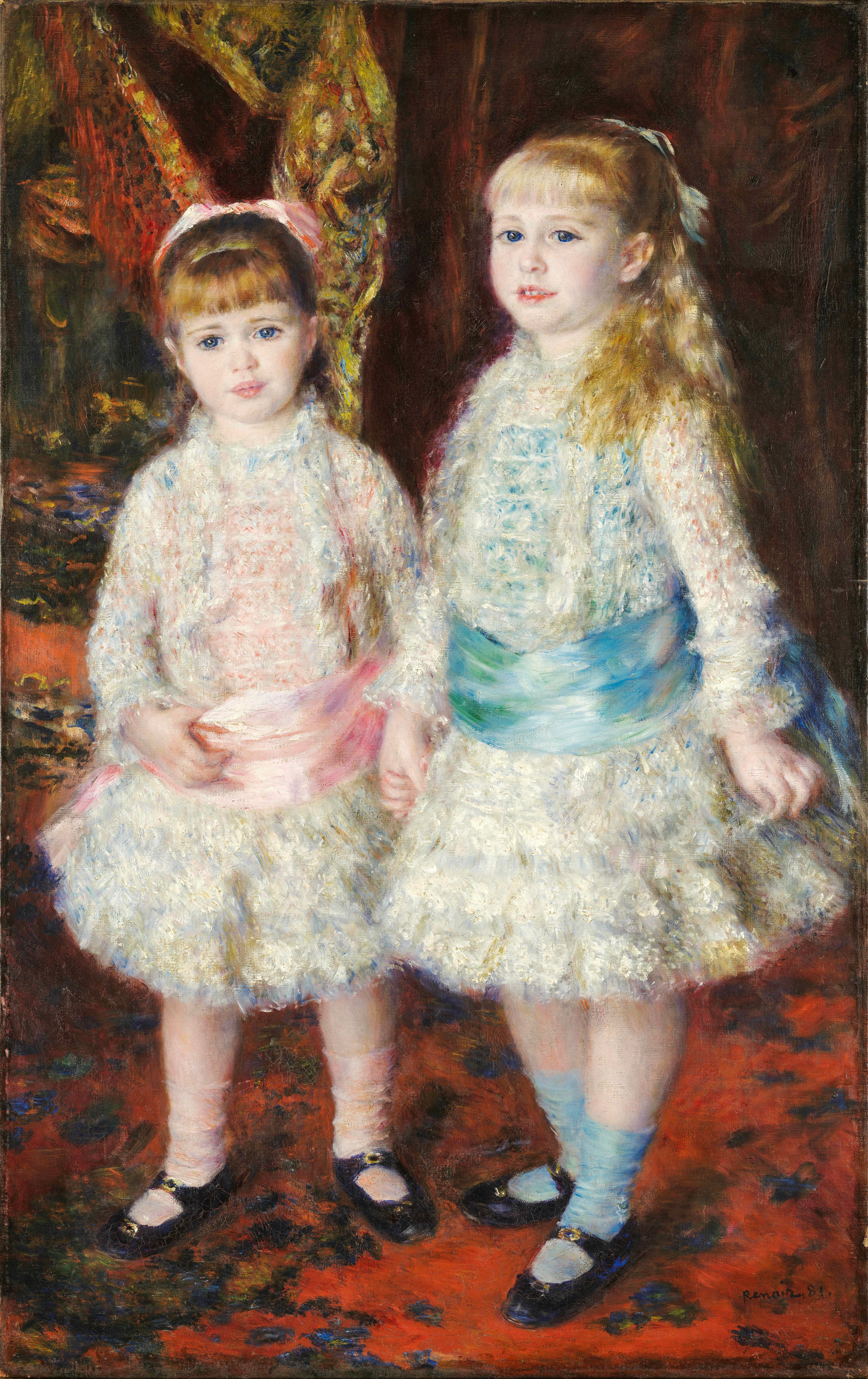
These daughters of a prominent Jewish banking family appeared in Renoir’s paintings. Irène was shown as Little Irène, or The Girl with the Blue Ribbon—dreamy, with a blue silk ribbon in her fiery hair, set against a background of thick foliage. Alice and Elisabeth were captured forever in Pink and Blue: four-year-old Alice’s feet spread out sweetly as she tucks a chubby thumb into her sash, while six-year-old Elisabeth holds her sister’s hand firmly. Renoir, who sometimes worked as a fashion illustrator and studied the way clothes draped throughout his life (his father was a tailor, his mother and wife were seamstresses), painted the beautiful fabrics of the Belle Époque better than anyone.
In the 1890s, the Dreyfus affair tore France apart, turning its underlying antisemitism into a kind of civil war. Captain Dreyfus, a Jewish army officer, had been wrongly convicted of treason. As evidence grew that he had been set up, half of France refused to accept his innocence. The Cahen d’Anvers family responded by showing their deep love and loyalty to France. They bought and restored the magnificent ruin of the Château de Champs-sur-Marne outside Paris, once home to Madame de Pompadour. Their son-in-law (Irène’s husband), Moïse de Camondo, built a house inspired by Le Petit Trianon and filled it with Sèvres porcelain and Beauvais tapestries. Moïse’s cousin, Isaac de Camondo, gave over 800 artworks to the Louvre. In the 1930s, the Cahen d’Anvers family donated their château to the French nation (it is now open to the public), and Moïse de Camondo also left his house as a museum. Their generosity was extraordinary.
Pierre-Auguste Renoir, Alice and Elisabeth Cahen d’Anvers (Pink and Blue), 1881, oil on canvas.
Photo: Fine Art Images / Heritage Images / Getty Images
As I researched the lives of the Cahen d’Anvers sisters, I realized that their whole lives were shaped by the antisemitism they faced. As grown women, they had the chance to change their identities through marriage—and they took it. Irène divorced her first husband, who was Jewish, became a Catholic, and married an Italian countess. Alice married an English soldier. Elisabeth also became a Catholic and married two Frenchmen.
But this did not save them. Elisabeth was murdered on the way to Auschwitz, betrayed by the local mayor—a French aristocrat who had known her family for generations. Irène’s daughter Béatrice, son-in-law Léon Reinach, and her grandchildren Fanny and Bertrand Reinach all died there too. Gaston Bernheim de Villiers, Renoir’s Jewish dealer, who by then owned Pink and Blue, suffered as his son Claude was deported and murdered in Auschwitz as well. Many of Bernheim’s paintings were stolen and never returned. All that life, that evocative elegance, and so much more were swept away in the brutal, unimaginable violence of the Holocaust.
As I researched the Cahen d’Anvers sisters, trying to understand how France’s golden age could fall into the horror of World War II, these lost families of Paris came to life before me. The salon hostesses, collectors, château restorers, patrons, and hostesses of those Jewish families made the artistic life of the Golden Age flourish through their support and commissions. Béatrice Ephrussi (née de Rothschild) left her pink palace in Saint-Jean-Cap-Ferrat; the Reinachs left their Greek-style villa, the Villa Kérylos, nearby in Beaulieu-sur-Mer. These families either emigrated or died when France turned against them during the Vichy regime. Their surnames no longer exist in France.
Priscilla died in 2004 and never knew that she, and those Renoir portraits, sparked a threefold desire: to capture the flavor of Belle Époque life, to tell a family story, and to show the importance of remembrance.In today’s conversations, the antisemitism that was hidden beneath the surface back then came back with brutal force in the 1940s. The lives of those Impressionist children in their party dresses were filled with both tragedy and courage.
Catherine Ostler is the author of The Renoir Girls, which is out this week.
Save to wishlist
Save to wishlist
The Renoir Girls: A Hidden History of Art, War & Betrayal
$35 $30 (14% off)
Amazon
Frequently Asked Questions
Here is a list of FAQs about the essay A Chance Meeting with Prousts Goddaughter Uncovered a History of Antisemitism
BeginnerLevel Questions
Q What is this essay about
A Its about a writer who meets an elderly woman who turns out to be the goddaughter of the famous French author Marcel Proust As they talk she reveals a shocking family history of collaboration with the Nazis and deepseated antisemitism
Q Who is Marcel Proust
A He was a famous early 20thcentury French novelist best known for his massive work In Search of Lost Time He was also Jewish
Q Who is the goddaughter in the title
A She is an elderly French woman named Lorraine Her mother was a close friend of Prousts and he became Lorraines godfather
Q What does antisemitism mean in this context
A It refers to prejudice hatred or discrimination against Jewish people In this story it specifically describes the actions and beliefs of Lorraines family during and after World War II
Q Is this a true story
A Yes its a personal essay by journalist and author Adam Gopnik published in The New Yorker It recounts a real conversation he had
IntermediateLevel Questions
Q What specific history of antisemitism did Lorraine uncover
A She casually revealed that her father and uncle were active Nazi collaborators They helped the Gestapo identify and arrest Jews in occupied France Her uncle even ran a hotel that was used to detain Jewish families before they were sent to concentration camps
Q How did the author react to this revelation
A He was shocked and horrified The woman seemed completely unashamed and matteroffact about it which made the encounter even more disturbing He struggled to reconcile her charming cultured persona with this dark family secret
Q What is the main point or lesson of the essay
A It shows how ordinary cultured and even nice people can harbor or normalize terrible ideologies It explores how antisemitism and collaboration were not just the work of monsters but of everyday people who saw themselves as respectable