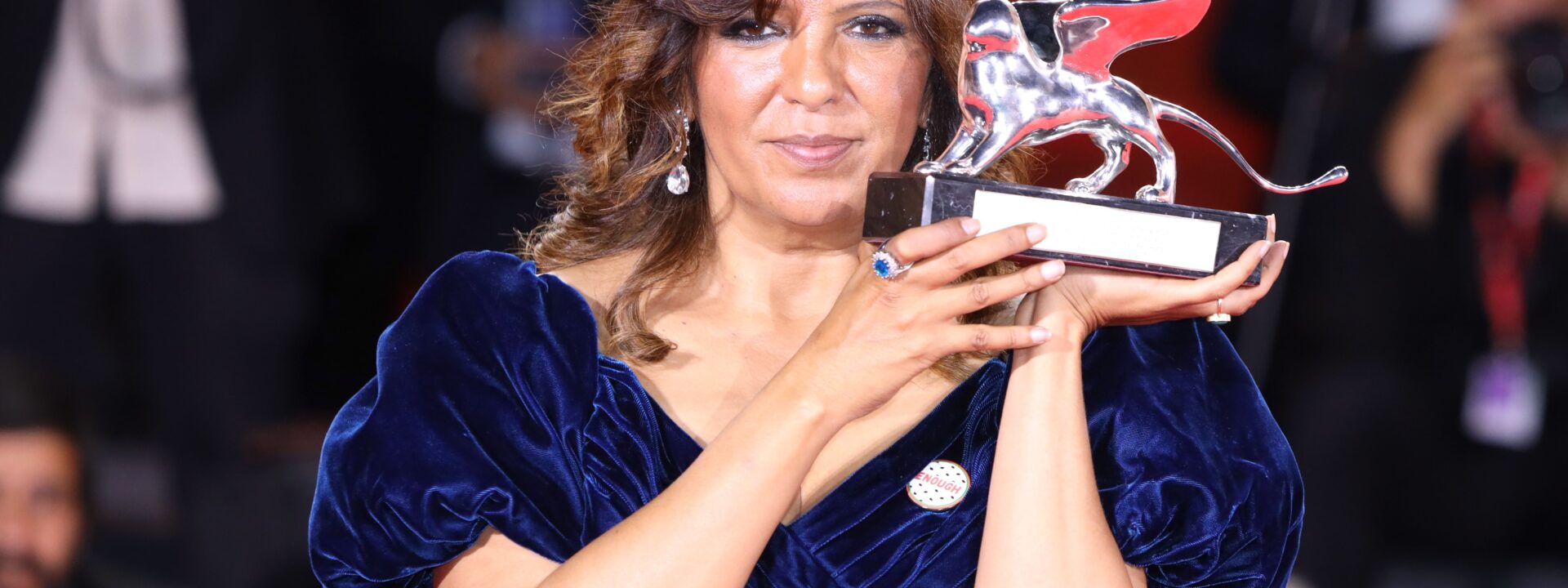
Among the many talking points from this year’s Venice Film Festival lineup announcement—most urgently, where were the Oscar hopefuls that had been rumored to head to the Lido?—one thing stands out to me as deeply troubling: the 2026 competition slate includes only one film directed by a woman. That film is Danish-Egyptian director May el-Toukhy’s Woman Unknown, about a housemaid on the verge of marrying her wealthy, widowed employer. The other 19 films vying for the Golden Lion are all directed by men.
This is a sharp drop from previous editions of the festival. Just last year, six women were among the 21 films in competition, including Kaouther Ben Hania, who took home Venice’s second-place Grand Jury Prize for The Voice of Hind Rajab. There were also six women-directed films in 2024, and five each in 2023, 2022, and 2021. In 2020, there were eight.
Over the past decade, Venice has made real progress on this front. Only seven women have ever won the Golden Lion in the festival’s 77-year history, but three of those wins have come in recent years (Chloé Zhao for Nomadland in 2020, Audrey Diwan for Happening in 2021, and Laura Poitras for All the Beauty and the Bloodshed in 2022). Since the late 2010s, several women have also led the competition jury (Isabelle Huppert, Julianne Moore, Cate Blanchett, Lucrecia Martel, and Annette Bening). Before that, only five women had held that role since 1935.
Still, these achievements don’t erase the situation the festival finds itself in this year—and it’s important not to brush this off as a one-off blip.
The festival’s artistic director, Alberto Barbera, would certainly like us to see it that way. Speaking to The Hollywood Reporter after the lineup was announced, he said he was “actually desperate. I would love to be able to find more female-directed films to put in competition. But it simply was not possible, for many reasons. The number of films made by women has decreased… And the quality of the ones we saw was not such that we could put them in competition.” He added that he believes it’s “a temporary negative situation. I hope next year [it] will improve again, [that] we’ll get more films made by women and the quality will improve. It’s difficult for us to understand. But we are at the end of a chain that we don’t control. There are choices made by the producers, by financiers. It’s a matter of the budgets [being given to female directors]. I’m very sorry about the situation but there was nothing we could do. We don’t want to select the competition on the basis of gender, but on the quality of the films.”
It’s true that in a struggling, uncertain, risk-averse, and cash-strapped film industry, the number of women-directed projects is falling across the board, and Barbera can’t change that. But other things are within his control. Look at Venice’s lineup beyond the main competition, for example, and you’ll see a very different picture. In the “Orizzonti” section, for emerging filmmakers, eight of the 19 projects are directed by women. According to Variety, two of these—Alina Marazzi’s The Girl with the Leica and Rubaiyat Hossain’s The Difficult Bride—were reportedly considered for the main competition at some point. Then there’s Anuparna Roy, who won the best-director prize in this section just last year for her debut feature, Songs of Forgotten Trees, and is back with her second film, Lovers in the Blue Night. Could she have been moved up to the main competition? If Barbera was so “desperate” for female representation, couldn’t he have found a way to include these titles?
The issue, I think, isn’t that women aren’t making enough great, highly deserving films or submitting them to Venice—the Orizzonti lineup makes it clear they are. Rather, it’s that many of these films aren’t being seen as worthy of the main competition, which has long been the domain of…The revered male auteur (this year, you’ll find Martin McDonagh, Danny Boyle, Hirokazu Kore-eda, Lee Chang-dong, Florian Zeller, and Werner Herzog on this list). Let’s tackle the quality question head-on: having attended the Venice Film Festival for the past few years, I can promise you I’ve seen many, many very bad movies by legendary male directors. Last year, Noah Baumbach’s Jay Kelly, László Nemes’s Orphan, and Benny Safdie’s The Smashing Machine were all in competition. The year before that, Todd Phillips’s endlessly criticized Joker: Folie à Deux was up for the Golden Lion, for crying out loud. For the biggest names, especially those with an existing relationship with the festival, the bar to enter the competition seems, at least to me, notably lower. Are any of the women-directed projects that could have made it into the competition this year but didn’t really worse than those (sorry) clunkers?
In the end, all of this is, of course, subjective—boundary-pushing cinema has always divided opinions. But then, does that mean more women need to be part of the selection process for Venice’s main competition? If Barbera continues to reject the idea of quotas to ensure female representation, how do we avoid slipping back into a male-dominated status quo?
The answer, I believe, lies in sustained scrutiny and pressure—the same spirited and ongoing conversation that has driven the progress we’ve seen over the past decade. It’s often when significant steps are taken toward a fairer system that a kind of complacency sets in, and that’s where Venice seems to be right now. But Barbera has already been questioned about the lack of women directors by every major film publication. Several Italian film organizations have criticized the line-up. And more outrage will surely follow once the festival kicks off in September. It’s crucial that it does, so this issue stays front and center for Barbera as he puts together the 2027 roster.
Here’s hoping this year serves as a warning—a glimpse of what might happen if we take our foot off the gas. In 2026, after so much historical erasure and only a handful of recent, hard-won victories, it’s just unthinkable that a festival like Venice can have only one woman-directed film in competition. And it must, absolutely, never happen again.
Frequently Asked Questions
Here is a list of FAQs addressing the lack of female representation in the main competition at the Venice Film Festival written in a natural tone
General Background
1 Wait is it true that only one woman is competing for the Golden Lion this year
Yes its true Out of the 21 films selected for the main competition only one is directed by a woman That director is Athina Rachel Tsangari for her film Harvest
2 Why is this such a big deal Isnt it just a coincidence
Its a big deal because its a recurring pattern not a oneoff While film festivals dont have quotas critics and industry insiders point out that this level of underrepresentation doesnt reflect the actual number of talented female directors working today It suggests a systemic blind spot in the selection process
3 Who is the one female director in the competition
Her name is Athina Rachel Tsangari a highly respected Greek filmmaker known for films like Attenberg and Chevalier Her new film Harvest is an adaptation of a Jim Crace novel
4 Is this the worst year ever for female representation at Venice
No its actually tied with other years In 2021 there was also only one female director in the competition It fluctuates but the numbers have never been close to equal For example in 2023 there were three women out of 23 films
The Selection Process Politics
5 How does the selection process work Who chooses the films
The Artistic Director currently Alberto Barbera has the final say He watches hundreds of films and consults with a small team of trusted programmers They decide which films make it into the main competition which go to other sections and which are rejected
6 Doesnt the festival just pick the best films Why does gender matter
The definition of best is subjective The festival curates a specific narrative for its program Critics argue that if the selection committee relies on the same networks distributors and producers theyve always worked with they will unconsciously overlook great work from women The issue is that the best is being filtered through a very narrow lens