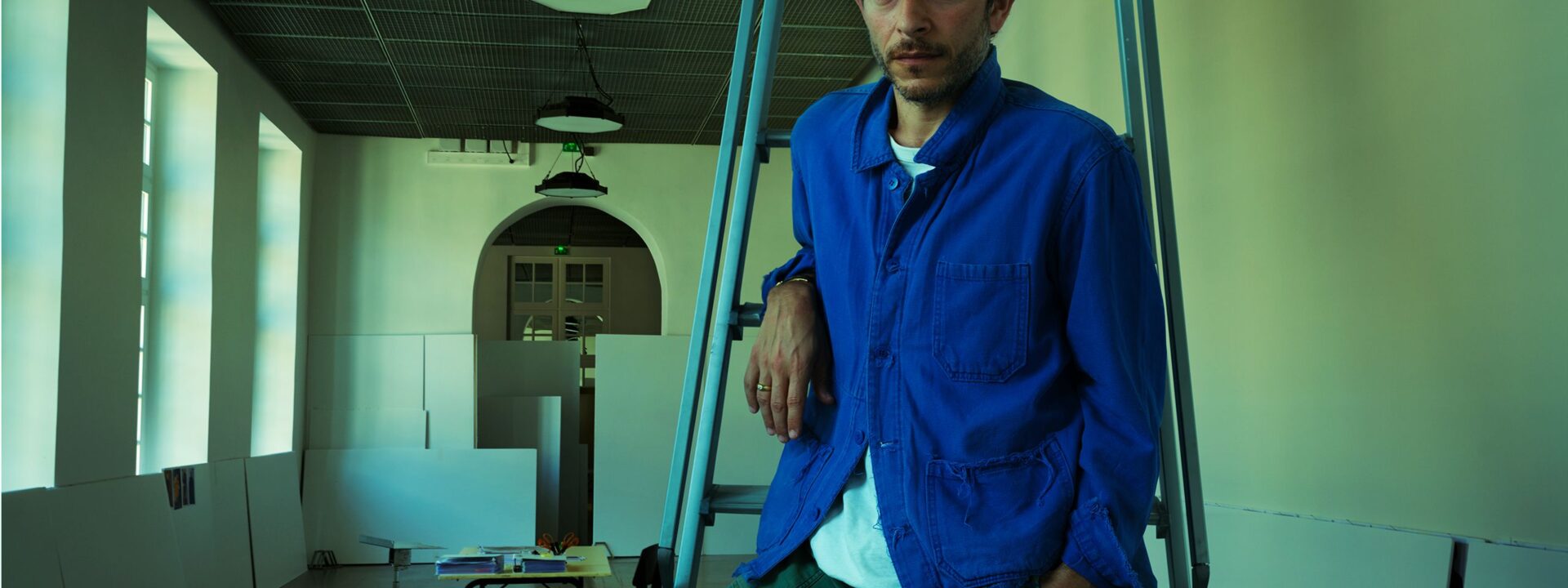
Portraits by Annie Leibovitz. Fashion Photographs by Francesc Planes.
If Michael Rider isn’t in his office on Paris’s rue Vivienne, you’ll probably find him in the gardens of the Palais-Royal. This quiet, cloister-like park is just a few blocks south of Celine’s grand headquarters—originally built in the 17th century as the home of Cardinal Richelieu. It serves as a casual break spot for the brand’s new artistic director. That’s where Rider and I end up on a windy weekday afternoon, when the threat of rain cancels our plans to bike around the city.
SHOWING YOUR STRIPES
Model Angelina Kendall wears a lively tiger coat, red kick-flare pants, and a sequined skullcap—perfect examples of Rider’s mix of American sportswear and easy elegance. All items are from Celine (here and throughout); celine.com. Fashion Editor: Malina Joseph Gilchrist.
Photographed by Francesc Planes. Vogue, Summer 2026.
“I used to come here a lot during Celine part one,” Rider, 45, tells me as we walk through rows of lime trees, the beige gravel crunching under our feet. (“Celine part one” is his shorthand for his first time at the historic French label—the nine years he worked as design director under Phoebe Philo, before moving to Polo Ralph Lauren in 2018 to oversee womenswear.) Rider is compact and athletic, with warm, dark eyes and a messy head of brown curls touched with silver. This afternoon, he’s wearing a camel hair trench coat, a thick brown cashmere scarf wrapped heavily around his neck, faded blue jeans, and sneakers. A pair of wire-rim glasses sits bookishly high on his nose. Now, eight years later, with three acclaimed collections behind him—his popular spring line is in stores, and his fall collection got a rapturous response when it was shown in March—Rider has definitely put to rest any lingering questions about how a curious kid from Washington, DC, ended up running one of the most Parisian fashion houses.
Founded in 1945 by Céline Vipiana as a small boutique in the 11th arrondissement, Celine has long been known for providing a go-to uniform for Parisian women. But by the late ’90s, it had become a bit stale and matronly, until LVMH brought in Philo in 2008 (and later Hedi Slimane in 2018) to revive it. While Rider’s work is praised for blending the wearable sophistication of Philo’s Celine era with the sporty flair of his own time at Ralph Lauren, he’s actually created a new chapter that’s entirely his own—one that feels joyful and, even in today’s world, wildly optimistic.
I had met Rider a few weeks earlier at Celine’s limestone neoclassical headquarters. (One of Philo’s lasting contributions was completely renovating the building to use as the label’s offices.) The interior is ice white and seems designed to impress—until Rider appears with a big smile and a hug, wearing a blue sweatshirt with frayed cuffs and a mesh baseball cap that says “so good to see you” across the front. That fits perfectly with his new era for Celine: His spring ready-to-wear collection was full of bright, playground-like primary colors, and his latest It bag is called the Smile bag because of its zipper’s emoji-like curve. (In his fall collection, sharply tailored black coats came with plastic pins on the chest that read “Bienvenue Chez Celine.”)
Today, at the Palais-Royal, we walk around its shady colonnade before grabbing chairs by the fountain. “I like coming here, even if it’s just for a few minutes—it’s nice and nothing like Washington, DC,” Rider says. He pauses. “Which is surprising, because DC was planned by a Frenchman, who based its boulevards and roundabouts on Paris.” Rider listens carefully to questions and seems to think before he answers.Not once during our time together does he glance at his phone.
RING PARTY
Kendall—who pairs a strong shoulder with plenty of jewelry—lets out an approving shout. Fashion Editor: Malina Joseph Gilchrist. Photographed by Francesc Planes. Vogue, Summer 2026.
Since returning to Paris in the fall of 2024, Rider has been living in an apartment in the northern part of the Marais with his husband, knitwear designer Emmanuel “Manu” Morlet. But they still haven’t fully settled in. “There’s stuff everywhere,” Rider says, “which can feel a bit chaotic.” He admits with a wry laugh that much of his life is organized by the photos and notes he pins to his fridge. “I don’t know what I’d do without a refrigerator door—or a corkboard.”
He’s a hands-on designer who prefers to think in terms of fabric weight and texture, and how clothes feel on the body, rather than in abstract ideas. This love of physicality goes beyond fabrics too: In his second-floor office at Celine, he’s hung a rope from the 13-foot ceiling and uses it throughout the day for “get-ups”—an exercise where he lies on the floor and climbs the rope hand over hand until he’s standing. Most mornings, he bikes to work. (Biking has become a new signature for Rider: Celine-branded bicycles lined the street outside his first show last July, and the most sought-after item from his October collection was a carbon-fiber bike helmet with the Celine logo.)
It’s worth noting that inspiration from the streets of Paris is built into the label’s DNA. The idea for the interlocking-C logo came to Vipiana in 1972 when her car broke down near the Arc de Triomphe and she noticed the pattern of the security chain around the monument. Et voilà: Celine’s new emblem was born. “Pedestrian” isn’t a dirty word to Rider, who aims to create a complete, all-day wardrobe for his customer—a jacket or dress that could be worn zipping down rue de Rivoli on an e-bike during the day or toasting at a cocktail party in the Faubourg Saint-Germain at night.
Filmmaker and writer Miranda July, who attended Rider’s October show in Paris’s Parc de Saint-Cloud, agrees. “The clothes seem simple or familiar, but they’re very special,” she says. “The red wool turtleneck I wore to the show I wore again that night at the after-party—it went from rich-lady chic to club chic, but both were very Celine.” When real life is your mood board, ideas seem to pop up everywhere if you’re paying attention. “Public transportation is full of ideas,” Rider says. “I’m always looking at everything—definitely at people—and I’m also a collector. I have a lot of stuff inside me that somehow finds a way out.”
“Ever since he was young, he’s been an incredible observer,” recalls Rider’s older brother, Jordan, who now lives on Martha’s Vineyard, working as a community mediator and a patient observer at the local hospital. The two grew up near Rock Creek Park in Northwest DC, the sons of lawyers. Rider describes their upbringing as one filled with leftist politics and activism, where the bookstore Politics and Prose was like a guiding star. “Curiosity was valued in our family,” Jordan says, “and Michael’s interests are very broad. When he left Celine the first time, his plan was to make cider in Normandy; he wanted to take piano lessons. He wants to learn to fly a plane; he’s learning Arabic—he can probably hold a conversation with just about anyone.”
The brothers have always been close. When they stopped sharing a room as kids, they slept on each other’s floors for months. But while Jordan was captain of every sports team and the lead in school plays, “I kind of became the yang to his yin,” Rider says.He says, “I was a prankster—I liked tricks and jokes. I liked to draw and paint.” Rider can’t pinpoint when his interest in clothes first started, but his brother Jordan remembers him taking an early interest in what people wore, maybe as a way to figure out where he fit in the world. “I loved clothes,” Rider says. “Not fashion exactly, but I’ve always had an emotional connection to garments.”
That love grew during his teenage years, when his wardrobe became both a way to express his identity and a creative outlet. He would search thrift store racks for pieces he could customize before going dancing at DC’s legendary LGBTQ+ club Tracks. (“I’d look for the same things I’m still drawn to today,” Rider says: “Jeans, military parkas, a ton of blue oxford shirts.”) Still, he never thought about going to art or fashion school. “Maybe because I grew up around teachers and activists,” he says, “fashion didn’t seem like a way to contribute in the way I wanted to.” Rider went to Brown University, where he studied education and Latin American studies. After graduating in 2002, he got a teaching job at a progressive charter school in Oakland. “It was wild,” he says. “The kids were amazing, but there was abortion, violence, identity, tragedies, and hormones—it was a lot.” That’s when Rider slowly realized that, even though he loved teaching, he couldn’t ignore his desire to explore his creative side.
FRESHLY COATED
Kendall wears a multicolored knit intarsia dress, a leather bucket hat, and white knee-high boots—she has no interest in blending in. Fashion Editor: Malina Joseph Gilchrist. Photographed by Francesc Planes. Vogue, Summer 2026.
In 2004, he moved back to New York, and through his friend, designer Trevor Ballin, he got his first job as an apprentice with Garment District couture designer Rogelio Velasco. “It was just four sewers, two pattern-cutters, him, and me,” Rider says. “I would cut organza for him, get pins, sew for him, or manage a fitting.” Rider found a studio apartment—right next door to Ballin—on Christopher Street in the West Village, just above an adult video store. The West Village was much more edgy in the early 2000s than it is now, and the streets near the Hudson River attracted a lot of gay, trans, and nonbinary youth. This created not only an exciting sense of community but also a colorful fashion show right outside their windows. “It was an inspiring place to live,” Ballin recalls, “being surrounded by young kids who wouldn’t let other people’s style define them.” But New York was just a quick stop on the way to what Rider soon realized was his dream: working for Nicolas Ghesquière in the Paris atelier of Balenciaga.
“I remember clicking through a show of Nicolas’s online and never seeing anything like that before,” Rider says. “People thought of it as highly conceptual, but I didn’t. I thought of it as right and real and urgent—I was captivated.” Rider took a big risk and traveled to Paris in the summer of 2004, somehow managing to get a series of interviews for a menswear internship with the house. “I didn’t speak French; I had to put together sketches, references, and mood images at an Office Depot—I mean, it was a complete joke,” Rider admits now. Finally, with summer almost over and Rider nearly out of money, he called the Balenciaga offices from a payphone on rue des Archives and learned that the internship had been given to someone else. Feeling down, Rider flew back home—first stopping to visit his family on vacation in Martha’s Vineyard—only to get a call a few days later saying the internship was his. His mother fainted from excitement.
That internship turned into a full-time position that lastedIt lasted four years—a dream job in more ways than one. Rider’s future husband, Morlet, worked as the first designer under Ghesquière. Rider says Morlet was horrified by the long-haired American newcomer in their sacred French atelier—Rider showed up on his first day wearing shorts—but they soon started dating and never split up.
Rider’s learning curve under Ghesquière was intense. “I learned everything,” he says. “How people develop their work, how they push it and pull it back. I learned from a 70-year-old pattern-cutter who had worked with Cristóbal [Balenciaga] and a 22-year-old designer on the cutting edge—and how those two meet somewhere in the middle.” The design team was small and close, and became like a second family.
Rider’s close friend, actor Dan Levy—they met through Ballin around that time—describes him as having a “fear of affectation. He’s always been very much himself,” Levy says. “It was never part of his story to put himself in the spotlight. But when you know your friend is so talented, you always wonder: When are you finally going to be the boss?”
Rider steps away to get coffees for both of us while I save our seats in the Palais-Royal. When he comes back, carefully balancing the cups on top of each other, a group of kids racing around the fountain nearly bumps into us before running off toward the rose garden. Rider laughs, takes it all in, and quickly finishes his coffee. As he walks me through his career, it becomes clearer that if Balenciaga was his apprenticeship, joining Celine in 2008 as design director of ready-to-wear—working under Philo—was his coming of age. Rider stayed for almost 10 years, traveling between the Paris atelier and Philo’s London offices. By then, his reputation was strong enough that he could have chosen his next move in fashion. Instead, he decided to stop.
SHELLING OUT
Kendall’s necklace—covered in seashells and tusks—adds a playful touch to her strong-shouldered look. Fashion Editor: Malina Joseph Gilchrist. Photographed by Francesc Planes. Vogue, Summer 2026.
In the year before he decided to quit, Rider had been teaching French to refugees in Paris. He felt overworked and disconnected from where the industry was heading. “I had a blast at Celine,” he says. “But you have to know when something is special and unique and leave it at that. I wanted to breathe.” He left in 2017, just before Philo did, and three days later married Morlet at the City Hall of the 2nd arrondissement.
The break didn’t last more than a couple of months. Few would have guessed that Rider’s return to fashion would take him away from a chic Paris label, let alone back to his home country. But when he was offered the role of womenswear creative director at Polo Ralph Lauren, he saw it as a valuable way to broaden his skills. “I tell anyone in Paris who works in fashion: Go work in the United States for a couple of years. Parisians think they breathe holy air, and they’re not wrong. But there’s a huge, lively world out there full of different ways of doing things.”
Rider, who had loved vintage Polo since childhood, flew to New York to meet Lauren at his Madison Avenue office. They hit it off right away. (The wire-frame glasses Rider is wearing today were a gift from Lauren.) Drawn to the idea of a more democratic kind of fashion—something “really big but meaningful,” as Rider puts it—he took the job. (Morlet, who was then designing knitwear at Loewe under Jonathan Anderson, visited often from Paris.) “Ralph’s a merchant—he won’t tell you he’s a designer—but he’s a fabulous dreamer and storyteller,” says Rider, who credits his six years working for him with reigniting his excitement for making clothes. “Had I never left [Celine]…”He continues, “I wouldn’t be doing what I’m doing now.”
Rider insists he didn’t pay much attention to Hedi Slimane’s Celine during that time—a period when the famously territorial French designer removed the accent from the first ‘e’ in the label’s name, introduced menswear, couture, fragrance, and makeup, and gave the brand a sleeker, edgier look. Slimane didn’t just grow Celine’s audience; he nearly tripled its sales.
ALL TIED UP
Taverner pairs her rugged leather jacket and oversized shield sunglasses with a crisp white scarf. Fashion Editor: Malina Joseph Gilchrist.
Photographed by Francesc Planes. Vogue, Summer 2026.
Returning to Paris felt like coming home, especially because it meant Rider could be with Morlet full-time again. Morlet currently designs knitwear for both Celine and Dior. On weekends, the couple escapes to their 17th-century country house in Normandy’s Perche region, where they bike, listen to the radio, and watch old movies. The previous owner—a famous set decorator who worked on Apocalypse Now and Evita—had installed a screening room, which Rider and Morlet have made part of their evening routine. Rider runs and cooks; right now, he’s deep into a new biography of James Baldwin, written by a childhood friend from Washington. Every morning, he reads the newspaper in print—he refuses to read on a phone, one of many small protests against letting digital life take over. “Everything important in my life,” he says, “happened through encounters that never would have happened if I had a phone, because I wouldn’t have been paying attention.” Paying attention—being fully present—is essential to Rider’s creative work.
Rider admits he has a fetishistic relationship with clothes. His personal collection—many pieces from his own life, each tied to a specific memory—fills multiple storage units around the world. At the fountain, he waves toward the Marais, pointing out that one of his frequently visited units is just a few blocks away. “It’s a mess right now,” he admits. “I’m not even sure of everything that’s in there. I have thousands of pieces I’ll never get rid of.” Among them are what he calls his “good-time shirts.” When I ask what that means, he laughs and says, “A shirt in which one has had a very good time.” He gives an example: a green fatigue shirt with a hole in one elbow. The piece is simply filled with memories, he says, and when he puts it on, it takes him places. For Rider, tears, rips, sweat stains, and frayed collars are loving embellishments, not signs of damage. “Most people who are sensitive have deep relationships with the things they wear,” he says, “and those people tend to have a lot of style. I wish I got that feeling more from fashion.”
Backstage at his March show along the Seine at Paris’s stunning Institut de France, Rider said he started his design process by thinking about the “complex, slightly messy inner lives of the people under the beautiful clothes.” On the runway, models wore necklaces overloaded with seashells and tusks, mismatched chunky earrings, and multiple rings. A black leather belt didn’t match its leopard-print coat; maybe only one pant leg was tucked into a pair of boots. Rider once again proved his mastery not just in le flou—loosening the cut of knits and silks into softer silhouettes—but also in razor-sharp tailoring.
Actress Natasha Lyonne, who sat front row, said afterward, “The show’s curation and creativity felt deeply personal—like the decisions were made with intellect and heart.” Ballin, who joined the design team soon after his friend arrived, thought Rider was “showing his sense of humor and having a little bit of fun.” Case in point: a series of shimmery dresses, one made from silver…One was made of chain mail, with giant letters scattered randomly across it spelling out “CELINE PARIS.” Another was crafted entirely from soda-can tabs, and yet another was embroidered with silver sequin beads as big as drink coasters.
Back in the park, I mention that Rider’s March show felt strongly like a community gathering—the indoor stage was designed to look like a community center, and the plastic pins on the coats clearly resembled political buttons. I can’t help but ask him: As a teenager, he didn’t see how fashion could make a meaningful difference in the world. Has his time in that world changed his mind?
“Yes, of course,” he says, with what seems like his whole heart. “Fashion can make people dream, and it can make their realities more functional and more exciting at the same time. I think it can also change how we see the world, how we see each other. And—deeply—how we see ourselves.”
For Annie Leibovitz portraits of Michael Rider: grooming by Jillian Halouska. Produced by AL Studio. Set design by Mary Howard.
For Francesc Planes fashion photographs: hair by Karim Belghiran; makeup by Karin Westerlund; manicurist: Magda S; tailor: Alami Fatim-Zahra. Produced by NILM.
Frequently Asked Questions
Here is a list of FAQs about the reimagined Bienvenue Chez Celine by Michael Rider written in a natural conversational tone
General Brand Overview
Q What is Bienvenue Chez Celine Is it a new store or a new collection
A Its a new creative direction for the Celine brand Designer Michael Rider is reimagining the label with a focus on joy optimism and standout accessories Think of it as a fresh happy chapter for the house
Q Who is Michael Rider and why is he the one doing this
A Hes a talented designer known for his clean modern and wearable style Hes bringing a sense of lightness and fun back to Celine moving away from a more serious or edgy vibe
Q What does Bienvenue Chez Celine actually mean
A Its French for Welcome to Celines Its an invitation to step into a world that feels warm joyful and personallike youre being welcomed into someones home or a happy curated space
Products Design
Q What kind of clothes and accessories should I expect
A Expect classic chic French pieces with a twist of modern optimism Think tailored blazers easy dresses great denim andmost importantlybold standout accessories that become the star of any outfit
Q Are the accessories really the main focus
A Yes Michael Rider is putting a huge emphasis on accessories that are fun sculptural and full of personality Bags shoes and jewelry are designed to be conversation starters and bring instant joy to an outfit
Q Will the clothes be practical for everyday wear
A Absolutely The collection is built on wearable versatile pieces The joy comes from the detailsa bright color a playful shape or a clever cutnot from impractical designs
Q Is this line very expensive
A Its still a luxury French label so prices reflect that However the focus on standout accessories means you might be able to invest in a single amazing bag or pair of shoes that feels fresh and special rather than buying a whole new wardrobe
Common Questions Practical Tips