I’m standing in the center of Edinburgh’s Royal Mile, surrounded by crowds of tourists heading to the city’s famous castle at the top of the road. Gift shops offering discounts on tweed beckon from nearly every storefront, and the sound of bagpipes echoes from somewhere nearby. Yet I barely notice any of it. I’m listening, completely captivated, to the story of Maggie Dickson, a wronged woman from history who, in the early 18th century, was falsely convicted of infanticide and hanged on this very spot. Against all odds, Dickson survived the public execution and went on to live for decades.
This isn’t a ghost tour, though Dickson’s story could easily be told in a chilling way. It’s something firmly rooted in truth: a walking tour focused on the overlooked stories of Edinburgh’s historical women, women who had long been invisible. Gayle, my tour guide, arguably understands feelings of invisibility better than most. Like many others, she experienced periods of homelessness after struggling with mental health and a series of abusive relationships. After years of hardship, sleeping in hostels and women’s shelters, she has found not just employment, but a platform: leading tours for Invisible Cities, a quietly revolutionary social enterprise that is reshaping how we understand homelessness, tourism, and the stories cities choose to tell.
Founded in 2016, Invisible Cities trains people who have experienced homelessness to lead narrative-rich walking tours of their own cities, drawing from their own perspectives. Today, the organization operates in six cities across the United Kingdom—Edinburgh, Glasgow, Manchester, York, Cardiff, and Aberdeen—with ambitious plans to expand to ten cities by the end of 2026, their 10th anniversary year. The model is deceptively simple: tourism as a vehicle for employment, storytelling as a means of connection, and cities seen through the eyes of people who have lived on their margins.
Like Gayle, who designed the “Women of Edinburgh” tour, each of Invisible Cities’ guides creates their own itinerary, weaving personal insights with local history and culture. The result is an experience that feels powerfully intimate. When you walk through a city with someone who has slept on its streets, navigated its social services, and rebuilt a life within its borders, the place itself comes into sharper focus, and you see it in a new and richer context.
Invisible Cities is the brainchild of Zakia Moulaoui Guery, whose own winding path led her from her native France to Scotland, where she settled in her early 20s. She worked as a teacher in Edinburgh before transitioning to producing large-scale events. One event in particular left a lasting impression: the Homeless World Cup, an annual international soccer tournament that supports people who have experienced homelessness.
Moulaoui Guery’s time with the Homeless World Cup—she worked as its director of international partner development for several years—took her around the world, from Paris to Mexico, Poland, Chile, and beyond. She witnessed firsthand how participation in the tournament transformed players’ confidence and sense of identity. “It sparked the idea that you can do something creative while supporting people,” she says. “It’s not about meeting immediate needs—you’re not providing food or shelter—but about giving people a sense of purpose.” Yet she kept returning to a nagging question: how could that same kind of meaningful connection with people facing homelessness happen outside of an annual, structured event? How could everyday people, from locals to tourists, access those stories in a way that felt natural and respectful?
In 2014, Moulaoui Guery received a devastating cancer diagnosis, pausing her career in events. “It made me realize how important travel was to me,” she says.“My first thought was, does this mean I can’t travel anymore? The doctors told me, ‘Absolutely not—you need to rest and heal,’” she says. Facing serious illness brought everything into sharp focus. “Like it does for many people, it made me want to do my own thing, to build my own organization instead of working for someone else,” she continues. “It made me a little braver in that way.”
After finishing treatment, she asked herself what she truly loved. The answer was clear: travel, storytelling, and genuine human connection. She joined an incubator program to develop an early idea, and by summer 2016, she officially launched Invisible Cities.
From the beginning, she designed Invisible Cities to work closely with local homelessness organizations, which provide guides with training, mentoring, and ongoing support. That partnership is essential, she explains. “Our guides may still be dealing with health issues, mental health challenges, family situations, or housing instability. We always lead with partnership.”
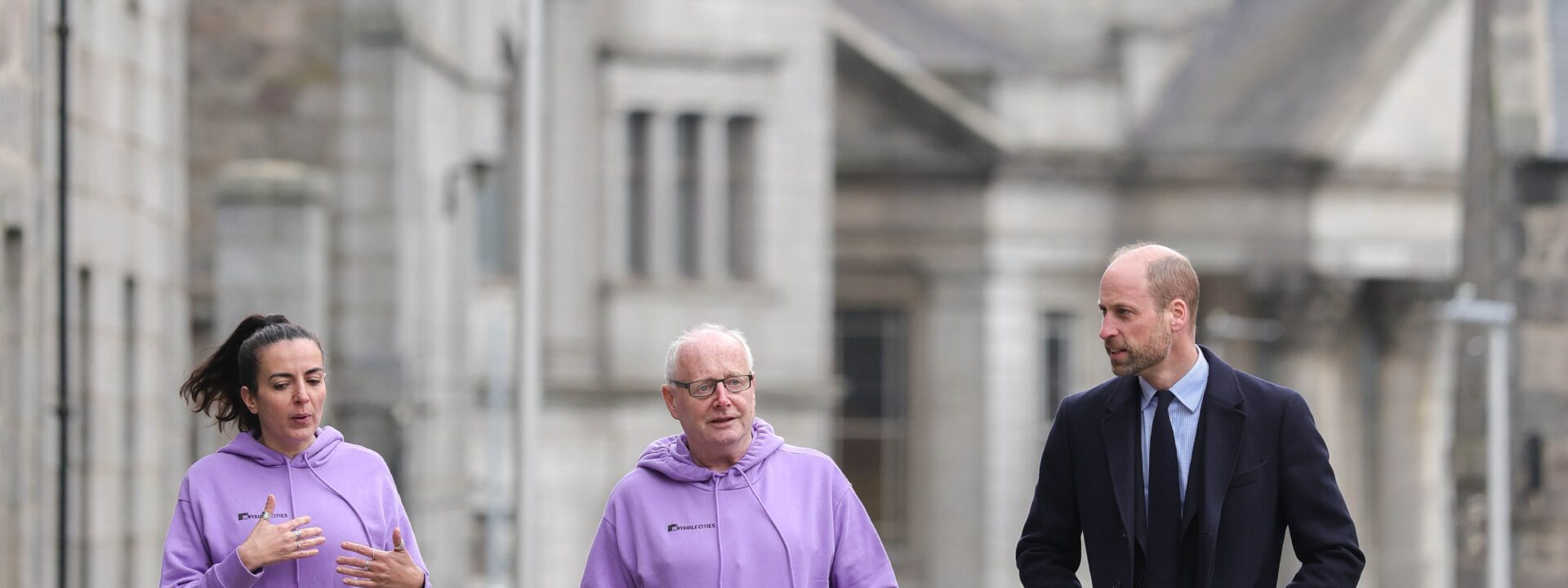
A major turning point came after a BBC feature highlighted Invisible Cities. By chance, someone at the Royal Foundation saw it and reached out. The foundation’s mission—to change the narrative around homelessness—aligned perfectly with Invisible Cities’ ethos. In March 2025, as part of the Aberdeen launch, Prince William joined a tour led by one of the guides and stood alongside Moulaoui Guery in meetings with partner organizations and potential sponsors. “He asked a lot of questions,” Guery says, “but always came back to, ‘So how are we going to support what’s happening?’ He takes that responsibility very seriously. The team around him does, too. It was just, ‘We will support you. Don’t worry about the rest. We’ll do it.’”
Despite the high-profile recognition, the heart of Invisible Cities remains deeply personal. Guides choose the stories they want to tell and the routes they want to walk. For Gayle, my guide in Edinburgh, a tour focused on women was a natural fit. She first learned about Invisible Cities through Sparkle Sisters, an event for homeless women offering free bra fittings, haircuts, clothing, and toiletries. Guery was there and spoke briefly about her organization. “I was fascinated and wanted to get involved,” Gayle says. After an interview and training, she began creating her own tour about the women of Edinburgh. She’s been a guide for three years now and, like her colleagues, has found not only employment and independent living, but also a way to share untold stories centered on women. “It’s completely different from anything I’ve done before,” she says. “It brings me independence and self-confidence.” Gayle was able to move into independent living, though Guery notes that recruiting female guides remains a challenge.
The organization’s impact is measurable in some ways—mostly through the employment and transferable skills provided to its dozens of guides and trainees—but its effects are also harder to quantify. The tours attract travelers who are increasingly interested in conscious tourism, sustainability, and experiences that give back. They’re younger, bolder travelers willing to try something new. Given tourism demographics in the UK, many tend to be American. They want something outside the ordinary—something that leaves an impact both on the place they’re visiting and on themselves. And increasingly, “they want their money to support a good cause,” Guery notes. It’s certainly a completely different experience from sitting on a tour bus, just looking out the window.Trying to see as many sights as possible.
Currently, Guery is focused on the organization’s expansion plans, with new locations underway in Sheffield, Bournemouth, Lambeth in England, Newport in Wales, and Belfast in Northern Ireland. “I told Prince William it would be 10 cities in 10 years,” she laughs. “So now I have to make it happen.”
Leaving the bustle of the Royal Mile after my tour, I reflected on how easily cities can be simplified by tourism—reduced to just landmarks and legends, or experienced without any deeper understanding. Invisible Cities challenges that by emphasizing that the local people we pass by have stories to share. More often than not, they’re stories worth hearing.
Frequently Asked Questions
Of course Here is a list of FAQs about a walking tour company that aims to change perspectives on homelessness designed to sound like questions from real people
Beginner General Questions
1 What is this walking tour about
Its an educational walking tour led by guides with lived experience of homelessness It focuses on human stories systemic causes and local history to foster understanding and compassion rather than treating homelessness as a distant issue
2 How is this different from a regular city tour
While a regular tour highlights architecture and famous history this tour highlights social history resource centers and personal narratives The goal is insight not just sightseeing
3 Who leads the tours
Tours are primarily led by individuals who have personally experienced homelessness or housing insecurity often in partnership with social workers or community advocates This ensures authenticity and provides fairwage employment
4 Is it safe
Yes Tours follow planned public routes during daylight hours The company works closely with community partners and prioritizes the safety and comfort of all participants and guides
5 How much does it cost and where does the money go
Ticket prices vary but a significant portion directly supports the guides wage with the rest funding the social enterprise Some tours may offer paywhatyoucan options or donate a portion of profits to local housing initiatives
Deeper Questions Impact
6 Whats the main thing you want people to take away from the tour
We hope people leave seeing homelessness as a complex systemic issue involving real people with diverse stories rather than a monolithic problem or a result of personal failure The goal is to replace stigma with empathy
7 Does this actually help homeless people or is it just poverty tourism
This is a key concern A responsible tour distinguishes itself by 1 Employing and empowering guides with lived experience 2 Centering their agency and narrative 3 Directing resources back into the community and 4 Focusing on education and advocacy over spectacle
8 What are some common myths about homelessness that the tour addresses
The tour often challenges myths like Its always a choice Theyre all addicted or mentally ill Theyre not from here or Services are easy to access Guides provide nuanced realworld context