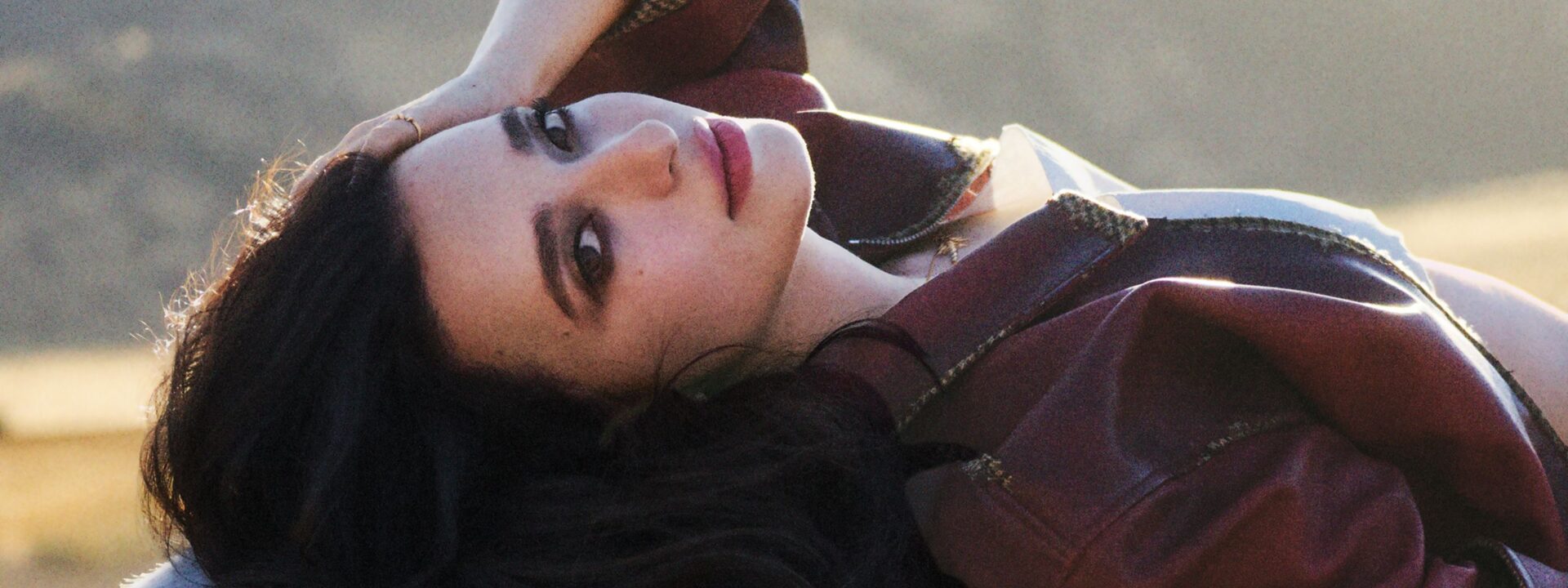
Just as water finds its own level, horse girls have a way of finding each other. Mikey Madison—or rather, Mikey Madison’s publicist—found out about my brief time on a college equestrian team, so for our interview we’re booked on a scenic trail ride through Griffith Park, ending at a hillside spot with sweeping views of the San Fernando Valley. Afterward, Madison thought we might visit her two new donkeys.
Arriving for our 11 a.m. appointment, I have no trouble spotting the 27-year-old actor, sitting alone inside the barn. She’s wearing a pink plaid button-down shirt tucked into blue jeans and a wide-brimmed hat, and she signed in using her last name, Rosberg. (Only slightly undermining this just-a-normal-girl vibe are Christian Dior sunglasses and a big gold locket she found in an antique store while working in Budapest.) Madison is very soft-spoken, very pretty, and effortlessly polite, immediately offering to grab me a hat from her car for the ride. (Since this is my first time on a horse in quite a while, I borrow a plastic helmet instead.) Then, after a brief introduction to our horses (a big, dark bay gelding named Walter for her; a smaller dark bay gelding named Floyd for me), we’re on our way: our guide, Madison, me, and a rather mischievous 12-year-old girl who’s a regular here.
A serious rider before she was an Oscar-winning actor, Madison came from equestriennes—her grandmother rode, her mother still does—and started early, competing in medal finals and doing drill team. Even so, as a child in the Los Angeles neighborhood of Woodland Hills, just north of the Santa Monica Mountains, she says she felt like “the black sheep” in her family. For one thing, none of her siblings—a twin brother, a younger brother, and two older half sisters—shared her love of horses, nor had they chosen to be homeschooled in seventh grade, as she had (to ride more). For another, there was the matter of her striking looks: she had raven hair and almond-shaped eyes in a house otherwise full of redheads. “I grew up with everyone assuming that my brothers were twins and that I was adopted,” Madison tells me, a fiction that delighted the boys—and that she herself sort of started to believe. (She eventually took a DNA test to put all that to rest.)
Her interest in acting was another anomaly. Though they liked movies well enough, her parents, both practicing psychologists, knew no one in the entertainment business. “I think people have this understanding that all of Los Angeles is Hollywood, but it’s really not,” Madison says. “I grew up feeling completely separated and just totally unaware of any of that.” Still, visions of young women out and about, having experiences—in Pretty in Pink, The Princess Diaries, Frances Ha, Almost Famous… (which Madison has watched every year on her birthday for more than a decade)—unhitched something. As deeply as she loved riding, it was an isolating sport, and though she was, and still is, quite shy, “I do like people,” she says. “I like talking to them, and I want to participate in the world, and there was a big portion of my life where I was just too scared to.” She recognized acting as something that could shake her loose a bit and allow her to “play all different kinds of wild characters, or try on all these different kinds of personalities.”
So her trips to the barn became drives with her mom to auditions, sometimes five days a week. She got into the room for a handful of independent projects, including 2017’s Liza, Liza, Skies Are Grey, a road drama set in the 1960s. That the filmmaker, Terry Sanders, had won two Oscars was a selling point, even if one was for a documentary about Maya Lin. (Though Madison looks mildly horrified when I bring it up, the movie was, she says, “overall a really sweet experience. My mom was with me a lot. I actually saw the director at an Academy scA year or two ago, he was like, ‘I discovered you!’”
If there’s a common thread in the work that followed, it’s how completely different all her characters are from Mikaela Madison Rosberg. Madison has played screamers, fighters, girls with attitude, and even characters with a taste for violence. But the person I meet has all the key traits of a horsewoman: a straight back, balanced weight in her heels, a firm but gentle hand, and sharp observation skills. (When she notices the little girl in our group might be getting run away with, Madison pauses our conversation to alert the guide.) But while nothing about her seems drawn to chaos, I can tell she could handle a wild buck.
Madison’s first big break came when she was cast in Better Things, a dramatic comedy series created by Pamela Adlon and Louis C.K. She wasn’t even 16 yet. “It took hundreds of auditions for something to finally stick,” she says. “So I was obviously beyond excited.”
As Max, she played the wild eldest daughter of Adlon’s Sam Fox, a divorced working actor raising her kids in LA. (In her first appearance in the pilot, Max is just screaming at her mother in the street.) Critically praised but somewhat overlooked—and briefly overshadowed by C.K.’s sexual misconduct allegations in late 2017, after which he was removed from the show—Better Things ran for five seasons. It basically taught Madison everything. “I learned how to be a professional,” she says. “I didn’t know anything about acting, about work, about having a job.” She also did her first red-carpet events, wearing a yellow dress she bought at Goodwill for probably $8 with “a pair of Jessica Simpson heels” to one premiere. Looking back, she doesn’t think she looked half bad.
Madison’s second big break came a couple of years into Better Things, when she was eager to see what else she could do. In 2018, she auditioned for Quentin Tarantino’s sprawling Western comedy and alternate-history film Once Upon a Time…in Hollywood, a movie now so linked to its many soon-to-be stars—Austin Butler, Sydney Sweeney, Maya Hawke, Margaret Qualley, Victoria Pedretti—that it’s easy to forget Al Pacino and Kurt Russell are also in it. Madison went all out for her audition, reading a poem barefoot and giving the director a painting she’d made in the style of a strung-out Manson girl. (It included a bit of her hair.) When she was cast as Sadie—who meets a gruesome end by being mauled by a dog, beaten up by Brad Pitt, and then set on fire in a pool with a flamethrower wielded by Leonardo DiCaprio—Madison found herself doing night shoots with Tarantino after spending the day on the Better Things set.
That was Sean Baker’s introduction to her: the filmmaker, known for his vivid, often darkly funny portrayals of American lives on the margins (Tangerine, The Florida Project), had never seen Better Things, but Madison caught his attention right away in Once Upon a Time…in Hollywood. “I thought she was stealing all her scenes,” Baker says. “In a three-hour movie, for her to come out of nowhere in the last 15 minutes and make such an impact—I remember telling my wife, ‘There’s something special about her.’ And I think she was the one who said, ‘Yeah, she’s been on Pam Adlon’s show forever.’” Yet it was only after seeing her in 2022’s Scream, playing a snarky, dryly funny Woodsboro high schooler later revealed as the Ghostface killer, that Baker felt he’d found his next lead.
By then, he had a storyline for Anora but no real script; he prefers to write with an actor in mind. Madison, he thought, would give him a lot to work with. “She had such a presence,” he says. Baker liked the subtle humor in her delivery, “and she proved that she could deliverthe intensity—and the screaming. I knew this character was going to face a home invasion and just needed to scream.” A spiritual cross between Pretty Woman and Uncut Gems, Anora follows Ani, a stripper and sex worker from Brighton Beach, Brooklyn, who marries a young client—the sweet but immature son of a Russian oligarch—only for his scandalized parents to go to extraordinary lengths to get the marriage annulled. “Sean sort of plucked me out and gave me this incredible opportunity and this amazing character who I couldn’t have been more different from,” Madison says. “I wanted to do justice to the character, and I wanted to do justice to him.” Entertainment journalists tended to call her elaborate preparation for Anora “Method”—installing a stripper pole in her home, taking Russian lessons, doing her own stunts. But all she was trying to do was sell it. “I recently had a meeting with a director who was like, ‘I didn’t know that you were actually an actress.’ And that’s the kind of thing that’s important to me.” The demands of the experience and the agency she felt in developing the role set a standard for the kind of work Madison wants to do going forward. “Honestly, it took me so long to realize that I’m not just an actress for hire—that my voice is really important, and people care about my input. It’s still a learning process, because I also have this people-pleasing tendency of just: yes, yes, okay,” she says. But she also has ideas of her own. “There are things that don’t exist yet that I want to do.” When, a few weeks before her 26th birthday, she mounted the stage of the Dolby Theatre to accept the Oscar for best actress in 2025, Madison—wearing a strapless, bow-fronted pink-and-black Dior ball gown reproduced from a 1956 design—became one of the youngest women ever to claim that prize. By now, the months leading up to the ceremony—starting with the 2024 Cannes Film Festival, where Anora won the Palme d’Or—are one big, bewildering blur to her. “I think I was just sort of living outside of myself for a certain amount of time,” Madison says. “I definitely will pass by my shelf in my living room and be like, Oh, wow. I guess that really did happen.” I ask if the recognition felt, well…a little soon to her, even after a decade as a working actor. (The takes about Demi Moore—the odds-on favorite for her performance in The Substance, a lurid allegory for ageist misogyny—losing the Oscar to someone born in 1999 practically wrote themselves.) She pauses before answering this, in part because we are entering a tunnel that requires us to ride in single file. “I’m definitely more of an anxious-leaning person,” she says at last. “I tend to be very practical, in terms of, keep your expectations low so you don’t hurt yourself…. I’ve always been like that. So I think that when it happened, it superseded every expectation I’d had for myself, ever.” Even the idea that she might not have to audition anymore was shocking. When I ask Baker if, during the time they spent promoting Anora, he observed any changes in Madison—to her confidence, the way that she handled the press, anything—he tells me that, no, he doesn’t think he did. The campaign, to be clear, was “grueling,” he says, “like a whole other job.” Yet Madison appeared unfazed. “She didn’t change. She’s the same sweet, wonderful, very intelligent and fun person that she was, and devoid of any diva attitude.” Madison articulates the same thing another way: “I still feel like this working actor who feels the need to prove themselves.” If The Social Network was about the people who laid Facebook’s foundation, Aaron Sorkin’s follow-up, The Social Reckoning, is about the whistleblower and the journalist who exposed the rot in its infrIn 2021, Frances Haugen, a product manager at Facebook, teamed up with Jeff Horwitz, a reporter for The Wall Street Journal, to uncover what the company knew—and what it did or didn’t do—about issues like extremist groups and the spread of misinformation on its platforms, especially after the 2020 election, as well as the harmful effects of Instagram on teenage girls’ mental health. How Facebook tried to balance its data on these issues with the need to keep users engaged became the focus of the Facebook Files, a series of reports the Journal published in late 2021.
For Madison, agreeing to play Haugen was an easy decision. “You read a script like that and you’re like, I have to do this,” she says. “It’s also a really interesting story to me, about this woman—this massive hero—that no one really knows about. She didn’t feel aligned with what she originally loved about that company, and she did something pretty brave.” (The film also stars Jeremy Allen White as Horwitz and Jeremy Strong as Mark Zuckerberg, with strong supporting performances from Wunmi Mosaku, Betty Gilpin, and Bill Burr.)
Honestly, it took me so long to realize that I’m not just an actress for hire—that my voice is really important, and people care about my input.
She did, however, have questions. Madison looked very little like Haugen, a blue-eyed, square-jawed blonde, and the age gap between them was significant; Haugen was in her mid-30s when the events of the film took place. “I met Aaron, and I was like, ‘I love this script. This is an amazing character. But I don’t look like this person at all,'” Madison says.
She was open—even willing—to undergo a complete physical transformation; Anora had given her a taste for that kind of thing. But that wasn’t what Sorkin had in mind at all. “Listen, if you’re playing Elvis or Lucille Ball, there’s an obligation to approximate some kind of physical or vocal impersonation,” Sorkin explains to me later. “But that wasn’t here. I wanted her to just play the character in the script.”
This threw Madison a bit. “For a while I was like, How do I play someone and use her name but not feel like I’m authentically representing her in that way?” (She recalls telling Sorkin that she’d read Haugen’s memoir—just “to have a better understanding of how things happened”—and noticing some dismay in his reaction.) But Sorkin stood by his approach, “and I trusted him.” She has since written Haugen a letter, and the two have “talked a little bit over email. I think she really just wants the story to be told.”
To find her own Frances, Madison tried a few things. Reasoning that a woman with such a desk-bound job might have a “softer physicality,” she mostly stopped working out; and for the first time in her life, she dyed her hair and cut it to about shoulder length. “I had this jet-black, waist-length hair. I didn’t feel like this woman who’s a data scientist, who works at a computer all day, would maintain that,” she says. “Something that felt a little mousier felt more like the character to me.”
A closely guarded early screening of the film—still not quite finished—in August revealed that character to be a perfectly Sorkinian creation: wary, wry, and nerdily superior, given to spouting data points and calling out mixed metaphors. (Pity the colleague who compares her both to the Trojan priestess Cassandra and the boy who cried wolf.) Not long after they connect via LinkedIn DM, she and Horwitz are sparring like siblings—she, skeptical that he actually understands the information she’s leaking; he, disturbed by her belief that Facebook can still be a tool for good, even after seeing its emphasis on free speech and community-building distorted beyond recognition. (The film’s dutiful unpicThe king of the ties that bind Big Tech, politics, and the media set its release for early October—just weeks before the midterm elections—making it especially timely. I ask how Madison found White as a scene partner. Much of the movie has them hunched over a laptop, discussing how Facebook’s algorithm works. (Their career paths have also been similar: both spent years on a family dramedy before a darker, more grown-up role made them a sudden sensation.) “Very sweet,” she says. “Very, very, very professional. Stoic. I appreciate his work ethic.” Sorkin’s set could not have been more different from Sean Baker’s. “It was challenging in some ways, especially because Anora was the movie I did before Reckoning. That had an entirely different energy and vibe, with so much improvisation,” she says. “With Aaron’s dialogue, it’s scientifically perfected, in a way.” He expects you to say it as written, I offer, meaning it as a question. “And I want to too,” Madison replies. “Because every line and every word is very intentional, so it’s important to do it a certain way.” If she struggled at all to adjust to the rigors of his filmmaking style, Sorkin wasn’t aware of it. “Mikey doesn’t need much more than: Play it a little hotter…a little cooler…. Drive to the end of the line…, things like that, and she’s there,” he says. “As great as she was in Anora and as great as she is in The Social Reckoning, I’m certain she hasn’t yet done the best work she’s going to do.” Of course, the funny thing about her playing a Facebook wonk is that Madison herself isn’t on social media at all. She was, for a time—in middle school she was one of millions of other 13-year-olds Instagramming slices of pizza or cookies on a cooling rack—but it was never an obsession, and eventually she forgot the account existed. (Only recently did her father discover that her Instagram was, indeed, still live.) Now staying offline is more deliberate. “It feels kind of big and vast and stressful,” she says, referring, it seems, to the internet in general. Acting may have made her slightly less shy, but Madison still describes herself as “sensitive”—too nervous to read reviews (“I don’t think I ever did until Anora, but that was only after someone told me it was safe and I wouldn’t get my feelings hurt”) and certainly too delicate to face a comments section. I wonder how she’s coped with losing out on parts—how she handled, as a teenager, all the drives and the self-tapes that came to nothing. “If I’m honest,” she says, “it’s still something I’m learning.” By this point, we’ve returned to the barn, hopped off our mounts (“The Western saddle feels different on the butt, doesn’t it?” she remarks with a giggle), and made our way to where she keeps the donkeys—rescues named Loulou (after the Isabelle Huppert movie) and Gus Freckles. After turning them out in a ring, we settle into Adirondack chairs to watch them play. (If you were curious what, exactly, one does with donkeys, it’s pretty much just this. “You walk them around, pet them, give them a snuggle,” Madison says. “It’s just for fun.”) She is easily her happiest at home, surrounded by her animals; in addition to the donkeys, Madison has three Chihuahuas and one very patient cat. She has always loved to cook and bake, skills she picked up from her father, a onetime sous-chef. (Later that day, in fact, she’ll be preparing a feast of miniature pizzas, kale-and-orzo salad, and peanut butter cookies to celebrate her mother’s birthday.) Gardening is a more recent hobby—she’s trying to branch out from tending the succulents in her yard and start growing some vegetables and herbs. When she’s in towMadison says she sees her parents, who still live “deep in the Valley,” several times a week. Her twin, who works in finance, is also nearby, while her younger brother is away at graduate school studying psychology. (Though we skip over her dating life, she very much wants a family of her own someday. “I’ve always dreamed of getting married and having that white-picket-fence life,” Madison says. “My sisters have it, and my friends are getting married and thinking about having kids. It definitely makes me think about it a lot.”) Earlier this year, she spent three months in Hungary filming a new adaptation of The Masque of the Red Death; Loulou and Gus Freckles were gifts from the film’s director, Charlie Polinger. When Madison left, her mother cried. “She kept calling me and saying, ‘If you ever want me to come over, just let me know,'” Madison says. “I’m like, ‘That’s so sweet, but I actually have to work.’ But my twin came and hung out for a while.” As it turns out, a dozen or so years after choosing acting over horses, Madison had to do some riding for Masque. “I was so confident and cocky going into it,” she says. “I was like, ‘You guys, I’ve got this, just show me where I need to go.'” But something surprising happened. “This horse was so amazing—it would hear them say ‘action’ on the walkie-talkie and take off. Then it would see the camera and slow down.” It was funny—feeling like she knew what she was doing and then completely being taken for a ride. The first time it happened, “it scared the shit out of me,” Madison says. But the crew, full of awe, couldn’t tell the difference. She seemed completely in control the entire time.
In this story: hair, Jimmy Paul; makeup, Raoul Alejandre; manicurist, Kim Truong; tailor, Hasmik Kourinian. Produced by Rosco Production. Set Design: Jeremy Reimnitz. Visuals Editor: Paige Viti.
Frequently Asked Questions
Here is a list of FAQs about Mikey Madisons October 2026 Vogue cover story The Social Reckoning and her choice to stay offline
Beginner Questions
Q What is The Social Reckoning in Vogue
A Its the title of Vogues October 2026 cover story The article focuses on how constant social media use is affecting actors and celebrities and it features Mikey Madison as its cover star
Q Who is Mikey Madison
A Shes an American actress She gained major attention for her role in Once Upon a Time in Hollywood and won widespread acclaim for the film Anora
Q Is Mikey Madison on social media
A No She has said she doesnt use social media platforms like Instagram TikTok or X She stays offline entirely
Q Why is she off social media
A She says it protects her mental health helps her stay focused on acting and lets her live a more private normal life
Q What does staying offline mean here
A It means she doesnt have public social media accounts and doesnt scroll feeds or post content like most celebrities do She still uses the internet for practical things like email or research
Intermediate Questions
Q What does the Vogue article say about her decision
A The story presents her as part of a growing social reckoning a moment when celebrities are questioning whether constant online presence is worth the cost It frames her choice as deliberate not out of fear or ignorance
Q What are the benefits she mentions from staying offline
A She says she has more mental clarity less anxiety deeper focus on her craft and stronger reallife relationships She also avoids reading negative comments about herself
Q Doesnt being offline hurt her career or fame
A She argues the opposite Her work speaks for itself and directors and studios still find her She believes talent and good projects matter more than follower counts
Q How does she promote her movies without social media
A She does traditional press interviews premieres and film festivals Her team handles promotion and she participates in scheduled media events rather than daily online posting
Q What common problems does she avoid by not being online
A