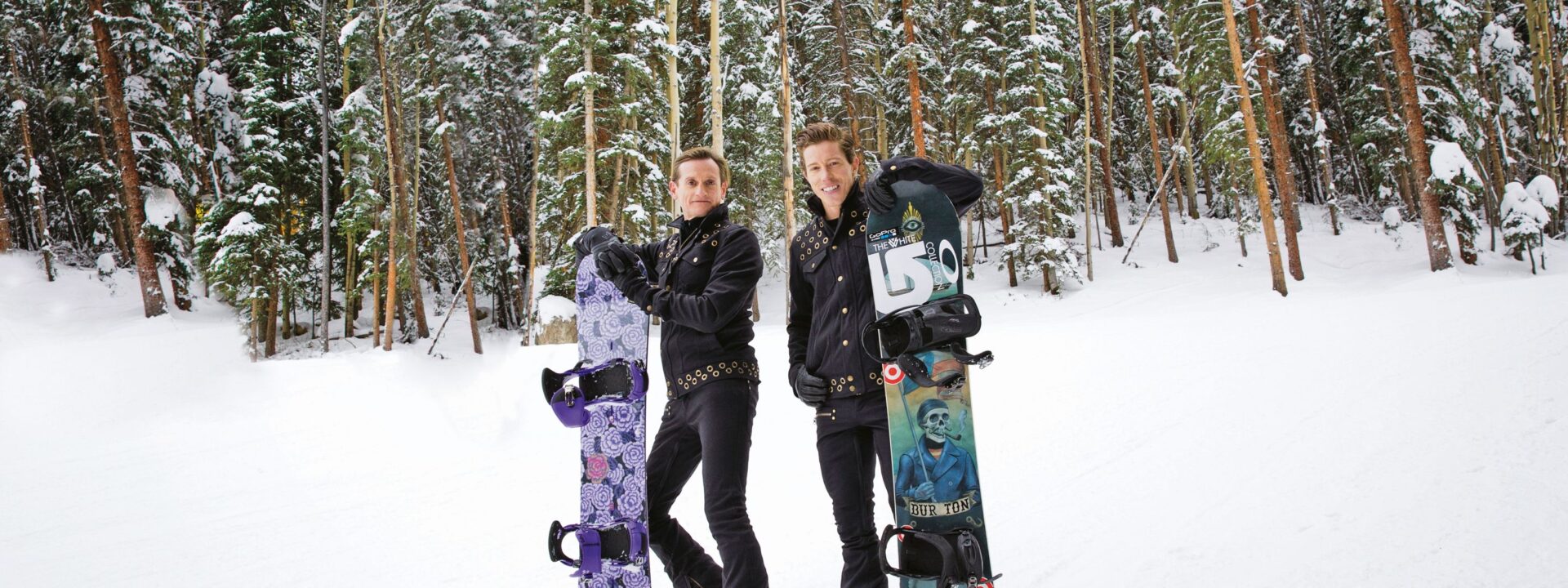
“Shredding With Shaun,” by Hamish Bowles, originally appeared in the February 2014 issue of Vogue. For more highlights from Vogue’s archive, sign up for our Nostalgia newsletter.
When I was a boy and snow fell on London, my sister and I would take wooden tea trays to the gentle slopes near Whitestone Pond at the top of Hampstead Heath. We’d hurtle down the hill in gleeful terror, usually tumbling into a heap of bobble hats, bruises, and woolen mittens thoughtfully connected by elastic ribbons to keep them from getting lost.
Those were my first and last attempts at sliding on snow.
My family didn’t ski, and neither did my childhood friends. By the time I met people who spent summers working in chalets or flirting with handsome ski instructors, I felt it was too late to learn—and I wasn’t fond of fondue. More than the dangers of the slopes, I disliked the clothing. I admired Jacques-Henri Lartigue’s photos of Alpine adventures from the 1910s, with women in Chanel and Patou tweeds and furs, and men in plus fours, fine knits, and elegant boots. Then I’d see the puffy synthetic gear and clunky boots of today—well, you know the rest. If they could make the Princess of Wales look like a Smurf-blue Michelin Man, what hope did I have?
But decades later, Anna’s idea sparked my midlife conversion to the slopes, specifically to the edgy art of snowboarding.
The plan: I’d visit Jake Burton, the guru of snowboarding, and his team at Burton HQ in Vermont. Then, equipped with a custom board, I’d head to Keystone, Colorado, to learn how to careen down a 12,000-foot mountain at breakneck speed while strapped to a fiberglass-and-wood board shaped like a giant ice cream spatula. Thanks, Anna. And there’s more: my instructor in Colorado would be Shaun White, the red-haired snowboarding champion who won Olympic gold in 2006 and 2010 and looked poised to do well in Sochi. He can also perform a Double McTwist 1260 somersault—which he calls a Tomahawk, since he invented it—about 25 feet in the air. Cue a sharp intake of breath.
In Burlington, Vermont, two weeks before Thanksgiving, the mood at Burton is euphoric. Snow fell a week early, so the 350 employees can swap the office skateboard ramp for the slopes. Jake, their leader, is personable, avuncular, and young at heart—like any serious snowboarder. His staff, passionate about snowboarding, are so laid-back they’re practically horizontal.
Then there are the dogs. Calling this a dog-friendly workplace is an understatement. There are 130 registered dogs—not teacup Pomeranians, but sturdy mountain dogs. Jake has Lily, a white retriever. They roam in packs or curl up on sofas placed around the office for their comfort. Bowls of dog biscuits sit on the reception desk.
In the entrance, warmed by a roaring fire where a pair of hounds bask, the walls display snowboarding history, including Jake’s early prototypes inspired by something called the Snurfer. At the 1979 Snurfing championship, Jake showed up with his custom board featuring bindings to secure his feet—and snowboarding was born.“I was a loser in shop class!” laughs Jake, who created over 100 prototypes before he came close to a board that could actually surf on snow. He then hit the road with his basic designs, trying to convince shops to carry them. “That was brutal,” he says of that lonely stretch, which he calls his “Willy Loman period.” “Surf shops didn’t want it, ski shops didn’t want it, skate shops… nobody wanted anything to do with it. Once, I left with 35 boards and came back with 37,” after an angry store owner returned two unsold boards from the previous season. Slowly, small groups of daring—and often injury-prone—enthusiasts began appearing across the country; Jake knew almost every one.
Snowboarding wasn’t an Olympic sport until Nagano in ’98, where Jake was disappointed to see it misspelled as “snoboarding.” Competitors were sent out in “a driving rainstorm” that skiers weren’t allowed to race in. “That was discouraging,” he recalls. By Sochi 2014, it was expected to be the most popular winter sport.
My board features a lilac camellia design, inspired by a Tom Ford tuxedo I wore for my fiftieth birthday, with “BURTON” spelled out on the underside in the VOGUE logo font. At the on-site Burton store, lilac bindings are attached, and I’m fitted with the rest of the extensive gear. I’m thrilled that Pharrell Williams’s collaboration includes a vibrant Chinese yellow outfit with Peruvian textile accents, and that Shaun White’s latest collection is a ’70s-inspired black denim with skintight flares and rivet trim—clearly tailored to his compact, wiry frame. I practically have to lie on the changing room floor to squeeze into the pants, which are, distressingly, a size L. These collections are all overseen by Greg Dacyshyn, Burton’s charismatic chief creative officer. Dacyshyn (as everyone calls him) designed the American snowboarders’ Olympic uniform, and I’m the first outsider to see it. Based on a vintage American patchwork quilt, it has a subtle, poetic Days of Heaven vibe. Shaun, however, seems unconvinced. “We’ll see how I look in cords,” he’ll tell me later, eyebrow raised.
In beautiful Stowe, I’m staying at the sprawling Mountain Lodge. With the season still a week away, it’s eerily reminiscent of The Shining, with its endless echoing corridors and empty, high-ceilinged restaurants. But the beginner slope is just a short walk away. Strapping my boots into the board without falling over is quite an ordeal, but the real challenge is keeping the board’s downhill edge off the snow—a simple idea that turns out to be brutal on the hamstrings (luckily, mine have been toughened up at Equinox, where ex-pro boxer Jared has been relentlessly prepping me for snowboarding). Shaun himself focuses on biometrics; he can’t afford to bulk up too much, or he’d be top-heavy on his board. “He’s borderline frail,” says Jake. “Sinewy.” After a lifetime of landing from great heights, Shaun’s legs, as I’ll discover, are slightly bowed, like Charlie Chaplin’s Little Tramp—an effect exaggerated by the second-skin pants he prefers.
On the snow, Jake is protective and calmly reassuring. “I love teaching people to ride,” he says. “I taught my kids, and it brought tears to my eyes.” To demonstrate, he glides down the slope with effortless grace, the S-curves he leaves in the fresh snow resembling the flourishes of Elizabeth I’s signature. The air is so clear it’s almost intoxicating, the views are stunning, and Jake’s careful guidance gives me a fool’s courage.
Properly prepared, I head to Keystone, Colorado, a week later. The first thing that greets me in my condo when I arrive in the middle of the night is the grinning head of a black bear mounted on the wall—a warning, if one were needed, not to wander off the beaten path in the dark here.Tomorrow brings the challenge of getting into my gear, followed by an awkward trek to the imposing gondola. For the record, I have a terrible fear of heights. I once foolishly booked a pod on the London Eye for my father’s seventieth birthday and spent the entire agonizingly slow rotation clinging to the bench, quietly sobbing. Meanwhile, my infant nephew and his friends happily pressed against the pod’s glass floor and walls, and other guests sipped champagne while admiring the view of Alexandra Palace six miles to the north. So it’s with considerable trepidation that I set off now.
But here’s the thing: my heart is in my mouth less from sheer terror than from overwhelming awe at the majestic landscape. Great white mountains bristle with towering pines, and in the distance lies Lake Dillon, its glassy surface hiding an Atlantis-like nineteenth-century mining town beneath.
We pause partway up the mountain at the beginner’s slope, a perfect place to start. Jake is joined by Gabe L’Heureux, a Burton photographer and team manager, and together they guide me through winding turns. My confidence grows slowly until I watch iPhone footage and see the unsettling image of a hunched old woman from a Brothers Grimm tale.
The next day, the friendly British-born Mark Lawes—a veteran of 20 seasons in New Zealand, three in Scotland, and fifteen at Keystone—joins my ever-growing team of snowboarding mentors, which now even includes Shaun White himself. I had managed to put my wrist guards on backward. “I once put my bindings on backward for a competition,” Shaun laughs. “That was the last time I did my own gear!”
Mark focuses on getting me to look up and enjoy the stunning views. “If you were driving, you wouldn’t stare at the pedals, would you?” he says.
“I’m kind of a bad coach,” Shaun admits. “I don’t really analyze things; I explain everything based on feeling.” But his low-key advice is powerful. “When you twist your upper body, your lower body will follow,” he tells me. “It’s all led by your front shoulder… keep it flowing. Once you get past that subtle hurdle,” he adds, “the whole mountain opens up—you can go anywhere!”
The plan is to relax for the afternoon, but after lunch I can’t wait to get back on the snow. It’s driving me crazy watching skiers and snowboarders glide down the mountain with stylish sweeps and turns. The final straw is seeing a mother and her tiny daughter—who can’t be more than four—confidently sailing down the vast mountain face together.
That evening, a dinner with the effortlessly charming Shaun proves revealing. He has just returned from Austria, where he was practicing his jumps. He trains separately for half-pipe and slopestyle (the latter, making its Olympic debut in Sochi, involves a series of linked jumps and tricks on steel rails). His trademark red hair, once as long and lush as that of a Charles II-era rake, is now trimmed short with a bouncy pompadour. Shaun favors Burberry and Saint Laurent, both of which tailor clothes to suit his lean frame. Although he now travels in style with vintage Vuitton luggage from Maxfield in Los Angeles, he didn’t discover shopping until he was 21 and began designing a line for Target. “I didn’t know you could try on clothes!” he tells me. “I’ve been sponsored since I was eight. I’d just go to a warehouse, look at a picture of a T-shirt or something, and say, ‘That’s cool.’”
How did all this begin?
“I was this horrible kid,” he recalls. Born with a heart defect, he was on skis by age four. “I had so much energy, my parents thought, ‘We’ll put him on a snowboard; he’ll fall all the time, and we’ll keep track of him.’ They just figured I wouldn’t get the hang of it.”
Clearly, they miscalculated. Shaun idolized his older brother Jesse, who was seven years his senior, and soon mastered all of his snowboarding tricks too. His parents enrolled him in competitions, and his talent quickly became undeniable.He won his first race at age six. “They didn’t make boards or boots my size, so I wore ski boots,” he says. Burton stepped in to sponsor him when he was seven. “That was a helping hand early on because it was hard for a family of five to afford everything—ski passes, lodging, food up at the mountain,” Shaun explains. To save money, the family had been sleeping in camper vans at upscale resorts like Aspen and skipping elaborate Christmas gifts.
“I got the taste for winning when I was fifteen, and then at sixteen I won everything,” he says matter-of-factly. His prizes included “five or six cars”—which he was too young to drive. “I donated a couple of them,” he remembers. One, a Lexus hybrid, he wrapped in a “big red bow” and surprised his mother with. When he first turned pro, his mother worried it might be a passing phase and wanted to ensure his education wasn’t overlooked. “I just kind of squeaked through middle school,” he admits, but with his relentless travel schedule, “high school was the hard one. By the time I’d come home and catch up on all the work, I’d leave again. It was unsustainable.” He struggled to keep up and asked for help, but recalls his school telling him, “We don’t consider your sport legitimate. We can’t help you.”
I’ve managed to put my wrist guards on backward. “I put my bindings on backward for a competition once,” Shaun laughs.
At the time, though, as Shaun points out, “I was making money, real money.” So at sixteen, he got a mortgage and bought a house in a new school district where his passion was supported. “I’m sure they’re kicking themselves now,” he says, laughing, about his former school.
Shaun believes his success vindicated his family, who had faced criticism from their community and his teachers over the years. He remembers being told, “Your kid’s gonna have no future.” That’s why that first Olympics meant so much. It felt more like we did it than I did it.”
The next morning, I’m back on the beginner slopes. By the end of the session, Mark lets go occasionally, and I experience the unmatched adrenaline rush of carving down the hill in wide sweeps—a frightening liberation, like a wild animal born in captivity suddenly freed into the unknown wilderness.
In the afternoon, I watch Shaun practice on a private slopestyle run built specially for him. As he streaks down the mountainside, kicking up sprays of snow, skimming a rail high above the ground, or gently clipping the dome of a feature shaped like an oil can, it’s hard to capture the poetry of his movement.
It struck me in what must be one of the more surreal sentences I’ve ever written. From my notes: “In the hot tub with Shaun White, I noticed the tattoos on his arms.” One is a Native American symbol for a storm; the other is more personal. Shaun asked a snowboard artist he’d worked with—whose 19th-century almanac style he admired—to design a tattoo that represented him. The result? A powerful image of a lion on a cloud. I simply can’t wait for Sochi.
Frequently Asked Questions
Of course Here is a list of FAQs about the Vogue article From the Archives Hamish Bowles Hits the Slopes with Shaun White
General Context
Q What is this article about
A Its a Vogue feature from their archives where fashion journalist Hamish Bowles spends a day snowboarding with Olympic champion Shaun White blending high fashion with snow sports culture
Q Who is Hamish Bowles
A He is a wellknown fashion journalist historian and the International Editor at Large for Vogue Hes famous for his deep knowledge of fashion history and his distinctive personal style
Q Why was Shaun White featured in Vogue
A Beyond being a snowboarding legend Shaun White is a style icon and cultural figure The article highlights his influence beyond sports exploring his personal style and life
Content Style
Q Is this a sports article or a fashion article
A Its a hybrid While its set on a snowboarding slope the focus is on the interaction personalities and style of both men Its a fashion piece set in an athletic world
Q What kind of fashion is featured
A The article likely highlights a mix of highperformance snowboarding gear and highfashion winter wear reflecting both Shauns athletic needs and Hamishs elegant vintageinspired style
Q Whats the tone of the article
A Its conversational insightful and slightly whimsical It captures the contrast and camaraderie between the meticulous fashion expert and the laidback champion athlete
Practical BehindtheScenes
Q Where did this take place
A The article is set on a snowboarding slope though the specific location isnt always named It was likely at a resort known for snowboarding like in Colorado or California
Q Did Hamish Bowles actually snowboard
A Yes thats the central premise The article humorously and honestly documents his attempt to learn from the very best highlighting the challenge and fun of the experience
Q When was this originally published
A The article is From the Archives so it was published in a past issue of