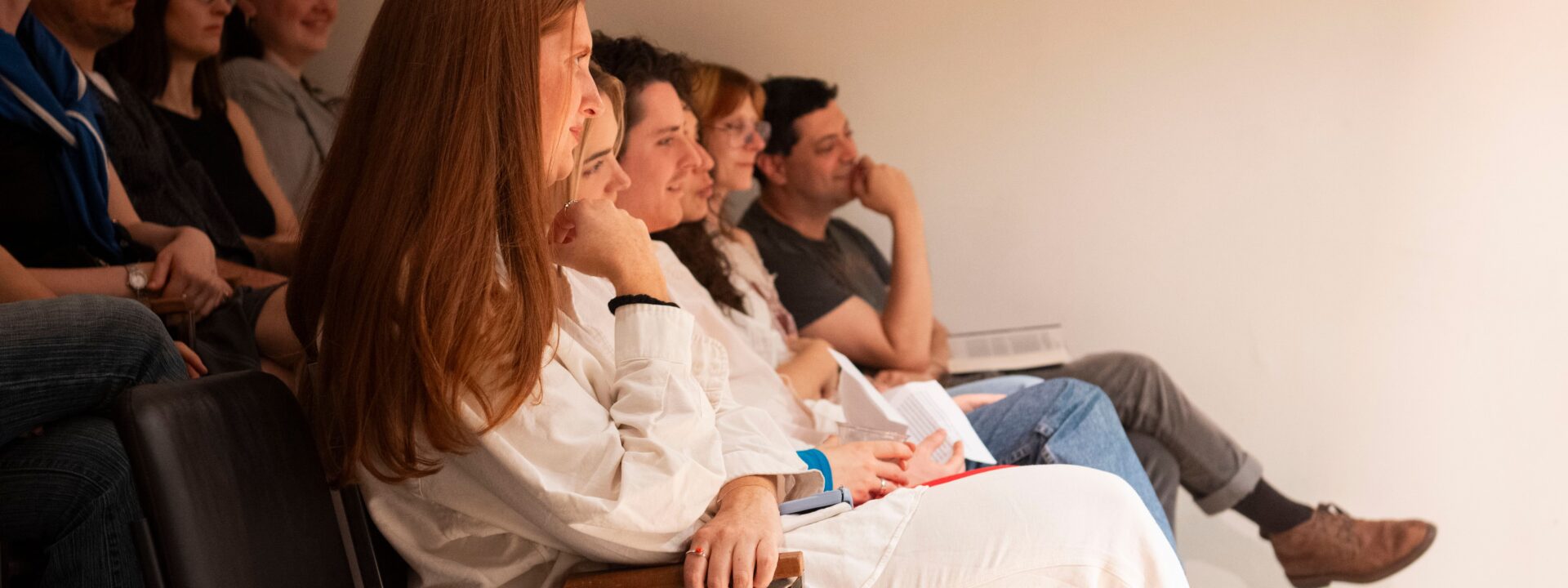
When Mikaela Dery launched her reading series Fashion Fiction almost a year ago, it was a way to combine two of her passions: fashion and literature. Dery, who works as a literary event programmer, was in the midst of a dreary winter when she decided to revisit Plum Sykes’s 2004 novel Bergdorf Blondes. At the end of the book, Sykes mentioned her long-running Vogue column “Fashion Fiction,” which Dery adored, and the idea clicked.
“I thought literary fashion writing would make a great series, and I could call it ‘Fashion Fiction,’ even though you don’t have to read fiction,” Dery explains. She contacted Sykes for permission to use the name, which Sykes gave.
At Dery’s series, fashion writing is celebrated as a genuine literary art. “What I really love is separating fashion from commerce and approaching it as an intellectual pursuit,” she says. “That’s what makes it so exciting to me—fashion can be part of your intellectual life.”
Approaching its first anniversary, Fashion Fiction has hosted writers like Zoe Dubno, Doreen St. Félix, Rachel Syme, and Katie Roiphe, and partnered with brands such as Warby Parker and Serviette fragrances. The events remain free and, as Dery describes, “roughly monthly,” moving between a few local venues. By now, it has gained a devoted following, with each reading selling out in hours, if not minutes.
At the most recent gathering, attendees filed into Surrender Dorothy on West 17th Street, sipping wine among vintage clothing. I spotted at least two pairs of vintage Chanel flats, a Marilyn Monroe miniskirt, and a Spice World T-shirt paired with a plaid pencil skirt. Jonathan Woollen’s praised new translation of Superstars, the cult-classic French novel by Ann Scott, was for sale near a tiara and a cluster of sparkling rhinestones. Upstairs in a small theater (the store’s building is owned by an actor), nearly every seat was taken.
Writers can read any genre of work—their own or by someone they admire—as long as it relates to fashion. Actress and Surrender Dorothy co-owner Ruby McCollister shared a story about an antique mall in Mansfield, Ohio. Amanda Lee Burkett, from the Substack You Can Talk About It, But Only With Me, read a passage from Ingeborg Day’s (aka Elizabeth McNeill) novel Nine and a Half Weeks, describing the main male character’s closet before “all the psychosexual stuff happens,” as Burkett joked. Writer David Kobe explored his connection to the aesthetics and attitude of basketball and the legendary Allen Iverson. Reading from Superstars, Jonathan Woollen set the scene before a queer French rave in the late 1990s, and writer Elisa Gonzalez shared a selection about celebratory dress from a project she’s working on. Throughout, the audience was captivated.
Below, Mikaela Dery shares five literary works that influenced her thinking about aesthetics, from fiction to essays. Follow Fashion Fiction on Substack for details on her next event.
Fashion Is Spinach by Elizabeth Hawes
Elizabeth Hawes was, among other things, a fashion designer in the 1930s. She believed American women were being sold the “French Legend” (the titular spinach), leading them to wear clothes that didn’t suit their lives simply because of the label. Fashion Is Spinach is incredibly witty and sharp; much of it still holds true today. According to Hawes, the future of American fashion lies with women who “make no pretensions to chic and no compromise with fashion. They dress as they please.” This, she says, “takes real character and is, in my opinion, the only way worth dressing.” Plus, Hawes’s designs are stunning. You can view them online in the Met archive.
A Left-Handed Woman by Judith Thurman
I think Judith Thurman might be the smartest person I’ve ever met. All of her books are wonderful, but I often find mI keep returning to A Left-Handed Woman, a collection of Judith Thurman’s essays from The New Yorker. Thurman says she often writes about “women who are either lost to history or lost in some ways to themselves.” What I love is that these pieces never treat clothing as a guilty stand-in for something supposedly more “real” or intellectual. For Thurman, clothes are woven into the fabric of her thinking.
Henry James and Edith Wharton both wrote beautifully about clothing, which often plays a key role in their novels. I’m especially fond of Daisy Miller, the story of an American girl in Europe who doesn’t understand—and ultimately doesn’t care to understand—society’s rules. Despite this, or maybe because of it, even her critics admit she “has that charming look that they all have… she dresses in perfection—no, you don’t know how well she dresses.”
The Coin by Yasmin Zaher is thrilling and deeply moving. It follows a stylish, wealthy Palestinian woman living in Fort Greene who gets caught up in a pyramid scheme centered on Birkin bags. Often, the fact that clothes are physical objects is held against them—being called “materialistic” is rarely a compliment. Zaher turns this idea on its head in a brilliant way. A home isn’t just an idea; it’s a physical thing.
Working on Fashion Fiction has made me realize that most writing touches on fashion in some way, because clothes are so woven into our lives. That’s why diaries can be such a wonderful source of writing about clothing. My favorite example is Helen Garner’s Yellow Notebook, which collects her diaries from 1978–1987. There’s a passage—not directly about clothes—where she decides her next book, The Children’s Bach, will be “a short one,” with a “domestic subject and setting.” She writes: “I walked home from work and passed a print shop, in the window of which stood a copy of that van Gogh painting of the inside of his bedroom: floorboards, a bed, two cane-bottomed chairs, a window. I thought, That’s a beautiful painting. And it’s only the inside of a room.” I think about that a lot.
Frequently Asked Questions
FAQs Essential Reading for Fashion Writing
Q1 Who is Mikaela Dery and why should I care about her book recommendations
A Mikaela Dery is a respected fashion writer and critic Her recommended books arent about fashion trends but about the deeper skills needed for thoughtful writinglike observation cultural analysis and crafting a compelling narrativewhich are essential for any aspiring fashion journalist
Q2 What are the five books that influenced her approach
A While the specific list may vary books that typically influence this approach include
The Fashion System by Roland Barthes
The Arcades Project by Walter Benjamin
Notes on Camp by Susan Sontag
The Society of the Spectacle by Guy Debord
A key work of narrative nonfiction for style and voice
Q3 Im new to fashion writing Are these books too advanced or theoretical for me
A They can be challenging but thats the point Derys approach suggests that strong fashion writing is built on a foundation of big ideas Start with Sontags Notes on Camp or a Joan Didion essaythey are more accessible entry points into critical thinking and beautiful prose
Q4 Whats the main benefit of reading these dense theoretical books instead of just following fashion blogs
A Blogs often report what is happening These books teach you how to think about whats happening They provide tools to analyze why a trend matters what it says about society and how to write about it with authority and unique insight setting your work apart
Q5 I want to write about clothes not philosophy How does Roland Barthes The Fashion System help with that
A Barthes teaches you to read clothing as a language It helps you move beyond describing a dress as blue and silky to decoding what that blue that silk and that cut communicateabout luxury mood or rebellion It turns description into analysis