I hear Doja Cat before I see her. I’m standing under the fluorescent lights in the basement of Sydney’s Qudos Bank Arena, being watched closely by security guards. Her vocal warm-up drifts through closed doors: “Oh-oh-oh-oh-oh!” Doja’s assistant slips through, gives me a thumbs-up, and leads me into a dressing room as large as a tennis court, with black velvet curtains covering the walls. The arpeggios continue—“la-la-la-la-la-la-la!”—and then, as my presence is announced, Doja’s smooth, flexible voice shifts into a theater-kid vibrato: “I like ho-o-o-ot guys!”
From behind a black pleather sofa in the far corner of the room, a bright Ziggy Stardust wig pops up like a periscope, and Doja sizes me up. Petite and athletic, she moves to the center of the floor, leans forward to grip her toes in a yoga pose, then springs, grasshopper-like, into a makeup chair. She puffs on an ice-blue vape and poses dramatically into a mirror studded with light bulbs. I settle into the chair beside her and ask—over a playlist that has just shifted from a deep cut by Heidi Montag to a gloriously sleazy track by the X-rated British rapper Ceechynaa—how her afternoon was. “I caught chlamydia, syphilis, gonorrhea, and herpes,” she deadpans, flicking on a tabletop humidifier that releases a theatrical puff of fog. Sounds busy? “Oh yes,” she replies. “A very busy day.”
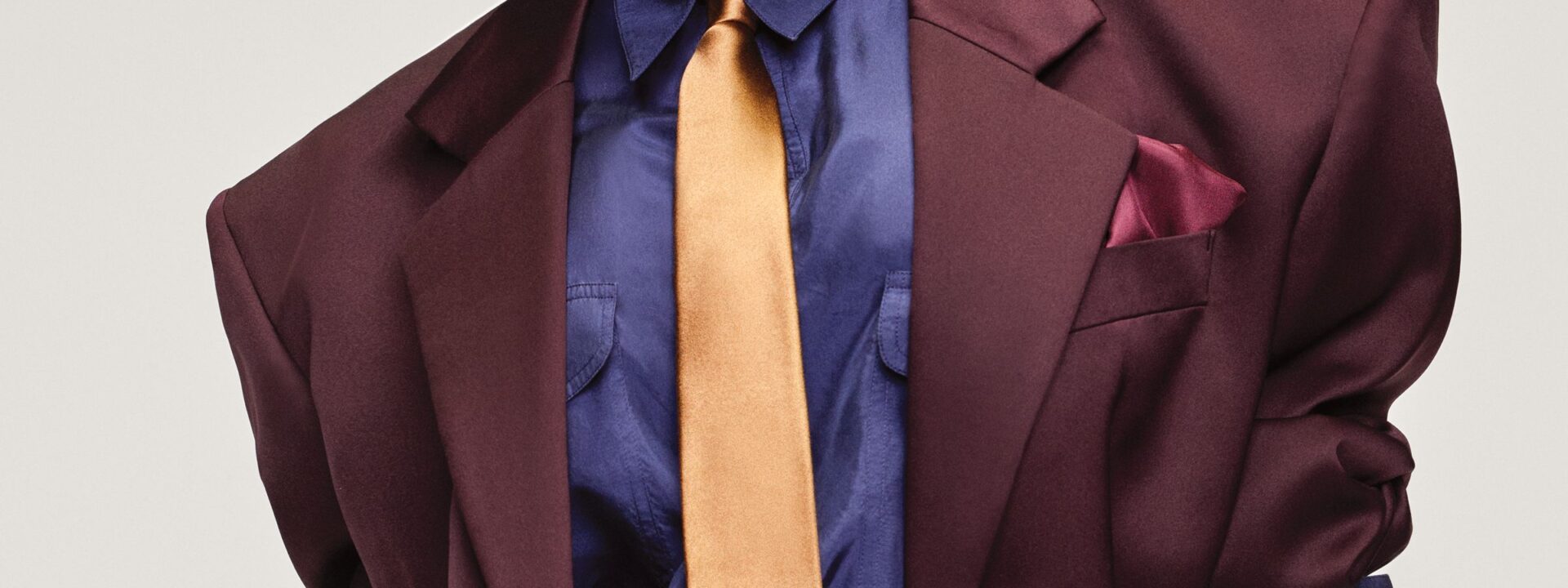
It’s a few weeks before Christmas, and Doja is in Australia for the fifth (and just-added sixth, due to demand) show of her world tour supporting Vie, her playful, genre-blending fifth album released in September. An artful mix of 1980s R&B, pop, and funk—with nods to Prince, Janet Jackson, cock rock, and German punk singer Nina Hagen—the record highlights Doja’s talent for clever (and sometimes silly) lyrics, killer hooks, and the ability to deliver a pun-filled verse. Vie has been accompanied by another radical Doja reinvention, this time into high-octane ’80s fashion featuring archival pieces from Claude Montana, Yves Saint Laurent, and more. Onstage, she’s been wearing blond mullet wigs, power shoulders, animal prints, and kaleidoscopic, smoky eyeshadow that looks straight out of an Antonio Lopez illustration.
Her hairstylist, Jared Henderson—a playful wig specialist known as @JStayReady—removes a bonnet from her head and begins massaging her scalp. (“Got to hydrate that melon,” he mutters.) Doja leans toward the humidifier; she’s already coming down with something. “Whether it’s the tail end or I have a new thing, I have no idea. But it’s been very…” She pauses to find the right word. “Annoying-dot-com.”
Hours later, Doja will power through a two-hour set in front of 15,000 fans, barely stopping for a sip of water. When she struts up a staircase to belt out “Cards,” Vie’s Minneapolis sound–inspired opening track, the arena erupts. The hits follow: “Kiss Me More,” “Woman,” “Paint the Town Red”—all of which have helped make her the third-best-selling female rapper of all time, after Nicki Minaj and Cardi B. (Doja’s 19 Grammy nominations surpass both.)
Looking around, I notice Doja’s fans are dressed in fluffy cat ears, colorful wigs, and cow ears—the latter a nod to her breakout 2018 hit, “Mooo!” There are skin-tight leopard-print skirts on the girls and neon crop tops on the boys, all wearing full makeup. In the upper tiers of the arena, I spot two Gen Z hijabi women enthusiastically singing along to “Tia Tamera” from her debut album, a track that compares the twins from Sister, Sister to a much-flaunted part of Doja’s anatomy.
It’s the pop performer’s job to give the crowd the time of their lives, even if she’s not having a great time herself. Doja’s command in this area is astonishing. “Adrenaline helps,” she tells me, her unassumingHer five-foot-three frame hunched over in the makeup chair. “And if anything happens, you can take a steroid. Obviously they’re not great for you. They make you feel like the Hulk. I toughed it out yesterday, and that’s why I feel so shit today.”
Doja plucks a strand of the neon green wig that Henderson has been trimming from between her teeth. Does she consider what she’s doing right now—and the long stretch of tour dates ahead, taking her all the way to the end of 2026—a pop concert? “I’m not sure exactly what a pop concert is anymore,” she replies, politely calling over her assistant to request a shot of Blue Label whisky. “I’ll have one shot before a show if I’m feeling good…that’s the goal,” she explains. “High spirits and positive thoughts.”
So is that her definition of a great pop concert? Powering through against the odds? “No,” she says firmly. “I think you can do anything with pop.”
A few weeks later, I speak to one of Doja’s friends and frequent collaborators, the artist SZA. “She does everything at such a high level,” SZA says of Doja. “She emotes at a high level. She performs at a high level. Her precision, her fearlessness, her freedom…. Precision and freedom usually don’t go together, but they do with her.”
You could chalk that fearlessness up, at least in part, to Doja’s unorthodox upbringing. She was born Amala Dlamini (everyone close to her calls her Amala or Ami) to the South African dancer and actor Dumisani Dlamini and Deborah Sawyer, a native New Yorker who worked in graphic design. The two met in the early ’90s when Dlamini had a run performing on Broadway, but after Dlamini returned to South Africa, Sawyer, along with Doja and her brother, moved in with her parents in Westchester County. A few years later, when Doja was six, they moved again—this time to the Santa Monica Mountains to join an ashram led by the jazz musician and spiritual leader Alice Coltrane, where Doja grew up singing Hindu devotionals and performing traditional Indian dance. Suffice it to say, ashram life—strict rules, weekly meditations, modest clothing—was not an easy fit for teenage Doja. Her frustrations eventually led Sawyer to take her family to the more affluent California neighborhood of Oak Park, where Doja dropped out of school at 16, retreating to her bedroom to smoke weed and scour online chat rooms while tentatively rapping over beats she found on YouTube and SoundCloud. “I was agoraphobic, fully,” she recalls. “I couldn’t leave my house.”
To trace Doja Cat’s rise is, in some ways, to chart the tangled and often contentious relationship between the music industry and the internet. In 2012, deep in her hermitic phase, Doja uploaded “So High,” an R&B stoner serenade that lit blogs on fire and led to a deal with Dr. Luke’s Kemosabe Records. (Doja’s association with the imprint is still active, but she hasn’t worked with Dr. Luke—who the musician Kesha sued in 2014 for sexual assault, battery, and emotional abuse—since 2021.) Doja’s first album, 2018’s Amala, which she later dismissed as being rushed due to label pressure, was released to little fanfare, and so it wasn’t until she self-released the viral “Mooo!” some months later—accompanied by a video of her in a cow-print crop top with french fries up her nose—that she began building an online following. A second album, Hot Pink, arrived in 2019, with a single, “Say So,” that became Doja’s biggest hit—largely thanks to TikTok, where a viral dance challenge made it a global sensation.
There was no barometer for how rapidly her audience was growing. “It was so fucking weird,” she says now. “I was getting offers for talk show performances. I was getting offers for things that I used to watch as a kid.” But she had autonomy for the first time in her life, andShe finally had a Los Angeles home of her own. “I had money,” she says. “It was nice to have money. It was nice to be able to have an apartment. That was really freeing for me.”
Still, Doja barely gave herself time to enjoy it. In 2021, she released Planet Her, which earned eight Grammy nominations and became one of the best-selling albums of the year. By then, she was feeling restless and annoyed by what she saw as people questioning her talent as a rapper. So, in an act of defiance, she shaved off her hair and eyebrows, tattooed a large bat skeleton on her back, and released 2023’s Scarlet. The album included the single “Attention,” a fierce hip-hop track that calls out anyone who might have underestimated her. Was this deliberately bold sound something she needed to express? “I think that’s correct,” she says.
This phase followed another reset. For the first time in her fast-paced career, Doja took a break and retreated to the LA suburbs. She enjoyed, as she puts it, “being a hermit”—drinking wine, playing Fortnite, and browsing the internet to gather inspiration. She now sees these quiet periods as a way to take care of herself. “Restimulating my creative bone,” is how she describes it. “When I’m home, I’m just home with my cat,” she says, describing her space as “lots of black, lots of gothic things, lots of iron, a little bit Brutalist, a little bit industrial, a little bit postmodern Italian.”
“She’s actually a very solitary star,” SZA notes. “I think by choice, she shields certain aspects of herself. And when it’s her choice to reveal those, I think that’ll be a gift.” This trait has always been there, her mom tells me over the phone. “She just was so creative—whatever she put her hands on, she would master it,” Sawyer recalls of Doja’s reclusive teenage years, when her daughter discovered songwriting and music production from her bedroom. “She taught herself all of these things from scratch. She was in the room, door closed, constantly creating.”
It’s perhaps no surprise that Doja is most comfortable within a tight-knit circle. That includes her managers, Gordan Dillard and Josh Kaplan, as well as her playful, diamond-earringed creative director since 2019, Brett Alan Nelson (“My best friend and sister,” Nelson says. “I would jump in front of a car for her”), and a few others from her glam team. When I ask Doja who she hangs out with back home, she gives a guilty smile and points to Henderson. “My favorite days are when you would be like, ‘Come over. I want to dress up.’” Henderson laughs while going through a bag full of hairpieces: “You’re the only person I drive all the way up the 101 for.”
“I’m very, very lucky to have the team that I have, and to have people that understand me, and also understand themselves,” Doja says. The next day, the group is off to Sydney’s Taronga Zoo to see the koalas. “We don’t all talk the same. We all dress completely differently, but we love each other so deeply. I think it’s because we appreciate those differences,” she says, before taking the makeup brush from her traveling beauty guru, Ivan Núñez, and starting to apply her own eyeshadow.
The plan that day had been for me to join Doja for a morning workout at her hotel. Deciding she was too sick to train, she suggests we go shopping instead—at Mecca, her favorite Australian beauty store. “Sephora on steroids,” she tells me, heading out of the hotel into the blazing Australian summer sun. She’s dressed in a leather jacket, a ruffle skirt, a dancer’s headband holding back a curly black wig, and a bag from The Row over her shoulder. Doja ushers me into the car, cheerfully saying that “we can be the naughty kids.”On the bus ride over, she offered me a throat lozenge and immediately launched into the story of her nightmare about swallowing a worm. But as soon as we arrived at the store, the mood changed. Doja was cheerfully adding Mario Badescu face mists to her basket when she noticed someone taking her photo from a distance and visibly tensed up. Her security team quickly guided us to the quieter upper floor. There, she handed me a test strip of a fragrance called Drunk Lovers—a boozy scent of cognac and berries that wasn’t for me—but it was clear the unwanted attention had unsettled her. (She did brighten for a moment when she spotted a ladybug on the windowsill and coaxed it onto her talon-like acrylic nail, exclaiming, “Oh my God, helloooo!”)
“It’s when you want to do things, just regular mundane stuff,” she told me later, “and people feel they’re owed a photo, or your attention, or your smile, a certain mood from you. That’s the most fascinating part of it for me personally.”
Other celebrities might have simply rented out the store for a private hour. But her excitement on the way there, and her disappointment as the outing unfolded, suggested that Doja still longs to shop like an ordinary person. “Yeah, 100%,” she says. “It makes me so upset. Would I go up to someone and say, ‘Stop filming me,’ and curse them out? No, I’m not going to do that. I don’t want to. I think I would rather handle it in a creative way.” What’s a creative way? “Sometimes I try to look purposefully ugly. I turn it into a game,” she explains. As if to prove her point, she left her hotel later that day wearing a bright red bonnet, pulling a deliberately unflattering face for the paparazzi.
“She’s actually a very solitary star,” her friend SZA observes. “I think by choice, she shields certain aspects of herself.”
Doja’s relationship with her fans, known as the “Kittenz,” has been famously complicated. They’ve often felt an unusual sense of intimacy with her—a parasocial bond partly nurtured by Doja’s love of TikTok and Twitch livestreams. But she has also fiercely pushed back at times, most notably in 2023 when she posted a series of now-deleted messages criticizing them: “If you call yourself a ‘kitten’ or ‘kittenz,’ that means you need to get off your phone and get a job and help your parents with the house,” she wrote on Threads. The outburst cost her half a million followers, but she later said she felt “free.”
A similar controversy erupted in Auckland right after the first night of her tour. A vocal group of fans criticized the lack of costume changes during the show. (Doja performs the entire concert in a single outfit—a different one each night.) She responded on X, stating she was “not a Broadway act,” and reminded her fans, “You are not the artist, you are the watcher.” She has since deleted X from her phone, she tells me, along with its “cesspool of negativity.”
Why engage with it in the first place, then? “Well, that’s the question I’ve been waiting for,” she sighs. “When I feel threatened, even if it’s not really a threat, it feels like: You are failing.” She pauses to collect her thoughts. “Look, I never do costume changes, but I feel like I have to defend my creative choices, and then I give those people power even though they could be anybody—they could have Cheeto dust on their fingers and no job.”
Someday, she might break this cycle of confronting and then retreating from her own insecurities and vulnerabilities. “I don’t know. In life, you grow. We’ll see where I am when I’m 50, if I’m still on Twitter doing stuff like that, who knows?” She gives a gentle chuckle. “Hopefully not.” I note that there areThousands of comments praise her performances every night. Does she go on social media to seek out criticism on purpose? “Artists in general…we can be quite critical of ourselves,” she admits. Seeing a comment that critiques something she already felt insecure about—”that’s a moment of, ‘See, I was right.'”
That doesn’t sound very healthy, I say, as empathetically as I can. “Obviously not, but it’s validating,” she says, turning from her makeup mirror to look at me directly. “You feel you’re more in control in a sense. ‘I’ve got it all figured out. I can’t sing. I’ve got it all figured out. I am ugly. I got it all figured out. I got cankles.'” Her glam team laughs. “It’s a useless way to spend your time. It doesn’t do anything for you other than entertain a part of you that was built during your childhood, a part of you that is stuck in the past.”
Therapy, which she began during the Scarlet album cycle, has helped. “I’m not cured of anything,” she says. “But it helps me understand why I do the things that I do.” (In early March, she spoke on TikTok about “struggling with BPD,” or borderline personality disorder. “I am so relieved and so proud of myself,” she said. “I’ve made it so far, and I still make mistakes.”) In fact, Doja tells me, if she weren’t a musician, she’d be a psychologist: “I think the human mind is just so complex and fascinating and beautiful and chaotic.”
Another positive to come out of therapy is the motivation to look after her voice. Ahead of recording Vie, she began working with a vocal coach for the first time, and you can hear it on the anthemic chorus of “Jealous Type” or in the velvety-soft verses of “All Mine.” She’s had to learn to curb some of her more indulgent habits to get there. “I love trash—I’m Oscar the Grouch,” she grins. “I love to eat garbage, and I love to drink, and I love to party. Not too hard, obviously… I don’t do any drugs.”
As Nelson describes it, the shift from Scarlet’s righteous fury to Vie’s romantic tone says a lot about what’s changed in Doja’s life over the past two years. “This [album] is so much about love and not about the men, right?” says Nelson. “Obviously songs are written about relationships and people she’s been in love with, but at the soul of it is her. And you can tell that she’s falling in love with herself even more every single day.”
On the subject of love and relationships: She’s described herself in the past as a “serial dater.” Is that still the case? “Yes,” Doja says firmly. “I’m 30, so I’m ovulating and horny.” She was most recently linked to actor Joseph Quinn—though she won’t tell me who her current partner is, even while admitting he’s planning to fly out to visit her on tour. Her favorite part of her current relationship? “I love when they leave.” She insists that’s healthy. “This is what therapy has done for me. It’s allowed me to be away and be at peace without being like, ‘I need tarot cards. I need an answer. Text me.’ I don’t do any of that anymore. It’s very nice.”
If there’s a subject that makes Doja visibly brighten—more than music, more than dating, more, even, than spotting a ladybug in a beauty store—it’s fashion. (When I ask how far into the songwriting process she starts thinking about the looks, her glam team bursts into laughter: “Immediately,” Núñez says. “Before she’s written the second song,” says Nelson.) “I think that one of my strong suits is world-building, and I do that really, really fast,” she explains. As for what she’s wearing on the Vie tour: “Some days I look very formal and less manic, with beautiful jewels, andIt’s all about suiting, structure, and things like that. Or it’s bras, sex, mania, and psychopathy.
Right next to Doja Cat’s backstage dressing room at the Sydney arena was a separate, equally spacious area. Rails of metallic lamé bodysuits stood alongside iridescent neon and zebra-print jackets. Trestle tables were covered with fascinators, costume jewelry, and belts in every color, all arranged for quick styling. “I think it makes the show stronger, and it makes me feel stronger inside,” Doja says about creating new outfits each night.
When she’s not on tour, Doja’s most outrageous looks have cemented her reputation as a provocateur. These include the 30,000 red crystals applied by Pat McGrath for a 2023 Schiaparelli couture show in Paris; the Oscar de la Renta cat outfit with prosthetics she wore to the Met Gala that same year; and the sheer, nipple-exposing Dilara Findikoglu corset she wore to the 2024 Grammys, complete with the designer’s name tattooed on her forehead.
The truth is, Doja simply understands fashion. In her video for the single “Gorgeous,” she faithfully recreates an ’80s TV beauty segment wearing vintage Mugler, with help from models Anok Yai, Alex Consani, Paloma Elsesser, and a delightful cameo from her mom. Her stylist, Brett Alan Nelson, shares a favorite story: when Doja attended the Schiaparelli show in that full-crystal look, she saw online complaints about her not wearing false eyelashes. So the next day, while getting ready for a Viktor & Rolf show, she applied lashes as a mustache and goatee. “She has no limits,” Nelson says with awe. “She’s always down to try new things. She keeps me on my toes.”
“Her talent is mind-blowing, and she has such a big heart—I love her,” says Donatella Versace, who has dressed Doja in custom looks for the Grammys twice. “She understands her body, what suits her, and the power of clothes. For me, she represents exactly the type of woman I love to dress.” Marc Jacobs echoes this sentiment, having designed an animal-print, crystal-studded bodysuit for the 2025 Met Gala that kicked off her current era.
“Doja is someone who knows exactly what she wants,” Jacobs says. “She came with references, mood boards, and really considered feedback… while never shying away from trying something the team suggested. And she can pull off a look like no one else.”
It’s worth noting that she arrived for her Vogue fitting in immaculate Jil Sander before heading off to visit The Row. These are the labels she’s drawn to now: Phoebe Philo, Khaite, Proenza Schouler. “I think it’s made me feel safer,” she says of these more subdued looks, with their subtle details of color, fabric, and fit. “It’s just as exciting as when I was wearing cat ears and go-go boots and crazy, silly, whimsical stuff.”
When I catch up with Doja again in January at her Los Angeles home, where she’s been enjoying some downtime—”changing litter boxes, unpacking Amazon packages, and readjusting planters”—she seems fully recharged. “In order to do things, I have to do nothing for an amount of time.” What does doing nothing look like? “Vacuuming and cleaning… and doing a little spa treatment,” which means colloidal oatmeal baths and gommage peels to “get all of the tour soot and crap off of me.”
The next morning, she’ll fly to Latin America for the next leg of the tour. True to her word, she hasn’t redownloaded X (formerly Twitter)—and she credits therapy for this: “I don’t know what I would’ve done without it or where I’d be without it,” she says. “I’ve been able to see through a lot of the fog that I couldn’t see through before.” I mention that her friends have told me she seems happier and more grounded than ever. “I don’t want to be in a state of agony before…””I don’t want to put on a show,” she says. “I don’t want to be exhausted. I don’t want to be unhealthy. Physically and mentally, I need to learn everything I can about how to do that.” She pauses, then breaks into a serene smile. “I’m glad that people are noticing.”
The tour will continue to the UK and Europe, then North America, finally wrapping up at Madison Square Garden in December 2026. “We’ve got a lot of fun ideas that I can’t spoil right now,” she says of the upcoming dates. Another project is on the way—it will either be a deluxe version of Vie or its own EP—that she hopes will surprise people. She describes it as “bubbly” and “futuristic” sounding. She plans to keep taking risks onstage, even if they don’t always work out. “I think because I’ve already dealt with embarrassment for so long, it’s become my best friend. So anytime I can use an embarrassing moment, whether it’s intentional or not, it’s just an opportunity.” I recall something she told me in Sydney—that the most important thing was to constantly find challenges, in whatever form they take. “Falling is an opportunity,” she says now. “Failing is an opportunity.”
In this story: hair by Mustafa Yanaz; makeup by Aaron de Mey; manicurist, Dawn Sterling; tailor, Jacqui for Carol Ai Studio Tailors. Produced by One Thirty-Eight Productions. The April issue is here. Subscribe to Vogue.
Frequently Asked Questions
Of course Here is a list of FAQs based on a hypothetical Vogue April 2026 cover story about Doja Cats reinvention and therapy journey
FAQs Doja Cat on Reinventing Herself Therapy Lessons
Beginner General Questions
1 What does reinventing herself mean for Doja Cat in 2026
Its not just a new look or sound It means shes consciously shedding old personas and public expectations to build a career and life that feels more authentic to who she is now prioritizing her mental health and creative freedom over chasing trends or fame
2 What was the main reason she started therapy
She reached a point of extreme burnout and creative stagnation The constant pressure to perform the noise of social media and the cycle of creating music for algorithms left her feeling disconnected from herself and her art She needed tools to manage her mental health
3 Whats the biggest lesson she learned from therapy
That her selfworth is not tied to her productivity streams or public opinion She learned to separate her identity as Doja Cat the celebrity from her private self allowing her to make decisions from a place of personal truth rather than fear or obligation
4 Did she take a break from music during this time
Not a complete break but she significantly slowed down She shifted focus from releasing constant content to intentional creation working on music privately without the pressure of immediate deadlines or public rollout
5 How has her style changed with this reinvention
Her style has become more minimalist avantgarde and personal Shes moved away from the colorful memefriendly looks toward a more curated artistic and sometimes stark visual language that reflects her internal shift
Advanced Deeper Questions
6 How did therapy specifically impact her creative process
Therapy helped her identify and break peoplepleasing patterns in her songwriting She now creates from a place of genuine curiosity and selfexpression not from guessing what will go viral She gives herself permission to experiment even if its not commercial
7 What was the hardest part of this public transformation
Dealing with the backlash from some fans who preferred her older more accessible persona She had to learn to sit with the discomfort of disappointing others to stay true to her own path which therapy gave her the resilience to handle