On a vaporetto in Venice’s Grand Canal in late May, I had to admit that my quest to uncover the secrets of Northern Italy’s famous chicories was starting to feel like a wild goose chase. The office listed as the meeting point for the private boat I’d hired was closed, leaving me 80 euros poorer and late for dinner. When I arrived at Osteria Venissa on the tiny island of Mazzorbo to try the insalata di radicchio (a chicory salad with goat cheese) and latterini fritti (small fried fish served with chicory), neither was available. Worse still, I may have timed my trip to the Veneto region for the one season when no chicories were on offer.
What are chicories? you ask. Or maybe you don’t, since the past decade has seen these beautiful vegetables finally gain recognition in America. If you’ve eaten at King in New York, Lula Cafe in Chicago, or Étra in Los Angeles, you’ve surely seen a striking salad of white-and-crimson leaves carried through the dining room, looking more like art than food. Speaking of art, perhaps you’ve seen Leandro Bassano’s Les Noces de Cana (circa 1579) at the Louvre. Or Rachel Antonoff’s spring 2025 radicchio dress.
But if not—imagine an elegant head of lettuce (they aren’t actually lettuces, but more on that later) so inherently beautiful that it needs no fancy plating. Imagine a flavor so complex—ranging from sweet to numbingly bitter—that it seems to need no further seasoning. Now give this better-than-lettuce (which, by the way, can be stored for months under the right conditions) plenty of vitamin C and the tendency, because of its bitterness, to make the body release the now-well-known satiety-signaling hormone, GLP-1.
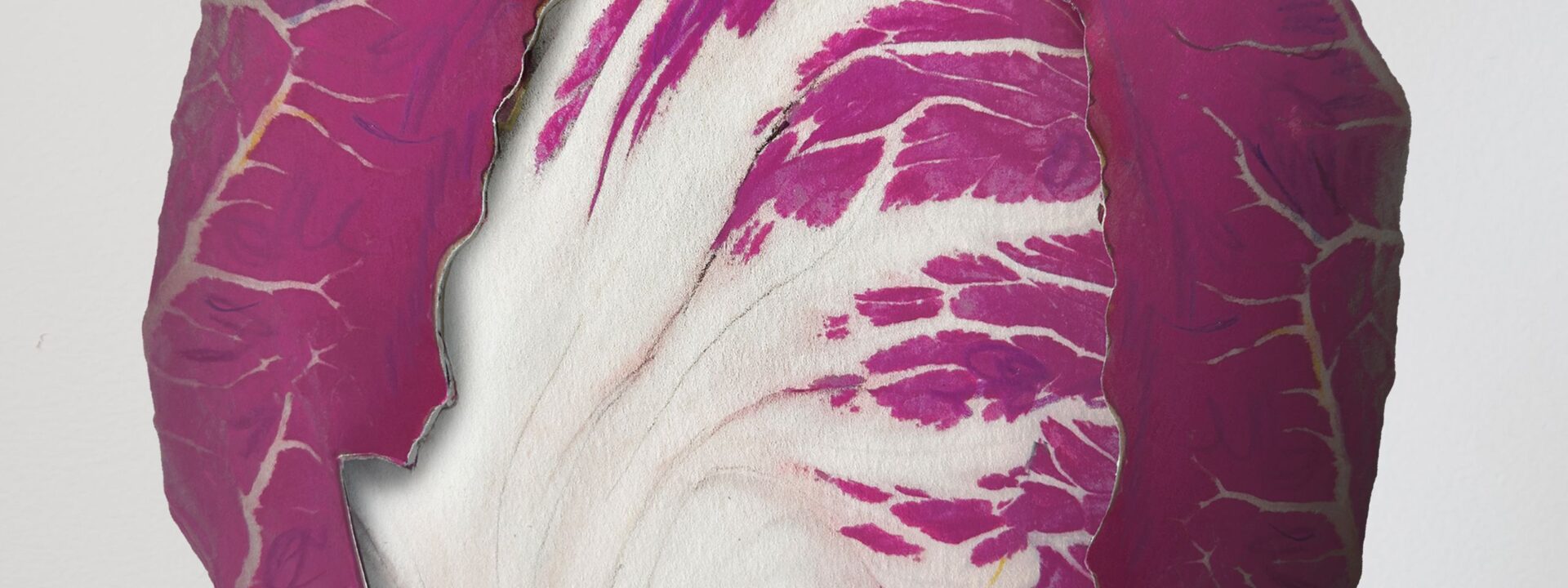
After an evening full of failure, there was nothing to do but settle in for a night of reading. The species Cichorium intybus (the botanical name for chicory) includes the green stalky Catalogna; the pan di zucchero, which is the Italian equivalent of iceberg; and the gorgeous radicchio. There are over a dozen radicchio varieties, each prettier than the last: radicchio di Chioggia, a dense, round, ivory-and-magenta head; radicchio di Treviso, a firm torpedo of deep reddish purple; its sibling Tardivo, a Seussian swirl of long, loose tendrils; and many more. All share a similar ineffable sweet-bitterness and the experiences that come with it.
At this point, I figuratively hit my forehead with my palm. Chicories, unlike almost all other leafy vegetables, have historically been a winter crop, harvested in the cold months around Christmas. My Italian contacts had said as much, telling me I should plan my visit for late in the year. I’m not always a good listener.
I went to bed, pinning my hopes on Andrea Ghedina, cofounder of a seed company called Smarties.bio in Chioggia—birthplace of the eponymous Chioggia radicchio. I’d learned about Ghedina, a chicory expert, from Lane Selman, an agricultural science professor at Oregon State University and coauthor of the newly published Radicchio: A Celebration of the Beloved Italian Vegetable. Selman had assured me that if anyone had chicories growing, Ghedina did.
On a warm bright day in May, I met Ghedina for lunch—risotto di radicchio di Treviso—at Cappello, in the town of Rosolina, about 20 miles south of Venice. He was a tall, bearded scientist wearing a T-shirt that read “Bitter is Better,” and he assured me we would eat all the chicories I wanted over the next few days. Over massive plates of inky rice dotted with sausage and ribbons of sweet radicchio di Treviso, he explained how chicories, which I’d always thought of as one of nature’s most bizarre inventions, were a profoundly human creation.
Cichorium intybus descended from a wild plant mentioned on ancient Egyptian papyrus and in Pliny the Elder’s Natural History (circa AD 77): “Chicory and the plants like it have leaves near the ground, budding from the root….” But today’s radicchio, and all those I’ve evRadicchio, with its distinctive white ribs and deep red or variegated leaves, has more in common—both in flavor and origin—with Belgian endive (also a type of chicory). Witloof, as Belgian endive is known in its native language, was only created in the 19th century when, like penicillin and X-rays, it was discovered by accident. (Legend has it that a Belgian farmer found a proto-version sprouting from stored chicory roots in his cellar.) After a series of developments, this discovery eventually led, decades later, to the exquisite radicchios of Northern Italy.
Over coffee, I asked Ghedina to explain. “It comes down to what’s called blanching or forcing. Radicchio Tardivo is planted in the field, then dug up—with the root—and forced in darkness for two weeks.” Why forcing? “You force it to grow in winter,” he said. In the dark and in water, the chicories develop sugar to avoid freezing. Depriving the plant of light prevents the development of chlorophyll—the green pigment responsible for color—and removes the chicory’s unpleasant flavor. Chicories prefer cross-pollination. This is beneficial in nature; it creates diversity. But the same systems plants develop for diversity make it hard for a seed breeder to create uniform lines. As Pliny noted, left alone, chicories grow low, leafy heads. They quickly go to seed, and their leaves become bitter.
As we wound among the rows, I snacked; he pointed. “We have eight varieties of Chioggia: Vesuvio, Stromboli, Teide, Etna, Hekla, Santa Helena, Amiata, Vulcano.”
In downtown Chioggia, we drove past the fields where farmers first made their fortunes growing radicchio. We stopped at a tidy farm growing Treviso from seeds Ghedina had bred especially for summer harvest. They stretched over rows the length of football fields in robust, firm cylindrical heads. When I reached to taste a leaf, Ghedina warned me that I might find them more bitter than winter radicchio. But I found them stunning. We finished our tour at Ghedina’s test fields. There, over a neat four or five acres, I encountered six, seven, eight varieties of any single type. As we wound among rows, I snacked; he pointed. “We have eight varieties of Chioggia: Vesuvio, Stromboli, Teide, Etna, Hekla, Santa Helena, Amiata, Vulcano.” At another plot: “For Verona,” a small head, the shape of an egg, “we have Alpone, Pasqualino, Romeo, Gaia, Scala.” Each was designed to be planted and harvested under slightly different conditions.
The next afternoon, at an osteria named Namelaka (which in Japanese means something like “creamier than cream”) in the town of Campagna Lupia, I had the chance to sample these varieties close to the source. Chef Michael Trolese presented Ghedina and me, as well as his business partners and their families, with a bespoke five-course menu of radicchios: First came insalatina di variegato—lightly dressed leaves of Castelfranco tossed with fried croutons, teardrops of fresh goat cheese, finely chopped egg, and toasted walnut. The previous day I’d seen Castelfranco that had been stored for four months before being stripped of its outer leaves and fluffed for sale, a picture-perfect head emerging from within. The salad was bright, lightly sweet, and perfectly crunchy. We went around the table sharing recipes for our favorite chicory salads. Ghedina combined white wine, vinegar, soy sauce, and olive oil. “I eat a head of radicchio like that every day,” he told me. “No lettuce.” Ghedina’s business partner, Luca, listed “hazelnuts, Taggiasca olives, and balsamic vinegar,” specifically for Rosso di Verona. No olive oil? He shook his head. “Just the oil from the olives, and no salt.”
Our second course arrived, involtini di precoce: lightly cooked Treviso, covered with Asiago cheese, then wrapped in bacon and roasted—hot pockets for the sophisticated set. Radicchio doesn’t wilt the wayWhen you cook lettuce, it becomes sweeter, reminding me of caramelized cabbage. This was showcased in a manzo alla tartara—a steak tartare served over concentrated Chioggia radicchio, cooked sous vide and sweetened with balsamic. Next came another radicchio risotto, made with Tardivo and a smoked provola fondue. Chicories can make you feel full, which isn’t ideal for a tasting menu. By the time the braised veal cheek in Amarone (with grilled Treviso radicchio) arrived, I was slowing down. I could only eat a few bites, but it was enough to notice that the slight bitterness in every dish reminded me of the pleasant, numbing feeling after a full Sichuan meal. I took one of each of Ghedina’s chicories with me, ignoring customs laws. I said I wanted to test how well chicories hold up in an airplane cargo hold. But really, even after eating more chicories than I comfortably could, I wanted to cook some. So a few days later, I gathered friends. After peeling away a layer of tired-looking leaves, the remaining heads were perfect. I made risotto di Treviso, without sausage but with plenty of parsley and wine, which gave it freshness and acidity. Then there was steak and braised radicchio with balsamic, along with a salad of Castelfranco and Chioggia with crushed garlic, anchovy, lemon, and olive oil. This salad was a bit unconventional—a mix of Roman puntarelle dressing and Venetian radicchios. Now it seems very much in the spirit of chicories—a plant that, with almost constant human care, has stayed both stubbornly unique and surprisingly open to change.
Frequently Asked Questions
FAQs About Chicory The Best Thing You Can Put on Your Plate
Beginner Questions
What is chicory exactly
Chicory is a leafy plant in the same family as radicchio and endive Its leaves can be eaten raw in salads cooked as a vegetable or roasted and ground to make a coffee substitute Its root is also used as a source of inulin a type of fiber
What does chicory taste like
Raw chicory leaves are crunchy and slightly bitter similar to endive or radicchio When cooked the bitterness mellows and becomes nutty and earthy Roasted chicory root tastes like deep dark coffee with a hint of caramel
Is chicory a vegetable or a coffee
Both The leaves are eaten as a vegetable and the roasted root is brewed as a caffeinefree coffee alternative Same plant different parts
Why is chicory considered so healthy
Its packed with fiber vitamins A C and K and minerals like potassium and calcium It supports digestion feeds good gut bacteria and is low in calories
How do I eat chicory
Young leaves work great raw in salads Larger leaves can be braised sautéed grilled or added to soups and stews The root can be roasted and brewed like coffee
Where can I buy chicory
Most grocery stores carry it in the produce section often near endive and radicchio Roasted chicory root powder is available online in health food stores and in some coffee aisles
Benefits and Nutrition
What are the main health benefits of chicory
It promotes gut health thanks to inulin supports digestion may help regulate blood sugar and provides antioxidants Its also linked to better liver function and improved mineral absorption
What is inulin and why does it matter
Inulin is a prebiotic fiber found in chicory root It feeds beneficial bacteria in your gut which can improve digestion boost immunity and support overall gut health
Can chicory help with weight loss
It can help indirectly Its low in calories high in fiber and keeps you full longer which may reduce overall calorie intake
Is chicory good for diabetics
It can be Inulin may help slow sugar absorption and improve blood