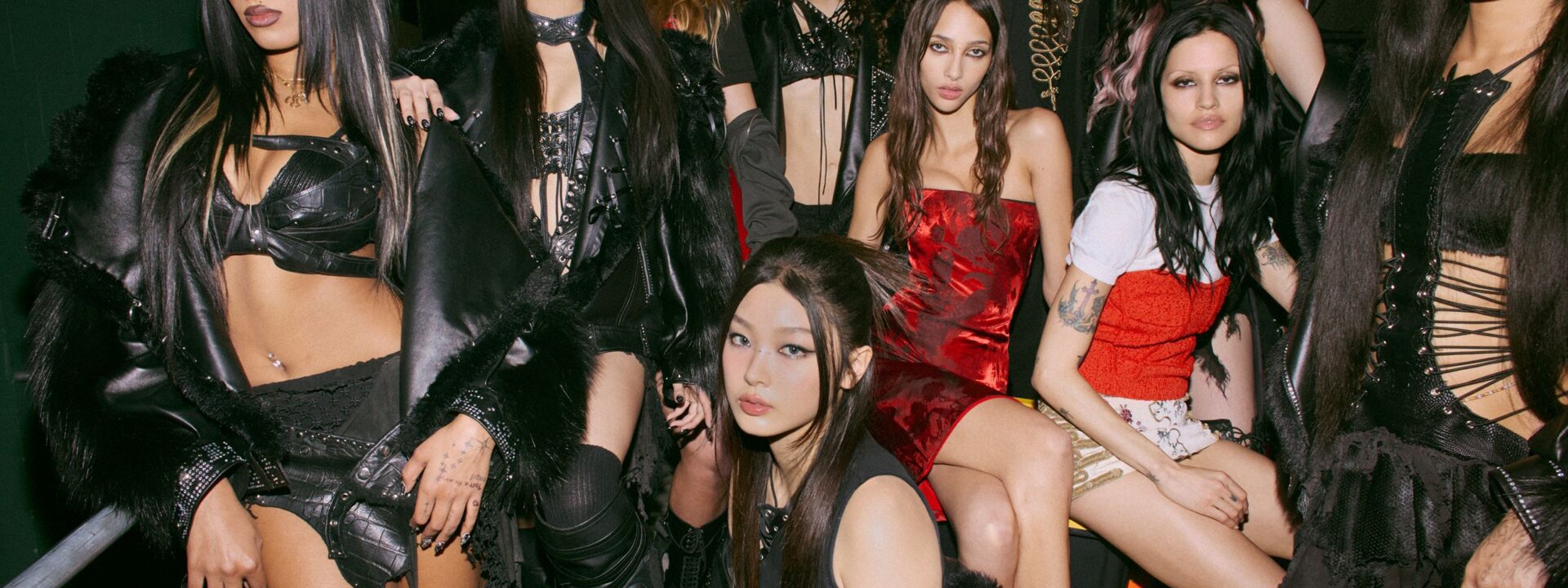
On a December evening in Los Angeles, a crowd of excited young pop fans lines up outside the Hollywood Palladium, the queue stretching down Sunset Boulevard. Dressed in Y2K-inspired pastels and LED cat ears, they’re here to see the rising global girl group Katseye on their sold-out debut tour.
An hour before the show, VIP fans enter the theater for an informal press conference. There, Katseye’s six members—Daniela Avanzini, 21; Lara Raj, 20; Megan Skiendiel, 20; Manon Bannerman, 23; Yoonchae Jeung, 18; and Sophia Laforteza, 23—answer questions and accept gifts like a bedazzled journal and even a wedding ring. The most devoted “Eyekons,” as Katseye fans are called, range from young children with their parents to millennials who grew up listening to the Spice Girls and Destiny’s Child. (“They’re like the second coming of the Pussycat Dolls,” says Jaz, a 29-year-old from Los Angeles.)
Girl groups have always inspired passion, but the Eyekons have been carefully nurtured. Katseye is a joint creation of Geffen Records and Hybe—the Korean entertainment giant behind BTS. The group was formed through a 12-week boot camp in Los Angeles, documented in the 2023 YouTube reality competition The Debut: Dream Academy. Twenty girls aged 15 to 21 underwent intense vocal training and dance lessons in heels, while fans watched and voted online. Their feedback, gathered on Hybe’s fan platform Weverse, was weighed alongside a panel of industry judges. The follow-up Netflix series Popstar Academy: Katseye showed how fan votes and judges’ opinions sometimes aligned and sometimes clashed during eliminations, with some contestants surviving on fan support alone. In the end, six members were chosen, and Katseye was born.
When I speak with Katseye over Zoom a few days after the Palladium show, they’re in Mexico City, the last stop of their Beautiful Chaos tour, which covered 14 North American cities in about a month. By now, everyone is feeling the strain. Avanzini had hoped to see Bad Bunny perform that night, but she was fighting a virus that had already sidelined Skiendiel, who was on bed rest.
The demands of pop stardom aren’t just physical, though. For every adoring Eyekon, there’s a harsh, anonymous critic ranking the members by talent or looks. (When Hybe and Geffen announced in February that Bannerman would take a “temporary hiatus” to focus on her health, fans pointed to both burnout and online trolls.) “We really do our best to support each other,” says Laforteza. “If any of us are going through something, we’ll all lock ourselves in a bathroom until we feel okay.” Between daily rehearsals, appearances, and performances, they’ve also made time for group therapy.
“We’ve been together every single day for the past two years,” adds Avanzini. “We’re learning about each other’s cultures and how we work, but what brings us together is our love for singing, dancing, and performing.”
Their cultural diversity is a key part of their identity: Avanzini was raised in Atlanta by Cuban and Venezuelan parents; Raj, the daughter of Tamil immigrants, grew up in New York City; Skiendiel is Chinese Singaporean American from Honolulu; Jeung is from Seoul; Bannerman is Swiss Ghanaian; and Laforteza grew up in Manila. While many K-pop groups emphasize uniformity, Katseye represents a vision of global pop.
That’s a point of pride for the members. Unlike traditional K-pop, Katseye sings mostly in English, though their second single, “Gabriela,”From their 2025 EP Beautiful Chaos, Avanzini contributed a verse in Spanish. The song earned the group two Grammy nominations this year: Best Pop Duo/Group Performance and Best New Artist. The other members are eager to incorporate their own cultural backgrounds into future songs. “Seeing Dani represent her culture, and then seeing how much it resonated, was a good sign that the global element works in our music,” says Raj. “We all want to put our cultures into our songs. Bollywood sounds were used so much in the 2000s by Timbaland and Pharrell, Britney Spears, even Lady Gaga. So there’s a lot of room to show our own flavor.”
Other singles have explored a weirder, more experimental sound—like last year’s polarizing “Gnarly,” a glitchy hyperpop track co-written with the Chinese avant-garde artist Alice Longyu Gao. Jeung found the song’s raunchy, playful lyrics liberating. During their training under Hybe, “we had to be really perfect and cookie-cutter,” she says. “But in Katseye, I learned to be more raw. So when we did ‘Gnarly,’ we got to show ourselves more… without being scared of not being perfect.”
“People have expectations of what a girl group should sound like,” Raj observes. “I don’t want us to make music that just makes people go, ‘Oh, cute.'”
Acceptance is a recurring theme for the group. On “Mean Girls,” also from Beautiful Chaos, they offer sweet assurances to transgender and gender-nonconforming youth, echoing the self-esteem anthems of the Y2K era like TLC’s “Unpretty” or Britney Spears’s “Lucky.” Given that openly queer K-pop stars are still rare, this message felt important. “[We] have a huge responsibility because Katseye is not just a Western group—it reaches so many countries that lack queer representation,” says Raj. Last March, she came out to fans as bisexual via Weverse; Skiendiel did the same a few months later.
“Seeing the love and safety our fans create made it feel right,” Skiendiel says. “I wanted to live honestly and let people feel less alone by doing the same.” (In LA, a 23-year-old fan named Francesca praised this candor: “They’re not as restricted as groups in the K-pop industry. You see them go out more. They can be more relatable.”)
Shrewd fashion collaborations have also been part of Katseye’s strategy. A fall 2025 denim campaign for Gap, soundtracked by Kelis’s 2003 hit “Milkshake,” has garnered over 63 million views on YouTube. “We’re constantly using fashion as a language to push boundaries,” says creative director Humberto Leon, who began his career at Gap in the 1990s before co-founding Opening Ceremony and later leading design at Kenzo. “We pull vintage Nicolas Ghesquière for Balenciaga pieces, but they also wear Conner Ives. Gigi Goode, a RuPaul’s Drag Race contestant, designed amazing outfits for their first festival, Wango Tango.” More recently, stylist Katie Qian fitted the group with custom Adidas boots for the Beautiful Chaos tour, and at the Grammys, each member wore a unique white mesh, lace, and leather dress by Ludovic de Saint Sernin.
Katseye is now preparing for a set at Coachella, which has inspired them to explore new genres. “With all these upcoming stages, it would be so fun to have hype songs that go crazy live… like techno or EDM.””Rock, Afrobeats,” says Bannerman, sparking a chorus of enthusiastic agreement. It highlights the group’s hard-to-define, and thus endlessly adaptable, identity.
“Just being ourselves, with our skin tones shining through, our individuality, and our style,” Raj reflects, “and being best friends through it all?” That’s the essence of Katseye: a fantasy of global sisterhood made real.
In this story: hair by Erol Karadağ; makeup by Holly Silius. Produced by Hyperion.
Frequently Asked Questions
Of course Here is a list of FAQs about why Katseye has everyone talking designed to answer questions from someone just hearing about them to a more invested fan
Beginner General Questions
Q Who or what is Katseye
A Katseye is a new global girl group formed through the survival reality show The Debut Dream Academy They are the first group launched under HYBEs new American label HYBE America
Q Why is a new Kpop group getting so much attention
A While they are under HYBE Katseye is being positioned as a global pop group not a traditional Kpop group Their focus is on breaking into the mainstream Western market with a multinational lineup
Q How many members are there and where are they from
A There are six members from six different countries Sophia Lara Megan Yoonchae Daniela and Manon This global makeup is a key part of their story
Q What show were they formed on
A They were formed on HYBE x Geffen Records survival show The Debut Dream Academy It was a unique documentarystyle show that followed 20 trainees over several months with the final lineup voted on by judges and global fans
Advanced FanCentric Questions
Q What makes Katseyes concept or strategy different
A Their strategy is often called gateway Kpop They use HYBEs proven training and production system but are creating Englishlanguage popRB music aimed directly at charts like the Billboard Hot 100 Theyre designed to be a bridge between the Kpop industry and the global mainstream
Q What are the common debates or controversies fans are talking about
A Discussions often focus on
The Final Lineup Some fans debate the judges choices vs fan votes from the show
The Global Group Label Questions about how theyll balance their diverse backgrounds without cultural appropriation
Comparisons Constant comparison to other HYBE groups and whether theyll receive similar support
Q Have they released any music yet