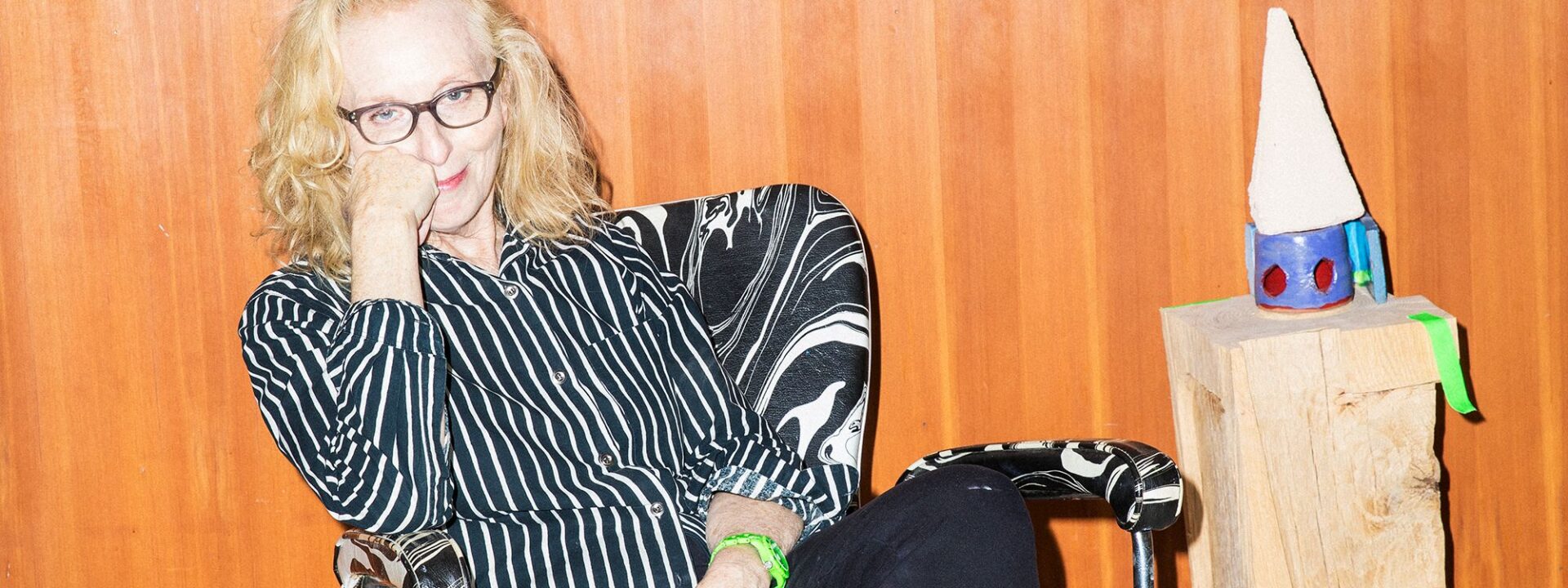
It’s a beautiful June day, and Arlene Shechet is giving me a tour of her studio in Kingston, about two hours north of New York City. “Here’s our little family of chainsaws,” she says. It’s a delightfully unexpected way to start the tour, and fitting for an artist whose sculptures combining ceramic, wood, and metal have made her one of the most innovative living sculptors.
The 5,000-square-foot space is impressively versatile. It has just about every tool you can imagine, plus a metal shop, a custom wood-drying kiln, an area for computer and paper modeling, shelves stacked with bins of clay, and a peaceful courtyard surrounded by concrete walls. “My own little LA in Kingston,” she jokes about the courtyard.
Shechet, 75, has had a studio in Kingston for 10 years, four of them in this space. It’s where she makes her large works. She still keeps a studio in Woodstock, where she’s lived for more than two decades, but she—or rather, her work—had outgrown it. “It’s up a dirt road, very hard to move sculpture, which I thought was the right idea to keep me under control,” she says with a sly grin. “But I lost control.”
In this case, that’s a good thing. Her 2024 show “Girl Group” at Storm King, which brought six soaring sculptures to the grounds of the Hudson Valley art park, was praised as a triumph. (One review in The New York Review said: “As a collagist and an amalgamator, as a colorist, as a shape generator, and as a no-nonsense feminist heroine, Shechet has few equals.”) It was her first time making outdoor sculptures at such a monumental scale, but for Shechet—at that point best known for elevating ceramic work into the realm of fine art—it felt like a natural extension of a practice rooted in pushing boundaries.
This fall, Shechet follows up Storm King with “She Said She Said,” now on view at Pace Gallery in Chelsea. For the exhibition, she has made three new monumental sculptures—two in the colorful, whimsical style of “Girl Group” and one in Corten, her first time using the weather-resistant steel—along with a suite of otherworldly ceramic installations.
Installation view of “Arlene Shechet: She Said She Said” at 508 & 510 West 25th Street, New York, NY.
Photo: Courtesy of Pace Gallery
“Each piece has many years behind it, where I let it go, then come back to it, then let it go again,” Shechet says. This unhurried approach produces sculptures that surprise you from every angle. You can’t grasp the whole story from just one viewpoint.
Take Eve, the first piece you encounter upon entering the front gallery. At 16 feet high, it’s the tallest of the new works (measured to the inch to fit the room) and painted in pale greens and gray-blues, “like the beginning of things,” Shechet says. At the very top of one side is a small squiggly cutout in the aluminum, a reward for those who look all the way up. At the base, a silver blob resembling a squished lychee supports a swooping section of terraced metal. The whole thing reminds me of a water slide as imagined by Dr. Seuss.
Arlene Shechet, Eve, 2026, welded and cast aluminum, epoxy-urethane paint, 16′ × 9′ 2″ × 7′ 6″.
Photo: © Arlene Shechet. Courtesy of Pace Gallery
It takes both intuition and full-throttle confidence to open a show with a work this massive and zany. “No one would install the biggest piece in the front; it’s got to be in the back or in the middle,” Marc Glimcher, Pace’s CEO, says during a press preview. “She knew it had to be in the front.”
Past Eve is the vibrant Jewel, a seafoam-tinted confection with layers that curl and collide. Like Eve, its pieces of welded aluminum are shaped by hand, not molds. Signs of human touch have long been important to Shechet, no matter what material she’s using.
Holding courIn the back of the room is Flo, a Corten steel work. It’s a wonder of cascading shapes, each a little askew: almost-ovals, not-quite triangles, and what looks like a pair of legs touching down, ready to dance. Every inch is united in a gorgeous natural patina, streaked like tigereye—a result of the weathering it endured out in the courtyard in Kingston. That’s the beauty of Corten: “It paints itself,” Shechet says. As with her previous metal pieces at Storm King, she’s taking a traditionally male material (Corten is most associated with Richard Serra) and injecting it with a feminine sensibility, which shows up in the rounded shapes and even in the title. Flo is a nod to Florine Stettheimer, an early-20th-century painter who, explains Shechet, “had freedom that so many women artists didn’t have.”
Arlene Shechet, Flo, 2026, Corten steel, 10′ 1¼” × 7′ 1″ × 6′ 8½”. Photo: © Arlene Shechet. Courtesy of Pace Gallery
Shechet, too, has long gone her own way. Born in 1951 in Forest Hills, Queens, she was always interested in putting things together. “I didn’t take sewing. I took woodshop,” she says. She was the only girl in that class. She studied at New York University for undergrad, then the Rhode Island School of Design (RISD) for grad school. She and her husband raised their two children first in Tribeca, where she had a studio in the basement, and then in Woodstock, where the family moved in 2002. She taught at RISD and Parsons, juggling work with motherhood and her own practice. It wasn’t easy. “I put up with a lot,” she says. The art world was not always kind to women, much less mothers. “People just wrote you off.”
Over the years her art evolved from smaller clay pieces she could make in her Tribeca basement to larger and more complicated creations using a mix of materials, including glass, cast iron, and concrete. A 20-year survey of her work in 2015 at the Institute of Contemporary Art in Boston was praised by critics and helped the artist see how her varied materials and approaches are all connected. “I was really struck by how sewn together all these different works were in ways I hadn’t seen before,” she says. She’s kept busy, chasing her never-ending curiosities with residencies at German porcelain manufacturer Meissen starting in 2012, which led to a revelatory show at The Frick, the first time that museum exhibited a contemporary artist, and the bathroom-fixture giant Kohler in 2017, after which she made her public art debut at Madison Square Park.
Installation image of “Arlene Shechet: She Said She Said” at 508 & 510 West 25th Street, New York, NY. Photo: Courtesy of Pace Gallery
In a gallery space adjoining the front room at Pace are 14 ceramic works, a series titled Touching Ground. It’s the first time Shechet has employed the ancient technique of terra sigillata (“sealed earth” in Latin), in which clay is refined over and over again to make a slip of such fine quality as to be practically waterproof. During the Roman Empire, terra sigillata was used to add a protective sheen to vases and tableware. There’s poetry in finishing the clay with a layer of its own ultra-refined material, Shechet says. “It’s a very elegant complement.” She was partly inspired by Agnes Martin, who painted in thin layers to achieve her poignant stripes and grids.
The Touching Ground pieces are exercises in juxtaposition: somehow both biomorphic and totally alien, with textures that vary from glossy to sandpaper. The architecture looks mushy. “They’re half falling down, and that’s what I really like,” Shechet says as she shows me a few at her studio back in June. The colors range from beige and bluish gray to hi-vis orange to midnight black, with plenty of airy gaps to keep them from feeling too dense. At Pace, some are ensconced in the walls or cantilevered à la Donald Judd, while others stand atop steel bases. Often they look like they’ve beesliced down the middle, their insides exposed. “For a ceramicist to successfully reveal the inside is kind of against the rules,” Glimcher says, “which is always Arlene’s favorite thing to do: whatever is against the rules.” Arlene Shechet, Touching Ground: Like A Book, 2026, terra sigillata, glazed ceramic and steel, 23½” × 27¾” × 7¾”. Photo: © Arlene Shechet. Courtesy of Pace Gallery. Indeed, experimentation is deeply embedded in Shechet’s practice—it always has been. She didn’t need to take on a new material (Corten) or technique (terra sigillata) at this point in her career. But coasting is not in her nature. By staying present in the studio—a Buddhist concept she values greatly—she remains open to whatever bubbles up. That is the through line in all her work. “I am able to surprise myself,” she says, looking around her studio. “That’s the thing. I have to keep myself interested and surprised.” “Arlene Shechet: She Said She Said” is on view at Pace Gallery’s 508 and 510 West 25th Street locations through October 24, 2026.
Frequently Asked Questions
FAQs Past and Future Meet in Arlene Shechets Otherworldly Sculptures
Beginner Questions
Who is Arlene Shechet
An American sculptor born in 1951 in New York City Shes known for playful colorful sculptures that mix materials like ceramic wood and metal in unexpected ways
What makes her sculptures otherworldly
They combine familiar shapes with strange dreamlike formsblobby ceramics growing out of sleek metal bright colors on rough surfaces They look like objects from another planet that still feel oddly familiar
What does past and future meet mean in her work
She pairs ancient techniques with modern industrial materials and processes Old and new exist side by side in one piece
What materials does she use
Clay porcelain wood steel aluminum bronze paint and cast metalsoften all in a single sculpture
Why is her work important
She broke down the hierarchy that ranked ceramics as craft and sculpture as fine art Her success helped ceramics gain serious recognition in contemporary art museums and galleries
Where can I see her work
Major museums like the Metropolitan Museum of Art the Whitney and the Los Angeles County Museum of Art Shes also had public commissions including works in New York City parks
Intermediate Questions
How does she actually combine old and new techniques
She handbuilds ceramic forms using traditional methods then has them cast in bronze or aluminum or combines them with fabricated steel She also uses digital tools like 3D scanning and printing to translate between materials
What does her creative process look like
Its intuitive and experimental She works in her studio without a fixed plan letting the clay guide her She describes it as a conversation with the materialshe responds to what happens rather than forcing a design
Why does she mix so many different materials
The contrasts create tension and surprise A glossy ceramic blob on a heavy steel beam makes you question whats natural vs industrial fragile vs permanent That friction is the point
What are some of her bestknown works