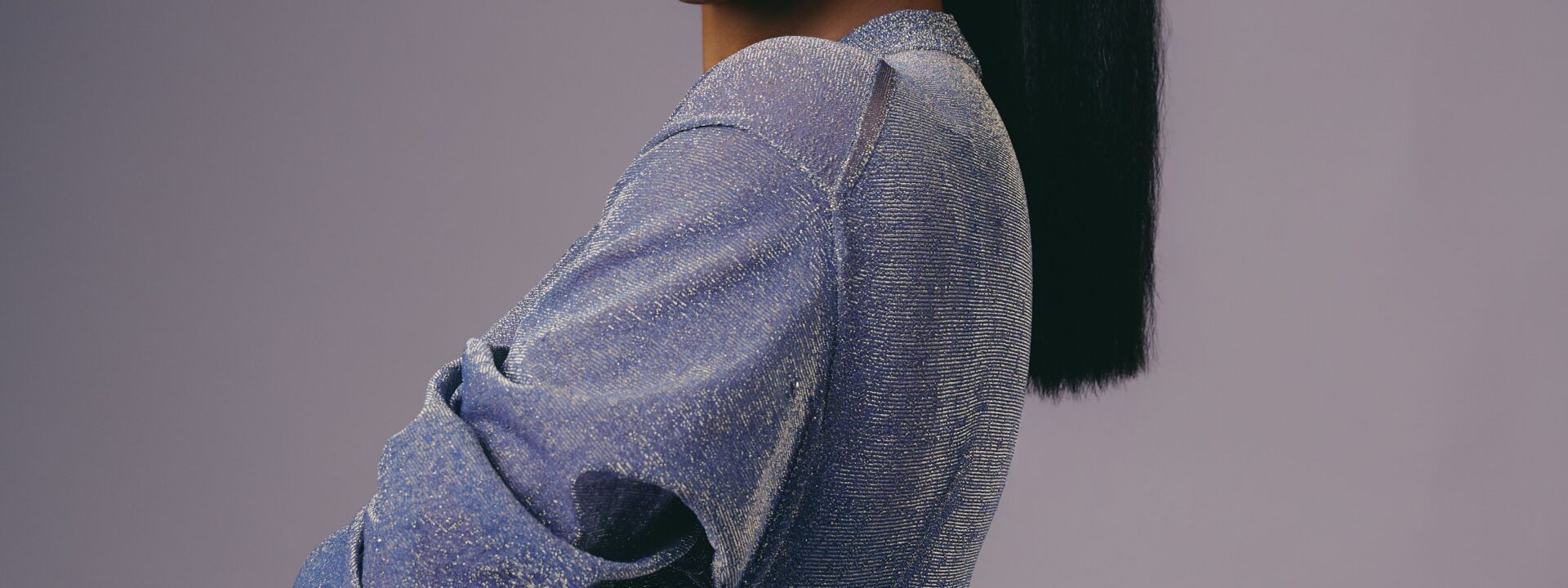
“I really don’t like waiting around to work, and I love to work.” One look at Kara Young’s résumé makes that clear enough. But she sells the line—just as she’s doing now in the first Broadway revival of Proof, David Auburn’s Pulitzer Prize-winning play from 2000. After winning back-to-back Tony Awards (for Purlie Victorious in 2024 and Purpose last year) and an off-Broadway run in Gruesome Playground Injuries (which moved into production quickly when the sought-after Lucille Lortel Theater became available earlier than expected), the actor had planned to take a well-earned break—at least from acting. Young knew the two movies she shot in late 2024—Aleshea Harris’s adaptation of her own play Is God Is and Boots Riley’s I Love Boosters (which, coincidentally, features her future Proof co-star Don Cheadle)—would come out around the same time, and doing press is a job in itself.
But life soon got in the way. A series of missed flights, deplanings, and cancellations meant she missed Boosters’ South by Southwest premiere—and then the call came. Would she step in for Samira Wiley, who had to drop out of Proof for health reasons? Young flew back to New York on a Monday, started rehearsals the next day, and was in previews a little over a week later. The process was “quick and dirty, the way it used to be,” she says, remembering the hustle of her early career. “You work fast, you make choices, you jump into the fire, and just go.”
Proof—which Young describes as “one of the plays that all the kids at the stage door tell me they’ve done a scene from”—follows two sisters dealing with the loss of their math-genius father. Young’s character, Claire, is the business-minded one, eager to take charge—a trait she shares with her Is God Is character, Racine. Harris’s film, however, trades clever dialogue for brutal violence, as a pair of twins, badly scarred from a childhood fire, go on a journey to confront the source of their trauma.
Young will start rehearsals for a star-studded off-Broadway revival of The Whoopi Monologues during the last few weeks of Proof’s run, at which point another theater veteran, Adrienne Warren, will take over her role. But before that, the charismatic actor sat down with Vogue to talk about career coincidences, onscreen anger, and growing up in Harlem.
Vogue: With about two and a half weeks to find Claire, are you happy with where you’ve landed?
Kara Young: I’m never happy in any process, to be honest. I’m always looking to build more history, more nuance, more humanity. Claire has been navigating being away from her family this whole time. There’s been a huge financial sacrifice she’s made to make sure her family is taken care of. I’ll keep building until my last performance—that’s always the case. There’s always room for more. How do I honor someone in the five scenes we have? How do I make this person real and full of life in just those few scenes?
How do you let go of screen performances?
It’s really different to get over. We had our premiere at BAM the other night, and there were people who know you and some who don’t—a mix, mostly of community, to some degree. That’s tough, but at the same time, I remember the first time I watched it. I watched it alone in a theater, walked out, and called my people. They asked, “What does it feel like to be leading a film?” And I said, “Honestly, I stopped watching myself because it was about the story.” It was so carefully and artistically put together in Aleshea’s vision, and every shot was so intentional that the story took me on the journey. I forgot I was in it.
Are you usually more self-conscious watching yourself?
For sure! But also, I don’t think I’ve ever had this experience. I’ve led films and seen them in theaters, but I haven’t had this kind ofThe play has now been adapted into a film. I see the journey a bit differently now, having seen it at Soho Rep in 2018. I was completely blown away by the performances and the story. Knowing the weight and importance of this cult play that Aleshea has given us—it’s been produced all over the world, and now it’s, like, locked away in the vault—there’s something about that that feels beyond me. My performance isn’t even the main thing, you know?
What does this story mean to you? It’s full of myths and starts off kind of like The Odyssey, but then it’s not that at all. It defies every expectation.
To me, the story is about two young women who have made their way through the world as survivors. They’re resilient people who grew up in the foster care system after a traumatic fire killed their mother. That’s all they’ve known. They’ve built a world that’s as joyful as possible, and they’re okay together. Of course, the world treats them very differently, but they exist together. Then they get a letter saying their mother is actually on her deathbed and wants them to visit. So the journey becomes almost like a trip to understand themselves a little more. When they meet their mother, she tells them their father tried to kill them, and her dying wish is for them to kill him. It’s about cutting off the root of the pain. Is God Is is the most epic, Southern, Greek-odyssey-road-trip sisterhood story. It’s about understanding where we come from and cutting that root.
The movie has an interesting take on violence. It’s about cutting off the root of trauma, but without giving anything away, the main characters aren’t Disney heroes. The roots of that violence have spread everywhere. What do you think about that?
What really struck me is that one character believes she’s a killer. There’s that line: “We come from a man who tried to kill our mama, and our mama wants to kill that man. It’s in the blood.” There’s something about accepting that as who you are. But I didn’t know that before. Think about a child who never knew who they were, and now they do. The violence in the film is definitely there, but there’s something about Racine pursuing it while Anaia doesn’t want to. It represents hope and breaking cycles, even picking at our scars, but they keep bleeding. Is Racine right? That’s for people to decide. The audience I saw it with reacted strongly when something happened. Picking at scars and reopening wounds might never be the healthiest thing, but if you don’t open the wound, it’s still there, and you still know it’s there. That’s Racine’s journey—completely reopening, obliterating, and doing surgery on the wound.
The movie is really gruesome. Are you squeamish?
I was sitting next to my mom the other day, and she kept saying, “No!” She’s very squeamish. I’m not going to say I like it. I don’t know what I like, actually. I really don’t. But I do enjoy what I see—a justified rage on screen. I heard Aleshea say the other day something like, “Witnessing the full spectrum of our rage, of our humanity—we’ve never seen that on screen. We’ve never experienced it from Black characters, seeing the full spectrum of our humanity.” And that rage, our rage, does exist. As people watch this, especially people of color and Black women, there’s a catharsis in what it means to heal and to be hopeful, and to get to the core of what makes you angry and full of rage. These are valid feelings. We’ve seen the patriarchy do that on screen over and over again. It’s ingrained in our minds. But we’ve never seen Black women like this, ever. It’s Greek! It’s like Medea killing her children.
Tell me about Boosters. I know you’ve worked with Boots before. It’s such a fun part—I haven’t seen this!
Are you kidding? What do you know?About that? Well, I know the story. I read the screenplay and thought it was a really wild ride.
So you don’t know what you look like in the movie?
I don’t! Here’s what I do know: I was on set. I finished shooting Is God Is in late 2024 and ended up staying an extra week in New Orleans. I have a lot of family there, so I spent my first Thanksgiving in the city and thought, let me fly to Atlanta, where Boosters was shooting, and say hi to Boots. It’s a quick flight. I’m in the South, so why not? I wanted to visit the set because, when we were shooting I’m a Virgo, I’d hang around even when I wasn’t filming. I’d heard the world of I Love Boosters is totally insane, so I went to the soundstage and—holy shit. It was the scene with Demi Moore and the rolling cart. I thought, This is so cool. Boots had already mentioned he wanted someone for this part and asked if I was available. Then he said, “I think you have a fitting right now.”
But the other story is even crazier. I was talking to this guy, just chatting. He was in prosthetics, so I couldn’t really see what he looked like. And Boots goes, “You know that’s Don Cheadle, right?” We’d never met before. So on set, we’re talking about theater, and he tells me they want him to read for Proof. I tell him it’s a great play, and then my phone buzzes with a message: “Proof reading offer.”
Why didn’t you follow up on that Proof offer?
Just decisions—I wanted to stay available for film and TV.
How long did Boosters take you?
I think I was only there for three days. Most of my voice work and the later scenes were either done over the phone or recorded after we shot.
Boots seems like the kind of person you either click with immediately or you don’t, but if you do, there’s instant trust.
Yeah, totally. Boots is a visionary, his imagination is radical. Like, what does freedom look like in your mind? Where can our thoughts go as artists? I walked onto that soundstage and was completely blown away. He really thinks outside the box. He’s always in creation mode, no matter what. Boots Riley: forever an inspiration.
Photo: Jenny Anderson
The last thing the public knows you’re working on is the premiere of Dominique Morisseau’s Mix and Master on Broadway early next year. It’s a Bronx story, but you’re a Harlemite—what’s that about?
I can’t wait for people to see this absolute genius. We’ve done a few workshops together over the past year, but now we’re building that world and stepping into it. Some people don’t know I was born in Harlem Hospital, but I spent my first few years in the Bronx. As a New Yorker, as a Harlemite, the two are very close. I love the Bronx, I really do. It’s about honoring those who came before you, the people whose shoulders you stand on. There are stories within the story, but it’s about two people where one really looks up to the other, and it’s set in the last standing record shop in the Bronx. Gentrification is everywhere, and it feels hopeless, honestly, because I’m from Harlem and I’ve seen that stuff. But it’s also about trying to save a life, trying to tell someone how much they mean to you, and how music can change you, how it can shift so much inside you, and remind you of your presence on the planet.
That’s going to be a New York story, Boosters is a Bay Area story, Is God Is is Southern gothic. What’s the Harlem story you haven’t told yet?
I don’t have these dream-role-type things, but I’ve always seen myself in an epic ’70s Harlem film. I’m talking about what it means to dance and be free. What was a time when we were just free? I don’t know how to describe it. I was supposed to be an adult in the ’70s. It was a time when Black people populated Harlem, and I wish I could just go back in time. Every time I see videos or pictures of Black women in Harlem in the ’70s, I’m just like, take me there right now.Right now, this conversation has been edited and shortened to make it clearer.
Frequently Asked Questions
Here is a list of FAQs about Kara Young takes the win based on the most common context
General Beginner Questions
Q Who is Kara Young
A Kara Young is a highly acclaimed American stage and screen actress She is best known for her powerful performances in Broadway plays like Clydes Purlie Victorious and Cost of Living
Q What award did Kara Young just win
A She won the Tony Award for Best Featured Actress in a Play for her role in Purlie Victorious A NonConfederate Romp Through the Cotton Patch
Q When did she win this award
A She won at the 77th Annual Tony Awards which took place on June 16 2024
Q Is this her first Tony Award
A Yes this is her first Tony Award win It was her third nomination in three consecutive years
Advanced Contextual Questions
Q Why is this win considered historic or significant
A Its significant for several reasons 1 She made history as the first Black actress to be nominated for a Tony Award three years in a row 2 Her win was seen as a major upset because she was competing against two other incredibly strong nominees from the same play 3 It solidified her as one of the most dominant dramatic actresses on Broadway
Q Who did she beat to win the award
A She beat her own castmates Leslie Uggams and Lillias White as well as Quincy Tyler Bernstine and Susannah Flood
Q What role did she play in Purlie Victorious
A She played the role of Lutiebelle Gussie Mae Jenkins a nave but spirited young woman trying to claim an inheritance
Q What was her reaction to winning
A Her reaction was emotional and joyful She was visibly shocked and tearful on stage giving a heartfelt speech thanking the playwright Ossie Davis her family and her castmates
Practical