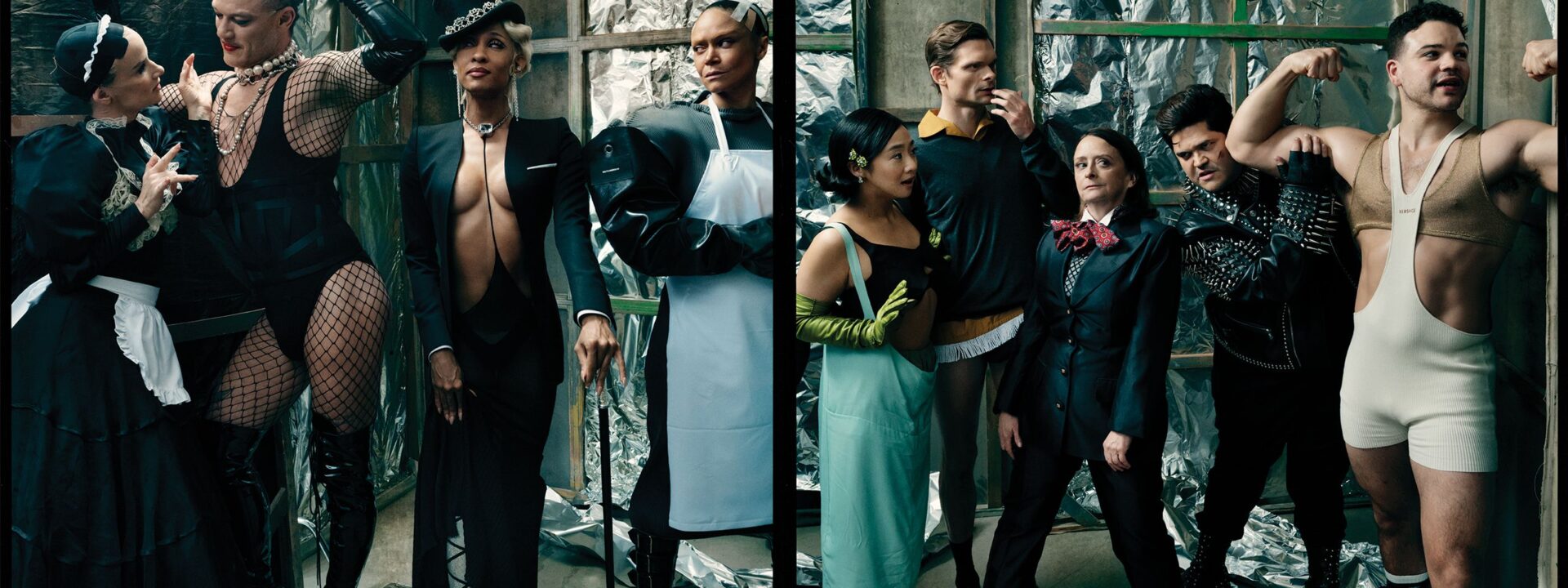
In the early 1990s, two friends and I wandered into a midnight screening of The Rocky Horror Picture Show at the Falls Theater in Cuyahoga Falls, Ohio. This was before the internet, and as teenagers, all we knew was that the movie had a cult following and a vaguely demonic reputation—and that you were supposed to bring props. We brought rice and toilet paper, which turned out to be a pitifully entry-level attempt. Everyone else in the audience was armed with squirt guns, newspapers, flashlights, and more, and they were all much cooler than we were, dressed in punk, goth, thrift-store drag, and DIY glam. The veterans knew exactly when to shout at the screen and treated the movie like a party, a fashion show, a masquerade. For kids experimenting with sexuality, gender, and identity, this was the stage. I remember thinking, Where have you people been my entire life?
The movie itself—a product of the mid-1970s—was flamboyant, camp, feral, genuinely heartbreaking, and anchored by one of the great musical scores of all time. But what thrilled me most was the communal experience. Being there felt like permission to be excessive and uncontained, to be defiantly who you were.
The source material came from Richard O’Brien, a one-time jobbing actor who wrote the script and score for The Rocky Horror Show, first produced in 1973 at the Theatre Upstairs at London’s Royal Court. Directed by Jim Sharman and starring a then-unknown Tim Curry, the stage show was a deliriously absurd pastiche of ’50s rock, ’70s glam, horror and sci-fi movies, and Old Hollywood fever dreams (the actress Fay Wray is a particular obsession). It became a megahit, running in London for seven years.
The movie version, released in 1975, was a box office flop and seemed destined for obscurity until resourceful programmers at the famed Waverly Theater in Manhattan’s West Village began running it at midnight. More theaters followed, and a cult was born.
The plot of both versions, such as it is, follows a wholesome young couple, Brad and Janet, whose car gets a flat tire in a rainstorm, leading them to wander into the castle of Dr. Frank-N-Furter, an intoxicatingly charismatic and seductive pansexual alien scientist. In a Frankensteinian flourish, he creates a blond muscleman (Rocky Horror), wreaks havoc on polite society, and is ultimately destroyed by fellow aliens named Magenta and Riff Raff. Along the way, we meet Eddie (a rock and roller who meets a grisly end), Dr. Scott (a baffled authority figure and Eddie’s uncle), Columbia (a heartbroken human who loves both Frank and Eddie), and an uptight Narrator who, with varying degrees of success, tries to manage the chaos.
It’s been 24 years since The Rocky Horror Show last appeared on Broadway, but it’s back now: a revival opened in previews on March 26 at Studio 54, directed by Sam Pinkleton, the Tony Award–winning visionary behind Cole Escola’s riotously unhinged Oh, Mary!. The cast includes Luke Evans, Juliette Lewis, Rachel Dratch, Josh Rivera, Harvey Guillén, Michaela Jaé Rodriguez, Amber Gray, Andrew Durand, and Stephanie Hsu—an eclectic group of Hollywood stars, singers, musical-theater performers, comedians, and, as Pinkleton tells me, “some capital-F freaks from Bushwick who dance on bars on the weekends.”
I first meet Evans over lunch in the Theater District. The 46-year-old Welsh actor, who will play Frank-N-Furter, is wearing a sweatshirt from his clothing line, BDXY, and looks disarmingly normal for someone about to play a pansexual alien scientist. We talk about his upcoming temporary move from his home in Portugal—and his plan to bring his dog along for company. He reaches for his phone and shows me a picture of an extremely adorable dachshund named Lala.
It turns out the role of Frank-N-Furter has been circling Evans for decades. In college in London, for his final student showcase, Evans performed the character.Luke Evans makes his louche entrance in drag with the number “Sweet Transvestite.” “It’s funny how it’s taken almost 30 years to actually come back into my life,” he says.
Evans is a classical leading man, best known for playing Bard the Bowman in The Hobbit trilogy, Gaston in Beauty and the Beast, and society illustrator John Moore in the period TV drama The Alienist. But he began his career as a trained singer and starred on the West End in celebrated productions including Miss Saigon and Piaf. Director Pinkleton, with perhaps a tiny hint of mischief, describes Frank-N-Furter as “the musical-theater Hamlet,” suggesting very few actors have the authority to carry the role for months on a Broadway stage. When Pinkleton offered him the part, Evans initially hesitated. His parents—devout Jehovah’s Witnesses—happened to be visiting him in Lisbon at the time, and he floated the idea over a bottle of wine. He explained how the show meant so much to so many people and that “his character was a self-described ‘transvestite.'” They didn’t blanch and told him he had to do it.
Frank-N-Furter is an alien, a narcissist, a tyrant, and, above all else, a performer. He is also devastatingly sexy. Evans describes the character’s allure as something intentionally multifaceted. “Frank can be flamboyant and feminine, slinky and sultry, but there’s a menace to him,” says Evans. That menace also carries a masculinity, an undercurrent of threat that intensifies the friction. “I want him to feel attractive in many, many different ways so that men and women can look at him and go, Hmmm.”
Frank-N-Furter may be the gravitational force of Rocky Horror, but it’s very much an ensemble piece. For many of the cast members, the show was a powerful formative experience. Juliette Lewis, an actor whose work favors volatility and voltage, plays Magenta and calls Rocky Horror her creative birthplace: Her brother snuck her into a Rocky Horror stage show in the San Fernando Valley when she was 11. “I knew immediately that I belonged in this universe,” she says. “It felt fantastical and magical and dangerous and electric.”
Lewis’s history mattered enormously to Pinkleton. He wanted Magenta to feel “absolutely real rock and roll, not a musical-theater person in a French-maid costume.” The two met backstage after Lewis came to see Oh, Mary!, and later began talking about Rocky Horror. Casting Lewis—who for years fronted a rock band and will open the production with the classic number “Science Fiction/Double Feature”—”helps me understand what show I’m making,” he says.
For Michaela Jaé Rodriguez, winner of a Golden Globe for her role in Pose and appearing here as the lovelorn Columbia, a Rocky Horror obsession also started early, with the cast album on repeat. Rachel Dratch, the veteran comic and Saturday Night Live alumna, playing the Narrator, first saw the movie as a kid in Massachusetts. Harvey Guillén, best known for his scene-stealing performance as Guillermo in What We Do in the Shadows and cast in dual roles as Eddie and Dr. Scott, recalls a midnight screening in high school as “an awakening of being an artist, an awakening of sexuality.”
Which is to say: Pinkleton isn’t merely directing a revival. He’s stewarding a show that already belongs to the actors performing it, and also, of course, to the audience.
Despite its camp and absurdity, Rocky Horror has always been an incredibly high-stakes affair, serving, for many who see it, as a glimpse at another way of being. As Rodriguez notes, “It’s a show for people who consider themselves eccentric, or quirky, or misfits—people who like to shake things up.” The ethos crystallizes late in the production with Frank-N-Furter’s “Don’t Dream It, Be It,” a line that functions as a command—one that is manifestly anti-self-help and hostile to any notion of fantasy without action.Stop wasting your life and be who you are now. Pinkleton says he wants his collaborators to work backward from that idea. “Don’t Dream It, Be It” is this production’s North Star.
Broadway revivals are often framed as if the show has never existed before. “But, actually, what’s fun about Rocky Horror is it has been done before,” Pinkleton says. “It’s been completely fine without me for 53 years. So coming in and saying, ‘Let me fix this,’ would not be the right choice. It doesn’t need fixing. I want to meet it at face value and embrace the many, many experiences people have with it.”
There are, of course, ways in which Rocky Horror can seem dated: The characters are often sexually coercive, and the show predates our modern language around consent and trans identity. Pinkleton acknowledges the discomfort: “I totally get that there are people who think the show should be in the bin.” At the same time, he’s wary of reshaping the work to comply with contemporary standards. “A punk alien musical from the ’70s can’t hold the multitudes and the complexities of our living, ever-changing moral compasses,” he says. “It just can’t. If you try, everyone will be miserable and we’ll make something boring.”
The messiness is the point. This has never been a show that behaves. Preparing for audience interjections becomes a large part of the job for the cast, since they must be ready for everything. Some audience members will be Rocky Horror fanatics; others will be encountering the show for the first time, and the actors will have to be game for both. Guillén and Dratch come from improv backgrounds, training that will certainly prove especially useful here. Hsu, an Academy Award nominee for her work in Everything Everywhere All at Once and appearing as Janet, also comes out of theater and comedy—experience that, she says, makes this kind of audience engagement “feel like the most delicious challenge and the most invigorating opportunity: being in a room full of people and surfing it together, going on a ride. Theater is one of the rare spaces where we can still do that.”
Dratch, as the Narrator (a role previously played on Broadway by none other than Dick Cavett), is directly on the firing line. One of the reasons she loves theater, she tells me, “is that immediate interaction with the audience.” Lewis, meanwhile, notes that during her years in her rock band, she used to dive straight into the crowd. “I don’t think I’ll be doing that,” she says dryly. Instead, she expects the audience to set their own terms: “They will lead us. They’ll lead the way to create that spirit in the theater.”
As for the design, Pinkleton and his team are keeping the set deliberately simple. “The danger for us is in Broadway-ifying it too much,” he says. The iconic costumes of both the original stage production and the film were designed by Susan Blane, whose vision helped create Rocky Horror’s famous punk aesthetic: fishnets, corsets, and thrift-store audacity. Pinkleton and his team are seeking to retain that same DIY spirit. The costume design by David I. Reynoso has also drawn inspiration from Rick Owens and his partner, Michèle Lamy, particularly for Riff Raff and Magenta; photos of Owens and Lamy are pinned up as reference points.
It feels exactly right that Rocky Horror will play at Studio 54. Says Pinkleton, “So many Broadway theaters are like, ‘Welcome to a fancy theater.’ In Studio 54, it’s like, ‘Sorry, we’re out of paper towels.'” His production will embrace the building’s history and its visible wear—the slight decay, the residue of past lives—which fits beautifully with the show’s ethos: lo-fi, a little tattered but still fabulous, and haunted by excellent ghosts.
For Guillén, the atmosphere is part of the appeal. “Just having the ghosts back there—to have the afterlife t”Maybe they’re just talking,” he says. “Or maybe they took a quaalude and are enjoying the show.”
That would be fitting: Rocky Horror is a lot of fun. As Luke Evans reminds me, it’s about aliens, after all. The excess is affectionate, even generous. “And there’s no rule book for an alien who just came to Earth.”
Styling: hair by Matt Benns; makeup by Sterling Tull; manicure by Yukie Miyakawa; tailoring by Lucy Falk.
Produced by Alexey Galetskiy Productions. Set Design by Viki Rutsch.
Frequently Asked Questions
Of course Here is a list of FAQs about Inside Broadways Rocky Horror Show Revival designed to cover questions from firsttimers to seasoned fans
General Show Ticketing
Q What is The Rocky Horror Show
A Its the original raucous stage musical that inspired the cult classic movie Its a hilarious interactive tribute to scifi and Bmovies following the innocent Brad and Janet as they meet the outrageous Dr FrankNFurter
Q Who is producing this revival
A This production is by Inside Broadway a nonprofit organization dedicated to creating professional theatre experiences for New York City youth and families
Q Where and when is the show playing
A Please check Inside Broadways official website or social media for the most current information on venue dates and showtimes as these details are specific to each production run
Q How do I buy tickets
A Tickets are typically available through the official venues box office website or a trusted ticketing partner linked from Inside Broadways website
Q Is this show appropriate for kids
A The Rocky Horror Show contains mature themes suggestive content and strong language It is generally recommended for ages 16 and up We advise checking the specific content guidance provided by Inside Broadway for this revival
For FirstTimers The Show Experience
Q Ive never been to a Rocky Horror show before What should I expect
A Expect a fun highenergy party The audience is part of the show People shout callback lines use props at specific moments and sometimes dress up as their favorite characters Its a unique communal experience
Q Is it like the movie
A The story and songs are the same but a live stage show has a different more immediate energy The cast interacts with the audience and each production has its own directorial style
Q What are callbacks and prop bags
A
Callbacks These are famous lines the audience shouts at the stage in response to certain cues