Despite global uncertainty and the passing of Valentino Garavani, the recent menswear season in Paris delivered standout moments from both major brands and emerging talents.
“Against a challenging international backdrop marked by geopolitical and economic tensions, as well as an ongoing crisis in both physical and online wholesale, Paris Fashion Week highlighted the creative resilience of designers,” said Pascal Morand, executive president of the Fédération de la Haute Couture et de la Mode. “This was expressed through their renewed vision of tailoring and diverse, inventive scenography.”
The schedule, which ran from January 20 to 25, featured 36 shows and 30 presentations, compared to 37 shows and 30 presentations in January 2025. As new creative directors settle into their roles, some houses are opting out of dedicated men’s shows. Following the example of Gucci, Bottega Veneta, and Fendi in Milan, Loewe skipped Paris Men’s Fashion Week, choosing instead to present a co-ed show in March. Meanwhile, Saint Laurent will stage its men’s show during couture week, as it did last January. However, a quick survey of editors revealed their schedules remained packed.
For the first time since Michael Rider and Peter Copping took the creative helms at Celine and Lanvin, respectively, these houses hosted standalone menswear presentations. The men’s calendar also featured LVMH Prize alumni, including Magliano, winner of the 2023 Karl Lagerfeld Prize, who joined the official Paris Men’s show calendar this season. “We are in a moment that can also give chances, I guess,” said the brand’s founder, Luca Magliano, backstage.
Here are our key takeaways from Paris Fashion Week Men’s.
Navigating Uncertainties
Paris Men’s Week unfolded amid new tariff threats. Coinciding with the World Economic Forum in Davos, President Trump threatened new tariffs on goods from eight European countries, including France, on January 17, but reversed course four days later. On January 19, he threatened 200% tariffs on French wine and champagne, causing luxury stocks to drop.
Some designers are finding creative ways to respond to tariffs. Backstage before his show, Kartik Kumra, founder of the New Delhi-based label Kartik Research, addressed the 50% tariffs imposed by the U.S. on India since August 27, 2025: “The first theme on my mind this season was tariffs. We opened a New York store three months before the 50% tariffs—brutal timing. While the store is performing well, the common theme from conversations with artisans in textile development is: what is happening? As a brand, I’m relatively agile and can shift to grow in certain demographics. But if you’re a maker with no direct access to your final customer, you’re kind of screwed. So it felt important to really double down on the craft we have access to. The level of embroidery you’ll see is quite different from anything we’ve done.” The embroideries in Kumra’s collection were handmade by artisans in India.
The ongoing wholesale crisis was also on everyone’s mind. Saks Global filed for Chapter 11 bankruptcy protection on January 14. Ahead of his show in Paris, Doni Nahmias said, “We are trying to navigate this right now. We have their whole spring buy in the warehouse, but until we get some answers, our factoring group isn’t approving the order guarantee.”
It’s not just Saks. The wholesale channel offers decreasing support for emerging brands, as many partners have struggled lately. Canadian online retailer Ssense, which is under bankruptcy protection, is restructuring. Matches has returned, but its acquisition and closure under Frasers Group strained several brand partnerships.
Jeanne Friot, who delivered a high-energy show for her debut on the official Paris men’s calendar, droppI decided to really believe in myself and my vision for the future of fashion, given today’s conditions. I want to truly stand by my point of view. I don’t even do a showroom after the collection—it’s just direct-to-customer. We do two or three pop-ups a year at La Caserne in Paris, and it’s working better and better. People come, we do custom-made pieces, and it’s amazing. So I really want to keep going in that direction. (She still has a few wholesale accounts in Asia.)
Collaborations remain a key strategy for independent designers, as partner support can be a game-changer. Nahmias unveiled a collaboration with Puma, Kiko Kostadinov with Crocs, and Willy Chavarria revealed the latest installment of his collaboration with Adidas. “This collaboration is for the World Cup in partnership with the Mexican Federation,” Willy Chavarria told Vogue Runway and Vogue Business global director Nicole Phelps. Sacai continued its collaboration with Levi’s, Jacquemus with Nike, and Louis Gabriel Nouchi introduced a partnership with OnlyFans (and opened an OnlyFans account).
“Collaborations are an established part of menswear now,” says GQ global fashion correspondent Sam Hine. “They don’t have that same fizzy surprise they once did, when it was rare for fashion brands to collaborate with sportswear brands. But it’s now part of the established vocabulary and business model. Thanks in part to the success of his Adidas partnership, Willy Chavarria was able to put on a really elaborate and ambitious performance in Paris.”
Fashion as Entertainment
Louis Vuitton’s men’s creative director, Pharrell Williams, has accustomed us to grand spectacles blending gospel and orchestra with incredible sets. This season was no exception: a prefabricated glass house served as the backdrop for his show, watched by First Lady Brigitte Macron, Callum Turner, and SZA.
In today’s landscape, where eye-catching and emotionally engaging content is essential, other brands have heightened their focus on spectacle. Willy Chavarria’s “Eterno” mega-show featured the Latin boy band Santos Bravos, singers Lunay and Mon Laferte, a telephone booth, and a convertible Cadillac, all projected live on a giant screen. Around 2,000 guests attended.
Jeanne Friot collaborated with Maud Le Pladec, the choreographer behind the Paris Olympic ceremonies and the Ballet de Lorraine, on a dance performance. “I wanted you to have a different experience. The challenge is that there isn’t a fashion show and then dancers behind—the show is the dancers. We had to alter every piece for freedom of movement.”
New Formality
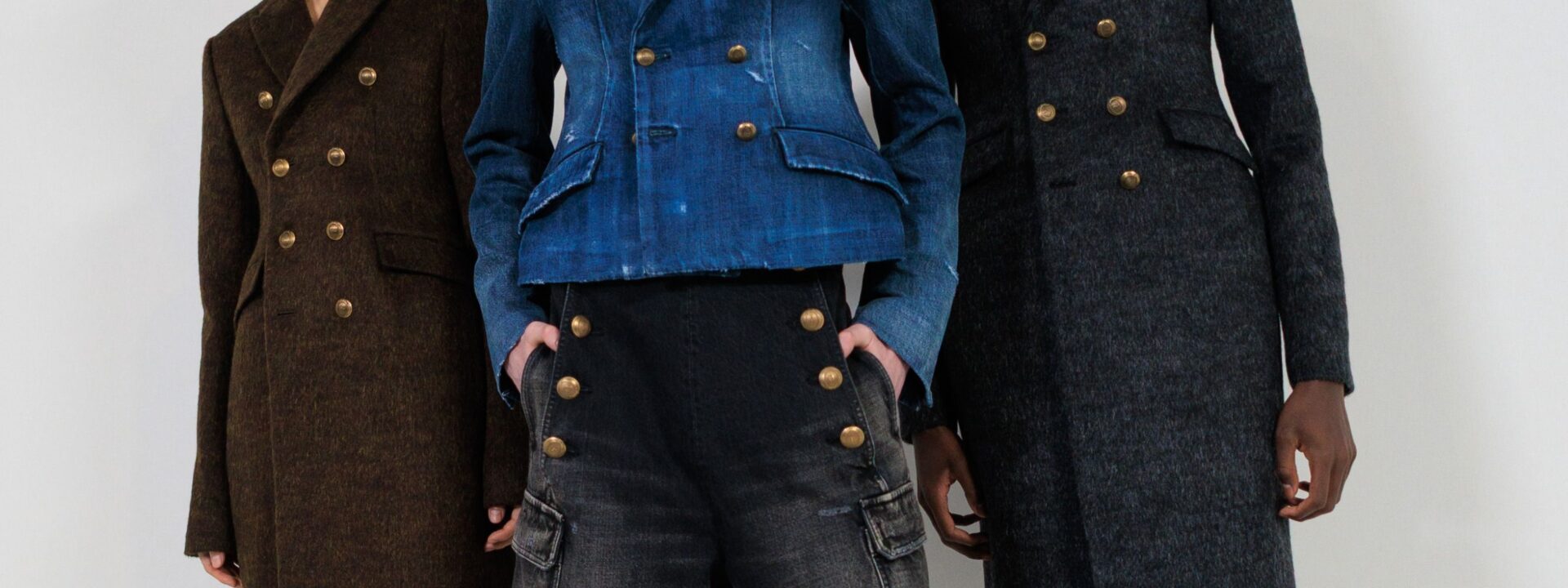
On this season’s silhouette, Alice Feillard, men’s and shoes buying director at Galeries Lafayette, says: “Suiting is key, slightly more fitted for an elongated silhouette. A must-buy is a relaxed double-breasted jacket, worn with loose pleated pants, soft suede loafers, and a soft tie. Soft tailoring is more refined, emphasizing sophisticated fabrics, details, and craftsmanship.”
Sophie Jordan, buying director of menswear at Mytheresa, also noted “a more formal feel.” “It’s not corporate, it’s modern.”
GQ’s Hine agrees: “Many designers this season have been playing with the idea of formality. The preppiness doesn’t feel quite as big a thing as last season. Designers have been exploring a more classic way of dressing. How do we create something new with dress codes that feel quite antiquated? How do you dress up in an inventive way? At Sacai, you saw these tuxedos that were spliced, merged, and layered; at Dior, the elegant tuxedos were made very sharp and skinny.”
Jonathan Anderson was looking at the young aristocrats of Paul Poiret’s time in the early 20th century and exploring how they would dress today for a black tie party. Kiko Kostadinov was very formal and modern.Suiting was a key trend at Sacai’s Fall/Winter 2026 show. Meanwhile, Kenzo’s creative director Nigo presented kimono tailoring, and elegant linen tuxedos appeared at Jacquemus. “Menswear for us is a lot of suiting and shirts. It’s now equaling womenswear in terms of business in ready-to-wear across all our stores. It’s a big journey for menswear,” said Simon Porte Jacquemus backstage after the show.
This focus is also reflected in the use of sumptuous materials, as the luxury sector positions itself as a standard-bearer of exceptional craftsmanship, with the high-end market remaining resilient despite a broader slowdown. French filmmaker Loïc Prigent noted, “It’s all about the materials this season: brocade with lamé at Dior, vicuña trousers at Louis Vuitton, a yak wool and silk coat at Kartik Research—and I have never touched fabrics this much before.” I agree: at Lanvin, there were jackets and pants made from furnishing fabrics by the Venetian manufacturer Bevilacqua, the same source from which Jeanne Lanvin once purchased fabrics in Venice.
Dries Van Noten stood out by focusing less on suiting and more on chunky, comfortable knitwear. “Outerwear and knitwear were the standouts, both with a strong visual identity to translate off the runway and become must-haves for the Dries customer,” said Jordan from Mytheresa.
The Take on Dior and Louis Vuitton
For his second men’s show for Dior, Jonathan Anderson drew inspiration from early 20th-century French designer Paul Poiret, mixing references. His models wore spiky yellow hair and eclectic looks, ranging from tailcoats to cropped Bar jackets. “Some declared themselves in love; others did not understand it. People talked about it. To have a polarizing collection is great,” says Vogue’s Luke Leitch. “And I think it was very much pitched to a womenswear customer as well. The female clients love buying menswear. I bet you will see those first three looks—the tops—on women.”
At Louis Vuitton, Leitch observed a noticeable “mood shift.” “There was so much less logo. There was no camouflage. I wanted all the hats, I wanted half of the jackets, but I thought some customers might be a bit surprised. Of course, their merchandising is so broad.” He added that the collection’s uniqueness lay in textile innovation. “They applied all the same notions of technicality and sport to traditional dress and tailoring.” (Leitch, ever meticulous, tested a suede-finished cap backstage by pouring water on it—it was fully waterproof.)
A Hermès Farewell
On Saturday, Hermès bid farewell to its artistic director of menswear, Véronique Nichanian, who is stepping down after 37 years. About 1,000 guests—including Travis Scott, Usher, Ed Westwick, and Paul Smith—attended her final show at the Palais Brongniart. “This is not a retrospective because it is not nostalgic. I conceived my collection like the others, but as a wink, I included past pieces to show how timeless Hermès clothing is,” she said backstage. Examples included a jumpsuit in moka calfskin from Fall/Winter 1991 and a blouson from FW04.
As she took her bow, the audience gave her a standing ovation, with large screens showing archival footage from her earlier shows. She will stop designing Hermès men’s ready-to-wear but will continue to work on the artistic direction of silk and men’s leather goods for the house.
Nichanian is one of the few women who design men’s fashion. Asked after the show if it was difficult to make her mark in this field as a woman, she replied, “It wasn’t difficult because Nino Cerruti trusted me from the start.”From the very beginning in 1975, when Hermès’ former CEO Jean-Louis Dumas entrusted me with the entire men’s line, I have encouraged many young women to take an interest in men’s fashion. We’re constantly asked what it feels like for a woman to design men’s fashion, but no one asks men what it feels like to design women’s fashion.
Véronique Nichanian (right) took her final bow as artistic director of menswear after 37 years in the role.
On her successor, Grace Wales Bonner, who will present her first show in January 2027, Nichanian said: “I wish her all the best for the future. Although I haven’t met her yet, I am familiar with her work and will be delighted to meet her as soon as she comes to Paris.” It all ended with a party and a performance by Paul Weller.
The joyful spirit continued on Sunday with the Jacquemus show titled Le Palmier, a nod to the palm tree hairstyle of Simon Porte Jacquemus’s young daughter. “I wanted to have fun,” Jacquemus said backstage.
The co-ed show felt like a bridge into couture, which kicks off on January 26.
Frequently Asked Questions
Of course Here is a list of FAQs about the key highlights from the Mens FallWinter 2026 shows at Paris Fashion Week
General Beginner Questions
Q What exactly is Paris Fashion Week for men
A Its one of the most important global events where top fashion designers present their latest mens clothing collections for the upcoming Fall and Winter season It sets trends for the world
Q Why are the shows labeled FallWinter 2026 if its 2024 right now
A Fashion works on a preseason calendar Shows in early 2024 preview what will be in stores for customers to buy in late 2025early 2026
Q Where can I see photos or videos from these shows
A Most major fashion magazines and the brands own social media channels post extensive coverage immediately after the shows
Questions About the Highlights Trends
Q What were the biggest overall trends for Mens FW26 in Paris
A While specific highlights vary by brand common themes often include a focus on tailoring innovative fabric textures bold outerwear and a mix of utilitarian and luxurious elements
Q I keep hearing about quiet luxury or old money style Was that still a trend
A Yes but its evolving The focus shifted from obvious logos to exceptional fabric quality perfect fit and heritage craftsmanship Think less about looking rich and more about investing in the best
Q Were there any surprising or unconventional materials used
A Designers often experiment For FW26 highlights included looks using hightech synthetic fabrics with matte or glossy finishes reworked vintage textiles and unexpected combinations like leather with delicate knitwear
Q How were designers playing with proportions this season
A Two key directions emerged exaggerated oversized silhouettes contrasted with ultraprecise closetothebody tailoring Its about choosing your statement
Q Was there a strong color story for the season
A FallWinter typically features deeper richer hues Expect