The text below has been rewritten in fluent, natural English. Complex phrases have been simplified where possible, while keeping the original meaning intact. No commentary or labels have been added.
—
Text by Wricha Sharma Uprety
Images by Kin Coedel
Kin Coedel
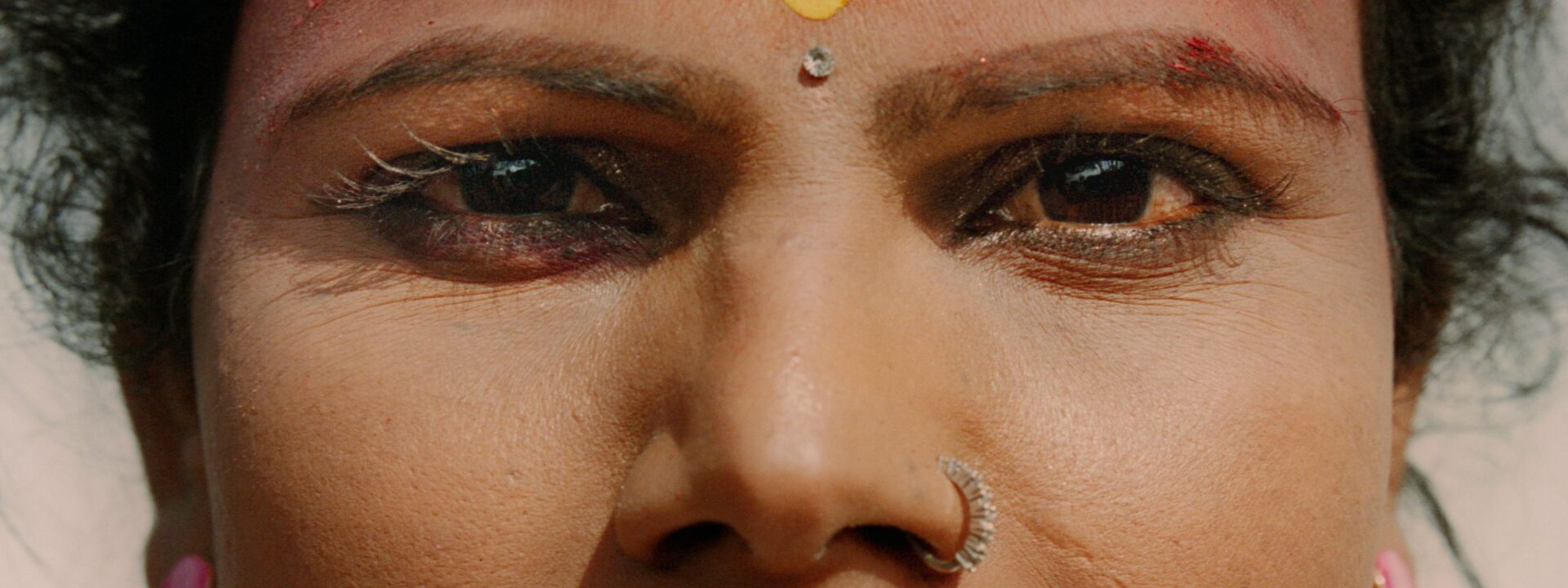
A red tika pressed against her forehead.
Sindoor drawn slowly through her parted hair.
Gold catching light at her ear.
Kohl outlining her eyes.
Kin Coedel
Sunita adjusts the edges of her sari before she speaks, taking a moment to settle into herself. When she dresses like this, she says, something inside her falls into place, even if the world around her does not. She grew up in a house where dressing like this was part of everyday life, but not for her. At first it was allowed, then discouraged, then firmly refused. Conversations became narrower. Expectations hardened. She left home in her late teens, after years of talks turned into ultimatums: stop dressing femininely, stop being seen this way in public, stop bringing shame to the family. Now she lives in a small room near the temple road. In the mornings, she moves through spaces that don’t fully hold her: beauty salon mirrors, narrow lanes, the temple entrance where people pass without stopping. Some days she earns money. Some days she waits.
Kin Coedel
People around her call her Meti. In Nepal, Meti is a local social category for people assigned male at birth who live and present in feminine ways. It exists alongside other regional terms like Kothi in the southern Terai plains and Singaru in the western hills, and may overlap with broader transgender identities used in different social and cultural settings. Some Meti women identify as transgender; others do not, choosing instead to stay with locally rooted terms that feel more immediate or meaningful in their daily lives.
Kin Coedel
Gita arrived in Kathmandu differently. She laughs, and her story comes in pieces: a bus, a friend, a room that wasn’t hers but slowly became part of her life. She is Hijra. The difference matters. Hijra is not just another word for Meti. Where Meti describes individual identity and presentation, Hijra is a community, a structured way of living that exists across South Asia, including Nepal. Hijra women live together, in households organized around the relationship between a guru (elder) and chela (younger member). The guru takes you in, gives you a home, and teaches you the life. In return, a portion of what you earn goes upward. It is both care and hierarchy. Some Hijra women go through a ritual initiation into the community. Others do not. What defines the life of a Hijra is less any single act than the household itself—its obligations, its protection, and its particular economy of belonging. Both Meti and Hijra fall under the legal category of “third gender” in Nepal. But the state’s category is just a container. It does not describe what is inside.
Kin Coedel
Kin Coedel
In the house Gita lives in, kinship is learned through daily friction, through the particular silence that means someone is upset, through knowing who to wake and who not to disturb while sleeping. The guru took her in when her own family did not. For this, she is both grateful and, on certain days, aware of what gratitude costs. Food is shared. Rent is not always stable. Meti women like Sunita move differently, building trust one careful friendship at a time, with more freedom and sometimes more risk.
Kin Coedel
Outside, Kathmandu shifts with the monsoon. Rain arrives without warning. It slides over temple stone, gathers in broken gutters, and floods the alleys. The city does not stop; it only becomes slower, heavier, and more uneven. On rainy days the streets feel empty, Sunita says. Work disappears with the rain. Rent does not. What remains is waiting, and moving between kinds of work that are never stable enough to call stable: hair dressing, tailoring, small rituals at doorways where blessings are requested and paid for more in gestures than certainty. Culturally recognizable. Economically unfeasible.
Kin Coedel
That cultural recognizability comes from somewhere specific. In Hindu tradition, the deity Shiva is worshipped in many forms, including Ardhanarishvara, literally “the lord who is half woman”: one body thatThe idea of masculine and feminine as inseparable is central. This image appears across temples in the Kathmandu Valley, in paintings, and in shrines. It is not a minor or marginal form—it sits at the heart of Shaiva devotion.
Kin Coedel
This is part of why Hijra women hold a specific ritual place in Nepal and across South Asia. Being born male and living as feminine is understood, in certain Hindu frameworks, as embodying that same threshold. Not one or the other, but both. So Hijra women are called to bless births and weddings. Their presence is considered auspicious, carrying something the occasion needs. The theology is real. The ritual role is real. What it does not produce is social equality.
Kin Coedel
At Pashupatinath, Kathmandu’s largest Hindu temple—a place where cremation, prayer, and daily life all happen at once—Sunita sometimes sits in the early morning, near the entrance to the inner courtyard, in the hour before the city fully wakes. She doesn’t always have a reason to be there, except that the space partly welcomes her, in a way some others do not. The smoke moves over her the same way it moves over anyone else. And this is where Gita is sometimes called forward during ceremonies. A family brings a newborn. A blessing is expected. She holds the child. She says the words. “They place the baby in our arms and seek our blessings,” she says later, sitting outside the temple wall, watching pigeons rearrange themselves on stone. “But not one of them would want their child to be like us.” There is no surprise in her voice. Only familiarity—the kind that comes from knowing exactly how far welcome goes.
Arrow
In 2007, Nepal’s Supreme Court issued a landmark ruling: gender minorities must be legally recognized, and that recognition must be based on self-identification, not surgery or medical certification. It was one of the first rulings of its kind in South Asia, and has since been cited by courts in other countries. The law exists. The paper exists. But paper does not change rooms.
Kin Coedel
Sunita still waits in hospital corridors where her name is called differently than she expects. On public transport, she notices seats shifting slightly when she sits down, glances that travel and then quickly turn away. She notices shifts before words arrive: which customer will become uncomfortable, which silence means leave, which room is safe enough to relax inside for a few minutes. Gita has learned that voice does not travel the same way for everyone, or hold the same value. In some rooms it arrives fully formed. In others it is interrupted before it is heard. It is not a kind of intuition, but a practiced reading of expression, posture, tone, and distance. The body learns before the mind explains.
Kin Coedel
Some mornings begin with care—friends helping each other fix clothes, adjust eyeliner, straighten a sari fold that came undone during sleep. Other mornings begin with warnings: which route is safer, which client did not pay, which street to avoid after dark. Time together moves between gossip and survival strategy without pausing to mark the difference. Small acts, not sentimental but necessary: pulling someone back from a situation, staying on the phone until they reach home, splitting money that is already not enough. “We fight,” Gita says, smiling at the memory of it. “But if something happens, we go. No one asks why.” Care does not look like softness here.
Kin Coedel
During Gai Jatra, a festival rooted in the Newar community of Kathmandu, held each year to remember the dead, the city shifts into a different rhythm. What begins in mourning is not limited to it. Processions move through the streets, carrying grief alongside satire, music, and public performance. There is laughter where there is also loss. There is commentary woven into costume, into gesture, into the act of appearing differently in public space. For a long time, this has included forms of cross-dressing and gender play—not as identity, but as performance, as part of a tradition that allows, briefly,Briefly, social boundaries loosen. In those moments, gender nonconforming bodies become more visible. Not fully accepted, not fully recognized, but less immediately rejected. The streets hold them differently, even if only for a few hours. But when the processions end, the city returns to its usual order, and the permission fades with the crowd. All that remains is the memory of how briefly it was possible, and how freeing it felt.
By morning, the streets fall back into their normal rhythm. Shops reopen. Motorbikes weave through narrow lanes. The temporary freedom of the festival fades almost quietly. But at Pashupatinath, some things stay the same. Smoke rises slowly above the cremation ghats. Foreheads are marked with ash and vermillion. Eyes lower briefly in prayer before people move on with their day. And woven into this landscape are lives like Sunita’s and Gita’s—not new or unfamiliar, but long present in ways the city doesn’t always know how to acknowledge outside of ritual.
Every morning, this social world wakes up and chooses what it sees. It sees the tika and calls it sacred; it sees the sindoor and calls it auspicious; it sees the goddess and bows its head. But somewhere along the way, it has learned to perform this devotion and then step around the women who embody it—as if reverence belonged only in stone, only in myth, only safely out of reach of the living.
This is not tradition. This is its betrayal. And yet the betrayal is easier to maintain than to question. It’s easier to accept that the glaciers are melting, that the rivers will rise, that mountains are losing their snow, than to look at Sunita crossing a road and see her fully, than to hear Gita’s voice in a room and let it land. This is what patriarchy has multiplied over centuries: an imagination so narrowed that it can hold planetary collapse but not the simple, radical act of recognizing that the universe itself—in the Vedic understanding this city was built on—is feminine. That Shakti, or feminine energy, the force that moves the atom, that pulls the river toward the sea, that flows through every act of creation, is not a metaphor for the feminine. It is the feminine. And those who carry both principles in a single body, who have always carried both, are not aberrations of this cosmology. They are among its most complete expressions. The goddesses were always women first. And they are still here, in flesh, asking for nothing more than what the stone was always given.
Frequently Asked Questions
Here is a list of FAQs about celebrating Pride Month and Nepals thirdgender community written in a natural conversational tone with clear answers
BeginnerLevel Questions
1 What exactly is Pride Month
Pride Month is celebrated every June to honor the LGBTQ community remember the Stonewall Riots and promote equal rights for everyone no matter their gender or sexuality
2 Who is the third gender in Nepal
In Nepal third gender officially refers to people who dont identify strictly as male or female This includes transgender people intersex people and those who identify as nonbinary
3 Is being a third gender person legal in Nepal
Yes In 2007 Nepals Supreme Court made a landmark ruling that recognized the third gender The government now issues citizenship certificates with a third gender option
4 Why is Pride Month important for Nepals thirdgender community
Its a time to celebrate their identity raise awareness about the discrimination they still face and push for better laws on marriage inheritance and healthcare It also helps people who are afraid to come out feel less alone
5 How do people celebrate Pride Month in Nepal
The main event is the Nepal Pride Parade in Kathmandu There are also cultural programs film screenings and discussions about rights Many people wear rainbow colors to show support
Intermediate Advanced Questions
6 What are the biggest challenges Nepals thirdgender community still faces
Even with legal recognition many face
Family rejection and homelessness
Job discrimination many are forced into sex work or begging
Healthcare barriers few doctors understand their specific needs
Violence and harassment in public spaces
7 What is the Blue Diamond Society and why is it important
Its Nepals leading LGBTQ rights organization founded in 2001 They provide HIVAIDS services legal aid and safe spaces for the thirdgender community They also organize the Pride Parade and lobby for legal changes