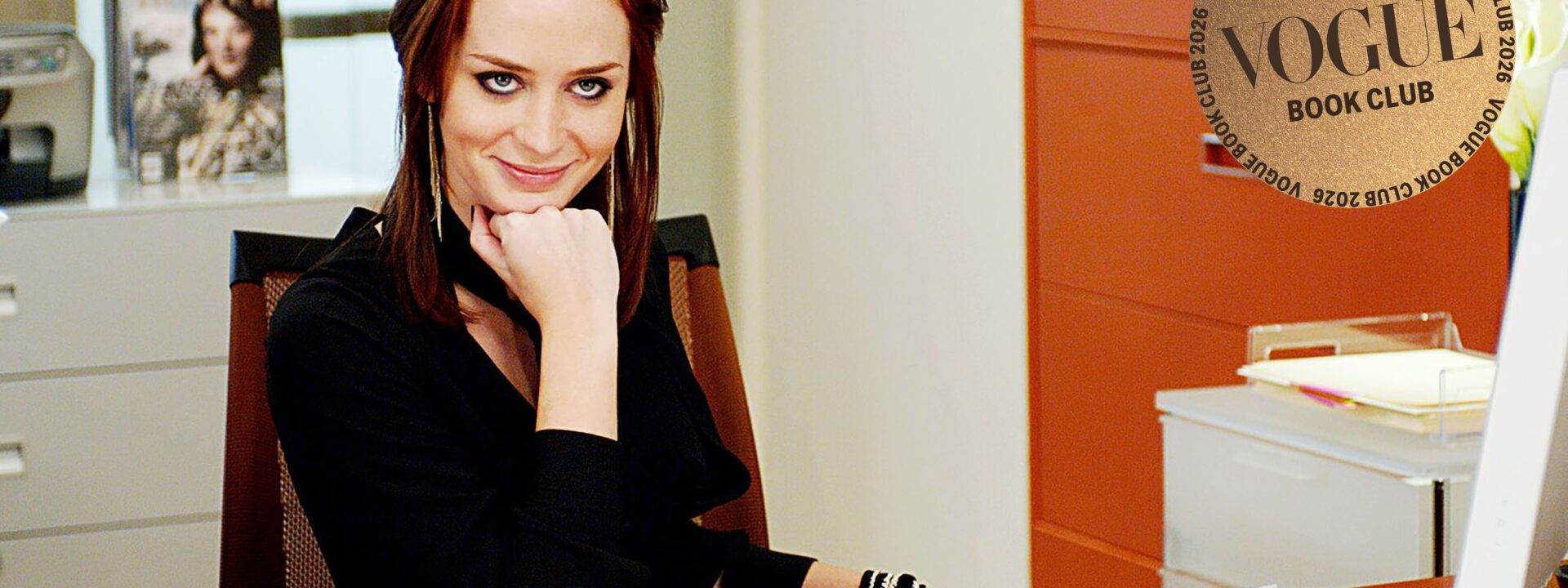
Dear reader, it’s rare these days to find yourself caught up in a case of mistaken identity straight out of an Oscar Wilde farce—but here I am, thoroughly misidentified. I’m in a bind: millions of TikTok users have connected the dots—specifically, one viral TikTok video, one novel, and one movie—and decided that I am the real-life inspiration for one of fiction’s snootiest fashion girls: Emily, the haughty English assistant to Miranda Priestly in The Devil Wears Prada.
I’ve suffered this accusation in silence, worried that speaking out—even though many brave women from the Vogue sisterhood have urged me to—would only invite more cruel scrutiny from TikTok’s bullying tweens. But a moment in a London cinema a few weeks ago made me realize I had to come forward.
Picture the scene: I’d settled onto a red velvet sofa at the Everyman Cinema in Bayswater to watch Wuthering Heights with my 15-year-old daughter Tess and her school friend Ernie. They’d insisted on arriving early to see all the trailers, so I was dozing off when Tess suddenly shot up and yelled, “Mum! It’s you!”
I looked up to see Emily Blunt, dressed head-to-toe in Dior, playing Emily in the trailer for The Devil Wears Prada 2. “Do my eyes deceive me?” she scoffs, squinting at Anne Hathaway’s Andy. The two are reuniting for the much-anticipated sequel.
“Don’t be silly, that’s not me, darling,” I told Tess.
“No, it is,” she insisted. “Everyone at school knows it’s you.”
“What? But Emily was so mean. I’m not mean.”
Ignoring me, Tess went on, “Mum, it is you. I looked it up.”
“Own it, Plum,” Ernie chimed in. “It’s a flex to be Emily.”
After a traumatic dinner where Tess and Ernie listed all the Google “evidence” proving I was Emily, I realized that to clear my name, I needed a full investigation. Thankfully, I watched a lot of CSI: NY in the 2000s after late nights out, so I knew just how to proceed: secure the crime scene, locate witnesses, interview persons of interest, make an arrest, and assemble a handpicked jury that agrees with you.
First, let’s revisit the original crime scene: 4 Times Square, an innocent skyscraper that housed Condé Nast on one side and a bunch of lawyers on the other (neither side ever spoke to the other, obviously). In the early 2000s, the Vogue office was invaded by a questionably dressed BBC TV crew making a documentary called Boss Women about Anna Wintour. I can’t be sure, but I suspect Anna, having little time for the cameras, told them to follow me around instead. So I ended up in the show, talking about the importance of wearing cocktail attire to work as a Voguette while gliding around the office in a chiffon Dolce skirt.
The show aired in England in 2003, and no one in New York paid it any mind. But decades later, when clips went viral on TikTok, newspaper articles began suggesting that Lauren Weisberger—who wrote The Devil Wears Prada (the novel was published in 2003, the movie in 2006) and once worked as Anna’s assistant—had based the character Emily on me. This rested on two key “facts”: first, that Emily has an English accent (which I do), and second, that I had been Anna’s assistant (which I never was).March 2004
I’ll admit, working at Vogue gave me some Emily-like tendencies: I booked hour-long blowouts at John Barrett at Bergdorf’s and called it work (telling myself it was the only way to observe Park Avenue princesses in their natural habitat); I wore only high heels—105s, of course—to the office and looked down on the girls in flats as unprofessional; I glided through the halls, flicking my straightened hair from side to side, with nails manicured every two weeks. Like Emily, I saw attending the Paris shows as the ultimate prize, but whenever I made it there, I’d usually come down with life-threatening strep throat from the exhaustion of planning my wardrobe for the week. I spent about half of Fashion Week in bed at the Hotel Costes, nursed by handsome French doctors—pretty standard for a Voguette.
Still, I wondered who the real Emily might be. My prime suspect was Kate Young. I’d always secretly thought Kate—then one of Anna’s assistants, now one of Hollywood’s top celebrity stylists—inspired the character. It made sense: Kate was impeccably groomed, with blonde hair rivaling Carolyn Bessette’s, and always neatly dressed in Helmut Lang or Chanel. She guarded the entrance to the editor’s office like a human portcullis; spoke with a chic English accent, having spent her junior year abroad at Oxford; and had an English boyfriend. She was also completely terrifying.
This week, I finally asked Kate point-blank. “I was never scary, was I?” she replied, clearly in denial. “I was a task rabbit. I did coffee, lunch, dry cleaning, shopping, party planning, kids, logistics, the book, ran down the hall to fetch people for meetings.” She made herself sound far humbler than she was: “I spent a lot of time smoking in cool editors’ offices when Anna wasn’t around, trying to figure out how to be more like them.” Then she claimed concrete proof she wasn’t the real Emily: “I was never the first assistant, so Emily definitely wasn’t based on me. I was second for one year. Leslie was first when Lauren was second.” (Just like in the book and film, the assistant hierarchy was very real.)
Leslie? Leslie Fremar—a stern but beautiful brunette I remembered—was definitely a person of interest. I wondered how to track her down. Coincidentally, she’s now another hugely influential Hollywood stylist.
I quickly reached out to fellow former Voguette Amy Taran Astley, who was beauty director during my time and is now editor-in-chief of Architectural Digest. “I swear on my extensive ’90s Manolo collection that it never occurred to me you could be Emily,” she said. I was relieved—briefly—until she continued: “You might have developed some cocktail-party outfits. You might have gone from no maintenance to high-maintenance in the blink of an eyelash extension. And you and Emily share a posh accent, brunette hair, and being sharp and clever. Okay, there is a bit of Plum in Emily.”
I stopped her right there. Amy was hitting a little too close to home. What about Leslie, who was first assistant when Kate Young was second (and is still Amy’s BFF)? I asked. “In general, I found A.W.’s assistants very intimidating,” Amy replied. “They were so busy and protective of the office’s secrecy. The vibe was ‘you can’t sit with us.’ I’d do my business with them and then scamper away.” Then she added, “I feel like Leslie could have influenced Emily quite a bit. She liked…”“Things done correctly.” —Leslie Fremar
Amy’s testimony was definitive. I tracked down Leslie, who, under intense questioning, emailed a statement: “Lauren worked for me, and unfortunately, it all tracks (except the mean part).”
Except the mean part? Emily is all mean parts. I was no closer to an answer.
I went back to Tess with my findings: that the real Emily was inspired by multiple Voguettes, but “the mean part”—well, I couldn’t pin that on anyone. Tess, now acting as judge and jury, looked at me wearily from behind her chemistry homework. “The whole point is that all movies need a villain,” she sighed. “And Mum, they have to be English.”
Thanks, Tess. I get it. Case closed.
P.S. When I contacted her office for a comment, Lauren Weisberger did not respond.
Tune in next week for the official Vogue conclusion to this two-sided investigation. Was Plum correct? Come back for the answer.
Frequently Asked Questions
Of course Here is a list of FAQs about the reallife inspiration for Emily in Emily in Paris
General Beginner Questions
Q Who is the real person Emily in Paris is based on
A The show is not directly based on one specific person The creator Darren Star has said the character is inspired by his own experiences as an outsider in Paris and by the many young American women he observed working in the French fashion and marketing industries
Q So Emily isnt a real blogger or influencer
A No Emily Cooper is a fictional character However her job and experiences are inspired by the realworld trend of American digital marketing professionals and influencers working in global cities like Paris
Q Did the creator Darren Star live in Paris like Emily
A Yes Darren Star lived in Paris for a period and has stated that Emilys wideeyed optimistic and sometimes clashing perspective is drawn from his own feelings of being an American in France
Advanced Detailed Questions
Q If not one person what are the specific reallife inspirations for her character
A The inspirations are more thematic
Cultural Clash The classic experience of American corporate hustle culture colliding with French worklife balance and business etiquette
The Expat Archetype The young professional who moves abroad for a career opportunity and navigates a new culture
Social Media Professionals The rise of a generation whose careers are built on social media savvy a field that was booming when the show was conceived
Q Are any of the companies or clients in the show based on real ones
A Not directly but they are archetypes of real Parisian industries Savoir is a fictional standin for a luxury French marketing firm Clients like a luxury perfume house a highend champagne brand or a fashion designer are all staples of the Parisian luxury landscape
Q Is Emilys rapid social media success realistic
A Its dramatized for TV While a viral post can happen her meteoric rise to influencer status with major brand deals is highly accelerated and simplified compared to the real highly competitive world of influencer marketing