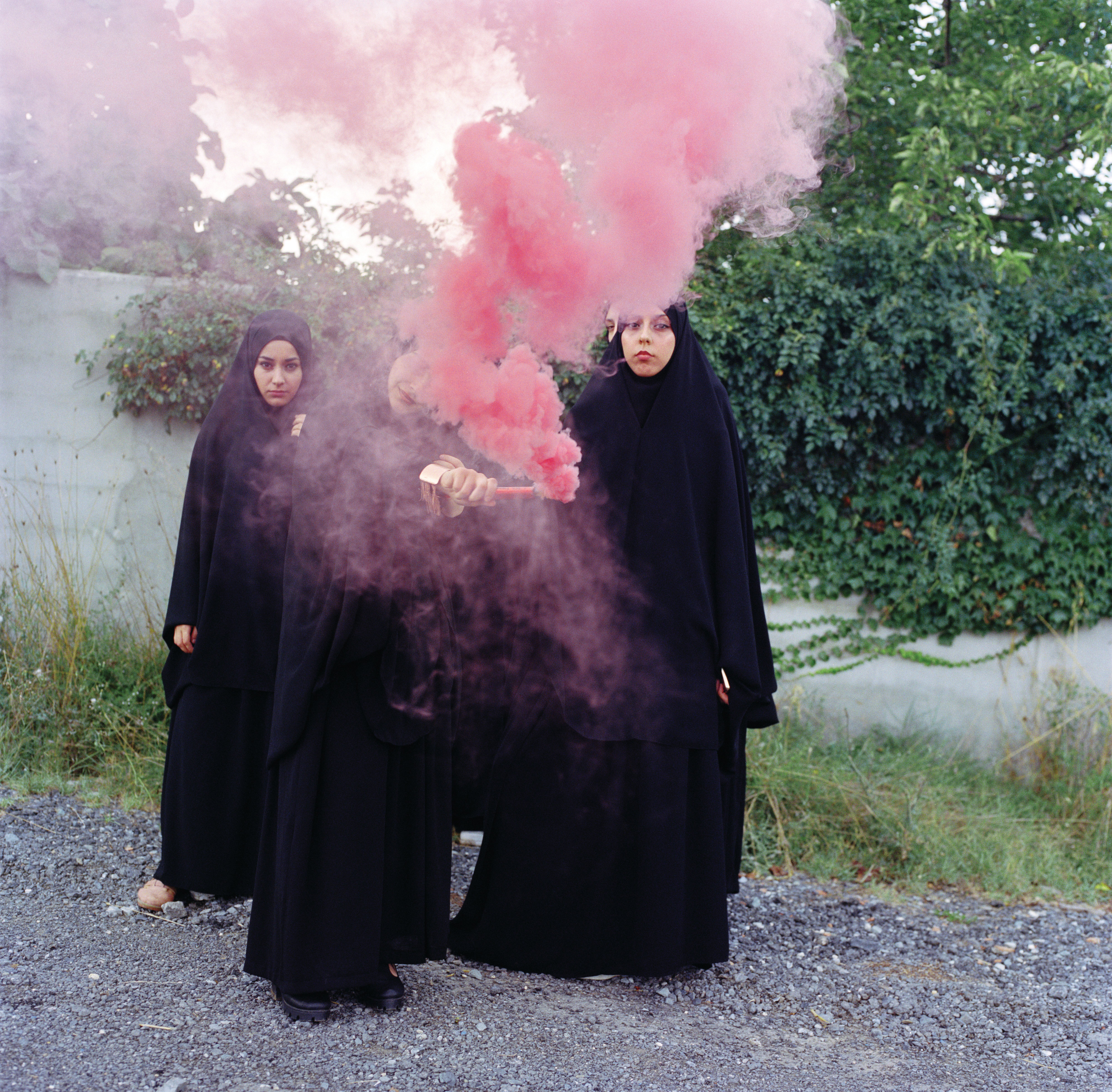
As we continue to seek out and celebrate contemporary image-making from the MENA region through our MENA Panorama Open Call, we’re highlighting a new exhibition in Perth that brings together nine artists from the Middle East, North Africa, and their diasporas.
The exhibition
On October 3, the Art Gallery of Western Australia (AGWA) will open No night is long enough for us to dream twice, a group exhibition featuring more than 100 works by nine artists making their Perth debut: Basel Abbas and Ruanne Abou-Rahme, Hicham Benohoud, Myriam Boulos, Mohamed Bourouissa, Sabiha Çimen, Hannah Darabi, Abdulhamid Kircher, and Mohamad Abdouni, who is also on the jury for PhotoVogue’s 2026 MENA Panorama Open Call.
Curated by Dalia Al-Dujaili, an independent curator, and Rachel Cieśla, Lead Creative at the Simon Lee Foundation, the exhibition takes its title from a poem by Palestinian poet Mahmoud Darwish. It brings together works that look beyond familiar narratives of conflict and crisis. Because we see this kind of nuanced, multifaceted representation as especially important to the MENA discourse today, we asked the curators some questions about the exhibition, its approach, and the artists it features.
The artists come from very different contexts, but you identify a shared “relation to pressure” between their practices. What does this pressure refer to, and why did it become an important point of connection for the exhibition?
Rachel Cieśla: Pressure is a useful word because it names something that happens to us but also inside of us. I was interested in how these artists make images from that point of tension: when social, political, emotional, or historical forces become almost too much, and something has to give. These artists work in very different places and from very different positions, but their images all seem to understand that a “decisive moment” can happen under pressure. Something builds, intensifies, and then there is an ecstatic release. The release might be pleasure, humour, violence, absurdity, beauty, desire. It might last fifteen seconds. It might be a photograph. And then it is gone.
That felt particularly important to me because of the condition of photography now. We tend to think of photography as a medium that captures something that has already happened — Barthes’s “that-has-been.” But we became increasingly interested in the possibility of a photograph that isn’t really about the past at all. What if the image is oriented entirely forwards? What if it is less a record of what was than a temporary symbolic gesture towards something that doesn’t yet have a social form?
That is what we see happening across these practices. The artists aren’t necessarily trying to reveal reality to us. They are making reality unstable enough that another possibility can briefly appear. Mohamad Abdouni’s photographs are a good example: his subjects make tiny claims on the world through a glance, a touch, a pose. There is romance and melancholy, playfulness and despair, all happening at once. The image doesn’t resolve any of those things. It simply gives them a moment in which to exist, and I think that is political. Not because the artists are necessarily making political statements, but because they create spaces in which something can appear that the surrounding conditions don’t easily permit.
A body occupies space. Someone desires someone else. Someone playfully refuses to behave correctly. So pressure and release became a way of thinking about the works without reducing them to a shared geography or identity. These artists come from places marked byThey faced extraordinary pressures, both historical and present-day, but we didn’t want that to be the explanation for their work. Instead, we were drawn to the particular energies that arise from those conditions — how an image can become a small space of freedom without pretending the conditions themselves have gone away.
Maybe that’s why the title No night is long enough for us to dream twice became so important to us. It speaks to the impossibility of returning to the same dream, or holding onto the same moment of freedom. You have this brief eruption, and then it falls back into the world. But the fact that it can’t last doesn’t make it insignificant. Quite the opposite — its very fleetingness is what gives it urgency.
Mohamed Bourouissa, Le cercle imaginaire 2007–2008. Courtesy of the artist, PALAS, Sydney, and MENNOUR, Paris. © Mohamed Bourouissa
What does it mean to bring these practices into conversation with audiences in Perth, and what kind of encounter did you hope the exhibition would create?
Rachel Cieśla: I think Western Australia is actually a very important place to hold this exhibition, precisely because it’s not an obvious place for it. WA is often thought of as geographically remote, but that sense of distance is also a kind of proximity. Perth is a city on the Indian Ocean, looking west and north as much as east, and we’re connected to the SWANA region through histories far older and more complicated than the idea of Perth as an isolated Australian city suggests. We weren’t interested in bringing these artists to Perth just because audiences here haven’t seen them before. We were interested in what happens when these practices enter a place with its own forms of belonging and exclusion, and its own relationship to the region.
Six of the artists are showing work in Australia for the first time, but the exhibition isn’t about filling a geographical gap or giving audiences a survey of the SWANA region. In fact, we were very careful to avoid the idea that these artists could somehow stand in for South West Asia and North Africa. They are not representatives. They are artists with very specific practices and ways of seeing.
We hope the exhibition might create an unexpected encounter with the SWANA region, and let audiences discover unexpected connections between the works. You might move from a photograph of a young woman laughing in a Qur’an school to an image of bodies gathered in a Parisian banlieue, or from a family photograph to a surreal video about racial profiling, and suddenly something starts to resonate that isn’t necessarily geographical.
The connections are emotional before they are explanatory. That feels especially important in Perth, because there’s always a danger, when looking at work from elsewhere, of asking it to explain somewhere else to us. We’d rather the exhibition complicate that position. Maybe the question isn’t, “What can these artists tell us about those places?” but, “What do these images let us see differently from here?”
What’s Ours. Lebanon. 2013–2023.
Myriam Boulos, Lebanon. What’s Ours, 2013–2023. Courtesy of the artist © Myriam Boulos
Myriam Boulos, What’s Ours. Lebanon. 2013–2023. Courtesy of the artist © Myriam Boulos
Many of the artists in the exhibition draw on deeply personal experiences, yet these stories can resonate far beyond the individual. When does the personal become universal? How can an artist’s intimate experience speak to something larger, across different cultures, geographies, and lived realities?
Dalia Al-Dujaili: The self is shaped by society just as society is shaped by and reflects its individuals. We are inextricably connected to one another, and we all eventually become the “universal.” But to be more specific, personal art becomes universal when it speaks in human terms. Which reminds me of that beautiful Kazuo Ishiguro quote about literature: “In the end, stories are about one person saying to another: This is the way it feels to me. CanYou understand what I’m saying? Does it feel this way to you?” That’s exactly what each artist does in No Night, and it’s what I find so powerful about the work in this show. Abdulhamid Kircher offers a deeply vulnerable look into the fragile, high-stakes masculine relationship between father and son, while Myriam Boulos captures the meeting point of violence and the erotic—or romantic—where queer couples embrace and women run between fires during protests. Then there’s Hicham Benohoud’s Classroom series, which shows children at play in silly, surreal, and absurd settings. Regardless of their geographic location—whether Beirut, Turkiye, or Tehran—what connects these images to viewers are the universal human feelings within them: yearning, lust, humour, violence, and grief. And those universal feelings are exactly what give specific geo-political and socio-political events meaning for diverse, vast audiences. That’s what resonates with all of us.
What’s Ours. Lebanon. 2013-2023.
Myriam Boulos, Lebanon. What’s Ours, 2013-2023. Courtesy of the artist ©Myriam Boulos©Myriam Boulos
There is such an extraordinary wealth of talent across the region. With so many artists and practices you could have chosen from, what drew you to these particular nine? What connected them for you, and what did you feel they could reveal when brought together?
Dalia Al-Dujaili: Rachel said something very important—that we were “conscious of avoiding the idea that these artists could somehow stand in for SWANA. They are not representatives. They are artists with very specific practices and ways of seeing.”
You’re so right to say that the SWANA region has such a wealth of talent to offer. Rachel and I had a very collaborative curatorial process; I feel we contributed equally to the artistic choices we ended up with. Where Rachel was interested in this relationship to pressure—which is so accurate and pertinent—personally, the reason I landed on these artists is because of their use of surrealism, absurdism, humour, and dream-like scenes. I hope that entering this show feels somewhat like walking into a fever dream.
This is important to me because artistic movements such as surrealism and absurdism are less often attributed to artists from the SWANA region; most curatorial and editorial choices tend to trap artists from the region in politics of representation (I have done this myself as an editor many times). With this show, surreality and dreams not only allow landscapes and individuals in the region to expand into alternative realities and unrealised possibilities, but also break these artists free from the suffocating expectation to represent the region in a specific, predetermined fashion or aesthetic—or to represent one version of reality in SWANA or the diaspora.
No Night is long enough for us to dream twice runs at AGWA from October 3, 2026 to January 31, 2027, with free admission.
Frequently Asked Questions
Here is a list of FAQs about the AGWA exhibition featuring nine artists from the MENA region
What is the AGWA exhibition about
It is a new art show at the Arab Museum of Modern Art that features work by nine different artists The exhibition focuses on contemporary art from the Middle East and North Africa region
What does MENA stand for
MENA stands for the Middle East and North Africa It is a term used to describe a large geographic region that includes countries like Egypt Morocco Lebanon and the United Arab Emirates
Who are the nine artists in the show
The exhibition includes a diverse group of nine artists from different countries within the MENA region They work in various mediums such as painting sculpture video and photography
What kind of art will I see
You will see a mix of contemporary art This includes paintings large installations videos and photographs The artworks explore themes like identity history culture and life in the MENA region today
Where is AGWA located
AGWA is located in Doha Qatar It is part of the Qatar Museums network
When can I visit the exhibition
You should check the official AGWA website or social media pages for the exact dates and opening hours Museum hours can change so it is best to confirm before you go
Do I need to buy tickets in advance
It is a good idea to check the museums website for ticket information Some exhibitions are free while others require a paid ticket Buying online in advance can save you time
Is the exhibition good for people who dont know much about art
Yes The exhibition is a great way to learn about a new culture and see different types of art You do not need to be an expert to enjoy it Many museums offer guides or audio tours to help explain the works
What is contemporary art
Contemporary art is art created in the present day It often responds to current events and ideas It can look very different from traditional or classical art
Why is an exhibition like this important
It gives a platform to artists from the MENA region It helps audiences from around the world see the diversity and creativity of the region which is often not represented in mainstream Western media
Are the artists famous
The artists are all respected in the art