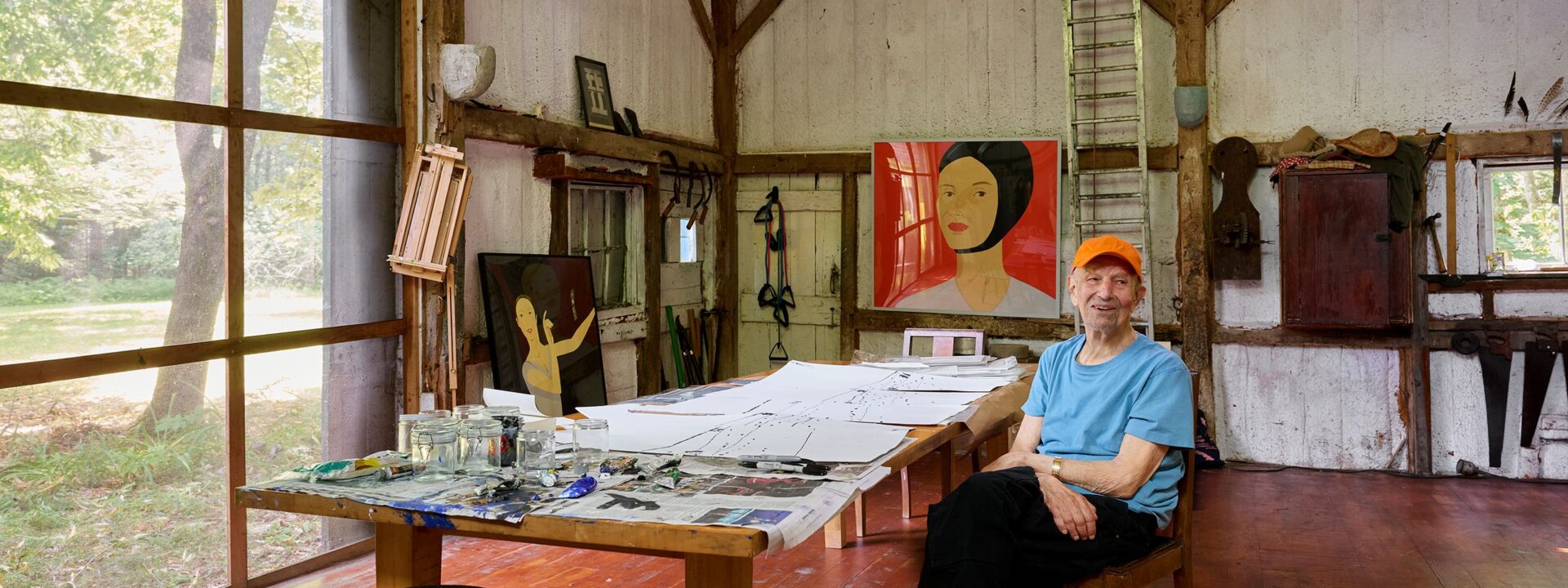
Being with Alex Katz in Lincolnville, Maine, is unlike anything else. Just 10 minutes from the picturesque harbor of Camden, the landscape is rural without feeling remote—you’re in the woods, but only a short drive from the coast. The winding road, lined with the tall, straight pines that appear in so many of Alex’s paintings, leads to the small beach where my late husband Tad and I, along with Alex (now 99) and his wife Ada, ate lobster rolls, laughing and talking, just eight years ago. Things are different this time. Tad isn’t with us. Neither is Ada—she no longer comes up from the city. But her presence is everywhere.
I wanted to return to Maine to see Alex and that bright-yellow house where he and Ada have spent almost every summer since they married in 1958. When I arrive at 11 on an August morning, he’s sitting at a round wooden table set on the green grass outside, wearing an orange baseball cap, drinking coffee and having a mid-morning snack with his poet son Vincent and Vincent’s wife Vivien (who runs the studio), their 27-year-old twin sons Isaac and Oliver and their girlfriends Anna and Kaylie, and Eno (named after Brian Eno), Vincent and Vivien’s ever-present dachshund. It’s a family gathering. It could also be an Alex Katz painting—if only his eternal muse Ada were there.
I join the group, and it feels as if no time has passed since Alex and I last spoke. “The thing about being up here is, we don’t have to worry about the parties we’ve missed,” he says, laughing. “I sleep and work.”
He speaks concisely—not unlike his paintings, a bit Hemingway-esque—and he’s funny. He comes out with the unexpected. He gets a kick out of what he says, laughing at it as if it surprises him. “I tried a hearing aid,” he tells me. “Lost it on the way home. Tried it again, lost that one too. They’re bad for painting.”
“How are they bad?” I ask.
“You don’t have to hear to paint.”
His studio is a short walk across the property, overlooking Coleman Pond, though these days he paints in the bright-blue barn studio attached to the house. Alex and primary colors get along well. I think of that unforgettable portrait of Ada against a bright-red background that belongs to the Whitney Museum. There’s another large close-up of Ada’s face (this time in a black bathing cap) against a bright-red background here, hanging in the barn.
“I spent a lot of time fixing up this house,” he tells me. “It was about to fall down. I bought it for nothing—$1,200—and the neighbors thought I got rooked.” He purchased it with the artists Lois Dodd and Jean Cohen, his wife at the time. “It was half an acre here and 20 acres down the road.” He tells me how the building was originally a rum store two miles away, owned by a blacksmith, and they had to drag it here and put it on a new foundation. “But it didn’t fit,” he adds. “About 20 years later we got a grown man to finish the foundation. Until then, it leaked.”
Alex doesn’t live the way so many other famous artists do. There are no trappings of the money his paintings have brought and continue to bring. He sleeps in a twin bed in a monastic room off the tiny living room. He built the kitchen cabinets himself decades ago, and the potato-print wallpaper in the entryway was made by Alex and Lois Dodd. Little has changed, either in the house here or in the SoHo loft he and Ada have lived in since the 1960s—the same space I remember from 1982, when I first met Alex.
“The past couple of years have been the biggest production of my life,” Alex tells me. “I did 150 paintings. Good size.” He has been painting pictures of the beach—dark, compressed images, very different from all those lush green Maine canvases. He’s in his late period. Like late de Kooning, the picture plane has been emptied of people—just Alex and his canvases. He first made his mark by ignoring emotion, chcharacter and mood. He paints the surface, outward appearances. “This winter I didn’t care if I ever did another painting,” he continues. “I was inspired by a Monet at The Metropolitan Museum.” He’s talking about the Met’s very large 1919 Monet, Water Lilies. “I had a show with water paintings in Venice. I don’t think people got them. They love looking at them, but they don’t understand what they’re about. Water has three properties: weight, transparency, and motion. They saw the paintings as illustrations of water, but no one understood what I was doing.” What he was doing, of course, was not standing still. He was moving forward. He’s curious, forever reinventing himself and learning more about what he loves most—making a new picture and surprising himself every time. I’m struck by his persistence and his singularity. His career has shifted in many ways, yet it stays the same—flowers and trees and landscapes and people and, especially, Ada. At 99, Alex Katz is lean and fit. He does 300 push-ups a day (he claims). He goes to galleries. And he’s still reinventing his game, not just giving people what they think they want to see in an Alex Katz picture. He’s painting for himself, forcing us to see only the essentials, just the way he does. “To be a painter, you have to be aggressive,” he explains. “My parents always argued. So I was brought up to be aggressive.” Katz grew up in St. Albans, a vibrant neighborhood in Queens rich with Black history and jazz culture (Count Basie, Ella Fitzgerald, and John Coltrane lived there), as well as Irish, English, German, and Italian families. Only one other family in the neighborhood was Jewish, and they lived across the street. His parents were Isaac and Sima Katz, who met in Russia. Sima turned Isaac down when he first asked her to marry him and became a star in the Yiddish theater on Manhattan’s Lower East Side, performing under the stage name Ella Marion after she emigrated to New York. Isaac emigrated separately and, once the couple reunited, worked for Sima’s brother in the wholesale coffee business. Alex’s mother was about 10 years younger than his father. “She read about people like Isaac in novels but had never met anyone like him,” Alex says. “He changed his clothes three times a day and had muscles on top of muscles.” When he asked her the second time, “he knocked her up, and I’m the result.” Alex’s father was a sharp dresser who knew high style and high culture when he saw it. “An apprentice aristocrat,” Alex says, adding, “a Jew with muscles.” And then: “The difference was, he was intellectual. He was very smart.” He wanted Alex to go into business with him, but Alex wanted to be an artist. “He said, ‘Okay, I’ll work on your kid brother.’ I thought that was the nicest thing.” “I was trying, trying, trying to do something ordinary,” Alex writes in his art autobiography, Invented Symbols. “Everything in our house was so damn bizarre.” Everyone, especially his father, was always painting and repainting the rooms of their house in strange colors. There was a pink sunroom decorated with triangles. Alex couldn’t stand it anymore. So he painted his bedroom beige with brown trim. Alex is a quintessential New Yorker. He read a lot, had a good deal of independence growing up, and his parents didn’t mind when he used his crayons to draw on the walls. He went to Woodrow Wilson Vocational High School in Queens so he could do art “half the day.” After graduating from the Cooper Union art school in Manhattan, he chose the Skowhegan School of Painting and Sculpture over Yale’s summer school program. “I was sick and tired of listening to teachers, and Albers”—Josef Albers was head of Yale’s art school—”had a real point of view, and I didn’t want a point of view. I wasn’t interested in that.” Later, he choseWhen Alex started painting in the 1950s, Pop art was just emerging—New York was buzzing with Robert Rauschenberg and Jasper Johns. But Alex went the other way. He grew up around figurative art, and that’s how he painted. His work was stubbornly unapologetic, just like him. (For 15 years, his daily lunch was a can of sardines, a slice of tomato, lettuce, and one piece of bread.) Alex’s friends were poets—Frank O’Hara, John Ashbery, James Schuyler, and the poet-dance critic Edwin Denby, who introduced him to choreographer Paul Taylor. This led to a decades-long collaboration designing sets and costumes for the Paul Taylor Dance Company.
Alex Katz didn’t really become Alex Katz until the fall of 1957, when he met Ada Del Moro. He was struggling to find his way, destroying scores of paintings along the way. It’s the only time he seems to have lost his self-confidence—or been “off the bubble,” as he puts it. Alex and Ada—a research biologist at Sloan Kettering—married in February, three months after they met, when he was 30 and she was 29. Over their nearly 70-year marriage, he has made more than 1,000 portraits of her. As art historian Irving Sandler wrote in 1998, Ada “is woman, wife, mother, muse, model, sociable hostess, myth, icon, and New York goddess.” In his hands, she is many different people.
We’ve been talking for hours when Alex tells me a story about his father, who died in a car accident when Alex was 16. As a teenager, Alex “went out with another guy” one day. “And we ran a bicycle 20 miles and made watercolors.” I like that he says “ran” instead of “rode”—it’s more visual, more active. Very Alex. “Then we came home. We showed them to my father. The other guy wanted to be a commercial artist. My father said, ‘You’re going to be a great commercial artist.’ And he looked at me and said, ‘You’re going to be a fine artist.'” He laughs. We all laugh.
He continues: “And then my father ended by saying, ‘Why do you have to ride 20 miles to make this? Why don’t you build your own backyard?’ I couldn’t see the backyard at all. And then the final thing was, ‘Don’t paint details.'” There it is—don’t paint details. The Alex Katz vision, all right there, a gift from his father just before Isaac died. He’s really enjoying telling a story he’s told many times before. It’s his creation myth, the making of Alex Katz the artist. “When he said, ‘Paint your backyard,’ I knew he was right.”
It’s the end of the day, and we’re finishing a dinner of Thai takeout, sitting around the wooden table outside the yellow house. He’s the paterfamilias, surrounded by family. He’s still doing what he wants to do.
Artworks: © 2026 Alex Katz/Artists Rights Society (ARS), NY. Visuals Editor: Paige Viti.
Frequently Asked Questions
FAQs A Visit with Alex Katz the 99YearOld Artist Who Never Stops
1 Who is Alex Katz
An American painter born in 1927 known for his large flat brightly colored portraits and landscapes Hes been painting for over 70 years and is still working at 99
2 What does A Visit with Alex Katz refer to
Its a profile or documentarystyle piece about spending time with Katz in his studio showing how he lives and works at nearly 100 years old
3 What is Katzs art style called
Its often described as figurative art with ties to Pop Artflat colors sharp edges minimal detail and a cool detached mood
4 Is he a Pop Artist
Not exactly He emerged alongside Pop Art and shares its bold graphic look but he focuses on portraits and landscapes rather than consumer culture and he started before the movement took off
5 Why is he famous
For his instantly recognizable style his portraits of friends family and cultural figures and his long productive career His work is in major museums worldwide
6 Whats the biggest takeaway from the visit
That he never stops working Katz paints almost daily and treats art as a jobdisciplined routine and ongoing
7 Whats a cutout in Katzs work
A freestanding lifesize painted figure cut from aluminum He places these flat figures in real space blurring the line between painting and sculpture
8 Why does his work look so flat
He deliberately removes shading and detail to capture light and movement quickly The flatness makes the images feel immediate and modern
9 What can beginners learn from him
Consistency matters more than inspiration Katz shows up paints and finishes worksimple habits anyone can copy
10 What common problems does Katzs approach solve
Overthinking and perfectionism He works fast makes decisions boldly and moves on which keeps him productive
11 How does he stay productive at 99
He keeps a strict studio routine works in daylight hours and paints from life and photographs The visit shows art as daily practice not occasional bursts
12 Does he paint from photos
Yes often He uses photographs to plan